Yes, cannabis is legal for adults in Ohio. Anyone 21 or older can buy from a licensed dispensary, carry and keep set amounts and grow a few plants at home. Ohio also runs a separate medical program, and every licensed store serves both adult-use and medical customers.
The rules come from Issue 2, which voters approved in November 2023, and Senate Bill 56, the legislature’s rewrite that took effect on March 20, 2026. The Ohio Division of Cannabis Control (DCC) writes the store and product rules, and several of those changed again in September and October 2026.
Below: buying and carrying limits, where you can use cannabis, driving, home grow, fines, taxes and what changed in 2025 and 2026, checked against the Ohio Revised Code, the Ohio Administrative Code and DCC pages in November 2026. This guide is general information, not legal advice.
Key takeaways
- Any adult with a valid government photo ID can shop at an Ohio dispensary, and visitors from other states follow the same rules as residents.
- Buying limits reset every day, but the carry limit counts everything you own, including what’s at home and what you grew.
- Smoking and vaping are only legal on private homes and farms. Parks, sidewalks, hotels, workplaces and moving cars are off limits.
- Most first-time mistakes are minor misdemeanors, but selling, giving cannabis to anyone under the legal age and driving high carry real jail exposure.
- Rules differ by state and province, and cannabis bought in another state is illegal to have in Ohio. Never cross a state line with it.
Is cannabis legal in Ohio?
Yes. Medical cannabis has been legal since 2016, and adult-use sales began on August 6, 2024.
- Adult use: You must be 21 or older to buy, possess, grow or use cannabis (ORC 3796.06).
- Medical: Registered patients and caregivers buy at the same dispensaries, with their own limits and no state cannabis tax.
- Who regulates: The DCC, part of the Ohio Department of Commerce, licenses businesses and sets product rules. The Ohio Department of Taxation collects the cannabis tax.
- The laws: Chapter 3796 of the Ohio Revised Code, as rewritten by SB 56, and the DCC’s rules in division 1301:18 of the Ohio Administrative Code.
What ID do you need?
Under DCC rule 1301:18-8-02, staff must check a government-issued photo ID with your date of birth before you enter the sales floor and again at the register. An out-of-state driver’s license or a passport works, and Ohio has no residency rule for adult-use buyers. Lying about your age or using a fake ID at a dispensary is a first-degree misdemeanor. Read our guide to why dispensaries scan your ID.
How much cannabis can you buy in Ohio?
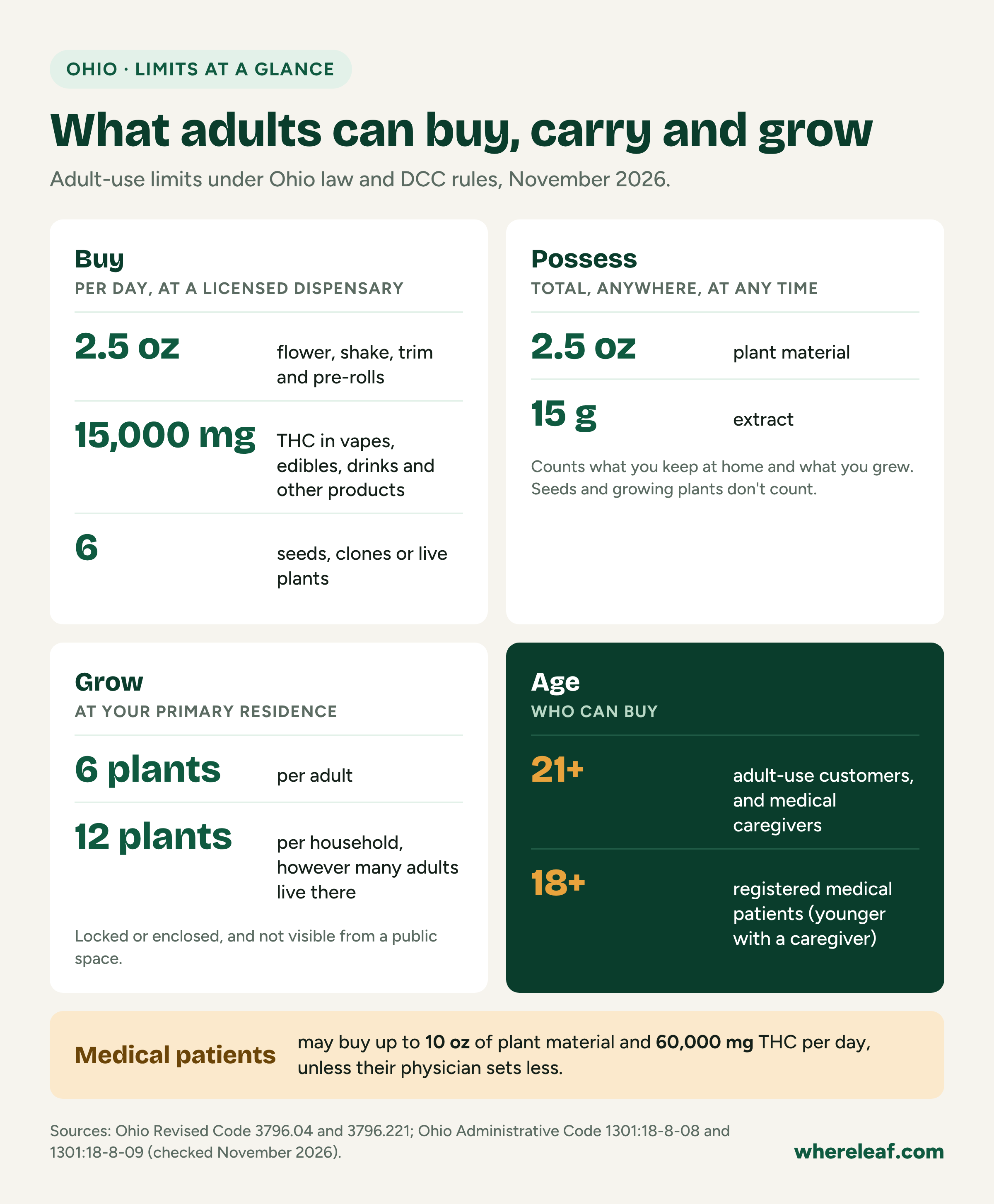
Ohio sets its purchase limits per day, not per sale or per week. The amounts are in the graphic below; here is how they work at the counter:
- Two buckets: Flower, shake, trim and pre-rolls count by weight. Vapes, concentrates, edibles, drinks, tinctures and topicals count by total milligrams of THC on the label.
- Plants and seeds: Seeds, clones and live plants have their own small daily cap, and only licensed dispensaries may sell them.
- The register tracks it: Sales are logged in the state tracking system, so the budtender will stop a cart that goes over.
- Medical patients: Patients have much higher daily caps and a separate 90-day supply count (see the medical section).
Why package size matters
Since October 5, 2026, DCC rule 1301:18-4-06 caps each package: one ounce for a jar of flower, five grams for a pre-roll pack. The cap is per package, not on your daily total.
How much can you have, and what are the potency caps?
ORC 3796.221 sets one possession limit for everything you have, wherever it is. It counts store-bought and homegrown cannabis together, but not seeds, clones or live plants.
- In public and in a vehicle: The same total applies. There is no separate, higher amount for home.
- At home: Your stash at home counts toward the limit. A single harvest can push growers over.
- Edibles: Keep them in their original package whenever you aren’t using them (ORC 3796.06(H)).
- Gifts: One adult may give another adult up to the possession amount per day, for free, but only on private residential or agricultural property. Giving cannabis away at a park or a bar counts as an illegal transfer.
THC caps on edibles, drinks and vapes
The package rule sets strict caps for adult-use products. An edible may hold 10 mg of THC per serving and 100 mg per package. A drink may hold 10 mg per can or bottle, with up to 12 in a pack. Vape and concentrate packages hold up to three units of 2 grams each, at no more than 90% THC. Medical patients can buy stronger edibles, up to 55 mg per serving. The statute caps flower at 35% THC. Edibles can take an hour or more to kick in, so start low and go slow. Our edible THC limits by state page compares other markets.
Ohio cannabis limits at a glance
Where can you use cannabis in Ohio?
SB 56 made Ohio one of the stricter legal states on location. Smoking, burning and vaping adult-use or homegrown cannabis is allowed only on privately owned property used mainly as a home or farm (ORC 3796.06(C)).
- Private homes: Allowed, with the owner’s permission. Child care homes, halfway houses and similar licensed facilities are excluded.
- Rentals and apartments: A lease can ban smoking, vaping and growing. It can’t ban edibles or tinctures, according to the Ohio Judicial Conference’s 2026 summary. Federally assisted housing, such as Section 8, bans all cannabis.
- Parks, sidewalks, bars and restaurants: Not allowed. Public places and workplaces are expressly off limits.
- Hotels: A hotel isn’t a private residence, so smoking or vaping in a room isn’t covered by the law’s permission, and most hotels ban it anyway.
- Lounges and events: Ohio has no licensed consumption lounges, and dispensaries can’t allow use on site.
- Workplaces: Employers may keep drug-free policies and may fire or refuse to hire over cannabis use, according to the DCC.
- Federal land: Federal law applies at Cuyahoga Valley National Park, Wayne National Forest and other federal sites.
- Campuses: Colleges that take federal funds ban cannabis on campus and in dorms, even for students who are 21.
Driving and cannabis in Ohio
Driving under the influence of cannabis is an OVI (operating a vehicle while impaired) under ORC 4511.19, the same law used for drunk driving. Cannabis legalization changed nothing about that.
- Per se limits: Unlike most states, Ohio sets THC numbers. A blood or urine result at or above them is an OVI even without other signs of impairment, and a lower metabolite level counts if you are also impaired. Metabolites can linger long after the effects wear off.
- No smoking in the car: A driver who smokes or vapes faces OVI penalties even without proof of impairment. A passenger who smokes or vapes while the car is being driven commits a separate offense.
- Storage: Carry cannabis in its original, unopened package. Once opened, it must go in the trunk, or behind the last upright seat if there’s no trunk. Homegrown cannabis always goes in the trunk (ORC 3796.062).
- Testing: Officers use field sobriety tests and can request blood or urine.
Our guide to cannabis and driving laws compares Ohio with other states.
Can you grow cannabis at home in Ohio?
Yes. Adults 21 and older may grow at their primary residence, and local governments can’t ban home grow. The plant counts are in the graphic above. Under ORC 3796.04:
- Plants must be in a secured closet, room, greenhouse or other enclosed area that keeps out anyone under 21.
- Plants must not be visible to the naked eye from a public space.
- You may not grow for someone else, sell your harvest or trade it. Free gifts follow the gifting rule above.
- Hand or mechanical processing is fine; hydrocarbon (butane-style) extraction is not.
- Rentals whose lease bans growing, child care homes and halfway houses are excluded.
Our guide on growing weed in Ohio covers setup and buying seeds.
Ohio cannabis fines and penalties
Ohio grades most cannabis offenses by misdemeanor degree, with fixed maximum fines in ORC 2929.28 and jail caps in ORC 2929.24. Possession above the legal limit is charged under the general drug law, ORC 2925.11, and graded by weight. The table runs from minor to serious.
| Offense | Type | Maximum fine | Possible jail |
|---|---|---|---|
| Smoking or vaping in a public place or workplace | Minor misdemeanor | $150 | None |
| Opened package not in the trunk, or carrying cannabis not bought in Ohio, in a vehicle | Minor misdemeanor | $150 | None |
| Possessing over the limit, plant material under 100 g | Minor misdemeanor | $150 | None |
| Possessing plant material from 100 g to under 200 g | Fourth-degree misdemeanor | $250 | 30 days |
| Asking someone to buy for you at a dispensary, first offense | Fourth-degree misdemeanor | $250 | 30 days |
| Passenger smoking or vaping in a moving vehicle | Third-degree misdemeanor | $500 | 60 days |
| Under the legal age: buying, using or possessing | Banned by ORC 3796.06; no specific penalty set in Chapter 3796 | Check with a lawyer or the court | Check with a lawyer or the court |
| Fake or altered ID at a dispensary, first offense | First-degree misdemeanor | $1,000 (at least $250) | 180 days |
| Giving or selling cannabis to anyone under the legal age, first offense | First-degree misdemeanor (repeat: fifth-degree felony) | $1,000 | 180 days |
| OVI, first offense | First-degree misdemeanor | $1,075 (at least $565) | 3 days mandatory, up to 6 months |
| Possessing plant material from 200 g to under 1,000 g | Fifth-degree felony | $2,500 | 6 months to 1 year |
| Selling without a license, or growing over the plant limit | Trafficking or illegal cultivation, graded by amount | Depends on amount | Depends on amount |
A first OVI also brings a one- to three-year license suspension. A minor misdemeanor possession conviction isn’t a criminal record you must report on job applications, and since March 20, 2026, older low-level possession convictions can be expunged for a small court fee.
What taxes do you pay at the register?
Adult-use purchases carry a 10% state cannabis excise tax under ORC 3796.40, plus regular sales tax. Ohio’s state sales tax is 5.75%, and county and transit taxes can add up to 2.25 points more, so the full bill runs roughly 15.75% to 18% above the shelf price depending on the store’s county. Your receipt must show the excise and sales tax on separate lines. Medical purchases skip the 10% tax. See our tax rate comparison for other states.
Medical cannabis patients in Ohio
Registered patients shop at the same dual-use dispensaries but follow different rules:
- Age: Patients may register at 18. Younger patients need a registered caregiver with them in the store, and caregivers must be 21 or older.
- Supply: Patients buy against a 90-day supply set by their recommending physician, tracked in two 45-day periods, on top of the daily caps.
- Caregivers: A caregiver’s daily purchase cap matches the adult-use cap, not the patient’s.
- Products: Patients can buy higher-dose edibles and drinks. Medical cannabis may be vaped by patients 18 and older but not smoked.
- Costs: Registration has no activation or renewal fee, and medical sales are exempt from the 10% excise tax.
The DCC’s pages describe the program for Ohio-registered patients and don’t list reciprocity for other states’ cards, so check with the DCC before you rely on one. A visitor who is 21 or older can always shop as an adult-use customer.
Traveling with cannabis from Ohio
Ohio’s protections stop at the state line, and moving cannabis between states is a federal crime.
- Coming in: Cannabis bought in Michigan or any other state is contraband in Ohio, even sealed in its original package. Only Ohio dispensary products and Ohio homegrown are legal here.
- Going out: Indiana has no legal program, and Kentucky, West Virginia and Pennsylvania are medical-only. Michigan allows adult use, but crossing into it with cannabis is still illegal.
- Airports: TSA screening follows federal law, and the Cincinnati airport (CVG) is in Kentucky. Read can you bring weed on a plane?
- Lake Erie: Boats heading toward Canada cross an international border, where carrying cannabis either way is illegal. See bringing weed across the border.
Ohio cannabis at a glance
Recent changes and what’s next
- December 19, 2025: Governor Mike DeWine signed SB 56 and vetoed a provision that would have kept hemp THC drinks on store shelves.
- March 2026: A referendum campaign against SB 56 said it fell short of the signatures it needed.
- March 20, 2026: SB 56 took effect. It added the private-property smoking rule, the vehicle storage rule, the out-of-state ban, expungement and the intoxicating hemp ban, under which any product over 0.4 mg of THC per container counts as marijuana.
- July 2026: A federal court let the specific brewers who sued keep selling hemp drinks for now. The ban still applies to everyone else.
- September 11, 2026: New DCC label and universal THC symbol rules took effect.
- October 5, 2026: The package-size and adult-use edible caps took effect, ending high-dose edibles for non-patients.
- Pending: House Bill 631 would set penalties for under-21 possession and use. It was still in House committee when we checked. The DCC said in September 2026 it planned to start rules for home delivery to medical patients; adult-use delivery isn’t allowed.
- Federal hemp change: A November 2025 federal law narrows the definition of hemp starting in late 2026. Ohio’s Legislative Service Commission lists November 12, 2026; other federal summaries cite December 11, 2026.
We found no statewide cannabis question on Ohio’s November 3, 2026 ballot. Local ballots can still include cannabis questions, so check with your county board of elections for results.
For dispensaries and delivery services
Running a store in Ohio? Our Ohio dispensary and delivery rules guide covers buying stock, Metrc tracking, sales, advertising and inspections. For licensing in every state and province, see our cannabis license guides. Shoppers can find licensed Ohio dispensaries on WhereLeaf.
Frequently asked questions
Can tourists buy weed in Ohio?
Yes. Any adult with a valid photo ID showing they are old enough can buy, including Canadians with a passport. Use it before you leave, because you can’t take it home, and keep in mind that hotel rooms don’t count as a legal place to smoke.
Can I smoke in my car in Ohio if I’m parked?
No. A car on a street or in a parking lot isn’t private residential property, so smoking or vaping there is illegal. In your own driveway the car is on private property, but if you’re in the driver’s seat you can still be charged with OVI for being in physical control.
Can I order cannabis online for pickup?
Yes, many stores take online orders and payment. You still pick up in person and show ID before the handoff. Some stores also offer curbside or drive-thru pickup with DCC approval, but home delivery isn’t available.
Can I bring my Michigan weed into Ohio?
No. SB 56 made any cannabis not sold by an Ohio dispensary or grown in Ohio illegal to have here. Bringing it across the state line is also a federal crime, even between two legal states.
Are delta-8 gummies and THC drinks still sold at gas stations?
Not legally, with narrow court-ordered exceptions for a few businesses. Intoxicating hemp products may now be sold only through licensed dispensaries. If a smoke shop is still selling THC gummies, it is breaking state law.
Can I clear an old Ohio marijuana conviction?
Often, yes. Since March 20, 2026, you can ask a court to expunge minor misdemeanor marijuana possession and some low-level hashish convictions. There’s no waiting period, and the fee can be waived if you can’t afford it.
Sources
- Ohio Revised Code: Section 3796.221, Rights of adult-use users (2026)
- Ohio Revised Code: Section 3796.04, Home grow (2026)
- Ohio Revised Code: Section 3796.06, Prohibited forms, locations and underage use (2026)
- Ohio Revised Code: Section 3796.062, Transport in a motor vehicle (2026)
- Ohio Revised Code: Section 3796.99, Penalties (2026)
- Ohio Revised Code: Section 2925.11, Possession of controlled substances (2025)
- Ohio Revised Code: Section 2929.28, Financial sanctions for misdemeanors (current 2026)
- Ohio Revised Code: Section 2929.24, Jail terms for misdemeanors (current 2026)
- Ohio Revised Code: Section 4511.19, Operating a vehicle under the influence (2025)
- Ohio Revised Code: Section 3796.40, Adult-use marijuana excise tax (2026)
- Ohio Administrative Code: Rule 1301:18-4-06, Limitations on packages for direct customer sale (2026)
- Ohio Administrative Code: Chapter 1301:18-8, Dispensary rules including 1301:18-8-02, 8-08 and 8-09 (2026)
- Ohio Division of Cannabis Control: Ohio Cannabis FAQ (2026)
- Ohio Division of Cannabis Control: Program Update, By the Numbers (October 2026)
- Ohio Department of Commerce: Intoxicating hemp ban now in effect (2026)
- Ohio Legislative Service Commission: Final analysis of Senate Bill 56 (2026)
- Ohio House of Representatives: House Bill 631, underage marijuana possession (2026)
- Ohio Judicial Conference: 2026 marijuana facts, SB 56 summary (2026)
- Ohio State University Drug Enforcement and Policy Center: Drugs on the ballot (2026)
- Cleveland 19 News: Overhaul to Ohio cannabis laws on the way after group fails to stop SB 56 (2026)
- WYSU: Why just some Ohio businesses can sell hemp beverages again, for now (2026)
- MedicateOH: Ohio cannabis updates on high-dose edibles, home delivery and genetics (2026)
- MedicateOH: Ohio DCC issues updated rules for packaging and purchasing (2026)
- NBC4 WCMH-TV: Ohio law increases penalty for selling cannabis to those under 21 (2026)
- Dutchie: Ohio cannabis laws, sales tax and local rates (2026)
- Wikipedia: 2023 Ohio Issue 2, election results (2026)
Last updated: November 2026. Laws and prices change; always check your state or provincial regulator.