
Yes, cannabis is legal for adults in Ontario. Under Ontario’s cannabis laws you must be 19 or older to buy, have, use or grow it, and the province allows both recreational (adult-use) cannabis and federally regulated medical cannabis, so it is not a medical-only market.
Two layers of law apply at once. The federal Cannabis Act sets the national rules on possession, growing, packaging and crime, while Ontario’s Cannabis Control Act, 2017, the Smoke-Free Ontario Act, 2017 and the Highway Traffic Act decide the age, where you can buy and use it, and how it can travel in a car.
Everything below was checked against government sources in November 2026. This guide is general information, not legal advice.
Key takeaways
- Adults of legal age can buy from an authorized private store or the Ontario Cannabis Store website, and nowhere else.
- You can smoke or vape in most places where tobacco smoking is allowed, but never in a car, at work indoors or near schools and playgrounds.
- Cannabis in a vehicle must stay sealed or packed away out of reach, even if nobody is using it.
- Crossing any international border with cannabis is a serious crime, even between two places where it is legal.
- Rules differ by province and territory. Check local rules before you buy, carry or travel.
Is cannabis legal in Ontario?
Recreational cannabis has been legal across Canada since October 17, 2018, and Ontario’s legal age is 19, the same as for alcohol and tobacco. That is one year higher than the federal minimum of 18, and it applies to visitors too: an 18-year-old from Alberta or Quebec can’t buy, carry or use cannabis while in Ontario.
Private stores are licensed and inspected by the Alcohol and Gaming Commission of Ontario (AGCO) under the Cannabis Licence Act, 2018 and O. Reg. 468/18.
ID rules for visitors. Stores must ask for ID from anyone who looks under 25 before letting them in. Any valid government photo ID showing your date of birth works in practice, including an out-of-province driver’s licence or a passport. Using someone else’s ID is a provincial offence. Our guide on whether dispensaries scan your ID explains what happens at the door.
How much cannabis can you buy in Ontario?
There are only two legal places to buy recreational cannabis in Ontario: an AGCO-authorized private store (in person, curbside or by store delivery) or the government-run Ontario Cannabis Store (OCS) website. Every legal store displays the official Ontario cannabis retail seal where you can see it from outside the entrance. If a shop doesn’t, read how to tell if a dispensary is licensed before you buy.
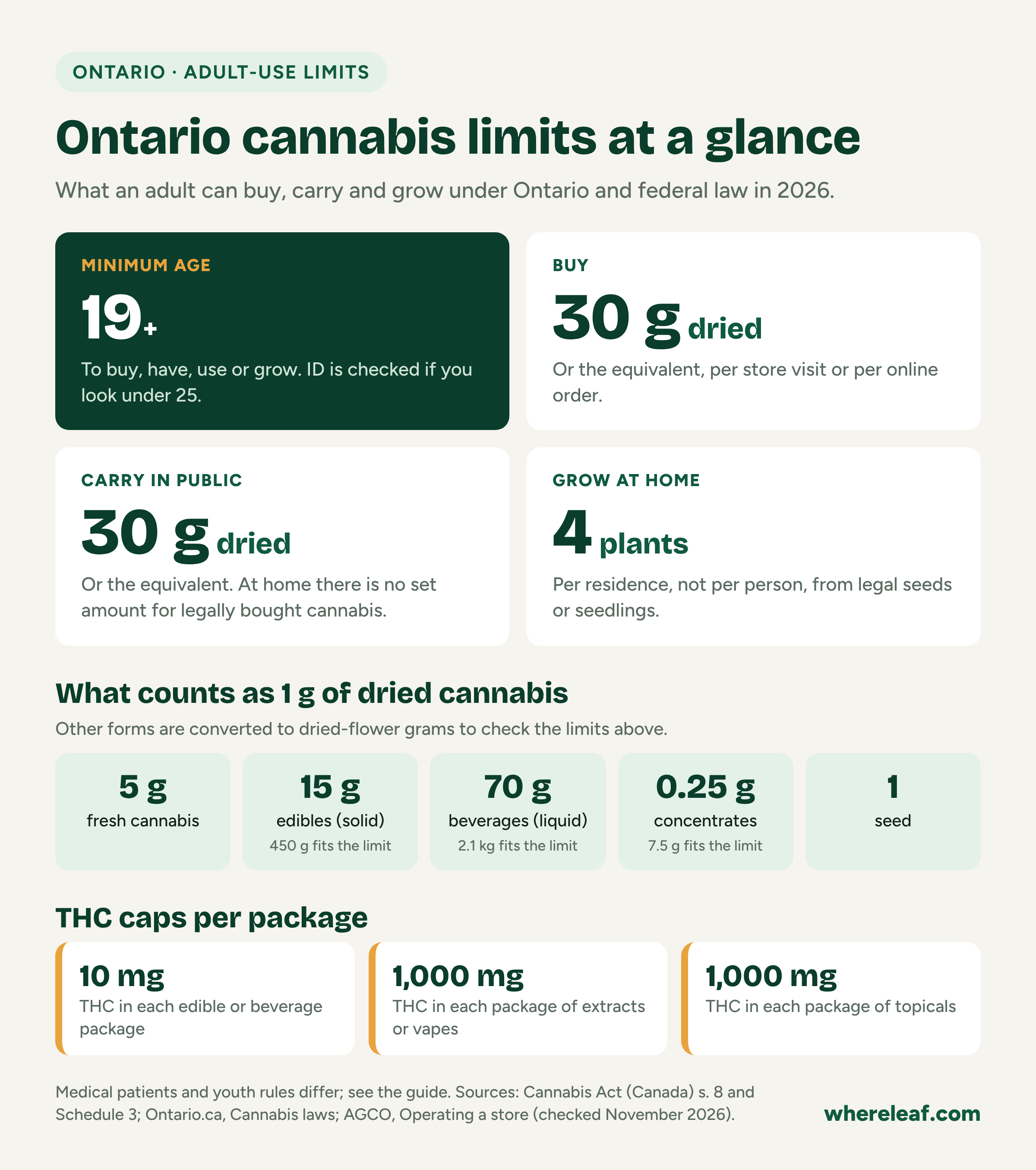
A store may sell you no more than 30 grams of dried cannabis, or the equivalent in other forms, in a single visit, and the same cap applies to each online or phone order. The cap covers every product form, because edibles, beverages and concentrates are converted to a dried-flower equivalent by weight; heavy drinks use up the limit fastest. The infographic below shows the exact rates.
Visitors from other provinces and countries have the same limit as residents. Medical patients can’t use a medical document to buy more at a store; their larger supply comes from federally licensed sellers (see the medical section).
WhereLeaf’s store finder lists Ontario shops near you, and our first dispensary visit guide explains what to expect.
How much cannabis can you have?
In public
Adults may carry up to 30 grams of dried cannabis, or its equivalent, in a public place under section 8 of the Cannabis Act. You can also share up to that amount with other adults of legal age, but you can’t sell it.
At home
Federal law sets no amount limit for legally obtained cannabis kept in a private home. The public limit applies the moment you step outside, so don’t carry more than that from your home to a friend’s place.
In a vehicle or boat
The public limit applies in a car, and Ontario adds a storage rule covered in the driving section.
Potency caps
Federal rules cap how much THC each package can hold. Edibles and drinks have the tightest cap per package, while extracts, vapes and topicals are capped per package at a much higher level. There is no THC cap on dried flower itself. For comparisons with U.S. states, see our edible THC limits guide.
Ontario cannabis limits at a glance
Where can you use cannabis in Ontario?
Ontario lets adults smoke or vape cannabis in most places where tobacco smoking is allowed. Edibles are not covered by the smoking ban, but public intoxication and workplace rules still apply.
Allowed
- Private homes, unless the home is also a workplace such as a long-term care home.
- Many outdoor public places, including sidewalks and most parks, unless a municipal bylaw says otherwise.
- Designated smoking guest rooms in hotels, motels and inns.
- Residential vehicles and boats, such as RVs, only while parked or anchored and set up as a home.
Not allowed
- Enclosed public places and enclosed workplaces, including indoor common areas of condos, apartment buildings and college or university residences.
- School grounds, playgrounds, child care settings, community recreation facilities and publicly owned sports fields, plus a buffer around many of them.
- Restaurant and bar patios and the area right around them, hospital grounds, and near hospital and care-home entrances.
- Covered outdoor areas with a roof and more than two walls that the public or workers use, such as bus shelters.
- Any vehicle or boat that is being driven or will be driven.
Rentals and condos. A lease or condo rules can ban smoking cannabis or growing it in your unit, so read yours before you light up or plant anything. Hotels decide which rooms, if any, are designated for smoking. Lounges: Ontario does not license cannabis consumption lounges, and indoor smoking or vaping in public places is banned. Workplaces: using cannabis in an enclosed workplace is illegal, and under the Occupational Health and Safety Act you must not work while unfit to do so safely. First Nations: some communities set their own rules, so check before you visit.
Many municipalities add their own limits through bylaws, for example on smoking in parks, on beaches or at city events, so check the local rules where you are.
Driving and cannabis in Ontario
Driving while impaired by cannabis is a crime under the Criminal Code, and Ontario adds its own roadside penalties under the Highway Traffic Act. Police can use roadside saliva screeners, field sobriety tests, a drug recognition expert evaluation and blood samples.
The Criminal Code sets blood THC limits for drivers, measured in nanograms per millilitre of blood:
- 2 to under 5 ng: a less serious offence.
- 5 ng or more, or 2.5 ng combined with a blood alcohol level of 50 mg: handled the same as impaired driving, with mandatory minimum penalties.
Zero tolerance. Any detectable cannabis is an offence for drivers aged 21 or under, G1, G2, M1 and M2 licence holders, commercial drivers and road-building machine operators. Roadside penalties for a first zero-tolerance or warn-range failure start with a 7-day licence suspension and a $250 penalty, rising to 14 days and $350, then 30 days and $450 for repeat failures within the look-back period. Commercial drivers get a 3-day suspension each time. Ontario lengthened these suspensions starting January 1, 2026.
Storage while driving. Under section 12 of the Cannabis Control Act, cannabis in a car or boat must be in its original packaging and unopened, or packed in baggage that is fastened closed and not readily available to anyone inside. Locking it in the trunk is the simplest way to comply. Medical patients are exempt from zero tolerance but can still be charged if impaired. Our cannabis and driving laws guide covers the science of THC testing.
Can you grow cannabis at home in Ontario?
Yes. Adults 19 and over can grow up to four plants per residence, not per person, so a house with three adults still has a four-plant limit. Plants must come from seeds or seedlings bought legally from the OCS or an authorized store, and the cannabis is for personal use only.
- Plants can be indoors or outdoors on your property. It’s wise to keep them out of public view and out of reach of children and pets.
- Budding or flowering plants can’t be carried in a public place.
- Growing is banned in a home where a licensed child care business is run, other than in-home services.
- Landlords and condo boards can ban growing in a lease or the condo’s rules.
- You can’t sell what you grow. Selling any cannabis without a licence is a crime.
Fines and penalties for cannabis offences in Ontario
Everyday mistakes usually mean provincial tickets; selling, large amounts and border crossings are federal crimes. Provincial set fines are ticket amounts and a victim fine surcharge is added on top.
| Offence | Type | Maximum fine | Possible jail |
|---|---|---|---|
| Under the legal age and buying, having or using cannabis | Provincial offence (CCA s. 10) | $100 set fine; youth diversion possible | No |
| Showing ID that isn’t yours to buy cannabis | Provincial offence (CCA s. 7) | $150 set fine | No |
| Buying from an unlicensed seller | Provincial offence (CCA s. 9) | $150 set fine | No |
| Open or reachable cannabis in a vehicle or boat | Provincial offence (CCA s. 12) | $175 set fine | No |
| Growing in a home used for child care | Provincial offence (CCA s. 13.1) | $175 set fine | No |
| Smoking or vaping where it’s banned | Provincial offence (Smoke-Free Ontario Act) | $1,000 first offence; $5,000 after that | No |
| Having more than the public limit | Criminal (Cannabis Act s. 8) | $200 ticket up to 50 g; $5,000 on summary conviction | Up to 5 years less a day |
| Growing more plants than allowed | Criminal (Cannabis Act s. 12) | $200 ticket for 5 or 6 plants | Up to 14 years |
| Driving with 2 to 5 ng THC | Criminal, summary | Up to $1,000 | No |
| Drug-impaired driving, first offence | Criminal | Minimum $1,000, plus $550 roadside penalty and 90-day suspension | Up to 10 years |
| Selling without a licence | Provincial (CCA) and criminal (Cannabis Act) | Up to $250,000 for an individual’s first provincial conviction | Up to 2 years (provincial); up to 14 years (federal) |
| Selling or giving cannabis to a minor | Criminal (Cannabis Act) | Set by the court | Up to 14 years |
| Taking cannabis across an international border | Criminal (Cannabis Act) | Set by the court | Up to 14 years |
The provincial maximum for unlicensed selling comes from a law firm summary of the Cannabis Control Act; check the current statute with the Ministry of the Attorney General. A drug-impaired driving conviction also brings a licence suspension of at least one year in Ontario and an ignition interlock condition.
What taxes do you pay on cannabis in Ontario?
Three charges are built into or added to the price of legal cannabis:
- Excise duty: on flower, the federal and Ontario shares together come to $1 per gram or 10% of the producer’s price, whichever is higher. Edibles, extracts and topicals are taxed at a combined 1 cent per milligram of THC.
- Ontario adjustment: Ontario adds a further 3.9% adjustment to its share of the duty.
- HST: 13% harmonized sales tax is added at the register.
Every legal package carries an Ontario excise stamp. Compare other markets in our cannabis tax rate guide.
Medical cannabis patients in Ontario
Medical cannabis is regulated by Health Canada, not Ontario. A patient with a medical document from a doctor or nurse practitioner registers with a federally licensed seller, which ships orders by mail. Patients can also buy at private stores like any adult, subject to the age of 19.
- Possession: registered patients may carry the lesser of 150 grams or a 30-day supply in public, in addition to the adult-use amount.
- Proof: carry the registration document, the label on the package, or a Health Canada certificate.
- Growing: patients can register with Health Canada to grow a set amount themselves or designate someone to grow for them.
A medical document doesn’t let anyone use cannabis in no-smoking areas.
Travelling with cannabis from Ontario
Other provinces: you can bring legal cannabis within Canada, but you must follow the age and rules of the place you are in. Quebec’s legal age is 21, so a 19-year-old from Ontario can’t buy or have it there.
Flights within Canada: federal rules allow adults to carry cannabis on domestic flights within the public possession limit. See can you bring weed on a plane for airport screening details.
The U.S. border and international travel: taking cannabis into or out of Canada is illegal in any amount, including CBD and edibles, even if it is legal where you are going. Failing to declare cannabis to the Canada Border Services Agency is a serious criminal offence, and you can be refused entry to the U.S. over past cannabis use. Read can you bring weed across the border before a trip to Michigan or New York.
Ontario cannabis at a glance
Recent changes and what’s next
- March 12, 2025: federal amendments (SOR/2025-43) allowed QR codes, clear windows on flower packages and simpler potency labels showing total THC and CBD.
- January 1, 2026: Ontario’s tougher roadside suspensions for young, novice and repeat impaired drivers took effect, along with a lifetime licence suspension for impaired driving causing death. Ontario’s impaired driving page notes further changes to conviction penalties from July 1, 2026.
- May 1, 2026: stores may open as early as 7 a.m. instead of 9 a.m. Closing time is still 11 p.m., and delivery hours did not change.
- September 26, 2026: Health Canada proposed streamlining its cannabis tracking rules, including ending federal reporting by provincial stores. Comments close in November 2026, and the change is a proposal, not law.
We found no Ontario bill to change the legal age, the possession limit or the home grow limit as of November 2026. If that changes, the Government of Ontario and the AGCO will announce it first.
For cannabis stores and delivery services
Run or plan to open a store? Our Ontario cannabis store and delivery rules guide covers OCS ordering, delivery and AGCO compliance, and how to open a cannabis store in Ontario walks through licensing. Other provinces and states are in our cannabis licence guides, and our overview of Canada cannabis laws by province compares Ontario with its neighbours.
Frequently asked questions
Can I smoke weed in my car in Ontario if it’s parked?
No, unless the vehicle is a parked RV or an anchored boat set up as a temporary home. A normal car that is parked but will be driven later is still off-limits, and you can be charged even if the engine is off.
Can tourists buy cannabis in Ontario?
Yes. Visitors of legal age can buy at any authorized store with a valid government photo ID, including a foreign passport. Use it up or leave it behind before you go home, because carrying it across the border is a crime.
Can I order cannabis online in Ontario?
Yes, from the OCS website or from an authorized store’s own website for pickup or delivery by its own staff. Someone of legal age must accept the order. See how to buy weed online in Canada.
Can my landlord stop me from smoking cannabis?
Yes, if your lease bans it, and condo boards can pass rules that ban smoking in units. Indoor common areas such as hallways, lobbies and laundry rooms are smoke-free by law no matter what your lease says.
Can I bring cannabis to a cottage or campsite in Ontario?
Yes, within the public limit and packed away while you drive. Ontario Parks and private campgrounds can set their own rules on smoking, and fire bans can apply, so check the park’s rules before you light up.
Is it legal to give cannabis to a friend?
You can share with another adult of legal age within the public limit, but not in exchange for money or anything else. Giving any amount to someone under the legal age is a serious crime, even at a party.
Sources
- Justice Laws: Cannabis Act, section 8, Possession
- Justice Laws: Cannabis Act, section 51, Ticketable Offences
- Ontario e-Laws: Cannabis Control Act, 2017
- Ontario Court of Justice: Set Fines, Cannabis Control Act, 2017, Schedule 0.3 (2025)
- Government of Ontario: Cannabis laws (2024)
- Government of Ontario: Cannabis and driving (2025)
- Government of Ontario: Impaired driving (2026)
- Department of Justice Canada: Impaired driving laws
- Government of Canada: Legalizing and strictly regulating cannabis, the facts (2021)
- Health Canada: Cannabis for medical purposes under the Cannabis Act (2024)
- Government of Canada: Cannabis and the border
- Canada Revenue Agency: EDM6-3, Imposition and Payment of Duty on Cannabis Products (2025)
- AGCO: Operating a Store
- AGCO: Cannabis Retail Store Hours Extended, Opening Permitted from 7:00 am (2026)
- Ontario Ministry of Health (via Eastern Ontario Health Unit): Smoke-Free Ontario Act, 2017, Enclosed Public Places fact sheet (2020)
- Health Canada: Summary of Changes Following the Streamlining of Regulations (2025)
- Canada Gazette, Part I: Order Amending the Cannabis Tracking System Order (2026)
- Ontario Cannabis Store: By the Numbers, Annual Data Report 2025 (2026)
- Health Canada: Canadian Cannabis Survey, Key Findings (2024)
- Aird & Berlis (law firm, backup source): The Ontario Cannabis Control Act and Implications for Commercial Landlords
- CTV News: Tougher Penalties Coming in 2026 for Motorists Caught Driving Impaired (2025)
Last updated: November 2026. Laws change; always check the Government of Ontario and the AGCO for current rules.