
To open a cannabis store in Ontario, you need two approvals from the Alcohol and Gaming Commission of Ontario (AGCO): a Retail Operator Licence for your business and a Retail Store Authorization for each location. You also need a site in a municipality that allows cannabis stores, at least one licensed retail manager, CannSell-trained staff and a wholesale account with the Ontario Cannabis Store (OCS), which is the only legal supplier.
The process is open to anyone who qualifies; Ontario dropped its early lottery system years ago. But it is detailed, with public notice periods, inspections and strict rules on where a store can go, so it pays to know the order of steps before you sign a lease.
This guide walks through each step, the AGCO fees, the municipal and distance rules, how buying from the OCS works and what to budget for. Everything was checked against AGCO and OCS sources in October 2026.
Key takeaways
- Ontario requires a licence for the operator, an authorization for each store, and a licensed manager unless a sole proprietor runs the store.
- Your store must be in a municipality that allows cannabis retail and must not be too close to a school.
- All products must be bought wholesale from the Ontario Cannabis Store; you can’t buy directly from licensed producers.
- Don’t commit to a long lease until you’ve confirmed the site meets AGCO and local zoning rules.
- Rules differ by province and can change. Always check the AGCO’s current requirements before you apply.
What licences do you need to open a cannabis store in Ontario?
Ontario’s system, set out in the Cannabis Licence Act, 2018 and Ontario Regulation 468/18, has three pieces:
- Retail Operator Licence (ROL). Issued to the business entity. The AGCO reviews your corporate structure, owners, financing and agreements.
- Retail Store Authorization (RSA). Issued for each physical store. You need a valid ROL before an RSA can be granted.
- Cannabis Retail Manager Licence (CRML). Required for anyone who manages a store’s operations, supervises staff or oversees compliance. Sole proprietors may not need one.
Since January 1, 2024, one operator and its affiliates can hold up to 150 store authorizations, up from the cap of 75 introduced in 2021.
How much are the AGCO fees?
Application fees cover a two-year term. At renewal you can choose a two-year or four-year term. Fees are non-refundable if you withdraw or are refused.
| Licence or authorization | Application fee | Renewal, two years | Renewal, four years |
|---|---|---|---|
| Retail Operator Licence | $6,000 | $2,000 | $4,000 |
| Retail Store Authorization (per store) | $4,000 | $3,500 | $7,000 |
| Cannabis Retail Manager Licence | $750 | $500 | $1,000 |
| Store Authorization transfer | $1,000 (one-time) | Not applicable | Not applicable |
A worked example: a first-time operator opening one store with one licensed manager pays $10,750 in AGCO application fees before opening day, then renewal fees every two or four years. That is regulator fees only; your lease, build-out and inventory will cost far more. For how this compares with U.S. markets, see our guide to dispensary license costs by state.
Where can you open a cannabis store in Ontario?
Location is where most Ontario plans succeed or fail. Three layers of rules apply.
Municipal opt-in
Ontario let municipalities decide whether to host private cannabis stores. They had until January 22, 2019, to notify the AGCO that they were opting out. Those that didn’t were opted in automatically, and stores could open there from April 1, 2019. A municipality that opted out can opt back in at any time, but once it opts in, it can’t opt out again. The AGCO publishes the full list of municipalities that allow or prohibit stores, and the OCS reported 353 participating municipalities in its 2024 data report.
Distance from schools
Your store must be more than 150 metres from a school, and the AGCO may count vertical distance from street level in that measurement. Filing an application does not confirm your site passes; the AGCO does a final school-proximity review right before it issues the authorization.
Zoning and the building itself
Even in a municipality that allows stores, you still need to meet normal zoning, building and signage rules. Call the municipal planning office early. You must own or lease the premises before your public notice can start, so many applicants negotiate a lease that only becomes binding once the authorization is approved.
What are the steps to get a Retail Store Authorization?
The AGCO’s own retailer roadmap has more than a dozen steps. The graphic below groups them into the key stages and shows the waiting periods you should plan around.
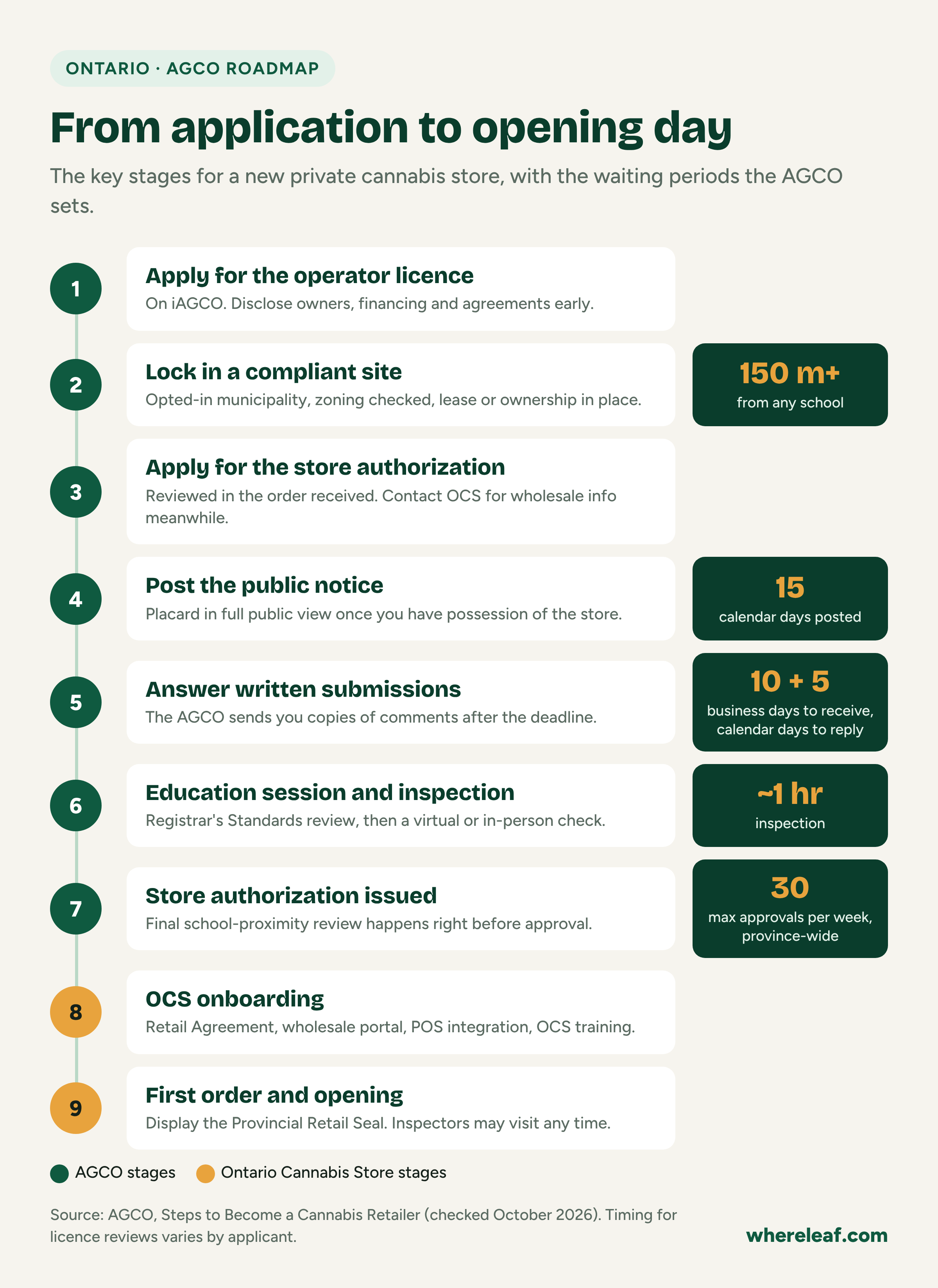
What happens during public notice?
Once you have possession of the store, the AGCO gives you a placard to post in the window. Residents and the municipality can send written submissions about whether the store is in the public interest. You receive copies and get a short window to respond. Objections don’t automatically block a store, but the Registrar considers them before making a decision.
The pre-authorization inspection
Before approval, an AGCO inspector holds an education session on the Registrar’s Standards and then inspects the store, virtually or in person. Expect questions about security cameras, product storage, how you’ll keep anyone under 19 out, and your POS. The POS must come from an integrated provider that can connect to the OCS data platform. Our dispensary security requirements guide is a useful prep list, even though it focuses on U.S. rules.
How does buying from the Ontario Cannabis Store work?
Every product you sell must come from the OCS, the provincial wholesaler. You can’t buy directly from licensed producers, and you can’t sell medical cannabis. The process looks like this:
- Before approval: Contact OCS Client Services and sign a non-disclosure agreement to see wholesale pricing and business information.
- After your RSA is issued: Sign the OCS Retail Agreement and set up your wholesale portal account.
- Integrate your POS with the OCS Data Reporting Platform and complete OCS training.
- Place your first order. You can’t order until you hold your RSA and are fully onboarded.
Plan your opening inventory budget carefully. Pre-rolls, vapes and flower made up most of Ontario’s sales in 2025, according to OCS category data, so many new stores lean their first orders toward those categories.
Those numbers show both the opportunity and the risk. Ontario’s market keeps growing, but competition is real and a meaningful share of stores close each year. Study the stores already near your site before you commit.
What rules apply once your store is open?
Day-to-day operations follow O. Reg. 468/18 and the Registrar’s Standards. Key rules as of October 2026:
- Hours: Since May 1, 2026, stores may open as early as 7 a.m. and must close by 11 p.m. Curbside pickup follows the same hours. Delivery is still limited to 9 a.m. to 11 p.m.
- Age: No one under 19 may enter. You choose your ID-check procedure, but it must keep minors out. See our guide on how dispensaries check ID.
- Staff: All employees need criminal background checks at hiring and must complete CannSell before their first shift. Read more in our budtender training requirements guide.
- Online sales and delivery: Allowed, but only your own employees can deliver; third-party delivery services are not permitted. Each purchase is capped at 30 grams of dried cannabis or the equivalent.
- Seal: Display the Provincial Retail Seal so it’s visible from outside the public entrance.
- Reporting: Meet the AGCO’s reporting timelines and send sales data through the OCS platform. Inspectors can visit at any time.
For how Ontario’s rules compare with other provinces, read our overview of Canada cannabis laws by province.
How much does it cost to open a cannabis store in Ontario?
Regulator fees are the easy part to estimate. The bigger costs vary so much by city and store size that any single number would mislead you. Build your budget around these line items:
- Lease and deposits: often the largest fixed cost, and you may be paying rent during the approval period.
- Build-out: fixtures, display cases, signage that meets AGCO advertising rules, and accessibility upgrades.
- Security: cameras inside and outside, alarms, and secure product storage.
- Technology: an OCS-integrated POS, ID scanners and an e-commerce menu.
- Opening inventory: paid to the OCS on its payment terms.
- Staffing and training: wages during setup, CannSell fees and manager licences.
- Professional help: a lawyer for corporate disclosure and lease review, and an accountant familiar with cannabis.
- Insurance and banking: the AGCO tells applicants to allow extra time for both.
Keep a cash cushion. Delays at the public notice or inspection stage mean paying rent on an empty store.
What mistakes slow down Ontario store applications?
Most delays come from avoidable problems. Watch for these before you file:
- Signing a lease before checking the site. A store that turns out to be too close to a school, or in a municipality that opted out, can’t be approved no matter how good the rest of your file is.
- Incomplete ownership disclosure. The AGCO wants to see everyone with an interest in the business, including lenders, landlords with profit-sharing terms and franchise or licensing agreements. Missing documents mean back-and-forth that adds weeks.
- Slow responses. Once public notice ends, the response window is short. Have someone ready to read and answer submissions quickly.
- A store that isn’t ready for inspection. Cameras, storage and POS should be installed and working before the inspector arrives, not on order.
- No licensed manager. Unless you’re a sole proprietor running the store yourself, you need a licensed Cannabis Retail Manager before hiring staff.
- Underestimating the wait for OCS onboarding. You can’t order until onboarding is finished, so build that time into your opening date and marketing plans.
Many applicants hire a lawyer or consultant who has filed Ontario applications before. That isn’t required, but it can help with corporate disclosure, lease terms and the school-distance review. Whoever prepares your file, keep copies of everything you submit, along with dates, so you can answer AGCO questions quickly.
It also helps to visit a few existing stores as a customer. Notice how they handle ID checks at the door, how menus are displayed and how staff explain products. You’ll learn what inspectors and shoppers expect, and you’ll get a feel for local competition. Our dispensary etiquette guide shows what customers expect from the visit.
Your Ontario cannabis store checklist
Screenshot this and work through it in order.
- Confirm your target municipality allows cannabis stores on the AGCO list.
- Set up your corporation, banking and insurance.
- Apply for your Retail Operator Licence on iAGCO and disclose all agreements early.
- Find a site, measure the distance to nearby schools and check zoning.
- Secure the premises with a lease you can exit if the authorization is refused.
- Apply for the Retail Store Authorization and line up a licensed retail manager.
- Contact OCS Client Services and sign the NDA.
- Post the public notice placard as soon as the AGCO sends it, and respond to any submissions on time.
- Install security, POS and storage before your inspection.
- Hire staff, run background checks and complete CannSell for everyone.
- After approval, sign the OCS Retail Agreement, integrate your POS and place your first order.
- Display your Retail Seal and open.
For new store owners
Once your doors open, customers need to find you. List your store on WhereLeaf so shoppers searching our dispensary finder see your hours and menu, and compare our listing packages for featured placement. Our guide to dispensary marketing and local SEO covers what you can promote under Canada’s advertising limits. Fixture, security and POS vendors can be found in our supplier directory.
Frequently asked questions
How long does it take to open a cannabis store in Ontario?
It varies with how complex your ownership is and how quickly you secure a site. The operator licence review can take a while if your company has many owners or agreements, and the store authorization can’t finish until public notice and inspection are done. Plan for several months, not weeks.
Can I open a cannabis store in Toronto?
Yes. Toronto allows private cannabis stores, but sites still have to meet the school distance rule, zoning and AGCO review. Some other large municipalities opted out, so always check the AGCO list first.
Do I need cannabis industry experience to get a licence?
The AGCO’s published steps don’t list industry experience as a requirement. Instead, it reviews the business’s owners, financing and agreements, and it checks the background of the people involved. Experience still helps you pass the inspection and run the store well.
Can I buy products directly from licensed producers?
No. Ontario stores must buy all cannabis from the Ontario Cannabis Store. Producers sell to the OCS, which then sells to stores at wholesale prices.
Can an Ontario cannabis store sell online?
Yes. Stores can take orders online for in-store pickup, curbside pickup or delivery by their own employees. Learn how this works for shoppers in our guide to buying cannabis online in Canada.
Can a municipality that allows stores change its mind?
No. Under Ontario’s rules, a municipality that has opted in can’t later opt out, though it can still use normal zoning and bylaws where provincial law allows.
Sources
- AGCO: Steps to Become a Cannabis Retailer
- AGCO: Licence and Authorization Fees
- AGCO: List of Ontario Municipalities Prohibiting or Allowing Cannabis Retail Stores
- AGCO: Frequently Asked Questions, Retail Store Operation
- AGCO: Cannabis Retail Store Hours Extended, Opening Permitted from 7:00 am (2026)
- AGCO: Educational Requirements for Cannabis Retail
- blogTO: Ontario Raises Cannabis Store Cap per Operator (2024)
- StratCann: Ontario Cannabis Sales Top $2.28 Billion in 2025 (2026)
- Ontario Cannabis Store: New OCS Data Report Showcases Progress of Legal Cannabis Industry (2024)
Last updated: October 2026. Laws and prices change; always check your state or provincial regulator.