Dispensary security requirements usually cover five things: 24-hour video surveillance, a monitored alarm system, locked safes or vaults for product and cash, controlled access to non-public areas, and fast incident reporting. The details, such as how many days you must keep camera footage, differ by state, from 30 days in Colorado and Michigan to 90 days in California, Massachusetts, Illinois and Oregon.
Security is one of the first things inspectors check and one of the easiest places to lose points. A single gap in recorded video or a broken alarm can lead to fines or a license action, even if nothing was stolen.
This guide is for dispensary owners, managers and applicants in US legal markets. It explains each requirement in plain English, compares camera footage retention days in eight states, and ends with a checklist you can print for your next walk-through.
Key takeaways
- Cameras are the backbone of every state’s rules, and a gap in footage is one of the easiest ways to fail an inspection.
- Retention periods and camera specs vary a lot, so buy equipment and storage for the strictest state you plan to operate in.
- Alarms, safes and access control matter as much as cameras. Inspectors check all of them, plus your written security plan.
- Have an incident plan ready before you need it, because reporting deadlines after a theft or breach are short.
- Rules differ by state and province, and cities can add more. Always check your local regulator.
What are the security requirements for a dispensary?
Most state rules group dispensary security into the same building blocks. The wording changes from state to state, but an inspector will usually look for these:
- Video surveillance: fixed cameras recording around the clock, with a date and time stamp and a set retention period.
- Alarm system: perimeter alarms on doors and windows, often with panic or duress buttons and third-party monitoring.
- Secure storage: a locked safe or vault for cannabis and cash outside business hours.
- Access control: locked limited-access areas, employee badges, and a visitor log.
- Failure alerts and backup power: notice when the system goes down, and enough backup power to keep it running in an outage.
- Reporting: notifying the regulator and police quickly after theft, loss or a security breach.
Many states, including Michigan, also require a written security plan. Keep that plan current and update it whenever you change the layout, add a camera or switch vendors.
Cannabis dispensary camera requirements
Cameras are the backbone of dispensary security rules. States want footage clear enough to identify every person who comes in or goes out and every transaction at the counter.
Where cameras must point
Common required coverage areas include:
- All entrances and exits, often recorded from both inside and outside.
- Every point-of-sale area, with enough detail to see faces. California requires cameras that capture faces “with sufficient clarity to determine identity.”
- Product display areas, storage rooms, vaults and safes.
- Areas where product is weighed, packed, loaded, unloaded or destroyed.
- The room that holds the recording device, and the door to it.
- Parking lots and outside areas in some states, such as Massachusetts, New York and Illinois.
Michigan and Colorado also require cameras to clearly record activity within 20 feet of entry and exit points.
Resolution and frame rate
Some states set minimum specs and others only require clear, identifiable images. Here is how several states compare as of October 2026.
| State | Minimum resolution | Minimum frame rate | Recording |
|---|---|---|---|
| California | 1280 x 720 pixels | 15 fps | Continuous, 24 hours a day |
| Oregon | 1280 x 720 pixels | 10 fps | Continuous, 24 hours a day, with real-time off-site backup |
| Michigan | 720p | Not specified | Continuous |
| Washington State | 640 x 470 pixels | 10 fps | Continuous, 24 hours a day |
| Illinois | Image quality suitable for facial recognition at exterior doors | Equivalent of 8 fps | Continuous, with real-time access for regulators through a secure portal |
| Massachusetts, New York, Colorado | No set number; images must clearly identify people | Not specified | Massachusetts: 24 hours a day. New York: continuous during operating hours, motion-activated otherwise |
Timestamps and tamper protection
Footage is only useful as evidence if nobody can question it. California and Washington State require recordings to show an accurate date and time measured to National Institute of Standards and Technology (NIST) standards. Washington State also requires the recording device to be locked or otherwise protected from tampering or theft, and Colorado requires footage to be archived in a format that guarantees it has not been altered.
A practical rule: buy cameras that meet the strictest spec in any state you plan to operate in. Upgrading later costs more than buying the right equipment once.
How long do dispensaries have to keep camera footage? Retention days by state
Camera footage retention is one of the most-asked dispensary security questions, and the answer differs widely. Several of them, including Colorado, Michigan, Massachusetts and New York, also require you to keep footage longer while an investigation is pending.
| State | Minimum retention | Rule |
|---|---|---|
| Colorado | 30 days | 1 CCR 212-3, Rule 3-225 |
| Michigan | 30 calendar days | Mich. Admin. Code R. 420.209 |
| Washington State | 45 days | WAC 314-55-083 |
| New York | 60 days | 9 NYCRR 125.3 |
| California | 90 calendar days | 4 CCR 15044 |
| Massachusetts | 90 calendar days | 935 CMR 500.110 |
| Illinois | 90 calendar days | 68 Ill. Adm. Code 1291.300 |
| Oregon | 90 calendar days, plus 30 days of off-site backup | OAR 845-025-1450 |
Worked example: how much storage do you need?
Storage depends on camera count, resolution, compression and motion, so ask your installer for a real estimate. As a rough planning step, multiply your cameras by your state’s retention days. A 20-camera store in Illinois needs 20 x 90 = 1,800 camera-days of footage on hand at all times. The same store in Michigan needs 600 camera-days, a third as much.
Plan for growth too. If you add cameras or move to a stricter state, your storage needs jump at once. Running out of space can leave a gap in footage that an inspector will find.
Dispensary alarm system requirements
Every state we reviewed requires an alarm system. The minimum is usually a perimeter alarm on all entry points and perimeter windows.
- Massachusetts requires a perimeter alarm, a backup alarm system, and a duress, panic or holdup alarm connected to local public safety or law enforcement. Equipment must be tested at least every 30 calendar days.
- Illinois requires perimeter alarms, glass-break protection, enough panic and holdup buttons, a duress alarm and an after-hours intrusion alarm that notify the local 911 center.
- California requires the alarm to be installed, maintained, monitored and responded to by a licensed alarm company operator or its registered agents.
- New York requires a perimeter alarm that alerts an internal designee and a third-party central monitoring station.
- Washington State requires an alarm on all perimeter entry points and windows. Motion sensors and panic alarms are optional.
Failure alerts and backup power
Illinois, Massachusetts and New York require designated staff to be told within five minutes when the surveillance system fails. Massachusetts and Illinois require security systems to run for at least four hours in a power outage, and New York requires eight hours. A battery backup sized for your cameras, recorder and alarm panel covers most of this.
Do dispensaries need a vault or safe?
Yes, in most states. Cannabis and cash usually have to be locked away outside sales hours.
- Illinois requires cannabis and cash to be kept in a locked, reinforced vault outside operating hours. Vault walls, floor and ceiling must be at least 8 inches of reinforced concrete or an approved alternative, and vault entry must be logged daily.
- Massachusetts requires finished products in a locked safe or vault, kept locked except when adding or removing product. Stores that deposit cash need a separate locked safe used only for cash, away from the sales floor.
- New York requires cannabis to be stored in a locked safe, vault or other approved equipment.
Where your state is less specific, your insurer may still have safe requirements, so ask before you buy one. Keep product counts and safe logs matching your inventory tracking system.
Access control: badges, locks and visitor logs
States want to know who is in your building and why. Limited-access areas, such as storage rooms and back offices, are for authorized staff only.
Common access-control rules
- Employee badges: Washington State requires staff to wear a badge with the trade name, full legal name and photo while on the premises. Massachusetts requires agents to display their badges.
- Visitor logs: Washington State requires a visitor log with name, badge number, arrival and departure times and purpose. Logs must be kept for three years.
- Escorts: Massachusetts requires visitors to wear a visitor badge, be escorted and be logged in and out.
- Electronic locks: Illinois requires electronic locks on limited and restricted access doors and limits security codes to authorized agents.
- Age checks at the door: Massachusetts and New York require positive identification so only adults 21+ enter. Learn how stores handle this in do dispensaries scan your ID.
Do dispensaries need security guards?
It depends on the state. California requires storefront retailers to have security staff, at least 21 and licensed by the Bureau of Security and Investigative Services, on site during operating hours. Non-storefront (delivery-only) retailers are exempt.
Many other states do not require a guard by rule, but local permits, landlords or insurers may. Check your city’s conditions of approval before you assume a guard is optional.
What happens after a theft or security breach?
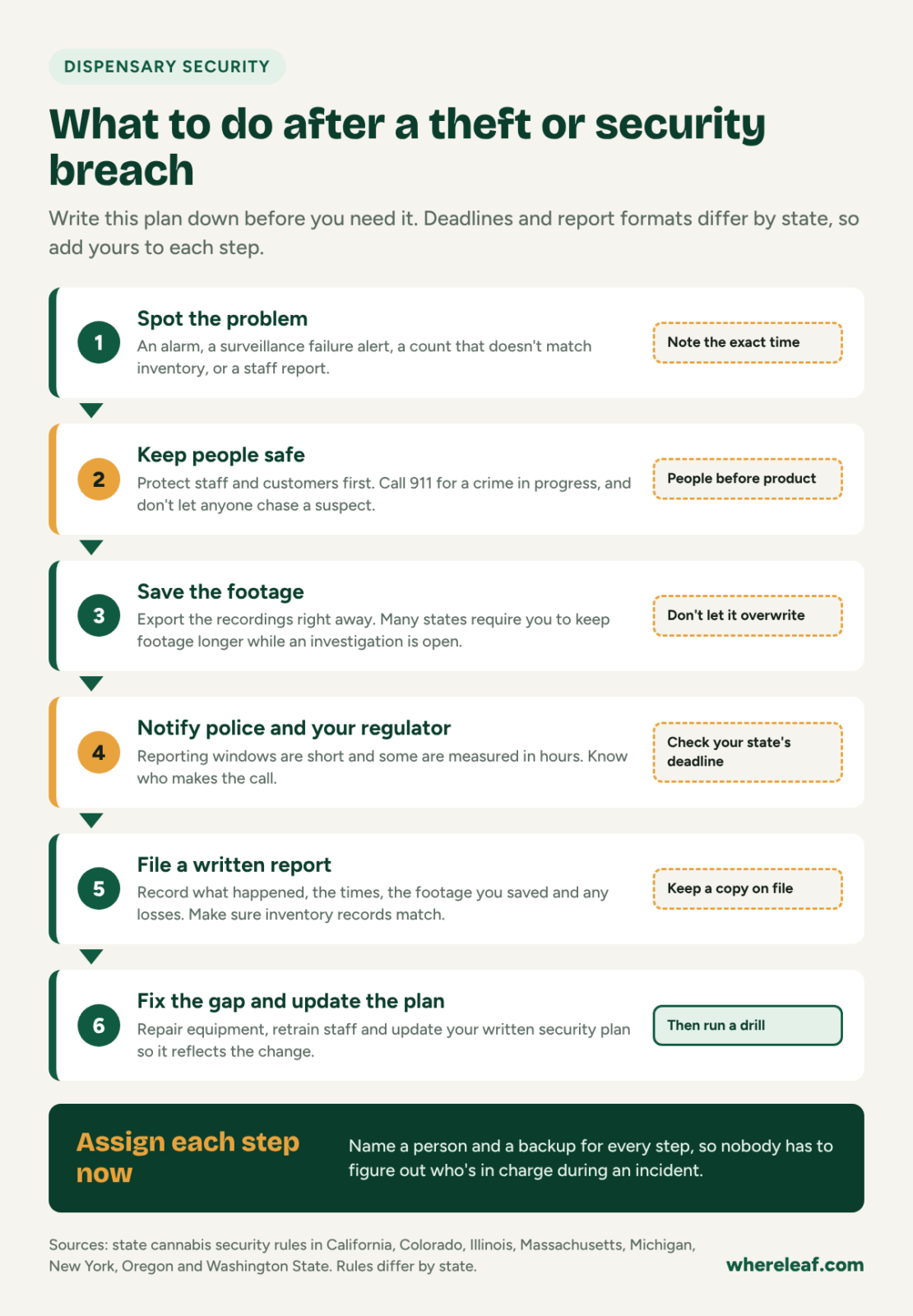
Report it fast. Massachusetts requires notice to law enforcement and the Commission right away, and no later than 24 hours after discovery, plus a written incident report within 10 calendar days. Illinois requires immediate notice of surveillance outages and a written outage report within five calendar days. The graphic below shows a simple response plan you can adapt.
Your dispensary security checklist
- Read your state’s security rule in full and note retention days, camera specs and alarm rules.
- Check city permits, landlord terms and insurance policies for extra requirements, such as a guard.
- Map every required camera view: entrances inside and out, sales counters, display, storage, vault and the recorder room.
- Confirm cameras meet or beat your state’s resolution and frame-rate minimums.
- Size storage for your retention period plus room to grow, and set up off-site backup if required.
- Check that every recording shows an accurate date and time stamp.
- Install perimeter alarms, panic buttons and third-party monitoring.
- Set up failure alerts to managers by phone or text within five minutes.
- Add backup power for cameras, recorder and alarm, and test it.
- Lock product and cash in a safe or vault after hours and keep a daily log.
- Issue staff badges, lock limited-access doors and keep a visitor log.
- Write down who reports incidents, to whom, and how fast. Run a drill twice a year.
For dispensary owners: build trust with customers
A secure, well-run store is something customers notice. Show adults where to find you with a free WhereLeaf listing: add your dispensary, or compare our listing packages for more visibility. Security, camera and safe vendors that serve licensed cannabis businesses can reach store owners through our supplier directory. If you are still applying, see our breakdown of dispensary license costs by state, and learn what customers check before they visit in how to tell if a dispensary is licensed.
Frequently asked questions
How long do dispensaries keep camera footage?
It depends on the state; the retention table above lists eight of them. Those are minimums. Several states require you to keep footage longer while an investigation is pending, and many owners keep extra days as a buffer so a busy week never forces an early overwrite.
Do dispensaries have cameras everywhere?
Cameras cover most of the store, including entrances, sales counters, display areas and storage rooms. New York, for example, requires cameras in all areas except where customers are consuming cannabis.
What camera resolution does a dispensary need?
Check the camera table above for states with set minimums. Where a state only says images must identify people, test it: pull a clip from the sales counter and the entrance and make sure you can read faces at the busiest time of day, in low light as well as daylight.
Do dispensaries need armed guards?
No state rule we reviewed requires armed guards specifically. California requires licensed security staff on site during operating hours at storefront retailers, and local permits or insurers in other states may require guards.
Can dispensary footage be stored in the cloud?
Often, yes, if the off-site system meets the same standards as on-site storage. Colorado, for example, allows off-site storage that meets or beats its on-site standards. Confirm that your cloud provider keeps accurate timestamps and that you can hand footage to regulators quickly.
Who can see dispensary security footage?
Your regulator and law enforcement can ask for it, and many states require you to provide it on request. Massachusetts requires footage to be available for immediate viewing by the Commission. Keep a short written process for who can export footage and how requests are logged.
Sources
- Cornell LII: 4 CCR 15044, Video Surveillance System (California, 2026)
- Cornell LII: 4 CCR 15045, Security Personnel (California, 2026)
- Cornell LII: 4 CCR 15047, Alarm System (California, 2026)
- Justia: 1 CCR 212-3, Rule 3-225, Video Surveillance (Colorado, 2025)
- Cornell LII: 68 Ill. Adm. Code 1291.300, Security Requirements (Illinois, 2024)
- Cornell LII: 935 CMR 500.110, Security Requirements for Marijuana Establishments (Massachusetts, 2025)
- Cornell LII: Mich. Admin. Code R. 420.209, Security measures and video surveillance (Michigan, 2022)
- Cornell LII: 9 NYCRR 125.3, Security and Storage of Cannabis (New York, 2023)
- Oregon Administrative Rules: OAR 845-025-1450, Video Surveillance Equipment (2026)
- Washington State Legislature: WAC 314-55-083, Security and traceability requirements (2026)
Last updated: October 2026. Laws and prices change; always check your state or provincial regulator.