
Do dispensaries scan your ID? Many do, but whether they must, and what they can keep afterward, depends on the state. Illinois and Nevada require stores to scan IDs electronically, while California and Colorado only require staff to inspect a valid ID.
The bigger question is what happens to that data. Some states ban stores from keeping anything beyond the age check, some allow more if you say yes, and some mostly leave it to general privacy law.
This guide covers why stores check ID, what a scan reads, which IDs work, Canada’s rules, and simple privacy steps.
Key takeaways
- Every licensed dispensary must check ID. In US adult-use states the minimum age is 21; in Canada it is 19 in most provinces, 18 in Alberta and 21 in Quebec.
- Scanning is required in some states (Illinois, Nevada) and optional in many others, where staff may simply look at your card.
- Several states limit what stores can keep. Oregon bars retailers from recording identifying information unless you agree to it, and California bars licensees from sharing your personal information with third parties without consent.
- A valid, unexpired government photo ID from any US state usually works. Expired IDs are refused in most places, and rules for foreign IDs vary.
- Rules differ by state and province. Always check your local regulator before you go.
Why do dispensaries check your ID?
Age checks are the law, not store policy. Every state and province with legal sales requires stores to confirm a buyer’s age, and a shop that skips it risks fines or its license.
Here is how a few regulators put it:
- California: Under Department of Cannabis Control rules (4 CCR § 15404), a licensed retailer may sell adult-use products only to people 21 or older and must confirm age and identity by inspecting a valid ID.
- Massachusetts: 935 CMR 500.140 says a retailer must “immediately inspect” proof of identification, and nobody may be admitted until their age is verified.
- Colorado: Marijuana Enforcement Division Rule 3-405 requires stores to refuse a sale if the ID is invalid or expired.
- Ontario: The Alcohol and Gaming Commission of Ontario says staff must check the ID of anyone who appears to be under 25, and nobody under 19 may enter.
Stores in states with daily purchase limits also use your ID to keep each buyer under the limit. New to all this? Our first dispensary visit guide walks through the whole trip.
Do dispensaries scan your ID, and is it required?
It depends on the state. Some make scanning mandatory; elsewhere, many shops scan anyway because a scanner checks barcodes and security features faster than a person.
States that require a scan
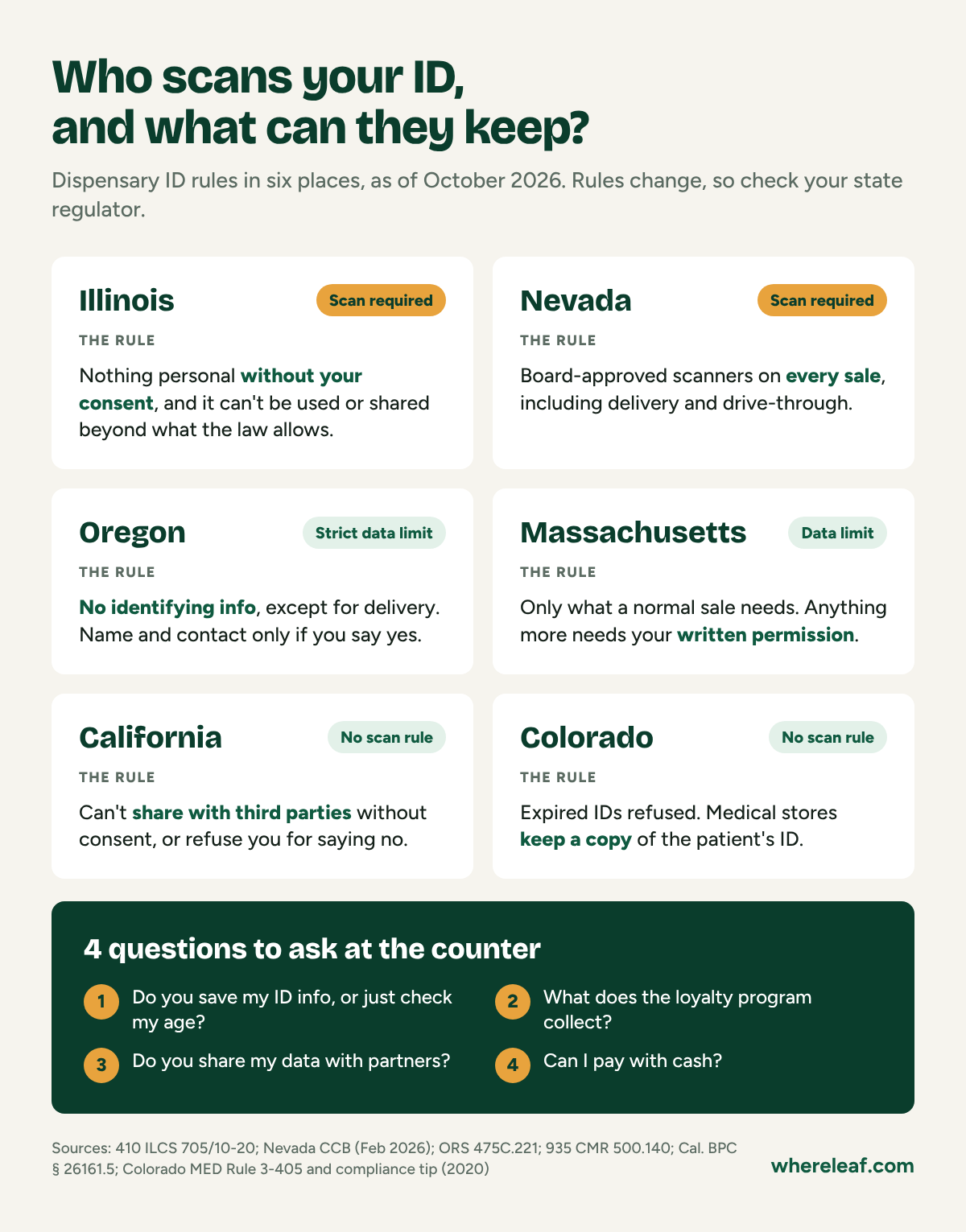
- Illinois: State law (410 ILCS 705/10-20) says a dispensing organization “shall use an electronic reader or electronic scanning device” to check a buyer’s government-issued ID for age and validity.
- Nevada: The Cannabis Compliance Board’s February 2026 guidance says licensees must use board-approved ID scanners for all sales, including delivery, curbside and drive-through orders. If the scanner fails, staff must do a manual check and record it on a standard checklist.
States where a visual check is enough
In California and Colorado, the rules require staff to inspect a valid ID but do not require a scanner. Colorado’s Rule 3-405 mentions electronic scanners only as one way a store can show it made a good-faith check if a minor uses a fake.
If a store scans your ID where the state does not require it, that is the store’s choice, and your cue to ask what the scanner saves.
What does a dispensary ID scan record?
The barcode on a US driver’s license holds the details printed on the front: name, date of birth, address, license number, expiration date and physical details. A scanner reads it all in a second. What matters is whether the software keeps it.
State rules fall into three rough groups:
- Keep almost nothing. Oregon law (ORS 475C.221) says a retailer “may not record and retain any information that may be used to identify a consumer,” except what is needed for delivery. It also bans transferring that information to anyone else.
- Keep only what a normal sale needs, unless you agree to more. In Massachusetts, retailers may not record personal information beyond what is “typically required in a retail transaction” without your voluntary written permission. Illinois law says stores cannot record your personal information without consent, and anything collected cannot be used or shared except as the law allows.
- Limit sharing rather than storage. California’s Business and Professions Code § 26161.5, in effect since January 1, 2019, bars licensees from disclosing your personal information to third parties without your consent, except as needed to process payment or for government oversight. Software vendors that run the sale are exempt if they do not reuse or keep the data.
Stores also keep other records. Colorado requires visitor logs for restricted areas, and licensed stores generally run security cameras.
Do dispensaries share your information?
Licensed stores in states with strong rules generally cannot sell or hand over your data without your permission. California’s law also says a store cannot refuse to serve you because you said no to sharing your information with a third party unrelated to the sale.
The bigger risk is often a leak. In January 2020, vpnMentor researchers found an unsecured cloud bucket owned by THSuite, a dispensary point-of-sale software company. Security Magazine reported it held 85,000 files on more than 30,000 people, including scanned IDs. Data a store never keeps cannot leak.
In Canada, the Office of the Privacy Commissioner said in December 2018 that stores may check ID but “are not required to record this information,” and that storing data in Canada is generally more privacy protective.
What forms of ID do dispensaries accept?
A valid, unexpired, government-issued photo ID with your date of birth is the safe choice everywhere. Beyond that, each state writes its own list. The table below shows common ID types and how a few states handle them.
| ID type | Usually accepted? | State examples (as of October 2026) |
|---|---|---|
| Driver’s license or state ID from any US state | Yes | Accepted in CA, CO, WA, OR and NV, including out-of-state cards |
| US passport or passport card | Yes | Listed in CA, CO, WA, OR and NV rules |
| US military ID | Yes | Listed in CA, CO, WA, OR and NV rules |
| Foreign passport | Often | CA names foreign passports; NV accepts those recognized by the US; CO and WA list “passport” without limiting the country |
| Canadian driver’s license | Varies | WA, OR and NV accept it; Colorado’s rule does not list foreign licenses, so bring a passport |
| Tribal ID | Often | CO, OR and NV accept federally recognized tribal IDs; WA accepts cards from tribes in Washington that meet its security standards |
| Expired ID | Usually no | Refused in CO, WA and OR; NV allows a state ID expired up to 2 years with a second ID |
| Digital or mobile ID | Varies | CO allows a “valid and verified” digital ID; OR requires a physical card |
| Photo or photocopy of an ID | No | Alberta requires an original; OR requires a physical card |
This is a general guide, not a full list. Check your state’s rules and call the store if your ID is unusual.
Do dispensaries take passports?
Yes, in every state ID list reviewed for this guide. Several states also accept foreign passports; Nevada requires one recognized by the United States.
Do dispensaries take military IDs?
Usually, yes. California accepts a valid Armed Forces ID showing your name, date of birth and photo, and Colorado, Washington, Oregon and Nevada list military IDs too.
Do dispensaries take expired IDs?
Usually not. Colorado, Washington and Oregon all say expired IDs are not acceptable, and Alberta’s guidance says ID must not be expired. Nevada allows a state license or ID card expired no more than two years if you also show a second acceptable ID.
Can you use an out-of-state ID at a dispensary?
Yes. Adult-use states generally accept a valid driver’s license or state ID from any US state. California accepts government-issued documents with your name, date of birth, height, gender and photo, and Colorado, Washington, Oregon and Nevada name licenses from any state.
Two notes for visitors:
- Purchase limits: Your limit is set by the state you are buying in, not your home state.
- Do not travel with it: Never take cannabis across state lines or national borders. It remains illegal under federal law, even between two legal states.
Before you go, use our dispensary finder and confirm the store is licensed. Our guide on how to tell if a dispensary is licensed shows how. Unlicensed shops ignore every privacy rule here.
What ID do you need at a dispensary in Canada?
The legal age is 19 in most provinces and territories, 18 in Alberta and 21 in Quebec, according to Health Canada. Staff in Ontario and Alberta must check ID for anyone who looks under 25.
The Ontario regulator’s photo ID page (written for alcohol sales) lists IDs such as an Ontario driver’s licence or photo card, a Canadian passport, a permanent resident card, a Secure Certificate of Indian Status, a Canadian Armed Forces ID and the LCBO BYID card. It also accepts equivalent foreign photo ID, such as a valid passport.
US visitors should bring their passport. Remember that you cannot bring cannabis into or out of Canada.
Medical card vs adult-use ID checks: what is different?
Medical cannabis programs usually ask for more paperwork, and the store often keeps more of it.
- Age: In California, medical buyers can be 18 or older, compared with 21 for adult-use, but they must also have a valid physician’s recommendation.
- Documents: Colorado’s December 2020 compliance tip says medical stores must check both the patient registry card and a personal ID at every sale.
- Records: That same Colorado guidance says stores must keep a copy of the patient’s ID on file, which adult-use stores do not have to do.
- Extra protection: California’s 2018 law (AB 2402) brought licensees that receive medical ID cards or physician recommendations under the state’s Confidentiality of Medical Information Act.
If you hold a medical card, ask how that information is stored and who can see it.
How can you protect your privacy at a dispensary?
The age check is not optional, but you can control much of what happens after it.
- Ask what the scanner keeps. “Does your system save my ID info, or just check my age?” is a fair question.
- Read the loyalty program terms. Sign-ups are how stores collect your phone number and buying history. In Massachusetts and Oregon, stores need your consent for this extra data.
- Uncheck data sharing. Decline any box that lets the store share your data with partners.
- Pay with cash if privacy matters to you. Canada’s privacy commissioner suggests cash as a way to limit the information a store holds about a purchase.
- Know that delivery needs more data. Oregon and Massachusetts let stores keep your address for delivery, but only for that purpose.
- Ask where data is stored. In Canada, the privacy commissioner suggests asking whether your data stays on servers in Canada.
Your dispensary ID and privacy checklist
- Confirm the store is licensed with your state or provincial regulator.
- Bring a valid, unexpired, physical government photo ID.
- Visiting from abroad, or license recently expired? Bring your passport.
- Ask whether the store scans IDs and whether the scan is saved.
- Say no to the loyalty program unless the deal is worth the data.
- Uncheck any option to share your data with partners.
- Pay with cash if you want fewer records of the purchase.
- Know the purchase limit for the state you are in.
- Keep your purchase in the state or province where you bought it.
For dispensary owners: make your ID policy easy to find
Shoppers ask these questions before they visit. A short note saying which IDs you accept, whether you scan, and what you keep builds trust. Make sure your software contracts match your state’s data rules.
Add your dispensary to WhereLeaf to list your hours, accepted IDs and payment options, or see our listing packages to feature your store in local search.
Frequently asked questions
Why do dispensaries scan your ID?
Stores scan IDs to confirm your age, spot fake or expired cards, and in some states to track daily purchase limits. In Illinois and Nevada, scanning is required by state rules. Elsewhere, it is often the store’s choice.
Do dispensaries keep your information?
It depends on the state. Oregon bars retailers from recording identifying information without your consent, and Massachusetts allows only what a normal sale needs unless you give written permission. In other states, ask the store directly what its system saves.
Can the police or federal government see dispensary records?
State regulators can review licensee records as part of oversight, and California’s law allows disclosure to state and local governments for official duties. A store that keeps less data has less to hand over.
Do you have to show ID for delivery?
Yes. Delivery drivers must check ID at the door, and Nevada requires the same scanning for delivery as in-store sales. Learn more in our cannabis delivery guide.
Will a dispensary accept a temporary paper license?
Some states do. Colorado’s rule counts temporary licenses and ID cards from any US state. Store policies vary, so call ahead and bring a passport if you have one.
Sources
- Cornell LII: Cal. Code Regs. tit. 4, § 15404, Retail Customers (2021)
- Justia: California Business and Professions Code § 26161.5 (2025)
- CalMatters Digital Democracy: AB 2402, Cannabis Licensee Privacy (2018)
- Cornell LII: 1 CCR 212-3, Rule 3-405, Acceptable Forms of Identification (Colorado MED)
- Cornell LII: 1 CCR 212-3, Rule 3-905, Business Records Required (Colorado MED)
- Colorado Marijuana Enforcement Division: Compliance Tip, Permitted Patient Card Formats and Medical Sale Guidelines (2020)
- Justia: 935 CMR 500.140, Additional Requirements for Marijuana Retailers (Massachusetts)
- Oregon Laws: ORS 475C.221, Retailer Recording of Consumer Information
- Oregon Liquor and Cannabis Commission: Acceptable ID for Marijuana (2021)
- FindLaw: 410 ILCS 705/10-20, Identification; False Identification; Penalty (Illinois)
- Nevada Cannabis Compliance Board: Age Verification and Acceptable ID (2026)
- Cornell LII: WAC 314-55-150, Forms of Acceptable Identification (Washington)
- AGCO: Authorized Cannabis Retail Stores, What Customers Can Expect
- AGCO: Photo Identification
- AGLC: How to Identify Minors, Tips for Licensees and Staff (2025)
- Health Canada: Cannabis Laws and Regulations in Provinces and Territories (2022)
- Office of the Privacy Commissioner of Canada: Protecting Personal Information, Cannabis Transactions (2018)
- Security Magazine: POS System in Cannabis Industry Leaks 85,000 Files (2020)
Last updated: October 2026. Laws and prices change; always check your state or provincial regulator.