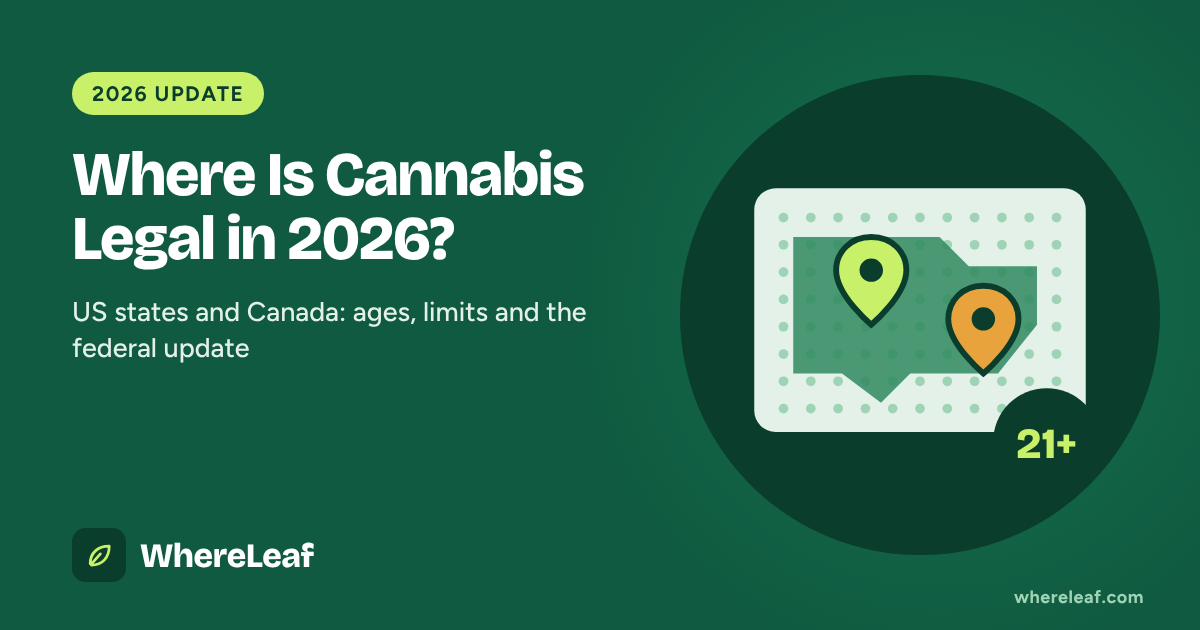
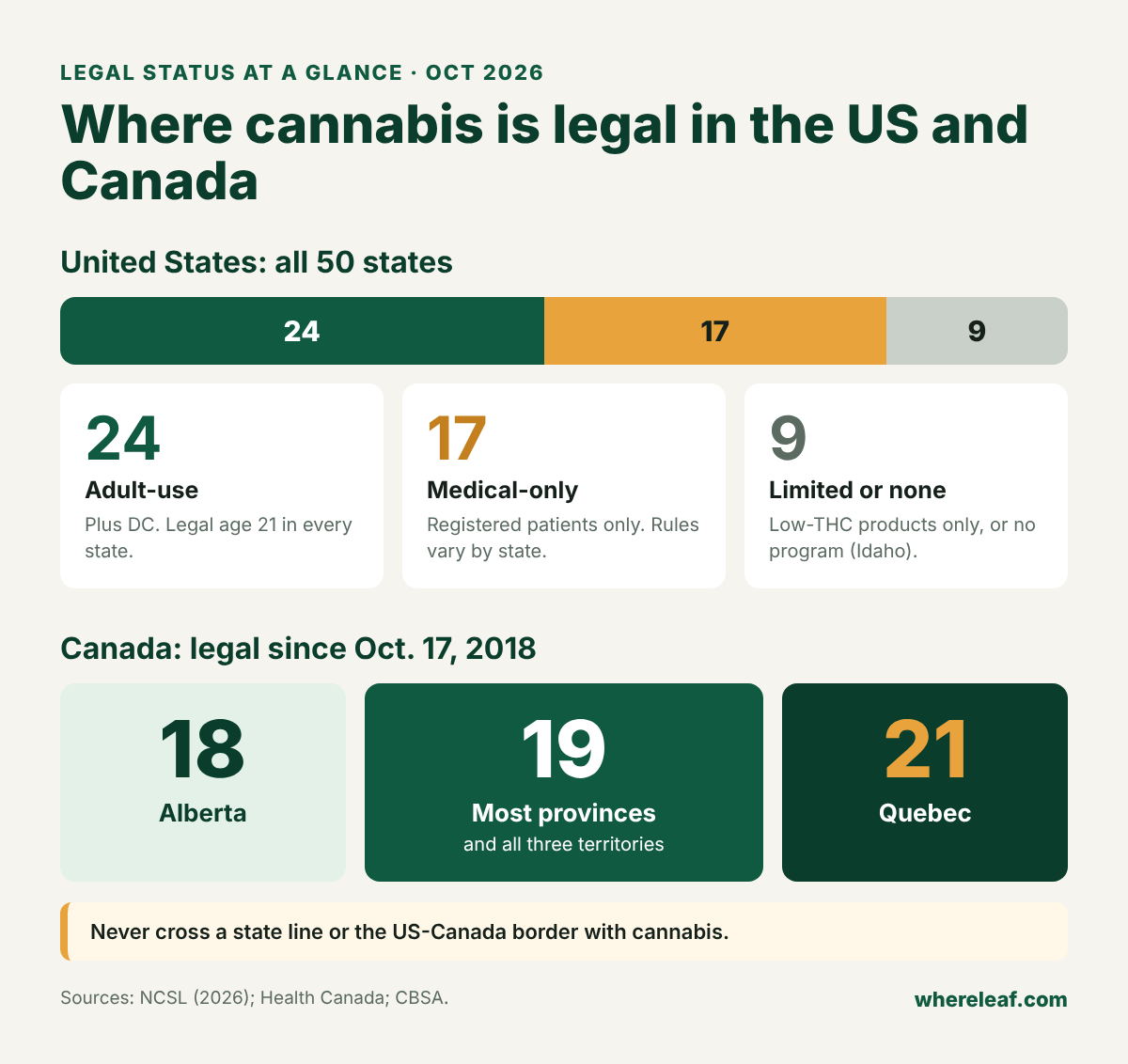
Where is cannabis legal in 2026? As of October 2026, adults 21 and older can legally possess cannabis in 24 US states plus Washington, DC. Another 17 states have medical-only programs, and the remaining 9 states allow only limited low-THC products or nothing at all. In Canada, cannabis has been legal nationwide for adults since October 17, 2018, but each province and territory sets its own minimum age.
That headline number has not changed since 2023, when Delaware, Minnesota and Ohio joined the list. But a lot is moving under the surface. Virginia has now passed a law to open licensed stores in 2027, Massachusetts voters will decide on a repeal measure in November, and the federal government has moved some cannabis to Schedule III while a broader decision is still pending.
This guide gives you the full state-by-state list, a table with the year each adult-use state legalized and its legal age, Canada’s provincial ages, the latest public opinion numbers and a plain-English look at what is happening federally. We checked the counts against the National Conference of State Legislatures (NCSL), the Marijuana Policy Project (MPP) and Pew Research Center.
Key takeaways
- 24 states plus DC allow adult-use cannabis as of October 2026. The legal age in every one of them is 21.
- 17 more states have medical-only programs, so about 41 states have some broad legal cannabis program.
- Virginia allows possession now, and its first licensed adult-use stores are scheduled to open on July 1, 2027.
- Canada legalized cannabis on October 17, 2018. The minimum age is 19 in most provinces, 18 in Alberta and 21 in Quebec.
- Federal status: in April 2026, the DEA moved FDA-approved products and state-licensed medical cannabis to Schedule III. All other cannabis is still Schedule I while a broader rescheduling decision is on hold.
- Never cross state or national borders with cannabis. It is illegal under federal law, even when you are traveling between two legal states.
Where is cannabis legal in the US? The short answer
US cannabis law works in three tiers. Each state decides which tier it is in, and the federal government has its own separate rules on top of that.
- Adult-use (recreational) states: Adults 21+ can possess cannabis without a medical card. Most of these states also have licensed stores.
- Medical-only states: Only registered patients in a state program can buy and possess cannabis. Adult-use is still illegal.
- Limited or no access: These states allow only narrow low-THC, high-CBD products, or have no program at all.
Counts can differ a little from one source to the next because groups define “medical program” differently. NCSL and MPP both count 24 adult-use states and 41 states with medical cannabis laws. Pew also counts 24 adult-use states, but it groups medical and low-THC states together, which is why you may see different medical numbers elsewhere.
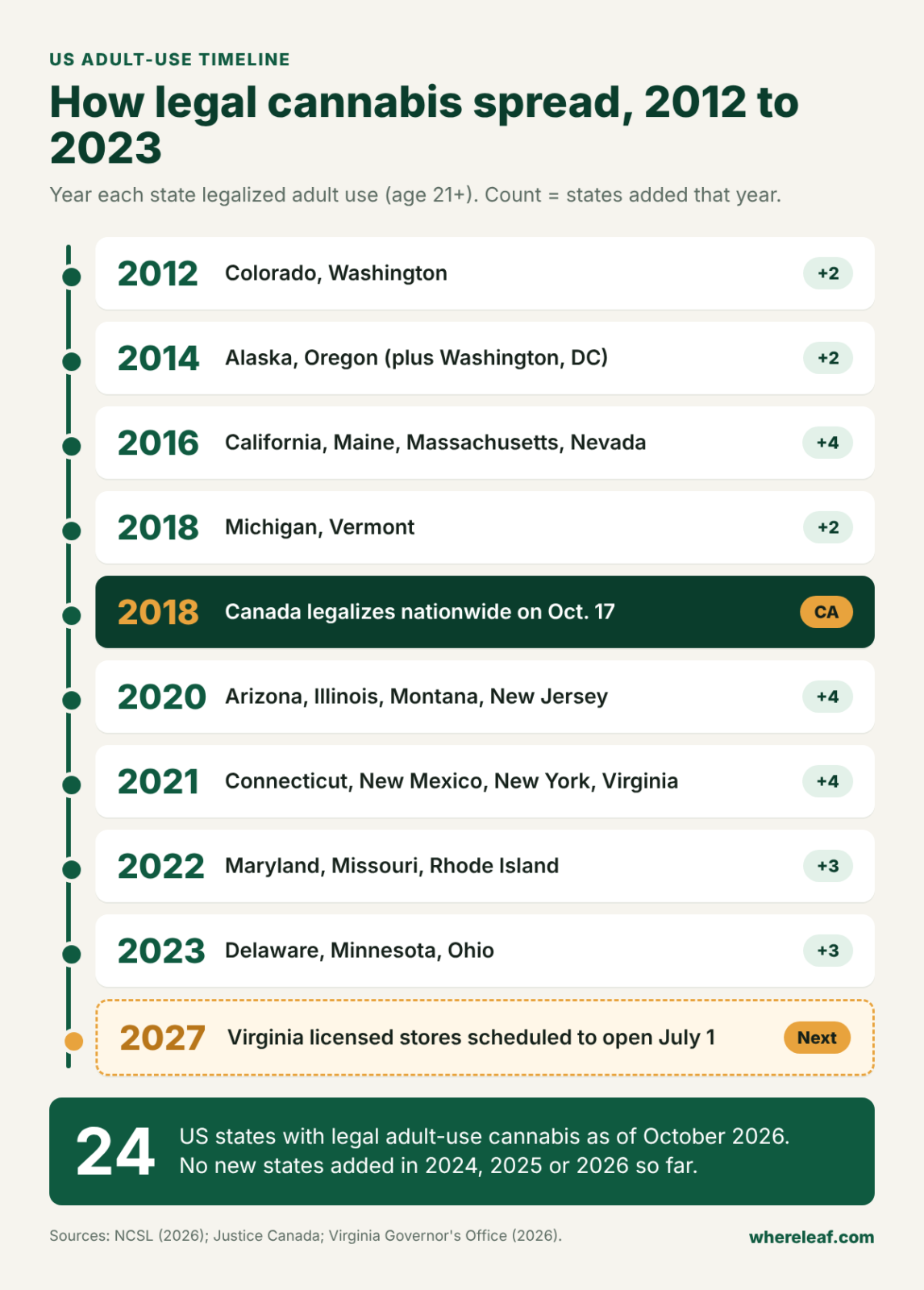
The 24 adult-use states, with year and legal age
The table below lists every state where adults can legally possess cannabis as of October 2026. The year is when the state legalized adult use, following NCSL’s dates. Retail sales often started a year or more later.
| State | Year legalized | How | Legal age |
|---|---|---|---|
| Alaska | 2014 | Ballot measure | 21 |
| Arizona | 2020 | Ballot measure | 21 |
| California | 2016 | Ballot measure | 21 |
| Colorado | 2012 | Ballot measure | 21 |
| Connecticut | 2021 | Legislature | 21 |
| Delaware | 2023 | Legislature | 21 |
| Illinois | 2020 | Legislature | 21 |
| Maine | 2016 | Ballot measure | 21 |
| Maryland | 2022 | Ballot measure | 21 |
| Massachusetts | 2016 | Ballot measure | 21 |
| Michigan | 2018 | Ballot measure | 21 |
| Minnesota | 2023 | Legislature | 21 |
| Missouri | 2022 | Ballot measure | 21 |
| Montana | 2020 | Ballot measure | 21 |
| Nevada | 2016 | Ballot measure | 21 |
| New Jersey | 2020 | Ballot measure | 21 |
| New Mexico | 2021 | Legislature | 21 |
| New York | 2021 | Legislature | 21 |
| Ohio | 2023 | Ballot measure | 21 |
| Oregon | 2014 | Ballot measure | 21 |
| Rhode Island | 2022 | Legislature | 21 |
| Vermont | 2018 (sales law 2020) | Legislature | 21 |
| Virginia | 2021 (stores planned July 2027) | Legislature | 21 |
| Washington | 2012 | Ballot measure | 21 |
Washington, DC also allows adults 21+ to possess and grow cannabis, but it does not have a licensed adult-use retail market. Guam, the Northern Mariana Islands and the US Virgin Islands have legalized adult use too.
Being on this list does not mean the rules are the same everywhere. Possession limits, home-grow rules, public consumption bans and store hours all vary by state. For example, NCSL and MPP note that Washington, Delaware, Illinois and New Jersey do not allow adults to grow at home for adult use.
Medical-only states (17)
These states allow cannabis only for registered patients in a state program. Adult-use is not legal. Years are the year the current program law passed, per NCSL:
- Alabama (2021), Arkansas (2016), Florida (2016), Georgia (2026), Hawaii (2000), Kentucky (2023)
- Louisiana (2017), Mississippi (2022), Nebraska (2024), New Hampshire (2013/2021), North Dakota (2016), Oklahoma (2018)
- Pennsylvania (2016), South Dakota (2020), Texas (2025), Utah (2018), West Virginia (2017)
Age limits, card rules and visitor access differ a lot between these programs. Some accept out-of-state patients and many do not, so check the state program’s website before you assume anything.
Limited or no access (9)
Indiana, Iowa, Kansas, North Carolina, South Carolina, Tennessee, Wisconsin and Wyoming appear on NCSL’s list of states with only narrow low-THC laws. Idaho has no program. In these states, regular THC cannabis is illegal for everyone.
What changed in 2025 and 2026
No new state has legalized adult use since 2023. In November 2024, voters turned down adult-use measures in Florida (55.9% yes, short of the 60% the state requires), North Dakota and South Dakota. Since then, most of the action has been in medical programs, retail rules and the federal process.
Virginia’s retail market is on the way
Virginia legalized adult possession in 2021 but never set up licensed stores. In June 2026, Gov. Abigail Spanberger and legislative leaders announced a budget deal to create a regulated retail market, and it became law that month. Under the plan, the Cannabis Control Authority will start taking license applications on February 1, 2027, and sales to adults 21+ are scheduled to begin July 1, 2027. The deal also raises the possession limit from 1 ounce to 2 ounces.
Medical program changes
Georgia’s SB 220 (2026) replaced the state’s old low-THC program with a broader medical cannabis law. Texas expanded its program through HB 46 in 2025, and NCSL now lists both states as medical-only states. Nebraska voters approved medical cannabis in 2024, but the measures faced a legal challenge over petition signatures, so check the current status before relying on that program.
On the November 3, 2026 ballot
- Massachusetts Question 8 would repeal much of the state’s law allowing licensed adult-use sales and home growing. According to Stateline, adults could still possess up to 1 ounce. If it passes, Massachusetts would be the first state to repeal a regulated adult-use market.
- Idaho has a constitutional amendment that would give only the legislature the power to legalize cannabis and other drugs. It would block citizen initiatives on the topic.
We will update this guide after the election. Until results are certified, the current laws in both states stay in place.
Federal status: is cannabis still illegal under US law?
Mostly, yes. Federal law and state law are separate, and the federal picture is in the middle of a change. Here is where things stand as of early October 2026, based on the DEA’s own updates and legal analyses from law firms that follow the case.
- December 2025: An executive order directed the Justice Department to speed up moving medical marijuana to Schedule III.
- April 2026: The DEA issued a final rule, published April 28, that moved FDA-approved marijuana products and marijuana covered by a state medical license to Schedule III. It also created a faster DEA registration path for state-licensed medical businesses.
- Everything else is still Schedule I. That includes adult-use cannabis sold in recreational stores.
- Broader rescheduling is pending. The DEA held a hearing on moving all marijuana to Schedule III from June 29 to July 15, 2026. On September 29, the judge paused the case to weigh a request to add a new Government Accountability Office report to the record. There is no set date for a decision.
What this means for you: rescheduling does not make cannabis legal for adult use under federal law, and it does not change state rules. Federal land, airports, national parks and borders are still federal territory, so the federal rules apply there.
Crossing state lines: the rule that trips people up
Taking cannabis across a state line is illegal, even if you are going from one legal state to another legal state. California’s Department of Cannabis Control lists “take cannabis across state lines” among the things federal law prohibits. The same is true when you drive from Michigan to Illinois or fly from Colorado to Washington.
- Buy in the state where you plan to consume, and finish or leave it there.
- Do not pack cannabis for flights. Airports and airplanes fall under federal rules.
- Do not bring it into national parks or onto other federal land, even inside a legal state.
- Cannabis is never legal to take across the US-Canada border in either direction. The Canada Border Services Agency says it remains illegal to bring cannabis into or out of Canada, even for personal use or as a gift.
Driving under the influence of cannabis is illegal everywhere. Keep products sealed and out of reach while in a vehicle, following your state’s open-container rules.
Canada: legal nationwide since 2018
Canada’s Cannabis Act made adult cannabis legal across the country on October 17, 2018. The federal law sets the basics, including a public possession limit of 30 grams of dried cannabis (or the equivalent). Each province and territory then sets its own minimum age, store model and local rules.
| Province or territory | Minimum age | Who runs stores |
|---|---|---|
| Alberta | 18 | Private |
| British Columbia | 19 | Public and private |
| Manitoba | 19 | Private |
| New Brunswick | 19 | Public |
| Newfoundland and Labrador | 19 | Private stores, public online |
| Northwest Territories | 19 | Public |
| Nova Scotia | 19 | Public |
| Nunavut | 19 | Private |
| Ontario | 19 | Private stores, public online |
| Prince Edward Island | 19 | Public |
| Quebec | 21 | Public |
| Saskatchewan | 19 | Private |
| Yukon | 19 | Private |
The quick version: 19 in most of Canada, 18 in Alberta and 21 in Quebec. Rules on where you can consume, how many plants you can grow at home and where you can buy also differ, so check the provincial site before you travel.
What Americans think about legal cannabis
Most Americans support some form of legal cannabis, but support for full legalization has cooled slightly in the last two years.
- Pew Research Center (January 2026): 55% of US adults say cannabis should be legal for both medical and adult use, 33% say medical use only, and 11% say it should not be legal at all.
- Gallup (October 2025): 64% say cannabis use should be legal. That is down from a record 70% in 2023 and 68% in 2024, and the lowest level since 2019.
- The partisan gap grew. Gallup found support among Republicans fell to 40% in 2025, from 53% a year earlier. Support among Democrats held at 85%.
- Where people live: Pew estimates that 53% of Americans now live in a state where adult-use cannabis is legal.
Checklist: before you buy in a new state or province
- Confirm the tier. Is the place adult-use, medical-only or limited? Use the lists above, then check the state or provincial regulator for anything new.
- Check the age. It is 21 in every US adult-use state. In Canada it is 18, 19 or 21 depending on the province.
- Bring valid government ID. Licensed stores scan or check ID at the door.
- Know the possession limit. It varies by state, and some limits have changed recently (Virginia and Massachusetts both moved to 2 ounces).
- Buy only from licensed stores. Use the WhereLeaf dispensary finder to find licensed shops and delivery services near you, and browse the strain library before you go.
- Learn where you can consume. Most places ban public use, and hotels and rentals often ban it too.
- Plan to leave it behind. Do not carry cannabis across state lines, onto flights or over the border.
- Use responsibly. Adults only, start low and go slow, never drive impaired, and store products away from children and pets.
Run a dispensary, delivery service or brand in a legal market? You can add your business to WhereLeaf, compare listing packages or connect with licensed suppliers.
Planning a trip? Check the exact rules before you buy: our guides to Michigan purchase limits and Ohio purchase limits list what visitors can buy, and can you bring weed on a plane? explains why cannabis should never go in your luggage.
Frequently asked questions
How many states have legalized recreational cannabis in 2026?
As of October 2026, 24 states plus Washington, DC allow adults 21 and older to possess cannabis. No new state has been added since Delaware, Minnesota and Ohio in 2023.
How many states have medical cannabis?
NCSL counts 41 states with medical cannabis laws: the 24 adult-use states plus 17 medical-only states. Several other states allow only limited low-THC products.
Is cannabis federally legal now that it was rescheduled?
No. In April 2026, only FDA-approved products and state-licensed medical cannabis moved to Schedule III. Adult-use cannabis is still Schedule I under federal law, and a decision on broader rescheduling is on hold as of October 2026.
Can I drive cannabis from one legal state to another?
No. Crossing a state line with cannabis is illegal under federal law, even between two legal states. Buy and consume in the same state.
What is the legal age for cannabis in Canada?
It depends on the province or territory: 18 in Alberta, 21 in Quebec and 19 everywhere else.
When can you buy cannabis in stores in Virginia?
Under the 2026 budget law, licensed adult-use sales are scheduled to start July 1, 2027. Adults 21+ can already possess cannabis and grow a small number of plants at home.
Sources
- NCSL: State Medical Cannabis Laws (2026)
- Marijuana Policy Project: 2026 Cannabis Policy Reform Legislation and Voter Measures (2026)
- Pew Research Center: Facts about marijuana (2026)
- Gallup: Americans Much More Positive About Progress on Drugs (2025)
- DEA: Marijuana Rescheduling Regulatory Actions (2026)
- Morgan Lewis: High Time for a Change? Post-DEA Hearing, Broader Marijuana Rescheduling Questions Remain (2026)
- Vicente LLP: DEA Judge Pauses Marijuana Rescheduling Hearing Over New GAO Report (2026)
- Office of the Governor of Virginia: Agreement on adult-use retail cannabis market (2026)
- Associated Press via WIS-TV: Virginia to allow recreational marijuana to be sold in retail stores beginning in 2027 (2026)
- Stateline: States put criminal justice, marijuana policies before voters in 2026 (2026)
- NORML: Massachusetts lawmakers urge No vote on marijuana repeal initiative, Question 8 (2026)
- Goodwin: Cannabis on the Ballot, 2024 results (2024)
- Department of Justice Canada: Cannabis Legalization and Regulation (2018)
- Health Canada: Cannabis in the provinces and territories (2022)
- Canada Border Services Agency: CBSA reminds Canadians of cannabis border laws (2022)
- California Department of Cannabis Control: What’s legal (2026)
Last updated: October 2026. Laws and prices change; always check your state or provincial regulator.