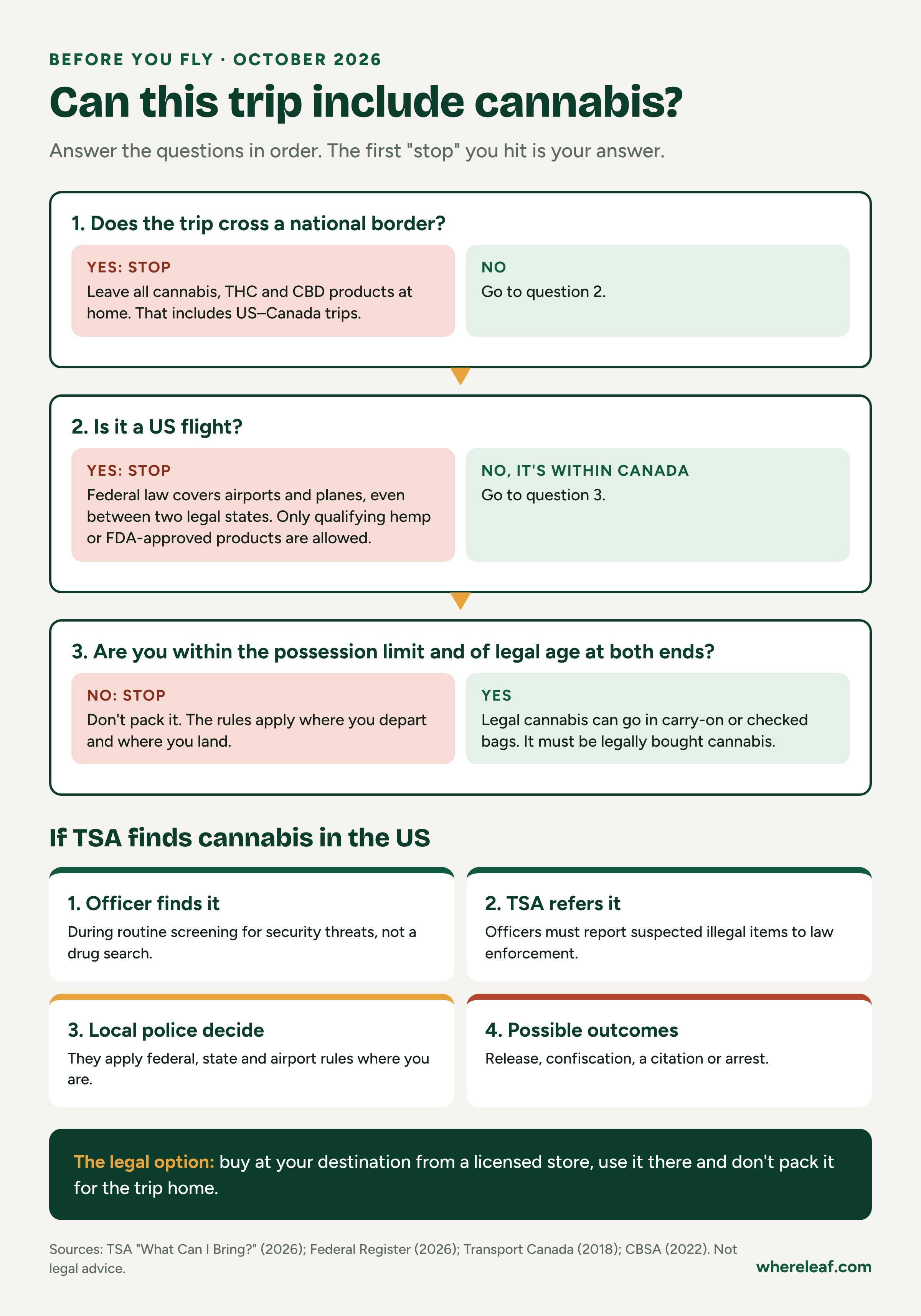
Can you bring weed on a plane? In the United States, no: as of October 2026, carrying cannabis through an airport or onto a flight is still a federal offense, even between two states where it is legal. In Canada, adults can bring up to 30 grams of legal cannabis on domestic flights, but never across the border or on an international trip.
The question got confusing in 2026. In April, the federal government moved state-licensed medical cannabis to Schedule III, and TSA edited its website a day earlier. Some headlines read that as “you can fly with weed now.” The rules changed far less than that.
This guide explains the law only: federal rules, TSA policy, airport rules, Canada’s domestic limit, hemp and CBD, and penalties. It does not give advice on getting through screening. If you want cannabis at your destination, the legal route is to buy it there from a licensed store.
Key takeaways
- US flights: adult-use cannabis is still federally illegal at airports and on planes, even between two legal states.
- The 2026 rescheduling was narrow. It did not create a right to fly with cannabis, with or without a medical card.
- Passing screening is not permission. Getting through security does not make cannabis legal on the plane or at either airport.
- Canada is the exception for domestic flights only. No country lets you carry cannabis across its border.
- Rules differ by state, province and airport. Always check your local regulator and your destination’s laws before you travel.
Can you bring weed on a plane in the US?
No. Airports, security checkpoints and the airspace above the US are under federal jurisdiction, and federal law still bans adult-use cannabis. State legalization does not extend to a TSA line or a plane cabin.
What the April 2026 rescheduling changed
On April 28, 2026, the Justice Department published a final order in the Federal Register that moved two narrow categories from Schedule I to Schedule III:
- FDA-approved drug products that contain marijuana.
- Marijuana covered by a state medical marijuana license.
Everything else stayed in Schedule I. That includes all adult-use (recreational) cannabis, even when it is bought at a licensed state store. The order did not address interstate transport or personal travel.
A separate DEA hearing on moving the rest of marijuana to Schedule III ran from June 29 to July 15, 2026. As of October 2026, no final decision has been made; the parties are waiting for the judge’s recommended decision. For the full state-by-state picture, see our guide to where cannabis is legal in 2026.
Is flying between legal states legal?
No. Flying from one legal state to another, such as California to Colorado, still means carrying a Schedule I substance across a state line and through federal space. Neither state’s law protects you there, and interstate commerce in cannabis also remains federally illegal.
What is TSA’s marijuana policy?
TSA’s “What Can I Bring?” tool has a “Medical Marijuana” entry. It lists the item as “Yes (Special Instructions)” for carry-on and checked bags, a label that has appeared there since at least 2019. As of October 2026, TSA has not published any special instructions, quantity limits or documentation rules to go with it.
The rest of the entry matters more:
- Cannabis products, including some CBD oil, are allowed only if they contain no more than 0.3% THC on a dry weight basis or are approved by the FDA.
- TSA officers must report suspected violations of law to local, state or federal authorities.
- Screening looks for threats to aviation. Officers do not search for illegal drugs, but if they find an illegal substance, TSA refers the matter to a law enforcement officer.
In late April 2026, TSA removed a paragraph from the page that said marijuana remains illegal under federal law. A TSA spokesperson told reporters that “TSA’s policy on medical marijuana has not changed.” NORML, the cannabis-reform group, makes the same point: passing screening is not legal permission.
Does a medical card let you fly with cannabis?
Not reliably. A state medical card is not a federal prescription, and TSA has not said what paperwork, if any, it accepts. If an officer refers you, local police at that airport decide what happens next, and that depends on the state you are in.
A card from one state also may not be valid in another, so check the rules at both ends of your trip.
Which airports publish their own cannabis rules?
Because TSA hands cases to local police, your departure airport matters. A few publish their own rules.
| Airport | Published rule | What it means |
|---|---|---|
| Los Angeles (LAX) | Airport police said in 2018 that adults with no more than 28.5 g of cannabis (8 g of concentrate) would be released, consistent with California law. | A local enforcement choice, not federal permission. LAX also warns that laws vary by state. |
| Denver (DEN) | Airport Rule 30.16-1 (revised June 2025) bans possessing, using or transporting marijuana anywhere on airport property. | Possession is a violation at DEN even though cannabis is legal in Colorado. |
| Las Vegas (LAS) | Clark County banned marijuana possession on airport property and installed “amnesty boxes.” | Cannabis is not allowed in the terminals, before or after security. |
| Chicago (ORD, MDW) | Locked amnesty boxes near checkpoints since January 1, 2020. | A place to leave cannabis before you reach screening. |
Airport rules change, so check the airport’s website. An amnesty box is a disposal option, not permission to fly with cannabis.
Can you fly with weed in Canada?
Yes, within Canada. Since legalization on October 17, 2018, Transport Canada has allowed adults to carry up to 30 grams of dried cannabis, or the equivalent, on domestic flights in carry-on or checked bags. That matches the Cannabis Act’s 30-gram public possession limit.
A few conditions apply:
- You must meet the legal age where you depart and where you land: 19 in most provinces, 18 in Alberta and 21 in Quebec.
- Cannabis oils count as liquids at security, so the 100 ml carry-on limit for liquids applies.
- In 2018 guidance, passengers carrying more than 30 g for medical purposes were asked to show medical documentation.
How much is 30 grams in edibles, vapes or drinks?
Schedule 3 of the Cannabis Act sets how much of each product equals 1 gram of dried cannabis. Here is what the 30 g limit works out to:
| Product type | Equal to 1 g dried | 30 g limit equals |
|---|---|---|
| Dried flower | 1 g | 30 g |
| Solid edibles (gummies, chocolate) | 15 g | 450 g |
| Concentrates (vape oil, hash) | 0.25 g | 7.5 g |
| Non-solids, not beverages (oils) | 70 g | 2,100 g |
| Beverages | 570 g | 17,100 g |
Worked example: 10 g of flower plus two 1 g vape cartridges (2 g ÷ 0.25 = 8 g equivalent) uses 18 g of the 30 g limit.
US vs Canada at a glance
| Question | United States | Canada |
|---|---|---|
| Federal status (Oct 2026) | Adult-use Schedule I; state-licensed medical Schedule III | Legal for adults under the Cannabis Act |
| Who screens | TSA (refers finds to police) | CATSA |
| Hemp and CBD | Allowed at 0.3% THC or less, or FDA-approved | CBD is regulated as cannabis |
| Minimum age | 21 in adult-use states | 18 to 21 by province |
Can you bring edibles, vapes or CBD on a plane?
In the US, edibles, vape cartridges and concentrates follow the same federal rules as flower. What matters is whether the product is marijuana under federal law, and licensed-store packaging does not change that.
Hemp and CBD on planes
TSA allows hemp-derived products, including CBD, if they contain no more than 0.3% THC on a dry weight basis, or if they are FDA-approved. That limit comes from the 2018 Farm Bill. Liquid CBD products also follow TSA’s 3-1-1 liquids rule in carry-on bags.
Hemp can look and smell like marijuana, so NORML notes it may still lead to a referral; a lab report showing THC content can help. Our guide on how to read cannabis lab results shows what those reports contain.
The federal hemp THC change coming in December 2026
A law passed in November 2025 redefines hemp so that hemp products can contain no more than 0.4 milligrams of total THC per container. Products above that limit become marijuana under federal law, which bans most intoxicating hemp THC products such as many delta-8 and THC gummies.
The change was set to start on November 12, 2026. On September 2, 2026, the President signed H.R. 6500, a short-term funding bill that delayed it to December 11, 2026. After that, many hemp gummies that pass TSA’s rules today may count as controlled substances. Check the status before you travel.
Is it legal to fly internationally with cannabis?
No, not from the US and not from Canada. The Canada Border Services Agency (CBSA) says it is illegal to bring cannabis into or out of Canada, even for personal use or as a gift, unless you hold a federal permit or exemption. The CBSA’s own summary is simple: “Don’t bring it into Canada. Don’t take it out of Canada.”
The rule covers CBD made from cannabis or hemp too. Travelers who don’t declare cannabis when entering Canada can face seizure, arrest or monetary penalties. Possession is also still prohibited under US federal law, so you can’t bring Canadian cannabis into the US, and the April 2026 rescheduling did not change that.
Leave all cannabis and THC products at home before any international trip.
What are the penalties for bringing weed on a plane?
Penalties depend on the amount, where you are and who handles the case. TSA does not arrest people; it calls police, who apply federal, state or local law.
- Federal (US): simple possession under 21 U.S.C. 844 carries up to 1 year in prison and a minimum $1,000 fine for a first offense. Larger amounts can bring trafficking charges.
- State and local (US): in a legal state, a small amount may lead to nothing, a citation or confiscation. In a state where cannabis is illegal, the same amount can lead to arrest. Airport rules, like Denver’s ban, add separate violations.
- Canada: carrying more than the 30 g public possession limit is an offense. Taking cannabis across the border is punishable by up to 14 years in prison on indictment, or a fine of up to $5,000 and up to 6 months in jail on summary conviction.
What is the legal alternative?
Buy at your destination. If you land in a legal state or province, a licensed store can sell to adults who meet the local age limit, with valid government-issued ID (check which IDs the store accepts). Possession and consumption rules are set locally.
You can find licensed dispensaries near your destination on WhereLeaf and confirm a shop is legitimate with our guide on how to tell if a dispensary is licensed. Before you fly home, use up or legally dispose of what you bought. Don’t pack it.
Your pre-flight cannabis law checklist
- Check whether your trip crosses a state line or a national border. If it does, leave all cannabis at home.
- Check federal status: as of October 2026, adult-use cannabis is still Schedule I in the US.
- Check your departure airport’s own policy on its official website.
- Flying within Canada? Confirm you are under 30 g dried or equivalent and meet the age at both ends.
- Carrying hemp or CBD? Confirm the label and lab report show 0.3% THC or less, and check the December 11, 2026 hemp change.
- Flying internationally? Carry no cannabis, THC or CBD products at all.
- Plan to buy from a licensed store at your destination instead of traveling with cannabis.
For dispensary owners: help travelers find you
Many visitors look for a licensed store as soon as they land. A complete listing with your license number, hours and ID rules helps them buy legally. Add your dispensary to WhereLeaf or see our listing packages to show up in local searches.
Frequently asked questions
Can I fly with weed if both states are legal?
No. Airports and flights fall under federal law, and adult-use cannabis is still Schedule I as of October 2026. State laws at either end do not protect you in federal space.
Will TSA search for weed?
Not on purpose. TSA screening looks for threats to aviation, and its officers don’t hunt for drugs. But a routine bag check can still turn cannabis up, and federal law applies whether or not anyone was looking for it.
Can I fly with my medical marijuana card?
A medical card does not give you a federal right to fly with cannabis. TSA has published no documentation rules, and local police decide what happens after a referral.
Can you bring edibles on a plane?
In the US, THC edibles follow the same federal rules as flower, so they are not legal to fly with. On Canadian domestic flights, edibles count toward the possession limit using the equivalents in the table above, so a heavy box of gummies can use up the limit quickly.
Can you bring CBD on a plane?
In the US, hemp-derived CBD that meets TSA’s rules can fly, and liquid CBD must also fit the 3-1-1 rule in carry-on bags. The federal hemp definition is about to tighten, so check a product again before each trip. Never take CBD across the Canadian border, where it is treated as cannabis.
Can you fly with weed from Canada to the US?
No. CBSA says taking cannabis out of Canada is illegal, and possession is prohibited under US federal law, even if your destination state is legal.
Sources
- TSA: What Can I Bring? Medical Marijuana (2026)
- Federal Register: Schedules of Controlled Substances, final order on marijuana (2026)
- DEA: Marijuana Rescheduling Regulatory Actions (2026)
- Foley & Lardner: Some Marijuana Products Reclassified to Schedule III (2026)
- Morgan Lewis: Post-DEA Hearing, Broader Marijuana Rescheduling Questions Remain (2026)
- AFAR: TSA Subtly Updates Its Medical Marijuana Policy (2026)
- NORML: Can I Fly With Medical Cannabis? (2026)
- Cornell LII: 21 U.S. Code 844, Penalties for simple possession
- Associated Press via CBS Sacramento: LAX Allows Marijuana In Airport, But TSA Says It’s Still A Crime (2018)
- Denver International Airport: Rule 30, Conduct (2025)
- Las Vegas Review-Journal: Pot amnesty boxes greet travelers at Las Vegas airport (2018)
- mg Retailer: Amnesty boxes in Chicago airports let travelers leave leftover cannabis (2020)
- CBC News: Canadians can bring up to 30 grams of pot on domestic flights (2018)
- Daily Hive: CATSA on cannabis oil on domestic flights (2018)
- Department of Justice Canada: Cannabis Legalization and Regulation (2018)
- Justice Laws Website: Cannabis Act, Schedule 3 and import/export offences (2026)
- Canada Border Services Agency: CBSA reminds Canadians of cannabis border laws (2022)
- Foley Hoag: A Temporary Reprieve for Hemp-THC Products (2026)
- The White House: Congressional Bill H.R. 6500 Signed into Law (2026)
Last updated: October 2026. Laws and prices change; always check your state or provincial regulator.