
Knowing how to read cannabis lab results is the fastest way to find out what is actually in the product you are buying. Every batch sold in a licensed store is tested by a lab, and the results are written up in a document called a certificate of analysis, or COA. The THC number on the label comes from that report.
The trouble is that COAs are written for regulators, not shoppers. This guide walks through a COA section by section, shows you the simple math behind “total THC,” and explains why the biggest number on the shelf is not always the most accurate.
Rules differ by state and province, so treat this as a general guide and check your local regulator for exact requirements.
Key takeaways
- A COA is a lab report for one specific batch. Match the batch or lot number on your package to the number on the report.
- Raw flower contains mostly THCA, not THC. Labs and regulators use the formula Total THC = THC + (THCA × 0.877).
- The safety sections (pesticides, heavy metals, microbials, mycotoxins and residual solvents) should all say “Pass.”
- Independent studies in Colorado have found that flower labels often overstate THC, so a very high number is not a guarantee.
- Many labels have a QR code or batch number that leads to the full COA. If you cannot find one, ask the budtender.
What is a cannabis certificate of analysis (COA)?
A certificate of analysis is the official report a licensed testing lab issues after it tests a batch of cannabis. In regulated markets, products must pass testing before they can be sold. California’s Department of Cannabis Control (DCC), for example, says a COA shows whether a batch passed or failed for each substance tested, and labs cannot change a COA after issuing it without DCC approval.
In Canada, licensed producers must have their cannabis tested by a third-party lab that holds a Health Canada analytical testing licence, and that lab must be independent of the company that sent the sample. Mandatory pesticide testing there has been in place since January 2, 2019.
What a typical COA includes
- Header: the lab’s name and license number, the producer, the product name, and the batch or lot number.
- Dates: when the sample was collected, received and tested, and when the report was issued.
- Cannabinoid profile: THC, THCA, CBD, CBDA and often minor cannabinoids such as CBG and CBN.
- Terpene profile: optional in many places, but common on flower and vapes.
- Safety panels: pesticides, heavy metals, microbials, mycotoxins, residual solvents, and sometimes moisture, water activity and foreign material.
- An overall result: Pass or Fail, plus a lab director’s signature.

THC vs. THCA: how total THC is calculated
Dried cannabis flower contains very little THC. Most of it is THCA, an acid form of the molecule. When you heat flower by smoking, vaping or baking, THCA loses a small piece of its structure (a carboxyl group) and turns into THC. This process is called decarboxylation.
Because that lost piece has weight, a gram of THCA cannot become a full gram of THC. The 0.877 factor reflects the weight difference between the two molecules. Connecticut’s cannabis program states the formula plainly, and California’s testing rules require labs to calculate total cannabinoids by multiplying the acid form by 0.877 and adding the neutral form.
Total THC = THC + (THCA × 0.877)
Total CBD = CBD + (CBDA × 0.877)
A worked example
Say a COA for a strain lists THCA at 24.1% and THC at 0.8%. The math is 24.1 × 0.877 = 21.1, then 21.1 + 0.8 = 21.9. So the total THC is about 21.9%, not the 24.9% you would get by simply adding the two numbers. If a label seems to add THCA and THC together without the factor, that is a red flag.
Edibles and many vape oils are already decarboxylated during production, so their COAs usually show mostly THC. Edible labels typically list milligrams per serving and per package.
| Term on the COA | What it means | Where you will see it |
|---|---|---|
| THCA | The acid form of THC found in raw plant material. Converts to THC when heated. | Flower, pre-rolls, some concentrates |
| Δ9-THC (THC) | The main intoxicating cannabinoid in cannabis. | All product types |
| Total THC | THC + (THCA × 0.877). The best single number for comparing potency. | Labels and COAs |
| CBD / CBDA | A non-intoxicating cannabinoid and its acid form. Total CBD uses the same 0.877 math. | Labels and COAs |
| CBG, CBN | Minor cannabinoids, usually present in small amounts. | Expanded cannabinoid panels |
| ND or <LOQ | Not detected, or below the lowest amount the method can reliably measure. | Any line on the report |
| mg/g | Milligrams per gram. 10 mg/g equals 1%. | Cannabinoid and terpene tables |
CBD, minor cannabinoids and terpenes
CBD is reported the same way as THC: a neutral number, an acid number (CBDA) and a total. Seeing “ND” next to CBD on a THC-dominant strain is normal.
Minor cannabinoids like CBG and CBN are often listed too. A CU Boulder study of Colorado products found that only 16% of products listed any information about lesser-known cannabinoids on the label, so the COA is often the only place to find them.
Reading the terpene section
Terpenes are aromatic compounds that give cannabis its smell. Common ones include myrcene (earthy), limonene (citrus), beta-caryophyllene (peppery) and pinene (pine). Terpenes are usually listed as a percentage or in mg/g, with a “total terpenes” line at the bottom.
Terpene testing is optional in many states, so its absence does not mean a product failed anything. You can look up the typical profile of a strain in our strain library, but remember that the COA for your batch is more accurate than any general description.
Contaminant panels: pesticides, heavy metals, microbials and solvents
The safety sections are arguably the most important part of a COA. A single failed test usually means the whole batch fails and cannot be sold. California’s detailed rules are a useful example; other states and Canada use different lists and limits.
Pesticides
California tests for 66 pesticides, split into two groups. The 21 Category I pesticides, such as chlorpyrifos and daminozide, must not be detected at all. The 45 Category II pesticides have set action levels in micrograms per gram (µg/g), with different limits for inhaled and non-inhaled products.
Heavy metals
Cannabis plants can absorb metals from soil and water. California tests for four: arsenic, cadmium, lead and mercury. For inhalable products, the limits are 0.2 µg/g for arsenic and cadmium, 0.5 µg/g for lead and 0.1 µg/g for mercury.
Microbials and mycotoxins
For inhalable products in California, a sample fails if Shiga toxin-producing E. coli, Salmonella, or any of four Aspergillus mold species (A. fumigatus, A. flavus, A. niger and A. terreus) is detected in one gram. Mycotoxins are toxins some molds produce. California caps total aflatoxins (B1, B2, G1 and G2) at 20 µg/kg and ochratoxin A at 20 µg/kg.
Residual solvents
Solvent testing matters most for concentrates and vapes made with solvents like butane, propane or ethanol. California holds the most hazardous solvents, such as benzene and chloroform, to 1 µg/g. Common extraction solvents like butane and ethanol have a limit of 5,000 µg/g.
| Panel | What it checks for | What you want to see |
|---|---|---|
| Pesticides | Farm chemicals used during growing | Pass; banned pesticides ND |
| Heavy metals | Arsenic, cadmium, lead, mercury | Pass; results below action levels |
| Microbials | E. coli, Salmonella, Aspergillus molds | Pass or “not detected” |
| Mycotoxins | Aflatoxins, ochratoxin A | Pass |
| Residual solvents | Leftover extraction chemicals | Pass (key for concentrates and vapes) |
| Moisture / water activity | How dry the flower is, which affects mold risk | Pass, where required |
How to find the COA for your product
In many markets the COA is easy to reach. New York’s Office of Cannabis Management, for example, says labels include a QR code that links to the certificate of analysis. Other states require batch numbers on labels, and some brands post COAs on their websites even when not required.
- Scan the QR code on the package with your phone camera, if there is one.
- Find the batch or lot number on the label. Make sure it matches the number on the COA you are looking at. A COA for a different batch tells you nothing about yours.
- Check the brand’s website. Many producers have a “lab results” page searchable by batch.
- Ask at the counter. Budtenders can often pull up the COA. Licensed stores listed on our dispensary finder sell lab-tested products.
- Check the dates. Look at the test date and any expiration date. New York advises checking the expiration date on the label, since results may not stay accurate forever.
A real COA comes from a licensed lab, lists that lab’s license number and matches your batch. Products sold outside the legal system have no required testing at all.
Potency inflation: why the THC number may be too high
Higher THC numbers tend to sell for higher prices. Several independent studies have found that the potency printed on flower labels is often higher than what a separate lab measures.
What the research found
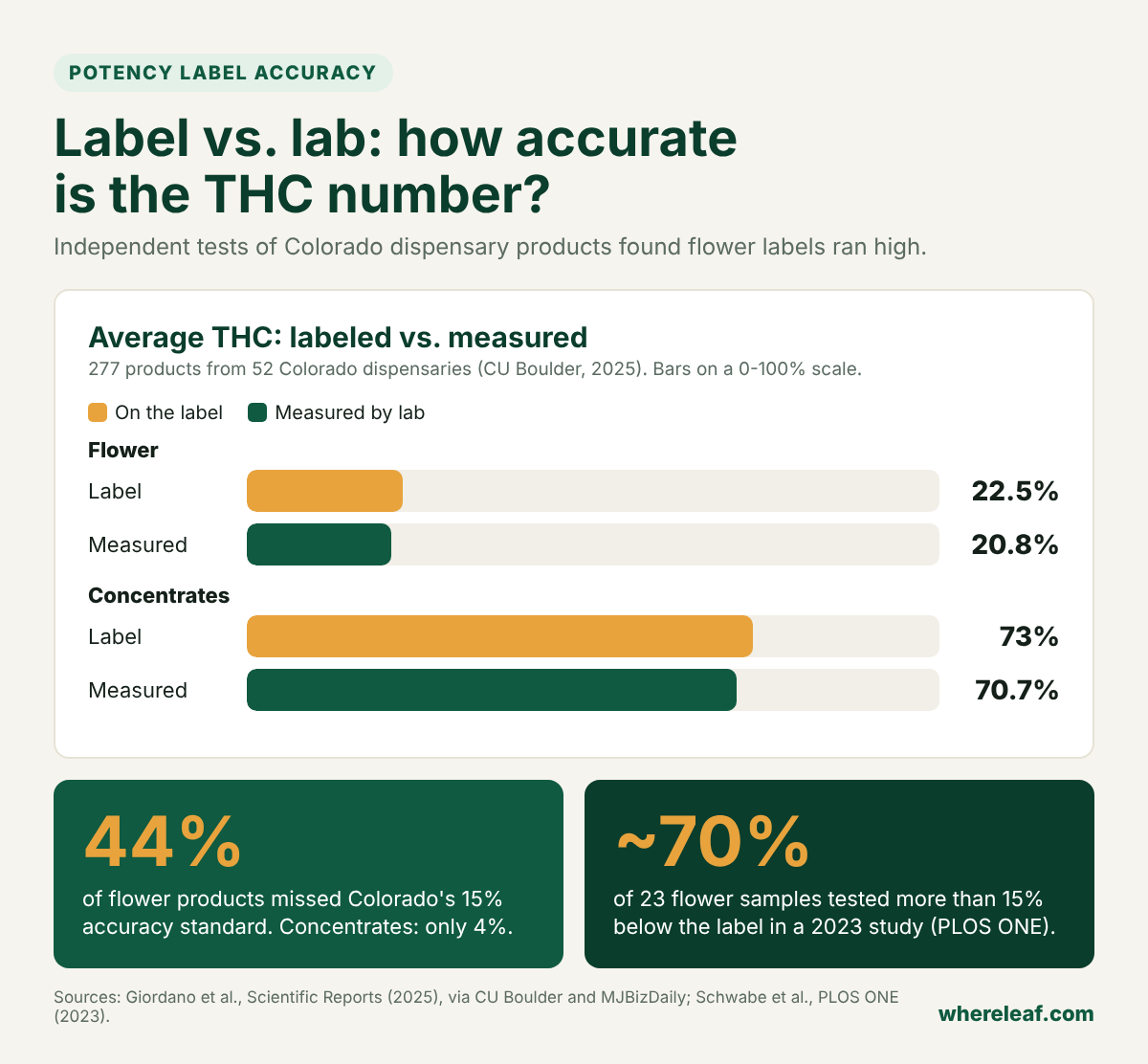
A 2023 study in PLOS ONE bought 23 flower samples from 10 Colorado dispensaries. About 70% of them tested more than 15% lower than the label claimed. On average, measured THC was 23.1% lower than the lowest value on the label.
A larger CU Boulder study published in Scientific Reports in 2025 tested 277 flower and concentrate products from 52 Colorado dispensaries. About 44% of flower products fell outside the state’s 15% accuracy standard, and most of those overstated THC. One product labeled at 24% tested at 16%. Concentrates were much more consistent, with 96% labeled accurately.
In California, lab scientists from two testing labs wrote in 2022 that some growers “lab shop,” choosing labs known for higher numbers. In their own testing of more than 150 flower samples, they reported that 87% failed their label claims. Those results came from the authors’ own sampling, not an official audit. California’s standardized cannabinoid test method for flower took effect January 1, 2024, and requires all licensed labs to use the same procedure for dried flower and non-infused pre-rolls.
Similar concerns have come up in Canada, where industry testing reported by The Globe and Mail in 2023 found many dried flower products below their labeled THC.
What this means for you
None of this means lab testing is useless. The safety panels still screen out contaminated batches. It does mean you should view a very high flower number with some caution and not pay a premium for THC percentage alone. Aroma, freshness and the full COA are better guides.
A quick checklist for reading any COA
- Is it from a licensed lab? Look for the lab’s name and license number.
- Does the batch number match the number on your package?
- Is the test date recent compared with the packaging or harvest date?
- Does the total THC math work? THC + (THCA × 0.877) should roughly equal the label’s total THC.
- Do the numbers look realistic? Be skeptical of flower claiming extremely high THC, or concentrates where total cannabinoids plus terpenes add up to more than 100%.
- Do all safety panels say Pass? Pesticides, heavy metals, microbials, mycotoxins and, for extracts, residual solvents.
As always, consume only where it is legal and only if you are of legal age. Start low and go slow, especially with a new product or a higher-THC batch, never drive after consuming, keep products locked away from children and pets, and do not carry cannabis across state or national borders.
For businesses: make lab results easy to find
Transparent brands stand out. If you run a dispensary, delivery service or brand, link COAs from product pages and train staff to pull them up. You can list your business on WhereLeaf, compare listing packages, or connect with labs and vendors through our supplier directory.
Frequently asked questions
What does COA stand for in cannabis?
COA stands for certificate of analysis. It is the lab report for a specific batch, listing cannabinoid levels, often terpenes, and pass or fail results for contaminant tests.
Why is THCA higher than THC on my flower’s lab results?
Raw cannabis contains mostly THCA. It turns into THC when heated, so the THC line on a flower COA is usually small. Use total THC to compare products.
How do I calculate total THC from THCA?
Multiply THCA by 0.877 and add the THC value. For example, 20% THCA and 1% THC gives 20 × 0.877 + 1 = 18.5% total THC.
Is a higher THC percentage always better?
No. Research in Colorado found flower labels often overstate THC, and higher potency simply means a stronger product. Look at the full COA and choose a product that fits your experience level.
What does “ND” mean on a cannabis lab report?
ND means “not detected.” The lab did not find the substance above its detection limit. On a pesticide or microbial panel, ND is what you want to see.
Are cannabis lab testing rules the same everywhere?
No. Each US state and Health Canada set their own testing lists, limits and labeling rules. Check your state or provincial regulator for local requirements.
Sources
- Connecticut Department of Consumer Protection: How is total THC calculated (accessed 2026)
- University of Georgia Extension: An Introduction to Hemp Chemistry and Lab Results (2026 revision)
- California Code of Regulations: 4 CCR §15724, Cannabinoid Testing (accessed 2026)
- California Code of Regulations: 4 CCR §15719, Residual Pesticides Testing (accessed 2026)
- California Code of Regulations: 4 CCR §15723, Heavy Metals Testing (accessed 2026)
- California Code of Regulations: 4 CCR §15720, Microbial Impurities Testing (accessed 2026)
- California Code of Regulations: 4 CCR §15721, Mycotoxin Testing (accessed 2026)
- California Code of Regulations: 4 CCR §15718, Residual Solvents and Processing Chemicals Testing (accessed 2026)
- California Department of Cannabis Control: Testing laboratories (accessed 2026)
- California Department of Cannabis Control: Standard cannabinoid test method and operating procedures FAQs (2024)
- Health Canada: Mandatory cannabis testing for pesticide active ingredients – Requirements (2019)
- New York Office of Cannabis Management: How to Read a Cannabis Label fact sheet (accessed 2026)
- PLOS ONE (Schwabe et al.): Uncomfortably high: Testing reveals inflated THC potency on retail Cannabis labels (2023)
- CU Boulder Today: Can weed labels be trusted? Study shows it depends on what you’re buying (2025)
- MJBizDaily: THC potency inflated in most Colorado marijuana flower, study shows (2025)
- Colorado Public Radio: Marijuana potency labels often inaccurate, CU study finds (2025)
- Cannabis Industry Journal: The Inflated THC Crisis Plaguing California Cannabis (2022)
- The Globe and Mail: Dried cannabis labels and THC content (2023)
Last updated: October 2026. Laws and prices change; always check your state or provincial regulator.