
Open a jar of cannabis flower and the first thing you notice is the smell. It might be bright lemon, fresh pine, black pepper, or something earthy like damp soil. Most of those notes come from cannabis terpenes, a large family of aroma compounds that plants make in their resin.
This guide explains what terpenes are and walks through the eight you will see most often on labels and lab reports: myrcene, limonene, caryophyllene, pinene, linalool, humulene, terpinolene and ocimene. For each one you will learn what it smells like, where else it shows up in nature, and a few strains it is often linked with.
We also cover what researchers have actually found so far, and where the science is still unsettled. That matters because a lot of terpene marketing goes further than the evidence does.
Key takeaways
- Terpenes are the plant’s main aroma compounds, which makes them one of the most useful ways to compare products by smell and flavor.
- A handful of terpenes dominate most flower, so you will see the same few names on label after label.
- Terpene data separates products more clearly than the indica, sativa or hybrid tag on the jar.
- A strain name is only a starting point. The lab report for your batch is the real record of its terpenes.
- Use terpenes as an aroma and flavor guide, not a promise of how a product will feel.
What are cannabis terpenes?
Terpenes are a huge group of natural compounds made by plants, and some insects, too. They give many plants their scent. The smell of a peeled orange, a pine forest or a sprig of rosemary comes largely from terpenes.
Cannabis makes its terpenes in the same tiny, mushroom-shaped glands that make THC and CBD. These glands are called glandular trichomes, and they cover the flowers of mature female plants. Plant scientists at the University of British Columbia described cannabis as producing “a terpene-rich resin in glandular trichomes” and noted that terpenes are responsible for much of the scent of cannabis flowers.
How terpenes are made
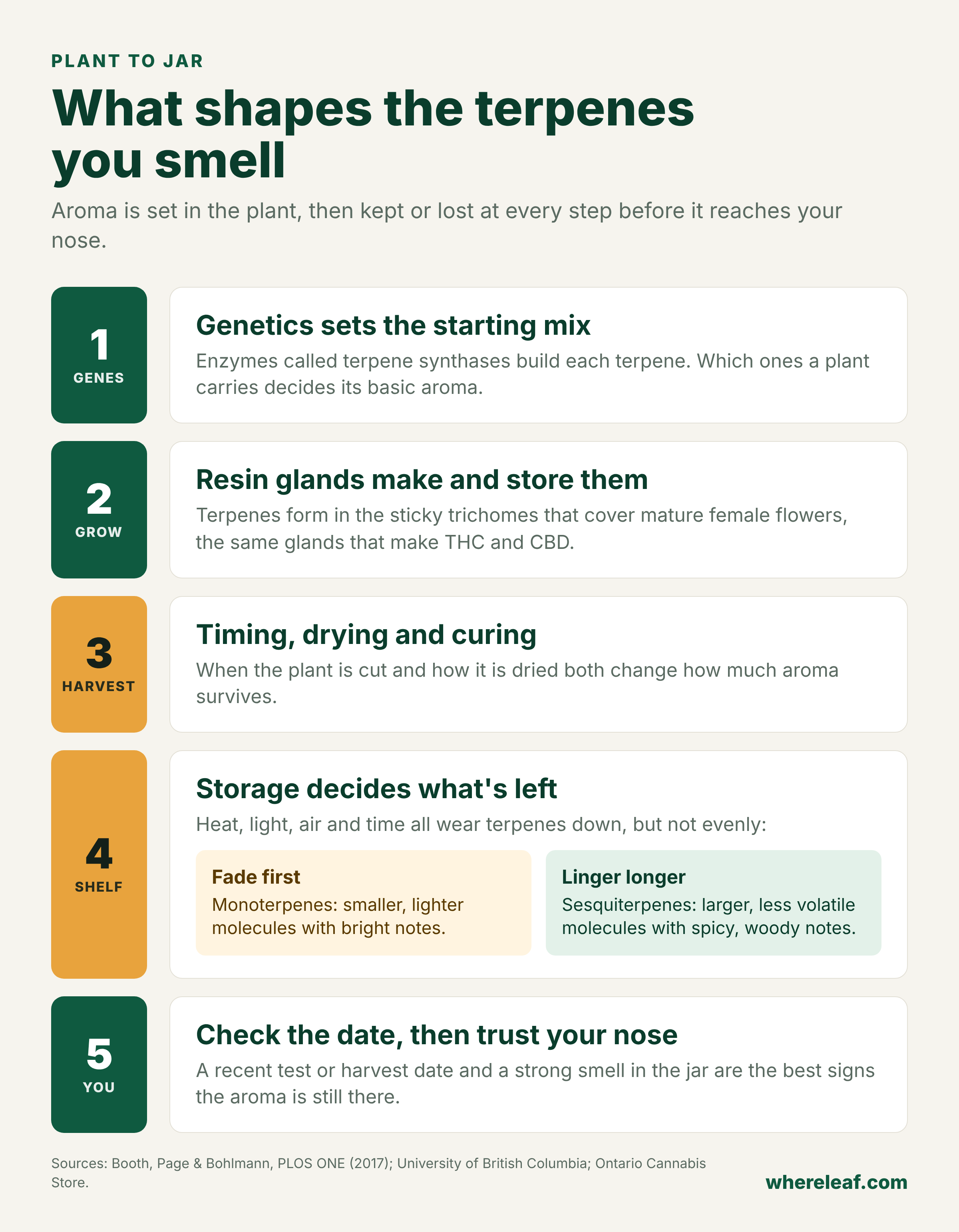
Plants use enzymes called terpene synthases to build terpenes. In a 2017 study of the hemp variety ‘Finola,’ researchers identified nine cannabis terpene synthases and showed that they produce most of the terpenes in that plant’s resin. Genetics sets the starting point, while growing conditions, harvest timing, drying and storage all affect how much aroma survives to the jar.
Monoterpenes vs. sesquiterpenes
You may see two technical words on lab reports. Monoterpenes are smaller, lighter molecules. They tend to smell bright and evaporate quickly. Myrcene, limonene, pinene, linalool, terpinolene and ocimene are monoterpenes (linalool is technically a monoterpene alcohol).
Sesquiterpenes are larger and less volatile, so they tend to hang around longer. Beta-caryophyllene and humulene are the two you will see most. They often bring the spicy, woody, peppery side of the aroma.
The 8 most common cannabis terpenes and their aromas
The sections below cover each of the eight terpenes in this guide, so you can put a name to what your nose is picking up. The comparison table further down sums them up in one place.
1. Myrcene: earthy, musky, herbal
Myrcene is often the most abundant terpene in cannabis flower. Its scent is usually described as earthy and herbal. Outside cannabis, it is found in hops, thyme, lemongrass and mango.
Strains often listed as myrcene-dominant include Blue Dream, OG Kush and Cherry Pie. Look them up in our strain library to compare their reported profiles.
2. Limonene: citrus and lemon peel
Limonene is the main aroma compound in citrus peel oils, so it smells like lemon, orange or lime zest. In cannabis, it often adds a sweet, sharp brightness on top of other notes.
Testing lab SC Labs lists Wedding Cake, MAC and Do-Si-Dos as examples of limonene-forward strains.
3. Beta-caryophyllene: black pepper and spice
Beta-caryophyllene (often just “caryophyllene”) smells peppery, spicy and woody. It is found in black pepper, cloves, oregano, basil and cinnamon. It is one of the most common sesquiterpenes in cannabis.
It is also scientifically unusual. A 2008 study in the Proceedings of the National Academy of Sciences found that beta-caryophyllene binds to the CB2 receptor, one of the receptors in the body’s endocannabinoid system, and the authors called it “a dietary cannabinoid.” That is a lab finding about how a molecule binds, not evidence of any effect from smoking or vaping cannabis. Example strains include GSC (formerly Girl Scout Cookies) and Sherbert.
4. Pinene: pine needles and fresh herbs
Pinene comes in two main forms. Alpha-pinene smells like pine needles and rosemary, while beta-pinene leans toward basil, dill and parsley. Together they give a crisp, woody, “walk in the forest” note. Pinene is also found in conifers like pine, cedar, spruce and fir.
Blue Dream often shows pinene as a secondary terpene behind myrcene. SC Labs also names Royal Pineapple and Sour Carmello as pinene-forward examples.
5. Linalool: lavender and soft florals
Linalool is best known as a main scent compound in lavender. It is also found in coriander, basil, rosewood, mint, cinnamon and citrus blossoms, and in more than 200 plant species overall. Its aroma is light, sweet and floral, sometimes with a woody or spicy twist.
Linalool usually shows up at lower levels than myrcene or limonene, so it is more of a supporting note. Leafly lists Zkittlez, Strawberry Diesel and Ice Cream Cake as linalool-rich examples.
6. Humulene: woody, earthy and hoppy
Humulene gets its name from the hops plant, Humulus lupulus. It is a key part of the “hoppy” aroma in many beers, and it is also found in sage. It smells herbal, woody and slightly spicy, very similar to caryophyllene. In fact, the two often appear together.
Strains that list humulene as a top-three terpene include Zkittlez, Gelato, Purple Punch, Thin Mint GSC and Headband.
7. Terpinolene: woody, herbal and floral
Terpinolene is harder to describe because it combines several notes at once: woody, herbal and floral at the same time. It is found in lilac, tea tree, apples, cumin and nutmeg.
Terpinolene-dominant flower is less common than the myrcene or limonene types, but it is distinctive. SC Labs lists Super Lemon Haze, Classic Haze, Trainwreck and Jack as examples.
8. Ocimene: sweet, green and tropical
Ocimene has a sweet, floral and woody scent with a green, fresh-cut edge. It is found in hops, mango, kumquat, basil, bergamot, lavender and orchids. In cannabis it is often a supporting terpene that adds a fruity lift.
SC Labs lists Harmony Rose and Pink Lemonade as ocimene-dominant examples, and Golden Pineapple and Dream Queen as strains where it also appears.
Terpenes at a glance: comparison table
Here is the same information in one place. Remember that a strain name is only a starting point. The actual terpene mix can change from grower to grower and batch to batch.
| Terpene | Typical aroma | Also found in | Example strains |
|---|---|---|---|
| Myrcene | Earthy, musky, herbal | Hops, mango, thyme, lemongrass | Blue Dream, OG Kush |
| Limonene | Citrus, lemon zest | Lemon, orange and other citrus peel | Wedding Cake, Do-Si-Dos |
| Beta-caryophyllene | Peppery, spicy, woody | Black pepper, cloves, oregano, cinnamon | GSC, Sherbert |
| Pinene | Pine needles, fresh herbs | Pine, rosemary, basil, dill | Blue Dream, Royal Pineapple |
| Linalool | Floral, lavender | Lavender, coriander, basil | Zkittlez, Ice Cream Cake |
| Humulene | Woody, earthy, hoppy | Hops, sage | Gelato, Headband |
| Terpinolene | Woody, herbal, floral | Lilac, tea tree, apples, nutmeg | Super Lemon Haze, Trainwreck |
| Ocimene | Sweet, green, tropical | Hops, mango, basil, bergamot | Pink Lemonade, Golden Pineapple |
What the science knows (and doesn’t yet know)
Terpene research has grown fast, but it is still young. Here is a fair summary of where things stand as of October 2026.
What researchers have shown
- Terpenes drive much of the aroma. This is well established in plant science and is the most solid reason to pay attention to terpene numbers.
- A few terpenes dominate. In a 2022 PLOS ONE study of lab data from six states (Alaska, California, Florida, Michigan, Oregon and Washington State), myrcene, beta-caryophyllene and limonene had the highest average levels.
- Products fall into a small number of terpene groups. The same study sorted THC-dominant flower into three main groups: caryophyllene-limonene, myrcene-pinene and terpinolene-myrcene. The first two groups held 87.4% of those samples.
- Indica, sativa and hybrid labels are a weak guide. The authors found these labels were “poorly or inconsistently aligned with the underlying chemistry.” Grouping by dominant terpene separated products more clearly.
- Strain names vary in reliability. In that study, 96% of products sold as “Purple Punch” landed in the same terpene group, but only 62.5% of “Tangie” products did.
Terpenes are not the only aroma compounds
A 2021 study published in ACS Omega traced the classic “skunky” smell of cannabis to a family of sulfur compounds, led by one called prenylthiol. It is the same compound behind the flavor of “skunked” beer. So if a jar smells strongly of skunk or gas, terpenes alone may not explain it.
What is still unknown: the “entourage effect”
You will often hear that terpenes and cannabinoids work together to shape the experience. This idea is called the entourage effect. The term first appeared in a 1998 paper by Israeli researchers studying the body’s own cannabinoid-like compounds. In 2011, researcher Ethan Russo published an influential review proposing that cannabis terpenes might interact with cannabinoids in a similar way.
The idea remains debated. Supporters point to lab and animal findings. Critics note that most human evidence is limited, and that the term is widely used in marketing. A 2024 scoping review in Cannabis and Cannabinoid Research urged regulators, industry and the media not to present the hypothesis as a proven phenomenon before the research catches up.
The practical takeaway: terpene profiles are a good way to choose by aroma and flavor. They are not a reliable way to predict how a product will make you feel. Many people report differences between products, but individual experiences vary widely, and dose and THC content play a big role.
How to use terpene info when you shop
Terpene data is becoming more common on labels, menus and certificates of analysis (COAs). Requirements differ by state and province, so some products list terpenes in detail and others list nothing at all. Here is a simple way to use what is available.
- Start with your nose. Think about scents you already like. Citrus fans might try limonene-forward products; people who like a hoppy IPA might enjoy humulene and myrcene notes.
- Find the top three terpenes. Look at the label, menu or COA for the three highest-listed terpenes. They will shape most of the aroma.
- Check total terpenes. A higher total usually means a stronger smell. In the 2022 study, flower averaged about 2% total terpenes by weight, so use that as a rough reference.
- Check the test and harvest dates. Terpenes evaporate over time. Fresher product usually smells stronger.
- Ask the budtender to let you smell. Many dispensaries offer sniff jars. Use our dispensary finder to locate licensed stores near you.
- Keep a simple log. Note the strain, the top terpenes and what you liked about the aroma and flavor. Over time you will spot patterns.
- Store it well. Keep flower in an airtight container, away from heat and light, and out of reach of children and pets.
A few responsible-use basics apply no matter which terpenes you prefer. Buy only from licensed retailers, follow the age limits where you live (21+ in US adult-use states, 18 to 21 depending on the province or territory in Canada), start low and go slow, never drive after using cannabis, and don’t carry cannabis across state or national borders.
For dispensaries and brands
Shoppers increasingly search by aroma, so clear terpene info can help your menu stand out. List the top terpenes and total terpene percentage when you have lab results, describe aroma in plain words, and avoid any claims your local rules don’t allow. If you run a licensed business, you can add your listing to WhereLeaf or compare our listing packages. Growers and processors can also connect with buyers through our supplier directory.
Frequently asked questions
What are terpenes in cannabis?
Terpenes are a huge family of natural compounds made by plants, and even some insects. In cannabis they create most of the scent and flavor. Lab reports usually list them as a percentage or in milligrams per gram, with a total at the bottom.
What is the most common terpene in cannabis?
Myrcene is often the most abundant. In a 2022 study of US lab data, myrcene, beta-caryophyllene and limonene had the highest average levels across flower samples.
Do terpenes decide whether a strain is indica or sativa?
No. Strain names are not fully reliable either. In a 2022 study of US lab data, 96% of products sold as “Purple Punch” landed in the same terpene group, but only 62.5% of “Tangie” products did. Check the batch’s own terpene results when you can.
Is the entourage effect real?
It is an open question. The entourage effect is a hypothesis that terpenes and cannabinoids interact. Some lab and animal studies are cited in support, but strong human evidence is limited, and recent reviews warn against presenting it as proven.
Why does some cannabis smell skunky?
A 2021 study linked the skunky note mainly to sulfur compounds, especially one called prenylthiol, rather than to terpenes. Terpenes contribute the citrus, pine, floral and spicy notes.
Do all cannabis products list terpenes?
No. Terpene testing is optional in many states and provinces, so some labels and lab reports list terpenes in detail while others show none. A missing terpene section is not a failed test. Ask the store whether a full lab report is available.
Sources
- PLOS ONE: Smith, Vergara, Keegan and Jikomes, The phytochemical diversity of commercial Cannabis in the United States (2022)
- PLOS ONE: Booth, Page and Bohlmann, Terpene synthases from Cannabis sativa (2017)
- PNAS: Gertsch et al., Beta-caryophyllene is a dietary cannabinoid (2008)
- ScienceDaily: ETH Zurich and University of Bonn research on beta-caryophyllene (2008)
- European Journal of Pharmacology: Ben-Shabat et al., An entourage effect (1998)
- British Journal of Pharmacology: Russo, Taming THC: potential cannabis synergy and phytocannabinoid-terpenoid entourage effects (2011)
- Cannabis and Cannabinoid Research: Simei et al., Does the “Entourage Effect” in Cannabinoids Exist? A Narrative Scoping Review (2024)
- Science News: Here’s the chemistry behind marijuana’s skunky scent (2021)
- SC Labs: Terpenes guide (accessed 2026)
- Leafly: What is linalool? Cannabis glossary (accessed 2026)
- Leafly: What is humulene? Cannabis glossary (accessed 2026)
- Leafly: What is humulene and what does this cannabis terpene do? (accessed 2026)
- Ontario Cannabis Store: Terpene spotlight: linalool (accessed 2026)
- Ontario Cannabis Store: Pinene terpene flavours and cannabis strains (accessed 2026)
- Ontario Cannabis Store: Terpenes (accessed 2026)
Last updated: October 2026. Laws and prices change; always check your state or provincial regulator.