Walk into almost any dispensary and the menu is sorted into three buckets: indica, sativa and hybrid. The usual shorthand says indica means “in da couch,” sativa means an upbeat, social experience, and hybrid lands somewhere in between. It is a simple system, and that is exactly why it stuck.
The short answer to the indica vs. sativa vs. hybrid question is this: the labels began as botany, describing where plants came from and what they looked like. Today they are mostly marketing categories. Large studies published in 2021 and 2022 found that these labels line up poorly with what is actually inside the product, meaning its cannabinoids (like THC and CBD) and its terpenes (the aroma compounds).
That does not make the labels useless, but it does mean you will shop better if you look past them. This guide explains where the words came from, what the research says, and how to read a product beyond its category.
Key takeaways
- The indica and sativa names come from plant science and were never designed as a guide to how a product feels.
- Botanists still debate whether cannabis is one variable species or several, so even the science behind the names is unsettled.
- Large lab studies find the labels don’t reliably separate products by what’s actually inside them.
- Two products with the same strain name can still differ a lot, so judge each batch on its own.
- Think of the label as a loose hint about aroma, not a promise about effects, and start low and go slow with anything new.
Where the words “indica” and “sativa” came from
The names are older than the United States. In 1753, the Swedish botanist Carl Linnaeus named Cannabis sativa in his Species Plantarum, the book botanists use as the starting point for plant names. The plant he had in mind was the hemp grown across Europe for fiber, not an intoxicating plant.
In 1785, the French naturalist Jean-Baptiste Lamarck named Cannabis indica for plants that came from India and other regions. He described them as psychoactive and strongly scented. He also described them as fairly tall, loosely branched and with narrow leaflets.
How the meanings flipped
Here is the twist. In modern shop talk, “sativa” means a tall plant with narrow leaflets, and “indica” means a short, bushy plant with broad leaflets. That is close to the opposite of Lamarck’s description. A 2018 review by botanist John McPartland in Cannabis and Cannabinoid Research traced how 20th-century researchers applied the names to Afghan plants, which drifted away from the original concepts. His summary is memorable: “Sativa” is really indica, and “Indica” is actually closer to what he calls afghanica.
Botanists still debate whether cannabis is one variable species or several. For shoppers, the takeaway is simpler: the words on the jar were never designed as an effects guide.
What growers still use the terms for
Some growers use “indica” and “sativa” to describe plant shape and growing habits. Narrow-leaf types tend to grow taller and take longer to flower. Broad-leaf types tend to be shorter and bushier. Those traits matter in a grow room. They do not tell you much about what is in the finished flower.
What the research says about labels vs. chemistry
If the labels predicted effects, you would expect “indica” products to share a chemical fingerprint that “sativa” products lack. Several research teams have tested that idea. The results point the same way.
The 2022 study: nearly 90,000 samples
In 2022, researchers Christiana Smith, Daniela Vergara, Brian Keegan and Nick Jikomes published one of the largest looks at legal cannabis chemistry to date in PLOS ONE. They analyzed lab data for 89,923 flower samples from testing labs in six US states. About 42,800 of those samples also had terpene data.
Their conclusion was blunt: “the Indica/Hybrid/Sativa nomenclature does not reliably distinguish samples based on their chemical content.” An indica-labeled product’s terpene profile was often indistinguishable from a sativa- or hybrid-labeled one.
Instead, the team found that THC-dominant products fell into three main terpene groups:
- Caryophyllene and limonene dominant (often described as peppery, spicy or citrusy).
- Myrcene and pinene dominant (often described as earthy, musky or piney).
- Terpinolene and myrcene dominant (often described as fresh, herbal or fruity).
About 87% of THC-dominant samples fell into the first two groups. The only group that leaned toward one label was the terpinolene group, which had roughly twice as many sativa-labeled products as expected. Even then, plenty of indica- and hybrid-labeled products landed there too.
The 2021 study: labels follow a few aroma genes
A 2021 study in Nature Plants, by researchers in Canada and the Netherlands (Watts et al.), tested 297 cannabis samples for chemistry and genotyped 137 of them. Samples labeled sativa and indica did not form clear genetic groups. Overall genetics explained only about 37% of the variation in how samples were labeled.
The authors wrote that the sativa–indica scale “poorly captures overall genomic and metabolomic variation.” What the labels did follow was a small number of terpenes. Myrcene, guaiol and two forms of eudesmol leaned “indica.” Bergamotene and farnesene leaned “sativa.” In other words, the label seems to track how a product smells more than what it is genetically.
The study also found that samples sharing the same strain name were often as different, genetically and chemically, as samples with different names.
Earlier warning signs
This was not a new idea. A 2015 PLOS ONE study from the University of British Columbia and Dalhousie University genotyped 81 marijuana and 43 hemp samples. It found only a moderate match between a strain’s reported indica or sativa ancestry and its actual genetic makeup. In one example, a strain sold as sativa was almost genetically identical to an indica from Afghanistan.
In a 2016 interview in Cannabis and Cannabinoid Research, researcher Ethan Russo went further, calling the sativa/indica distinction as used in the popular press “total nonsense and an exercise in futility.” He argued for accurate cannabinoid and terpene testing instead.
Indica vs. sativa vs. hybrid: myth vs. reality
Here is how the common beliefs stack up against the research above.
| Label | What the label is usually said to mean | Original botanical meaning | What studies found |
|---|---|---|---|
| Indica | Heavy, body-focused, “nighttime” | Lamarck’s 1785 name for psychoactive plants from India; tall with narrow leaflets | Loosely linked to higher myrcene in one study, but chemistry overlaps heavily with other labels |
| Sativa | Energetic, heady, “daytime” | Linnaeus’s 1753 name for European fiber hemp | Somewhat more common in the terpinolene group, yet most sativa-labeled flower falls in the same groups as indica |
| Hybrid | A balanced mix of both | Not a botanical category | Most modern cannabis is a cross of many lines, so in practice nearly everything is a hybrid |
| Chemotype | Rarely shown on menus | Groups plants by cannabinoid ratio: THC-dominant, balanced or CBD-dominant | Separates products by what they contain; recommended by researchers as a better system |
Cannabinoids, terpenes and chemotypes, explained simply
If the label is not the best guide, what is? Researchers point to the product’s chemistry. Here are the three terms worth knowing.
Cannabinoids
Cannabinoids are the compounds cannabis is known for. THC is the main intoxicating one. CBD is not intoxicating in the same way. You may also see minor ones such as CBG or CBN on a lab report. The amounts and the ratio between THC and CBD are usually listed on the package.
Terpenes
Terpenes are aroma compounds found in many plants, from citrus peels to pine needles. They give cannabis its smell and flavor. Common ones include myrcene, limonene, caryophyllene, pinene and terpinolene. Some people report that products with different terpene profiles feel different to them, but research on how terpenes shape effects in people is still limited.
Chemotypes
A chemotype groups cannabis by its main cannabinoids. The simplest version has three types:
- Type I (THC-dominant): high THC, little CBD. This is most of what is on shelves; 96.5% of samples in the 2022 study fell here.
- Type II (balanced): similar amounts of THC and CBD, often labeled 1:1.
- Type III (CBD-dominant): mostly CBD, with little THC.
Because almost all flower is Type I, terpene profile is often the more useful way to tell THC-dominant products apart.
How to shop beyond the label
You do not need a chemistry degree to shop this way. You just need to read a little more of the package or menu. Use this checklist the next time you browse.
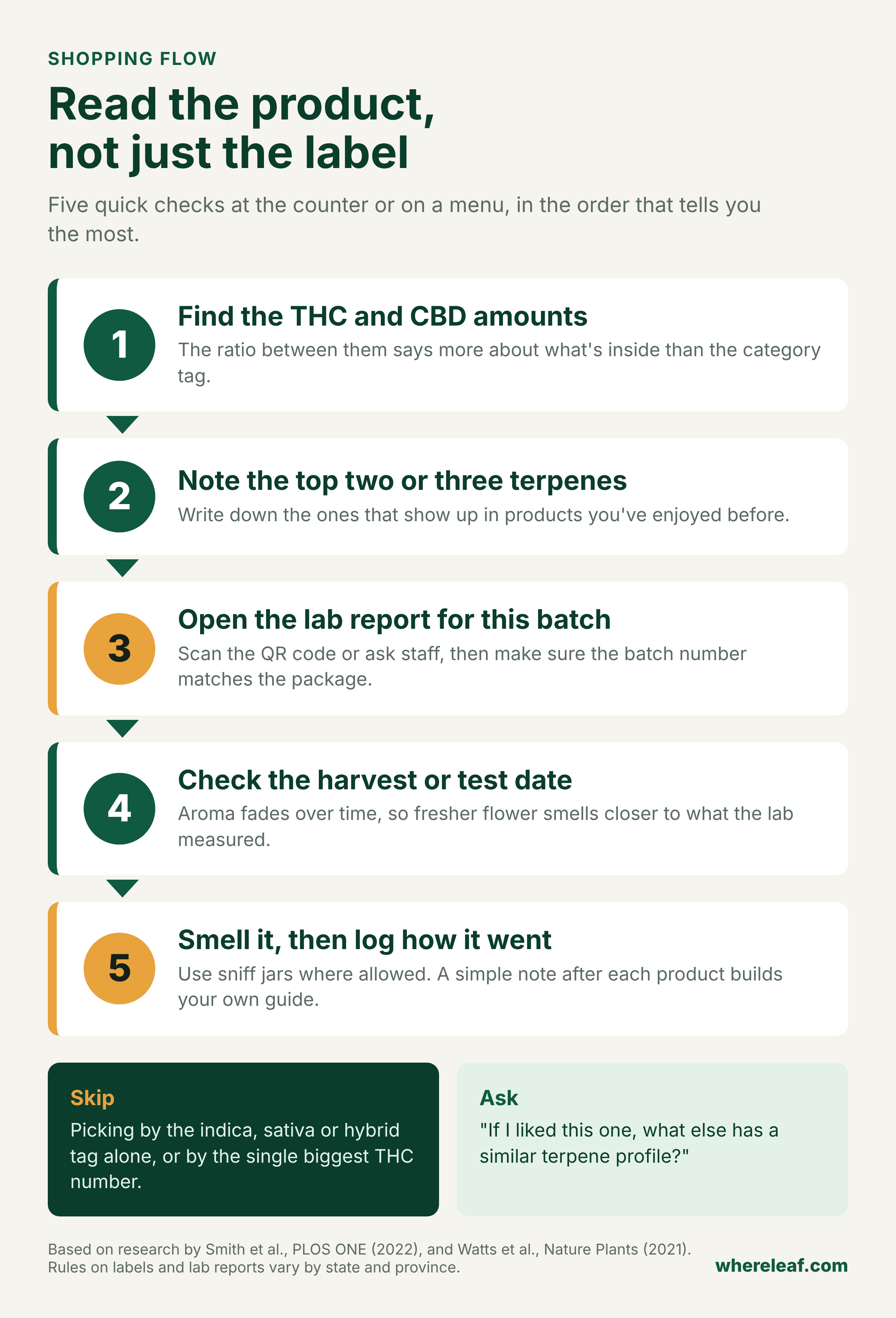
- Check the cannabinoid ratio first. Is it THC-dominant, balanced or CBD-dominant? This tells you more than the indica or sativa tag.
- Look at the top two or three terpenes. Many menus and labels list them. Note which ones show up in products you have liked before.
- Do not chase the highest THC number. A 2023 Colorado study tested 23 flower samples from 10 dispensaries and found only about 30% were within 15% of the THC on the label. Think of the number as a rough guide.
- Ask for the certificate of analysis (COA). In many legal markets, products are lab-tested and the report may be linked by QR code. Check that the batch number matches.
- Check the harvest, packaging or test date. Terpenes can fade over time, so fresher flower may smell closer to what the lab measured.
- Use your nose when allowed. Some stores offer sniff jars. Aroma is a real clue to terpene content.
- Keep simple notes. Write down the product, ratio, top terpenes, amount and how it went. Over time, your own notes beat any label.
- Start low and go slow. This matters most with edibles and with any product that is new to you.
You can explore strain profiles, including reported terpenes, in the WhereLeaf strain library. When you are ready to compare menus, find licensed dispensaries near you and ask staff for lab results.
Questions to ask your budtender
- “What are the top terpenes in this batch, and do you have the lab report?”
- “When was this harvested or packaged?”
- “Do you carry anything balanced, like a 1:1 THC to CBD product?”
- “If I liked this one, what else has a similar terpene profile?”
Why the labels persist (and when they still help)
If the science is this clear, why does every menu still use indica, sativa and hybrid? Partly habit. Shoppers know the words, and stores need some way to sort hundreds of products. The labels are also baked into decades of strain names, breeder descriptions and marketing.
The labels are not pure noise either. The 2021 study found they line up with a few aroma compounds, and the 2022 study found sativa-labeled products were somewhat more common in the terpinolene group. So a label can be a loose hint about aroma. It just is not a reliable promise about how a product will feel.
A note for dispensaries and brands
Retailers can help customers by listing cannabinoid ratios and top terpenes next to (or instead of) the indica, sativa or hybrid tag, and by linking each product to its lab report. If you run a licensed business, you can list your business on WhereLeaf and show shoppers the details they are starting to look for.
Responsible use reminders
- Cannabis is for adults of legal age only: 21+ in US adult-use states and 18+ to 21+ in Canada depending on the province or territory.
- Rules on possession, purchase limits and testing differ by state and province. Check your local regulator.
- Do not drive or operate machinery after using cannabis.
- Store products locked away from children and pets.
- Do not carry cannabis across state lines or national borders, even between two legal places.
Frequently asked questions
Is there a real difference between indica and sativa?
As plant types, yes: growers see differences in height, leaf shape and flowering time, and those traits matter in a grow room. As product labels, much less so. Researcher Ethan Russo has called the popular distinction “total nonsense,” and he and others argue for full cannabinoid and terpene testing instead.
What does hybrid mean on a cannabis label?
It usually means a product comes from crossing different parent lines. Stores and breeders use the word loosely, and there is no lab test or official standard that decides when something counts as a hybrid, so the tag tells you little about chemistry.
Where can I find terpene information if the label doesn’t list it?
Ask for the certificate of analysis for that batch. Terpene testing is optional in many places, so some products simply won’t have it. A strain library can show a strain’s typical profile, but the report for your batch is more accurate.
What does “1:1” mean on a cannabis label?
It means the product has roughly equal amounts of THC and CBD. Researchers call this Type II. If you want one, ask staff what they carry, or filter the store’s online menu by ratio where that option is offered.
Is a strain name more reliable than the indica or sativa label?
Sometimes, but not always. In the 2022 study, some strain names were very consistent while others varied widely. The 2021 study found products with the same name could differ as much as products with different names.
Sources
- PLOS ONE: The phytochemical diversity of commercial Cannabis in the United States, Smith et al. (2022)
- Nature Plants: Cannabis labelling is associated with genetic variation in terpene synthase genes, Watts et al. (2021)
- PLOS ONE: The Genetic Structure of Marijuana and Hemp, Sawler et al. (2015)
- University of British Columbia: Botanists conduct first large-scale genetic study of marijuana, hemp (2015)
- Cannabis and Cannabinoid Research: Cannabis Systematics at the Levels of Family, Genus, and Species, McPartland (2018)
- Cannabis and Cannabinoid Research: The Cannabis sativa Versus Cannabis indica Debate: An Interview with Ethan Russo, MD (2016)
- PLOS ONE: Uncomfortably high: Testing reveals inflated THC potency on retail Cannabis labels, Schwabe et al. (2023)
- NORML: Analysis: Indica, Sativa Labels “Poorly” Reflect Variations Between Cannabis Plants (2021)
Last updated: October 2026. Laws and prices change; always check your state or provincial regulator.