
If you are new to cannabis, the menu at a dispensary can feel like a foreign language. Flower, gummies, vape carts, wax, rosin: they all come from the same plant, but they behave very differently. This guide to flower vs. edibles vs. vapes vs. concentrates explains how each format works, how fast you can expect to feel it, how long it tends to last, and how much THC is in a typical serving.
The short version: inhaled products (flower, vapes and concentrates) are usually felt within seconds to minutes, while edibles can take 30 minutes to 2 hours or longer to kick in and can last much longer. Concentrates are far stronger per puff than flower. Edibles are the format where beginners most often take too much, simply because they wait too little.
Everything below is general information for adults 21+ (19+ or 18+ in parts of Canada) in places where cannabis is legal. It is not medical advice. Everyone reacts differently, so read every time range as typical, not a promise.
Key takeaways
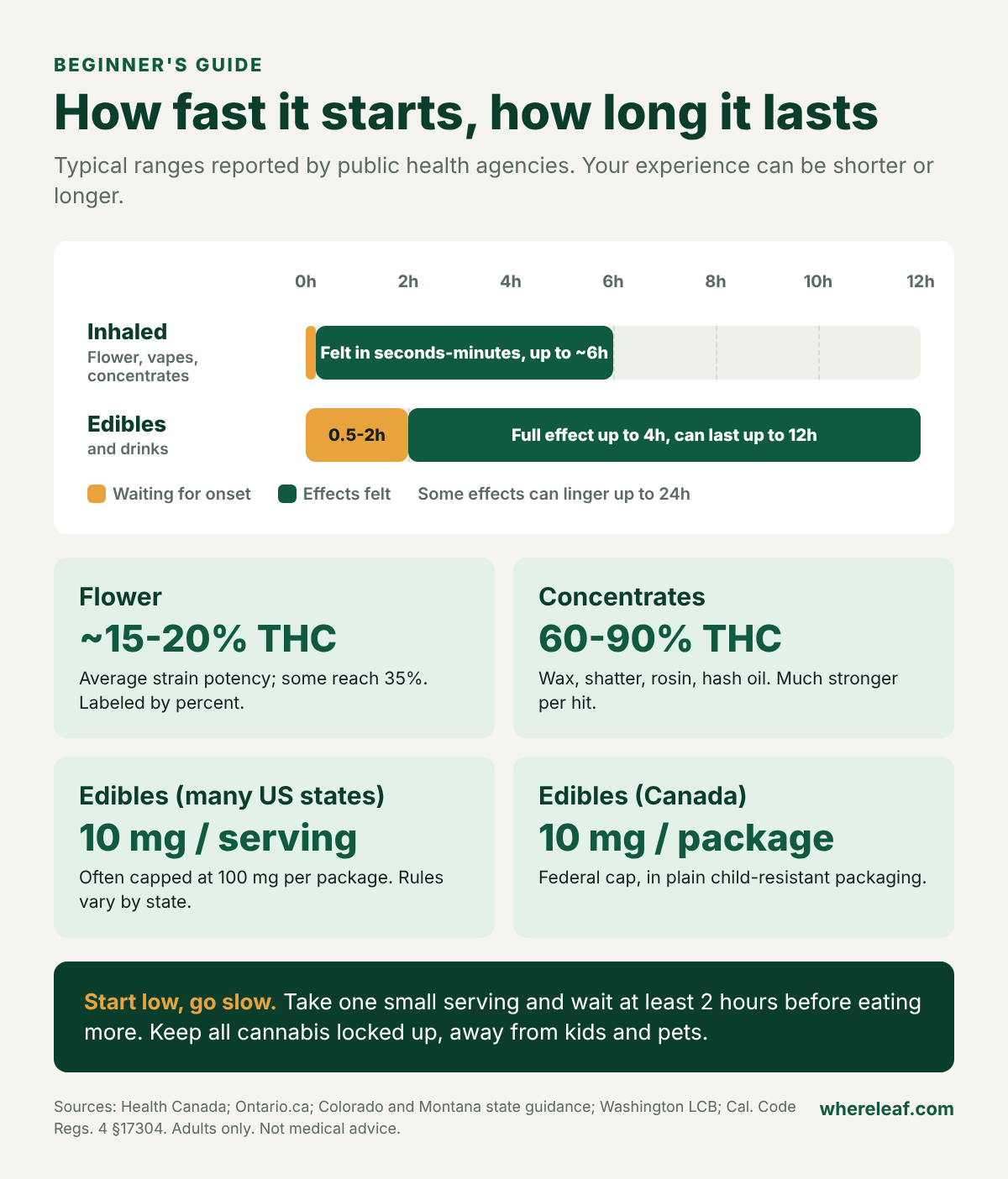
- Inhaled cannabis (flower, vapes, concentrates) is typically felt within seconds to minutes. Edibles and drinks typically take 30 minutes to 2 hours, sometimes up to 4 hours.
- Edible effects can last up to 12 hours, and Health Canada notes some effects can linger up to 24 hours.
- Many US states cap edibles at 10 mg THC per serving and 100 mg per package. Canada caps edibles at 10 mg THC per package.
- Concentrates are often 60% to 90% THC, compared with roughly 15% to 20% for average flower, according to Washington’s cannabis regulator.
- Start low, go slow: take one small serving, then wait at least 2 hours before taking more of an edible.
- Keep all cannabis locked up, in its original child-resistant package, away from kids and pets.
The four main formats at a glance
Before getting into timing, it helps to know what each product actually is. All four formats contain cannabinoids like THC and CBD, but they are made and used in different ways.
Flower
Flower is the dried, cured bud of the cannabis plant. It is sold by weight (grams, eighths, quarters) or as pre-rolled joints. People usually smoke it in a joint, pipe or bong, or heat it in a dry-herb vaporizer. Flower labels list THC and CBD as a percentage, and you can look up a strain’s typical profile in our strain library.
Edibles and drinks
Edibles are foods and drinks made with cannabis extract: gummies, chocolates, baked goods, mints, beverages and more. Because you eat or drink them, THC goes through your digestive system and liver before you feel it. That is why they behave so differently from everything else on this list.
Vapes
Vape cartridges and disposable pens hold cannabis oil that is heated, not burned, and inhaled as a vapor. They are compact and low-odor. Most cart oils are a concentrated extract, so they are usually stronger per puff than flower.
Concentrates
Concentrates are extracts that pack a lot of THC into a small amount of material. Common types include wax, shatter, budder, live resin, rosin, kief and hash. They are usually “dabbed” on a hot surface and inhaled, or sprinkled on flower. Washington’s Liquor and Cannabis Board says concentrates generally test between 60% and 90% THC, which is why they are not usually recommended as a starting point.
Flower vs. edibles vs. vapes vs. concentrates: comparison table
Time ranges come from public guidance by Health Canada, the Ontario government and Colorado and Montana state agencies. They are typical ranges reported for most people, and your experience can be shorter or longer.
| Format | How it is used | Typical onset | Typical duration | How strength is labeled |
|---|---|---|---|---|
| Flower | Smoked or heated in a dry-herb vaporizer | Seconds to minutes | Up to about 6 hours | THC % (average strains about 15-20%) |
| Vapes | Oil cartridge or disposable pen, inhaled | Seconds to minutes | Similar to other inhaled forms | THC % of the oil, plus total mg per cart |
| Concentrates | Dabbed or added to flower, inhaled | Seconds to minutes | Similar to other inhaled forms | THC % (often 60-90%) |
| Edibles and drinks | Eaten or swallowed | 30 minutes to 2 hours, sometimes up to 4 hours | Up to 8-12 hours; some effects up to 24 hours | mg THC per serving and per package |
Two things jump out. First, all three inhaled formats start fast, so you can feel the effect before deciding whether to take more. Second, edibles are labeled in milligrams, not percent, which makes dosing more precise but also easier to misjudge if you are impatient.
How fast does each format kick in, and how long does it last?
Health Canada says effects from smoking, vaping or dabbing can be felt “within seconds to minutes.” Montana’s Department of Revenue puts the average at 10 minutes or less for inhaled products. A Colorado state fact sheet on methods of use says smoked effects can last up to 6 hours.
Eating or drinking cannabis is a different story. Health Canada says effects can start within 30 minutes to 2 hours. The Ontario government adds that you might not feel the full effects for up to 4 hours, and that effects can last up to 12 hours. Health Canada notes that some effects, for either method, can last up to 24 hours.
These differences matter for planning. If you have plans later, need to drive, or have work the next morning, a long-lasting edible may not fit. Never drive after using any cannabis format, and give yourself plenty of time before you get behind the wheel.
Why edibles take longer (and feel different)
When you inhale cannabis, THC passes from the lungs into the bloodstream quickly. When you eat it, THC has to be digested first and then processed by the liver before it reaches the rest of the body. That trip takes time, which explains the slow start and long tail.
The Ontario government also warns that edibles “can be more potent than other forms and may affect you for longer periods of time.”
Timing also varies with what is in your stomach, your body, and the product itself. Drinks and some fast-acting products may start sooner than a dense brownie, but there is no guarantee. Assume every new edible could take the full 2 hours or longer.
The most common beginner mistake: eating one gummy, feeling nothing after 45 minutes, eating two more, and then feeling all three at once.
Standard doses and package labels
Edibles are measured in milligrams (mg) of THC, so reading the label is the best tool you have. Rules differ by state and province, so always check the label and your local regulator. Here is what common limits look like as of October 2026.
United States
There is no single national rule. Many adult-use states set edible limits at 10 mg THC per serving and 100 mg THC per package. California’s regulations, for example, cap edibles at 10 mg per serving and 100 mg per package, and Washington uses the same limits. A 2022 analysis by the Network for Public Health Law found that 13 of 17 adult-use states it reviewed used a 10 mg serving limit, while a few states, such as Connecticut, Vermont and Virginia, used 5 mg servings. States update their rules, so check your own state.
Canada
Under federal rules, a package of edible cannabis can contain no more than 10 mg THC in total. Cannabis extracts are capped at 10 mg THC per unit (such as a capsule) and 1,000 mg per package. Edibles and extracts must come in plain, child-resistant packaging with a health warning.
Flower, vapes and concentrates
Inhaled products are labeled by THC percentage instead of per-serving milligrams. That makes “one dose” harder to define. A single puff from a 15% flower joint and a single dab of an 80% concentrate are very different amounts of THC, even though both are “one hit.”
For beginners, the Ontario government suggests starting with an edible containing 2.5 mg of THC or less. Many gummies are scored or small enough to cut, and Washington’s regulator suggests splitting a serving into smaller pieces to control how much you take.
Start low, go slow: a beginner’s step list
“Start low, go slow” is advice you will hear from public health agencies, budtenders and experienced consumers alike. Here is what it looks like in practice.
- Choose one format. Do not mix a new edible with a vape or flower on the same day.
- Read the label. Find THC per serving (edibles) or THC percentage (flower, vapes, concentrates), and note the total in the package.
- Take a small amount. For edibles, consider 2.5 mg or less. For flower or a vape, take one small puff.
- Wait. Give inhaled products 10 to 15 minutes. Give edibles at least 2 hours, and remember full effects may take up to 4 hours.
- Do not stack doses. If you feel little, try a slightly larger amount on a different day instead of taking more now.
- Stay somewhere comfortable. Be at home or with people you trust, with water and snacks nearby.
- Skip alcohol and other substances. Combining them can make effects stronger and harder to predict.
- Plan your evening. No driving, and keep your next morning free if you tried an edible.
If you or someone else has taken too much and is not okay, call Poison Control at 1-800-222-1222 in the US, or 911 in an emergency. In Canada, call your provincial poison centre or 911.
Accidental ingestion: keeping kids and pets safe
Edibles often look like regular candy, cookies or chocolate, which is exactly why they are a risk around children and pets. A study in the journal Pediatrics found that reported edible cannabis exposures in US children under 6 rose from 207 cases in 2017 to 3,054 in 2021, an increase of about 1,375%. Nearly 98% of those exposures happened at a home.
Child-resistant packaging helps, but only if you use it. Simple habits make a big difference:
- Keep products in their original child-resistant package and reseal it every time.
- Store everything in a locked box or cabinet, out of sight and reach of kids and pets.
- Never leave edibles on counters, nightstands, in purses or in the fridge next to regular snacks.
- Do not use cannabis edibles around children or call them “candy.”
- Throw away leftovers so pets cannot dig them out of the trash.
- If a child eats cannabis, call Poison Control (1-800-222-1222 in the US) or 911. For pets, the California Department of Public Health lists the ASPCA Animal Poison Control Center at 1-888-426-4435.
For more storage ideas, including how to keep products fresh, see our guide to storing cannabis at home.
Buying smart: licensed products and vape safety
Whatever format you choose, buy from a licensed retailer. Licensed products are tested and labeled with THC content, and they come in child-resistant packaging. You can find licensed dispensaries near you on WhereLeaf.
Vapes deserve an extra note. During the 2019-2020 EVALI lung injury outbreak, the CDC reported 2,807 hospitalized cases or deaths and found that vitamin E acetate was strongly linked to the outbreak. Most cases involved THC vaping products from informal sources like friends, family or dealers. The CDC recommended that people not use THC-containing vaping products, especially from informal sources. If you choose to vape, never buy carts from unlicensed sellers and never add anything to a product.
A few questions to ask your budtender:
- How much THC is in one serving or one puff of this product?
- Is there a lower-strength version for new consumers?
- Is the lab result (certificate of analysis) available?
- What hardware does this cart need, and how should it be stored?
Never take cannabis across state lines or international borders, even between two legal places. It remains illegal.
Which format should a beginner try?
There is no single right answer, and nothing here is a recommendation to use cannabis. But if you are an adult who has decided to try it legally, here is how the formats generally compare for a newcomer.
- Flower gives fast feedback, so it is easier to stop after a puff or two. The downsides are smoke, smell and the fact that THC percentage can vary a lot between strains.
- Vapes are discreet and also fast, but cart oil is usually stronger than flower. Small puffs matter.
- Edibles are smoke-free and precisely labeled in milligrams, but the slow onset makes over-consumption easy. Patience is required.
- Concentrates are the strongest format and are usually best left until you know how you react to cannabis.
Your best format is the one where you can control the amount and plan your time around it. If you are a brand or retailer, you can also list your business on WhereLeaf to reach adult shoppers looking for licensed products.
Frequently asked questions
How long do edibles take to kick in?
Health Canada says effects from eating or drinking cannabis typically start within 30 minutes to 2 hours. Ontario notes full effects can take up to 4 hours. Wait at least 2 hours before taking more.
How long does a high from flower or a vape last?
Inhaled effects usually start within seconds to minutes. A Colorado state fact sheet says smoked effects can last up to 6 hours, and Health Canada notes some effects can linger longer.
What is a standard edible dose?
Many US states cap a serving at 10 mg THC, and Canada caps a whole edible package at 10 mg THC. Beginners are often advised to start with 2.5 mg or less. Rules vary, so check your local regulator.
Are concentrates stronger than flower?
Yes. Washington’s cannabis regulator says average flower is about 15-20% THC, while concentrates such as wax, shatter and rosin generally range from 60% to 90%.
Why do edibles feel different from smoking?
Eaten THC is digested and processed by the liver before it circulates, which slows the onset and lengthens the effects. Ontario says edibles can be more potent and last longer than other forms.
What should I do if a child or pet eats an edible?
Stay calm and call Poison Control at 1-800-222-1222 in the US, or 911 in an emergency. For pets, call your vet or the ASPCA Animal Poison Control Center at 1-888-426-4435.
Sources
- Health Canada: Health effects of cannabis (2024)
- Government of Ontario: Health effects of consuming cannabis edibles (2026)
- Montana Department of Revenue: Facts about Ingested, Marijuana-Infused Products
- State of Colorado: Retail Marijuana Methods of Use fact sheet (2015)
- Washington State Liquor and Cannabis Board: Understanding THC concentration and potency (2026)
- Cornell LII: Cal. Code Regs. Tit. 4, § 17304, THC Concentration Limits
- Network for Public Health Law: THC Limits for Adult-Use Cannabis Products (2022)
- Health Canada: Backgrounder, Final regulations on new cannabis products (2019)
- Pediatrics (Tweet, Nemanich, Wahl): Pediatric Edible Cannabis Exposures and Acute Toxicity: 2017-2021 (2023)
- California Department of Public Health: Cannabis Safety Measures
- CDC: Outbreak of Lung Injury Associated with the Use of E-Cigarette, or Vaping, Products (2020)
Last updated: October 2026. Laws and prices change; always check your state or provincial regulator.