The main difference in live resin vs rosin is how the oil gets out of the plant. Live resin is made with a hydrocarbon solvent such as butane or propane from cannabis that was frozen right after harvest, while rosin is solventless: it is squeezed out with only heat and pressure.
Distillate is a third path. Producers refine a crude extract through distillation until almost everything except the cannabinoids is gone, so it starts with little aroma or flavor. Many vape carts are built on distillate, and that is why labels like “live resin cart,” “live rosin cart” and “distillate cart” sit side by side on dispensary menus at very different prices.
Below: how each is made, what “live” and “cured” mean, diamonds and sauce, price tiers, residual solvent testing and safety basics.
Key takeaways
- The real choice is solvent or solventless. If avoiding solvents matters to you, rosin is the one to look for.
- “Live” on a label tells you about the starting plant, not the extraction method, so read both words.
- A higher THC number does not mean a better product. Flavor and process are what set these concentrates apart.
- All concentrates are much stronger than flower. Start with a very small amount, and leave extraction to licensed labs.
- Rules differ by state and province. Always check your local regulator.
Live resin vs rosin: what is the difference?
Both concentrate the resin from trichomes, the tiny sticky glands on the flower. The split comes down to two questions: was a solvent used, and was the plant fresh or dried?
- Solvent vs solventless. Live resin is a solvent extract, usually called BHO (butane hash oil) or hydrocarbon extract. Rosin is solventless. A press heats and squeezes flower, dry sift or ice water hash until the oil flows out.
- Fresh-frozen vs cured. “Live” products start from plants frozen right after harvest. “Cured” or standard products start from flower that was dried and cured first.
- Refined vs whole-plant. Distillate goes one step further, stripping the extract down to mostly cannabinoids. Live resin and rosin aim to keep the plant’s natural mix of compounds.
So “live rosin” is solventless and fresh-frozen, while plain “rosin” is often pressed from dried flower or hash. One word changes the product.
How is each concentrate made?
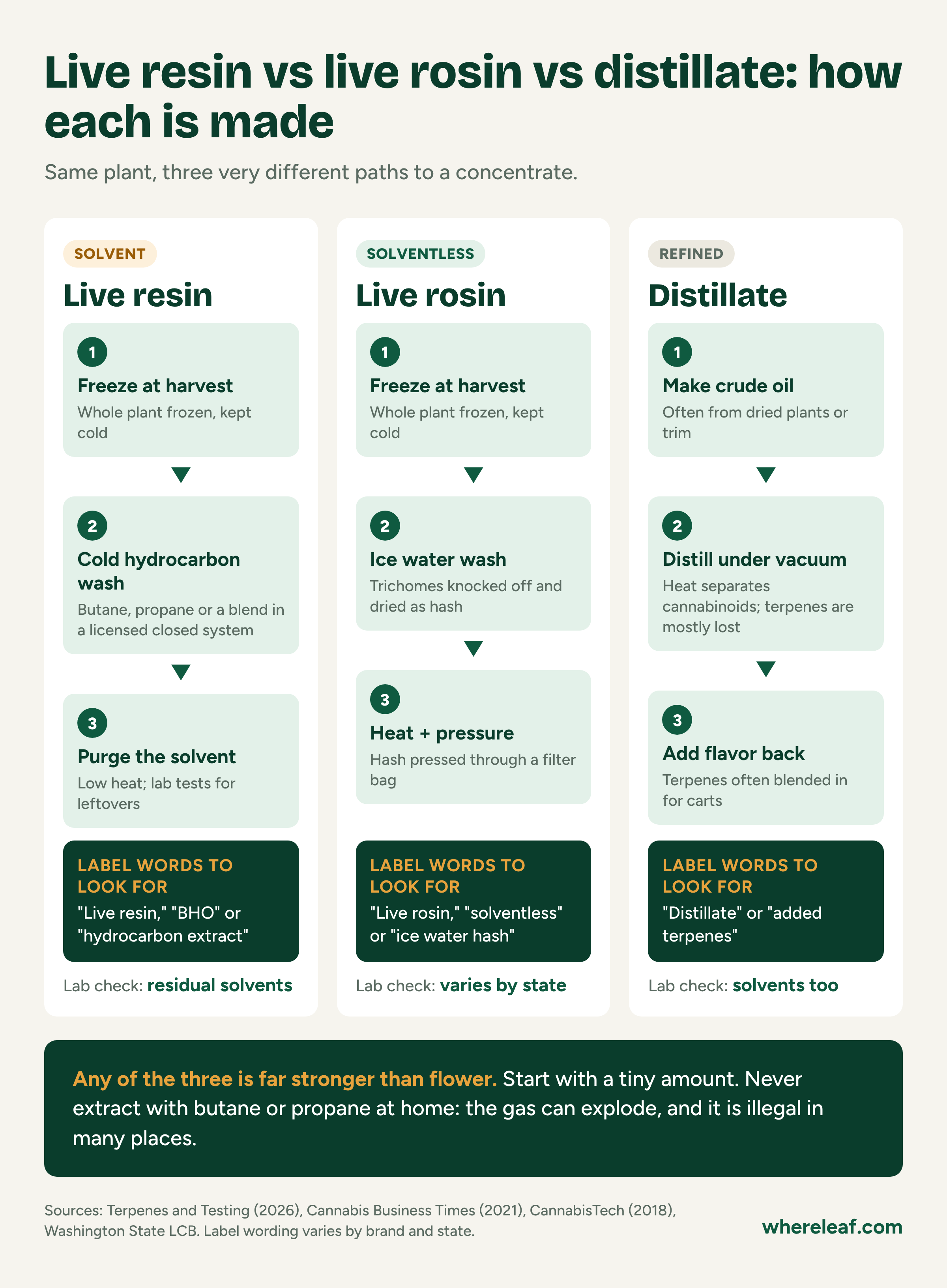
Knowing the basic steps makes menus much easier to read. The infographic shows the three main paths.
Live resin: hydrocarbon extraction from frozen plants
Producers freeze the whole plant soon after harvest and keep it cold through storage, handling and extraction. In a licensed lab, a closed-loop system washes the frozen material with cold butane, propane or a blend. The solvent dissolves the resin, then gets purged out at low temperatures so fewer of the volatile aroma compounds escape.
Depending on the purge and storage, it can end up as runny sauce, grainy “sugar” or soft “badder.”
Rosin and live rosin: heat and pressure only
Rosin is made by mechanical separation, not by dissolving anything. Plant material, dry sift or ice water hash goes into a filter bag and is pressed between heated plates. The heat softens the oil and the pressure pushes it through the filter, leaving plant material behind.
Live rosin usually starts with fresh-frozen plants that are washed in ice water to knock off the trichomes. That “hash” is dried and then pressed.
Distillate: refined until it is mostly cannabinoids
Distillate starts as a crude cannabis oil, often from dried plant material or trim. In short-path distillation, the oil is heated under a vacuum so different compounds boil off at different temperatures and are collected separately. The result is a clear, thick golden oil.
Terpenes boil at different temperatures than cannabinoids and are largely lost, so plain distillate has little taste or smell. Many brands add terpenes back, from cannabis or other plants, for a strain-like flavor.
Live resin vs live rosin: which keeps more terpenes?
Both start from fresh-frozen plants, so both are built to keep terpenes, the aroma compounds that give strains their citrus, pine or gassy notes. (Our cannabis terpenes guide explains the most common ones.) Freezing at harvest slows the evaporation and breakdown that drying and curing can cause.
The difference is the extraction step. Hydrocarbon solvents are very good at pulling terpenes, and a cold run with a gentle purge can produce a very aromatic product. Live rosin depends on the trichomes themselves, and fans often describe its flavor as closer to the living plant. Plant quality and the maker’s skill matter more than the label.
Why live rosin usually costs more
Solventless makers need material that washes and presses well, and the work is hands-on. Hydrocarbon extraction handles larger batches more efficiently. That is why, on most menus, live rosin sits at the top price tier and live resin a step below, though prices vary widely by state, brand and season.
Live resin vs cured resin: what does “live” mean?
“Live” is about the starting material, not the extraction method. Live resin comes from fresh-frozen plants. Cured resin (sometimes sold as “cured sauce,” “cured badder” or simply “BHO”) comes from flower that was dried and cured before extraction.
Drying and curing change a plant’s aroma. Fresh plants tend to carry more of the light, quick-evaporating terpenes called monoterpenes. A cured extract can still smell great, but often in a deeper, more “cured flower” way, while live products tend to smell brighter and fresher. Cured resin is often cheaper.
One caution: some products labeled “live resin” are really distillate with added terpenes. A certificate of analysis (COA) and a brand that names its process are your best checks.
What are diamonds and sauce?
Diamonds and sauce are a texture of hydrocarbon extract, most often live resin. After extraction, the partly purged oil is held in sealed jars. Over days to weeks, THCA (the raw form of THC found in the plant) comes out of the solution and forms crystals that sink to the bottom.
- Diamonds are those THCA crystals. They are very high in THCA but carry little aroma on their own.
- Sauce is the terpene-rich liquid left around them. It is not added back in; it is what remains after the crystals form.
Jars are usually sold as a mix of both.
Live resin vs distillate: what about vape carts?
This is the comparison most shoppers face at the vape counter. A distillate cart is refined THC oil, usually with added terpenes for flavor. A live resin cart contains extract that kept more of the plant’s own terpenes, often with a looser, more fluid texture. The live resin cart usually costs more.
Fans of live resin carts commonly report a fuller, more strain-specific taste, while distillate buyers often like the lower price and consistent flavor. These are reported preferences, not proven differences in effect.
Live rosin vs distillate carts
Live rosin carts are solventless from start to finish, and they are usually the priciest carts on the menu. Check the ingredient list. If it lists only “live rosin,” there should be no added terpenes or thinning agents. If it lists “distillate” plus “botanical terpenes,” you are buying a refined product with flavor added back.
For a broader look at how vapes compare with flower and edibles, see flower vs edibles vs vapes vs concentrates.
Side-by-side: texture, aroma and price
Price tiers are relative positions on a typical menu, not fixed prices.
| Type | How it is made | Starting material | Typical texture | Aroma and terpenes | Usual price tier |
|---|---|---|---|---|---|
| Live rosin | Ice water wash, then heat and pressure (solventless) | Fresh-frozen plants | Badder, jam, sauce-like; firm when cold | Strong, close to the fresh plant | Highest |
| Flower or hash rosin | Heat and pressure (solventless) | Dried flower or hash | Sappy, budder or jam | Good, more “cured” character | High |
| Live resin | Hydrocarbon solvent, purged | Fresh-frozen plants | Sauce, sugar, badder, diamonds and sauce | Strong, bright, fresh | Mid to high |
| Cured resin (BHO) | Hydrocarbon solvent, purged | Dried and cured flower or trim | Shatter, wax, budder, sauce | Moderate, deeper “cured” notes | Mid |
| Distillate | Crude extract refined by distillation | Often dried material or trim | Clear, thick oil | Little natural aroma; terpenes often added | Lowest |
Worked example: Say a menu lists a live rosin cart, a live resin cart and a distillate cart of the same size and brand. Ranked by price, the order is usually live rosin, then live resin, then distillate. The distillate cart may show the highest THC percentage, because distillation removes most of what is not THC. All three are far stronger than flower.
Why residual solvents show up on lab reports
Any product made with a solvent can keep tiny traces of it after purging. Regulated markets require labs to test for these leftovers, and the results appear in a “residual solvents” section on the COA. Our guide on how to read cannabis lab results walks through the whole report.
California, for example, sets action levels in parts per million (ppm). Butane, propane, ethanol and heptane are each capped at 5,000 ppm, while hexane is capped much lower at 290 ppm. Highly toxic solvents such as benzene are limited to 1 ppm. A product over the limit fails and should not reach shelves.
How to read the residual solvents section
- Look for “Pass” or “ND” (not detected) next to each solvent.
- Check that the batch number on the COA matches the batch on your package.
- Rules on which tests apply to solventless products differ by state.
How strong are concentrates, and is home extraction legal?
Concentrates such as wax, rosin, shatter and hash oil generally range from 60% to 90% THC, according to the Washington State Liquor and Cannabis Board. Most flower is far lower. Because of that, the effects are commonly reported to arrive faster and feel much more intense.
- Start low, go slow. Take a very small amount, such as a dab smaller than a grain of rice or one short puff, and wait before having more.
- Don’t drive or operate machinery after using cannabis.
- Store safely. Keep concentrates locked away from children and pets.
- Stay legal. Buy only from licensed stores, and never carry cannabis across state or national borders. In Canada, extracts are capped at 1,000 mg of THC per package under Health Canada rules.
Never try to make solvent extracts at home
Butane and propane are highly flammable, and gas building up indoors can explode from a single spark. In 2016, the Colorado Springs fire marshal called home hash oil making “a foolish practice” after several explosions damaged homes and injured people. Windsor Fire & Rescue in Ontario says hazardous extraction with butane “is against the law in homes and in basements.”
The injuries are serious. A 2015 study in the Journal of Medical Toxicology found that butane hash oil burns at a Colorado burn center rose after medical cannabis was liberalized. The median hospital stay was 10 days, and about 1 in 5 people needed a breathing tube.
It is also a crime in many places. California bans making concentrated cannabis with a volatile solvent unless it is done under a state license. Colorado makes unlicensed manufacture of concentrate with an “inherently hazardous substance” a level 2 drug felony. Licensed labs use specialized equipment and safety controls for good reason. Leave extraction to them.
Your concentrate shopping checklist
- Decide what matters most: flavor, price or a solventless process.
- Read the label for “live” (fresh-frozen) or “cured” (dried first).
- Check whether it says “resin” (solvent) or “rosin” (solventless).
- For carts, read the ingredient list for distillate or added terpenes.
- Scan the QR code or ask for the COA, and match the batch number.
- Confirm residual solvents show “Pass” or “ND” for solvent products.
- Compare price per gram, not just the sticker price.
- Buy only from a licensed store; use WhereLeaf’s finder to locate dispensaries near you.
- Start with a tiny amount and wait before using more.
- Store it locked, cool and away from children and pets.
For dispensary owners and brands
Concentrate shoppers compare menus before they visit. Clear labels like “live rosin, solventless” and linked COAs build trust. List your dispensary on WhereLeaf so concentrate shoppers can find you, and see our listing packages for featured placement. Extraction labs and brands can join our supplier directory.
Frequently asked questions
Is live rosin better than live resin?
Not automatically. Quality depends more on the starting plant and the maker than on the method. A well-made live resin can beat a poorly made live rosin. Many people pick based on flavor, budget and whether they prefer a solventless product.
Is live resin stronger than distillate?
Usually not by THC percentage. Distillate is refined to be mostly cannabinoids, so it often shows a higher number on the label. Live resin keeps more terpenes and other plant compounds, which many people report as a fuller flavor.
Does live resin have butane in it?
Live resin is made with butane or propane, which is then purged. In regulated markets, labs test for leftover solvent, and a batch over its state limit fails and cannot be sold. Look for “Pass” or “ND” in the residual solvents section of the COA.
What does “solventless” mean?
Solventless means no chemical solvent was used. The resin is separated with water, cold, sifting, heat and pressure only. Rosin, ice water hash and dry sift are the main examples.
Why are live rosin carts so expensive?
Making live rosin takes fresh-frozen material that washes well and a lot of hands-on labor, and the ice water wash only works if the plant is kept frozen the whole way.
Can I make rosin at home legally?
It depends on where you live, so check your state or provincial rules before trying anything. Solvent extraction with butane or propane at home is dangerous and illegal in many places, including California and Colorado, so never attempt it.
Sources
- California Code of Regulations: 4 CCR §15718, Residual Solvents and Processing Chemicals Testing (accessed 2026)
- Washington State Liquor and Cannabis Board: Understanding THC concentration and potency (accessed 2026)
- Health Canada: Backgrounder, Final regulations on new cannabis products (2019)
- Terpenes and Testing: Live resin cannabis concentrates (updated 2026)
- Terpenes and Testing: How THCA Diamonds Form (2026)
- Cannabis Science and Technology (Friesen): The Transformation of Cannabis Terpenes from Harvest to Shelf (2023)
- Cannabis Business Times: What Is Solventless Extraction? (2021)
- CannabisTech: Achieving ultimate purity with short-path distillation (2018)
- State of California: Health and Safety Code §11362.3 (accessed 2026)
- Justia: Colorado Revised Statutes §18-18-406.6, Extraction of marijuana concentrate (2022)
- KRDO: Colorado Springs Fire Department sees increase in hash oil explosions (2016)
- Windsor Fire & Rescue Services: Cannabis Fire Safety
- University of Toronto Scarborough: Burns from hash oil production at home need to be taken seriously (CMAJ Open study, 2018)
- Journal of Medical Toxicology (Bell et al.): Butane Hash Oil Burns Associated with Marijuana Liberalization in Colorado (2015)
Last updated: October 2026. Laws and prices change; always check your state or provincial regulator.