Your first dispensary visit is simpler than it looks. You show a valid photo ID at the door, wait to be called, talk with a budtender about what you want, pay (often with cash or debit), and leave with your products in a sealed bag. The whole trip often takes 10 to 20 minutes, and nobody expects you to know the lingo.
The details are what trip people up: which ID works, why the card reader says “debit only,” why the total at the register is higher than the price on the menu, and how much you are allowed to buy. Those rules change from state to state and province to province, so this guide walks through each step with real examples you can check against your local rules.
If you have not picked a store yet, start by finding a licensed shop on our dispensary finder. Then read on so you walk in prepared.
Key takeaways
- Plan for the total, not the menu price. Cannabis taxes are added at the register and differ a lot from state to state.
- Credit cards are rare at US stores because adult-use sales are still illegal under federal law, so cash or PIN debit is the safe bet.
- Purchase limits and possession limits are two different rules. Know both before you shop, especially as a visitor.
- Budtenders expect first-timer questions. Ask about serving size and lab results, and save health questions for a doctor or pharmacist.
- Start low and go slow, and never drive after use or cross a state or national border with cannabis.
Your first dispensary visit, step by step
Most licensed stores in the US and Canada follow the same basic flow. Some shops add an online pre-order counter or a drive-thru window, but the core steps stay the same.
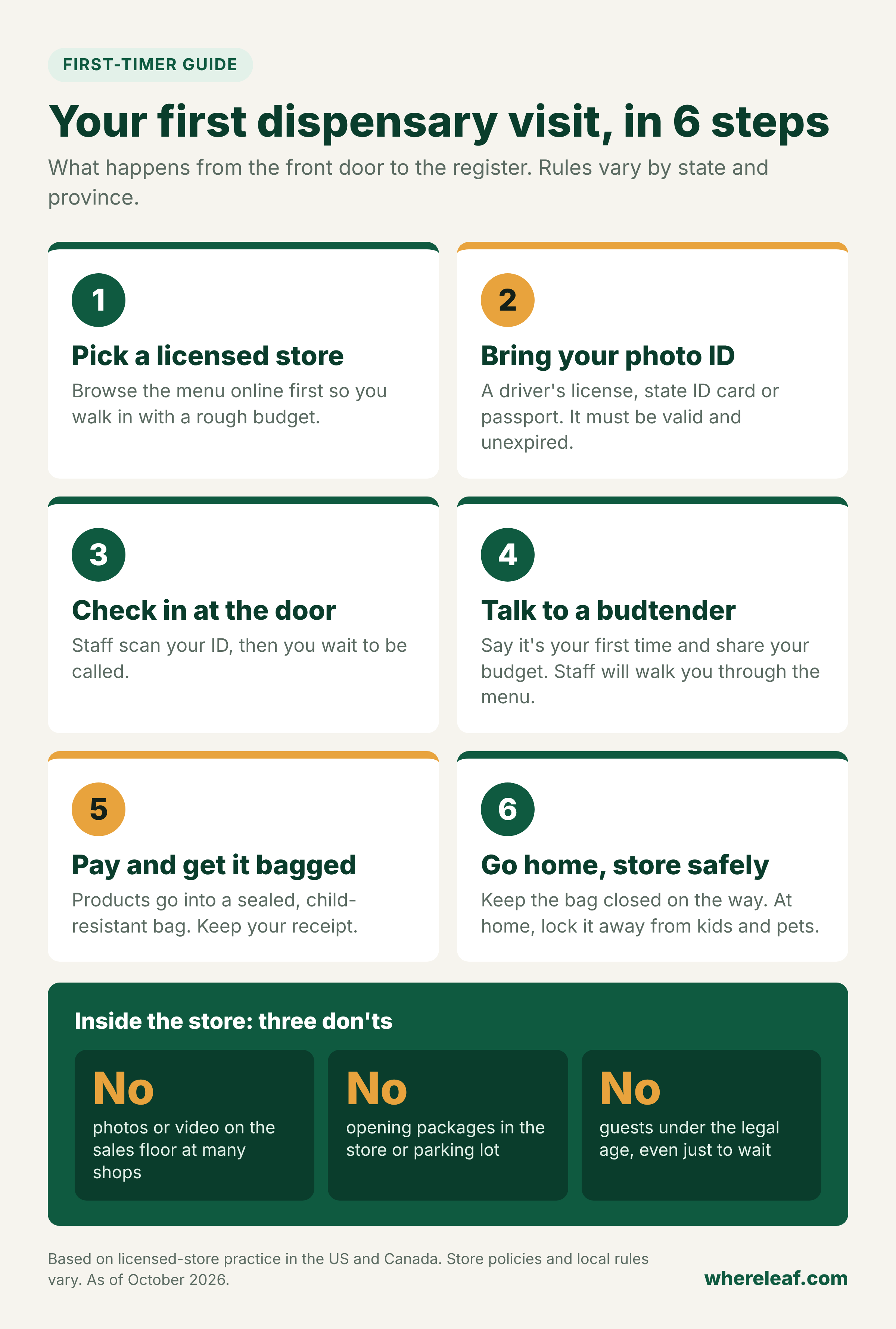
- Pick a licensed store. Use a directory like WhereLeaf and check that the store holds a state or provincial license. Look at the menu online so you have a rough budget in mind.
- Bring ID (and cash, just in case). More on both below.
- Check in at the door. Staff will scan or inspect your ID. Some stores collect basic details such as your name and birth date for their records or rewards program; you can usually decline the rewards part.
- Wait to be called. Many shops keep the sales floor small, so you may sit in a lobby for a few minutes.
- Talk to a budtender. Tell them it is your first visit. They will show you products, explain labels and answer questions.
- Pay and go. Products go into a sealed, child-resistant bag. Keep it closed until you get home.
What ID do you need?
You need a valid, unexpired government-issued photo ID that shows your birth date. A driver’s license, state ID card or passport is the safest bet. Staff are required to verify age, and they will turn you away if your ID is expired, damaged or missing, even if you clearly look old enough.
Age rules in the US
Every US state with legal adult-use sales sets the minimum age at 21. Out-of-state visitors can generally shop at adult-use stores with their home-state license or a passport, though some states give visitors lower possession limits (Illinois is one example below).
Medical cannabis programs are a separate legal category with their own rules. California, for example, allows adults 18 and older with a physician’s recommendation to buy from medical retailers, while adult-use buyers must be 21. Some stores serve both groups; some serve only one. Check the store listing before you go.
Age rules in Canada
In Canada, each province and territory sets its own minimum age. According to Health Canada, the age is 19 in most of the country, 18 in Alberta and 21 in Quebec.
| Jurisdiction | Minimum age to buy |
|---|---|
| All US adult-use states | 21 |
| Alberta | 18 |
| Quebec | 21 |
| BC, Manitoba, Ontario, Saskatchewan, Atlantic provinces and the territories | 19 |
How to pay: cash, debit and why credit cards are rare
In many US dispensaries, the card you are most likely to use is a debit card with a PIN, and many shops still prefer cash. Credit cards are often not accepted at all. It surprises a lot of first-timers, but there is a clear reason.
Why many US dispensaries do not take credit cards
Adult-use cannabis is still illegal under federal law. In April 2026, the federal government moved state-licensed medical marijuana and FDA-approved marijuana products to Schedule III, but marijuana outside those medical categories remains in Schedule I, and a broader rescheduling proposal is still pending as of October 2026. That means adult-use sales remain federally illegal.
Because of that, banks that serve cannabis businesses must follow extra federal reporting rules set out in FinCEN guidance from 2014, and many banks choose not to take these customers at all. Card networks have also pulled back. In 2023, Mastercard told banks and processors to stop allowing cannabis purchases on its debit cards, saying the federal government considers cannabis sales illegal. Visa had already shut down “cashless ATM” setups at dispensaries.
What to bring
- Cash always works. Many stores have an ATM in the lobby, but it usually charges a fee.
- Debit with a PIN works at some stores, depending on their payment processor. Ask when you check in.
- Payment apps built for the cannabis industry are accepted at some shops.
Canada is different. Cannabis is legal federally there, so card payments are much more common. Ontario’s government online store, for example, launched in 2018 accepting Visa and Mastercard.
Taxes: why your total is higher than the menu price
Cannabis is taxed more heavily than most goods, and the menu price often does not include tax. Here is how three large markets handle it as of October 2026.
| State | Cannabis-specific tax | Sales tax | Local taxes |
|---|---|---|---|
| California | 15% excise tax on the retail sale (back to 15% since Oct. 1, 2025) | Statewide 7.25%, charged on the price plus the excise tax | Many cities and counties add their own taxes |
| Colorado | 15% special retail marijuana sales tax, paid in place of the regular 2.9% state sales tax | Not charged on top at the state level | Local sales and marijuana taxes vary |
| Illinois | 10% for flower at or below 35% adjusted THC; 25% above 35%; 20% for infused products like edibles | 6.25% state rate | Cities up to 3%, counties up to 3.75% in unincorporated areas |
A quick example: a $50 purchase
- California: $50 plus 15% excise ($7.50) is $57.50. Sales tax of 7.25% on that adds about $4.17, for roughly $61.67 before any local cannabis tax.
- Colorado: $50 plus the 15% special sales tax ($7.50) is $57.50, before local taxes.
- Illinois: A $50 edible carries the 20% excise tax ($10) plus 6.25% state sales tax, so expect to pay well over $60 once local taxes are added.
These are simplified estimates. Your receipt will show the exact breakdown, and rates can change, so check your state revenue department for current numbers.
Purchase and possession limits
Every legal state caps how much you can buy at once, how much you can carry, or both. These limits are different things: a purchase limit is what a store can sell you in one day, and a possession limit is what you can legally have on you.
| State | Flower | Concentrate | Notes |
|---|---|---|---|
| California | 28.5 g per day (purchase) | 8 g per day (purchase) | Also up to 6 immature plants per day |
| Colorado | 1 oz per day (purchase); 2 oz possession | 8 g per day (purchase) | Edibles capped at 800 mg THC per day |
| Illinois (residents) | 60 g possession | 10 g possession | 1,000 mg THC in infused products |
| Illinois (visitors) | 30 g possession | 5 g possession | 500 mg THC in infused products |
Illinois doubled its possession limits in June 2026 with Senate Bill 3222, so older guides may still show the lower numbers. In Canada, adults can carry up to 30 grams of dried cannabis (or the equivalent) in public, and provinces may add their own rules. When in doubt, ask the budtender. Point-of-sale systems track limits, so staff can tell you how close you are.
Dispensary etiquette for first-timers
Dispensaries are retail stores with strict rules. A little courtesy makes the visit smoother for you and the staff.
- Have your ID out when you reach the door or check-in desk.
- Follow the phone rules. Many shops do not allow photos or video on the sales floor.
- Do not open packages or use products in the store or parking lot unless the business is a licensed consumption lounge.
- Ask before you touch. Some stores have display jars you can smell; others keep everything behind the counter.
- Know what you want to spend. Budtenders are happy to work within a budget.
- Tipping is optional. If someone spent extra time helping you, a tip is a kind gesture, but it is not expected everywhere.
- Do not bring anyone under the legal age. Minors are not allowed inside.
Questions to ask your budtender
Budtenders field first-timer questions all day. Good questions help you pick a product that fits your plans and budget. Keep them about products and experience, not health. Budtenders are not medical professionals, so take any health questions to a doctor or pharmacist.
- “I am new to this. What would you suggest for a low-dose first try?”
- “How much THC is in one serving of this, and how many servings are in the package?”
- “How long do people usually say this takes to kick in, and how long does it last?”
- “Can I see the lab results (certificate of analysis) for this product?”
- “What is the difference between these two options besides price?”
- “How should I store this at home?”
- “Are there any deals today, or is there a first-time customer discount?”
- “How close am I to the purchase limit with this order?”
Curious about strain names on the menu? You can read up ahead of time in our strain library.
Product formats at a glance
The menu can feel overwhelming. Most products fall into a few groups, and each one works a little differently.
| Format | What it is | First-timer note |
|---|---|---|
| Flower | Dried cannabis buds, sold by weight | Sold in small amounts like 1 g or an eighth (about 3.5 g) |
| Pre-rolls | Ready-made joints | No equipment needed; half-gram sizes are common |
| Vapes | Cartridges or disposable pens with cannabis oil | Buy only sealed, licensed products with lab results |
| Edibles and drinks | Gummies, chocolates, beverages | Effects are commonly reported to start much later than smoking, so wait before taking more |
| Concentrates | Wax, shatter, rosin and similar products | Very high THC; not usually a first purchase |
| Tinctures | Liquid extracts with a dropper | Easy to measure by the dose |
| Topicals | Lotions and balms applied to skin | Labeled for external use only |
Whatever you choose, start low and go slow. Read the label for THC per serving, and give yourself plenty of time before having more.
Your first-visit checklist
- Valid, unexpired photo ID (license, state ID or passport)
- Cash, plus a debit card as backup
- A rough budget that leaves room for taxes, which can add roughly 15% to nearly 40% depending on where you live
- Your state or provincial purchase and possession limits
- A short list of questions for the budtender
- A sober driver or a plan to get home without driving after use
- A safe, locked spot at home away from children and pets
After you buy, keep products sealed in the trunk or another area away from the driver while traveling, and never take them across a state line or international border. That is illegal even between two legal states and when entering or leaving Canada.
Own a dispensary and want first-time shoppers to find you? You can list your business or compare our listing packages. Growers and brands can also join our supplier directory.
Traveling for your visit? Read can you bring weed on a plane? before you fly, and check state rules such as the Michigan purchase limits. To know what a typical purchase costs, see how much is an eighth.
Frequently asked questions
Do I need a medical card to go to a dispensary?
Not in adult-use states. Adults of legal age can buy from licensed adult-use stores with a valid photo ID. Medical-only stores and states with medical-only programs do require a patient registration.
Can I use an out-of-state driver’s license?
Generally yes, at adult-use dispensaries in legal states, as long as it is valid, unexpired and shows you meet the legal age. Visitors sometimes face lower limits, so check before you buy.
Why won’t the dispensary take my credit card?
Card networks have pulled back from cannabis. In 2023, Mastercard told banks and processors to stop allowing cannabis purchases on its debit cards, and Visa had already shut down “cashless ATM” setups at dispensaries. Many stores have an ATM in the lobby, but it usually charges a fee.
How much should I spend on my first visit?
Keep it small. A single pre-roll, a gram of flower or a low-dose pack of edibles lets you try something without a big outlay. Remember to budget for taxes on top of the menu price.
Can I consume cannabis right after I buy it?
Not in the store or in public in most places. California and Illinois both ban use in public places, and Illinois also bans use in vehicles. Wait until you are home or at a licensed consumption lounge.
How long does a first visit take?
Usually 10 to 20 minutes, longer at busy times. Ordering ahead online can cut that down.
Sources
- Health Canada: Authorized cannabis retailers in the provinces and territories (accessed 2026)
- Health Canada: The Cannabis Act: Here’s what you need to know (accessed 2026)
- Pew Research Center: Nearly half of states have legalized recreational marijuana use (2026)
- Pew Research Center: Facts about marijuana in the U.S. (May 2026)
- Pew Research Center: Most Americans now live in a legal marijuana state, and most have at least one dispensary in their county (2024)
- California Department of Cannabis Control: What’s legal (2026)
- California Department of Cannabis Control: DCC regulations, 4 CCR section 15409 daily limits (2026)
- Treez: California purchase limits (accessed 2026)
- CDTFA: New Cannabis Excise Tax Rate Effective October 1, 2025 (2025)
- CDTFA: Cannabis Retailers (2026)
- Colorado Legislative Council Staff: Update on marijuana in the state budget (2025)
- Colorado Legislative Council Staff: Retail Marijuana, Colorado Law Summary (2025)
- KKTV: Governor Polis signs bill to increase marijuana possession limit for adults in Colorado (2021)
- Westword: Colorado marijuana purchase limit doubles if bill passes (2025)
- Westword: Push to double Colorado marijuana purchase limit fails (2025)
- Illinois Department of Revenue: Cannabis Tax Frequently Asked Questions (2026)
- State of Illinois: Cannabis FAQs (2026)
- NORML: Illinois Governor Signs Law Raising Adult-Use Marijuana Possession Limits (2026)
- Morgan Lewis: Post-DEA Hearing, Broader Marijuana Rescheduling Questions Remain (2026)
- FinCEN: BSA Expectations Regarding Marijuana-Related Businesses (2014)
- NBC Chicago: Mastercard blocks cannabis purchases on debit cards (2023)
- Global News: Ontario Cannabis Store online sales (2018)
Last updated: October 2026. Laws and prices change; always check your state or provincial regulator.