Do dispensaries take credit cards? In the United States, most do not: as of October 2026, Visa and Mastercard rules bar cannabis purchases on their cards, so the typical US dispensary takes cash, sometimes debit with a PIN, and sometimes a bank-linked payment app. In Canada the answer is different, because cannabis is legal nationwide and licensed stores can take Visa, Mastercard and debit like any other shop.
That gap catches a lot of people at the register. A store that took your debit card last year may be cash only today, and the lobby ATM can add a few dollars to every visit.
This guide explains why credit cards are so rare at US dispensaries, which payment options you are likely to find, what each one costs you, and how Canada handles it. If you are planning your very first trip, start with our first dispensary visit guide, then come back here for the payment details.
Key takeaways
- Most US dispensaries do not take credit cards. Visa and Mastercard do not allow cannabis purchases while adult-use cannabis is illegal under federal law.
- The April 2026 federal rescheduling covered only FDA-approved products and state-licensed medical marijuana. Adult-use cannabis is still Schedule I, and the card networks have not changed their rules.
- Cash always works. PIN debit, “cashless ATMs” and pay-by-bank apps such as Aeropay and CanPay work at some stores, and their fees vary.
- In Canada, licensed stores take credit and debit cards, including the government-run online stores.
- Rules differ by state and province, and payment options differ by store. Always check your local regulator and call the shop before you go.
Do dispensaries take credit cards in the US?
Usually not. A typical US dispensary offers cash, a lobby ATM, and maybe one or two cashless options. A store that really runs Visa or Mastercard credit for cannabis is the exception.
In September 2026, the Government Accountability Office (GAO) released a report on cannabis banking. It found that taking customer payments is a major problem for cannabis businesses and that “two major credit card companies prohibit cannabis purchases.” A card-industry trade group told the GAO that Visa and Mastercard would not change their policies unless cannabis is legalized at the federal level.
What about stores that say “cards accepted”?
When a US dispensary says it takes cards, it nearly always means one of these:
- Debit with a PIN, often run as a “cashless ATM” withdrawal rather than a normal sale.
- A pay-by-bank app that pulls money straight from your checking account.
- An in-store ATM, where you take out cash and then pay with it.
If a store swipes your credit card and the charge shows up under a different business name, the sale has likely been miscoded, which Visa says breaks its rules. Setups like that can stop working at any time.
Why don’t dispensaries take credit cards?
It comes down to three layers of federal rules: drug law, banking law and card network rules.
Adult-use cannabis is still Schedule I
On April 22, 2026, the DEA issued a final rule, published April 28, that moved marijuana in FDA-approved products and marijuana covered by a state medical license to Schedule III. Everything else, including cannabis sold in adult-use (recreational) stores, stays in Schedule I. A broader proposal to move all marijuana to Schedule III went through a DEA hearing from June 29 to July 15, 2026, and no final decision had been made as of October 2026.
So a recreational sale in a state where it is fully legal is still a federal crime. For the state-by-state picture, see where cannabis is legal in 2026.
Card networks follow federal law
Visa and Mastercard set the rules for every bank and processor on their networks. Both bar US cannabis sales. In July 2023, Mastercard said: “The federal government considers cannabis sales illegal, so these purchases are not allowed on our systems.” The partial rescheduling has not changed that.
Banks face extra federal reporting
On February 14, 2014, the Treasury Department’s Financial Crimes Enforcement Network (FinCEN) issued guidance on how banks can serve marijuana businesses. Banks must vet each business closely and file special suspicious activity reports on it. That costs money and carries legal risk, so many banks and processors simply say no.
Congress has tried to fix the banking side. A new SAFE Banking Act was filed in the Senate on June 24, 2026, and in the House the next day. Earlier versions passed the House several times but never became law, and the bill mainly protects banks rather than forcing card networks to allow cannabis purchases.
Do dispensaries take debit cards?
Some do, but less often than a few years ago. “Debit accepted” at a dispensary rarely means a normal debit sale, and the usual workarounds have run into trouble with the card networks.
What is a cashless ATM or “PIN debit”?
A cashless ATM looks like an ordinary card reader at the counter. You insert your debit card and enter your PIN, and the purchase is processed as an ATM cash withdrawal instead of a sale. Stores often round the total up to the nearest $10 or $20 and hand you the difference in cash, so the record looks like a withdrawal.
Visa warned in a memo dated December 2, 2021, that these terminals break its rules because they miscode purchases as cash withdrawals. A year later, in December 2022, many dispensaries saw their cashless ATMs go dark and switched back to cash.
Mastercard’s 2023 move against debit at dispensaries
In late July 2023, Mastercard told the banks and processors serving cannabis merchants to stop allowing cannabis purchases on its debit cards. The order targeted PIN debit systems, and many shoppers went back to cash.
Some stores still take PIN debit through other processors as of October 2026. These setups can change with little notice, so see debit as a bonus, not a plan.
Do dispensaries take Apple Pay or tap to pay?
Very rarely in the US. Apple Pay, Google Pay and tap-to-pay are not separate payment systems. They run on the Visa or Mastercard card stored in your phone or wallet, so the same network rules apply. If a dispensary cannot take your card, it cannot take that card through your phone either.
What you may see instead is a QR code from a cannabis payment app, which moves money straight from your bank account.
What payment options will you actually find?
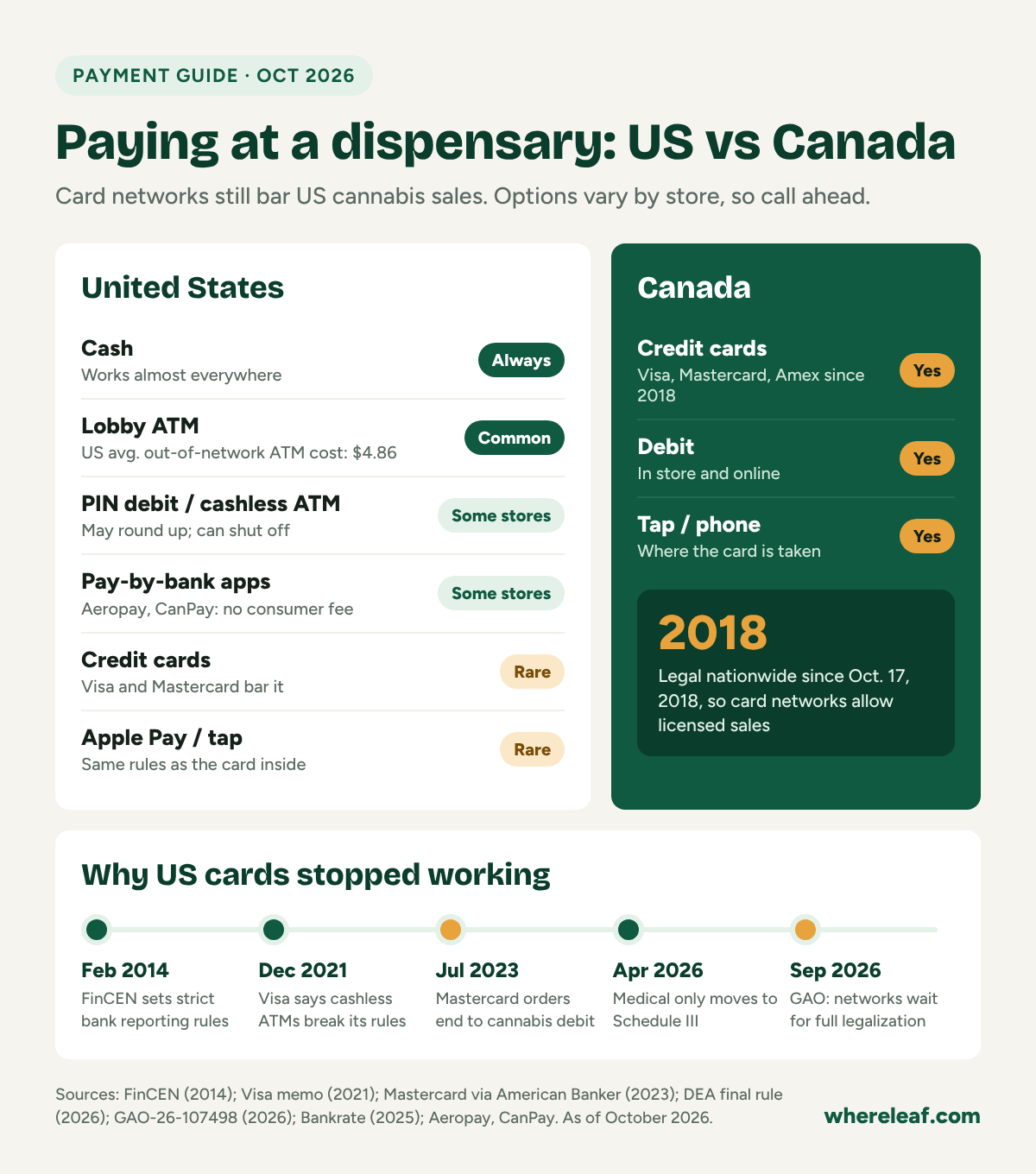
Here is how the common options compare at US dispensaries as of October 2026. Availability depends on the store and its processor, not just the state.
| Payment method | How common in the US | Typical cost to you | Watch out for |
|---|---|---|---|
| Cash | Accepted almost everywhere | Free if you bring it; ATM fees if you don’t | Carrying large amounts; exact change helps |
| In-store ATM | Common in lobbies | A surcharge plus your own bank’s fee (about $4.86 total on average for out-of-network ATMs) | Fee shown on screen; daily withdrawal limits |
| PIN debit / cashless ATM | Some stores | Often a per-transaction fee; total may be rounded up | Can shut off without warning; shows as an ATM withdrawal |
| Pay-by-bank app (Aeropay, CanPay) | Some stores and chains | No consumer fee, according to both companies | Needs a linked checking account and setup before you go |
| Credit card | Rare | Card fees, or a cash advance if used at an ATM | May break network rules; could stop working |
| Apple Pay, Google Pay, tap | Rare | Same as the card underneath | Same limits as credit and debit cards |
Payment apps like Aeropay and CanPay
Pay-by-bank apps are the closest thing to a card that most US dispensaries can offer. You link your checking account in the app once, and each purchase is a bank transfer for the exact amount.
- Aeropay links to your bank account, and the company says it does not charge consumers fees.
- CanPay links only to a checking account. You tap “Pay Now” to create a one-time payment code that the store scans, and the code expires after 30 minutes. CanPay says users pay no extra fees.
Not every store uses these apps, and most support only one. Check the store’s website before you download anything, and set the app up at home.
Are most dispensaries cash only?
Many are. A 2026 overview from point-of-sale company Cova described most US dispensaries as still mostly cash based. Cash is the one method a bank or card network cannot switch off.
How much do dispensary ATM fees cost?
There is no single dispensary ATM fee. The ATM owner sets a surcharge and shows it on the screen before you confirm. Your own bank may add an out-of-network fee on top. In Bankrate’s 2025 study, the average combined cost was $4.86: a $3.22 surcharge from the ATM owner plus $1.64 from your bank.
Worked example: paying for a $100 order
Say your total, with tax, comes to $100. Here is what each common method could cost you, using the averages above:
- Cash from home: $100, if you withdrew it free at your own bank.
- Lobby ATM: You take out $120 and pay about $4.86 in fees, for roughly $104.86. You leave with $20 in change.
- Cashless ATM: The store rounds you up to $120 and hands back $20 in cash, plus any fee on the screen. Count the change before you leave.
- Pay-by-bank app: $100, with no consumer fee according to Aeropay and CanPay.
- Credit card at the ATM: Avoid this. It counts as a cash advance. According to the CFPB, cash advances often carry a fee and a higher rate, and interest starts right away with no grace period.
Using the lobby ATM weekly at $4.86 a trip adds up to about $250 a year, so pull cash at your own bank first.
Can you use a credit card at dispensaries in Canada?
Yes. Canada legalized adult-use cannabis nationally on October 17, 2018, and that week Visa, Mastercard and American Express each said their cards could be used at legally licensed Canadian retailers. Tap, Apple Pay and Google Pay work wherever the store takes the card underneath.
- Ontario: The Ontario Cannabis Store, the province’s online retailer, launched in October 2018 taking Visa and Mastercard.
- British Columbia: BC Cannabis Stores takes credit and debit cards online and in its stores. Online orders appear as “BCS Online” on your statement.
- Private stores: Licensed private retailers can take debit and credit like any other shop, but each store chooses which cards it accepts, so check before you go.
US visitors who meet the local minimum age can pay with their cards too, but taking cannabis across the US-Canada border is illegal in both directions. Also, buy only from licensed stores; our guide to checking whether a dispensary is licensed shows how to confirm it with your provincial regulator.
Your dispensary payment checklist
- Look up the store on WhereLeaf’s dispensary finder and check its listing or website for accepted payments.
- Call ahead if you plan to pay with anything other than cash. Ask: “Do you take debit, and is there a fee?”
- Bring enough cash to cover the total with tax, plus a little extra.
- Withdraw cash at your own bank’s ATM before you go to skip surcharges.
- If the store uses Aeropay or CanPay, set up the app and link your checking account at home.
- Never use a credit card at the lobby ATM. That is a cash advance with fees and immediate interest.
- With a cashless ATM, read the fee on the screen and count your change before you leave.
- In Canada, expect to pay with a card as normal, and do not bring cannabis across any border.
For dispensary owners: make payments easy to find
A surprise at the register costs you sales. Say plainly what you accept on your website and your directory listings, including any ATM or app fees, and update it the day your processor changes.
List your dispensary on WhereLeaf to show your payment options, hours and menu link to nearby shoppers. See listing packages for featured placement.
Frequently asked questions
Why do dispensaries only take cash?
Adult-use cannabis is still illegal under US federal law, so Visa and Mastercard do not allow cannabis purchases, and many banks and processors avoid the industry. Cash is the one option that a bank or card network cannot shut off.
Can I use my credit card at a dispensary ATM?
Often you can, but it counts as a cash advance, which usually carries a fee and a higher rate, with interest starting right away. Use your debit card instead.
Did the 2026 rescheduling let dispensaries take credit cards?
No. The April 2026 rule moved only FDA-approved products and state-licensed medical marijuana to Schedule III, and adult-use cannabis stayed in Schedule I. A card-industry trade group told the GAO that Visa and Mastercard would not change their policies without full federal legalization.
Do medical dispensaries take credit cards?
Generally no. Medical stores face the same card network rules, and the 2026 move to Schedule III did not make their sales federally legal. Expect cash, PIN debit or a payment app.
Is it legal for a dispensary to take my debit card?
The issue is mostly card network rules. Visa says cashless ATM setups break its rules, and Mastercard ordered banks to stop cannabis debit purchases in 2023, which is why debit options can vanish without warning.
Can tourists use credit cards at Canadian cannabis stores?
Yes, licensed Canadian stores take major cards, and visitors who meet the provincial minimum age can buy there. Use it in Canada only, because carrying cannabis across the border is illegal.
Sources
- FinCEN: BSA Expectations Regarding Marijuana-Related Businesses (2014)
- U.S. GAO: Banking Services: Cannabis Businesses Face Access Challenges, GAO-26-107498 (2026)
- Cannabis Business Times: Visa, Mastercard likely won’t change cannabis payment policies under Schedule III, GAO finds (2026)
- Morgan Lewis: Post-DEA Hearing, Broader Marijuana Rescheduling Questions Remain (2026)
- American Banker: Mastercard demands shutdown of marijuana purchases on its debit cards (2023)
- MJBizDaily: Mastercard ban on cannabis debit-card purchases rocks industry (2023)
- Ganjapreneur: Visa warns against cashless ATM payments in cannabis dispensaries (2021)
- Fortune: Cashless ATMs at cannabis dispensaries (2022)
- American Banker: Weed shops switch to cash after cashless ATM crackdown (2022)
- National Law Review: The long and winding road, SAFE Banking returns to Congress again (2026)
- Cova Software: Can dispensaries accept credit cards? Cannabis retail payments explained (2026)
- Bankrate: Checking Account and ATM Fee Study (2025)
- CFPB: Can I withdraw money from my credit card at an ATM? (2026)
- Aeropay: How to pay with Aeropay (2024)
- CanPay: How Pennsylvania pays for cannabis (2024)
- American Banker: As Canada legalizes pot, Amex, Visa, Mastercard agree to handle payments (2018)
- Global News: Ontario Cannabis Store online sales (2018)
- BC Cannabis Stores: 5 great reasons to shop at BC Cannabis Stores (2024)
Last updated: October 2026. Laws and prices change; always check your state or provincial regulator.