
Do you tip at a dispensary? You don’t have to: tipping your budtender is optional everywhere in the US and Canada, but in many adult-use stores a small tip of a dollar or a few dollars is a common way to say thanks for good help. No law requires it, and no budtender should make you feel bad for skipping it.
The confusion is fair: a budtender does part retail work and part advice, and the counter often has a tip jar or a card screen asking for a percentage. Some people tip every time, some only when they get real help, and plenty never tip at all.
This guide gives you an honest answer with real numbers where they exist: what budtenders report as normal, what they earn, the state rules that once banned tips, delivery and pickup norms, how Canada differs and the basic etiquette that matters more than any tip.
Key takeaways
- Tipping at a dispensary is optional. It is never a condition of sale, and Washington’s regulator says so in writing.
- Budtenders and store managers quoted in the press describe $1 to a few dollars as a typical in-store tip, with more for long consultations or large orders.
- Delivery is where tipping is most expected. Denver delivery services have reported drivers usually get $5 to $15 per stop.
- In Canada, tipping at cannabis stores is less established, and recent surveys show many Canadians are tired of tip prompts.
- Rules differ by state and province. Always check your local regulator.
Do you tip at a dispensary? The honest answer
Yes, many people do, but it is not required. Tipping budtenders became common in US adult-use markets in the 2010s, and you will now see tip jars at many stores. Still, budtenders and store managers interviewed by Leafly and High Times describe tips as a bonus, not an expectation.
The fair way to think about it: a dispensary visit sits between buying something at a regular store and getting help at a coffee shop or bar. If the budtender just hands over a pre-ordered bag, skipping the tip is normal. If they spend ten minutes helping you compare products, a small tip is a kind gesture.
Why tipping comes up at all: how much budtenders earn
Budtenders are retail workers, and their pay looks a lot like other retail jobs. There is no separate federal job code for budtenders, so the closest official figure is the Bureau of Labor Statistics median for retail salespersons. Job-posting data from Indeed gives a budtender-specific average.
That last number matters. Under federal law, employers can pay “tipped employees” as little as $2.13 an hour in cash wages if tips bring them up to the minimum wage, though many states set higher rules. In practice, most dispensaries pay budtenders a regular hourly wage, and tips are extra. You can’t tell from the counter how a given store pays, which is one reason a small tip for good service is a reasonable habit.
How much to tip a budtender
There is no official standard, and no large survey measures dispensary tips. What we do have are reported norms from people who work the counter:
- $1 to $5 is the commonly reported range. A Washington store owner told Leafly a dollar is nice and some customers give $5 on large purchases. A Florida dispensary manager told High Times that “a couple of dollars” is standard and she would not expect 15% or more.
- More for a long consultation. Weedmaps’ 2025 guide suggests 15% to 20% when a budtender spends real time with you. That is a suggestion from one publisher, not a measured norm, so think of it as an upper end.
- Little or nothing for a quick pickup. Weedmaps suggests $1 to $2. Many people pay nothing for an order they placed online.
A worked example
Say you buy a $60 order after asking a few questions about flavor and price. A $2 tip is about 3% of the order. A $5 tip is about 8%. Both sit inside what budtenders describe as normal. A restaurant-style 20% would be $12, which most budtenders would see as very generous rather than expected.
Percentages also get awkward because cannabis taxes are high in many states. Tipping a flat dollar amount based on the help you got, not the total on the receipt, is simpler and fair.
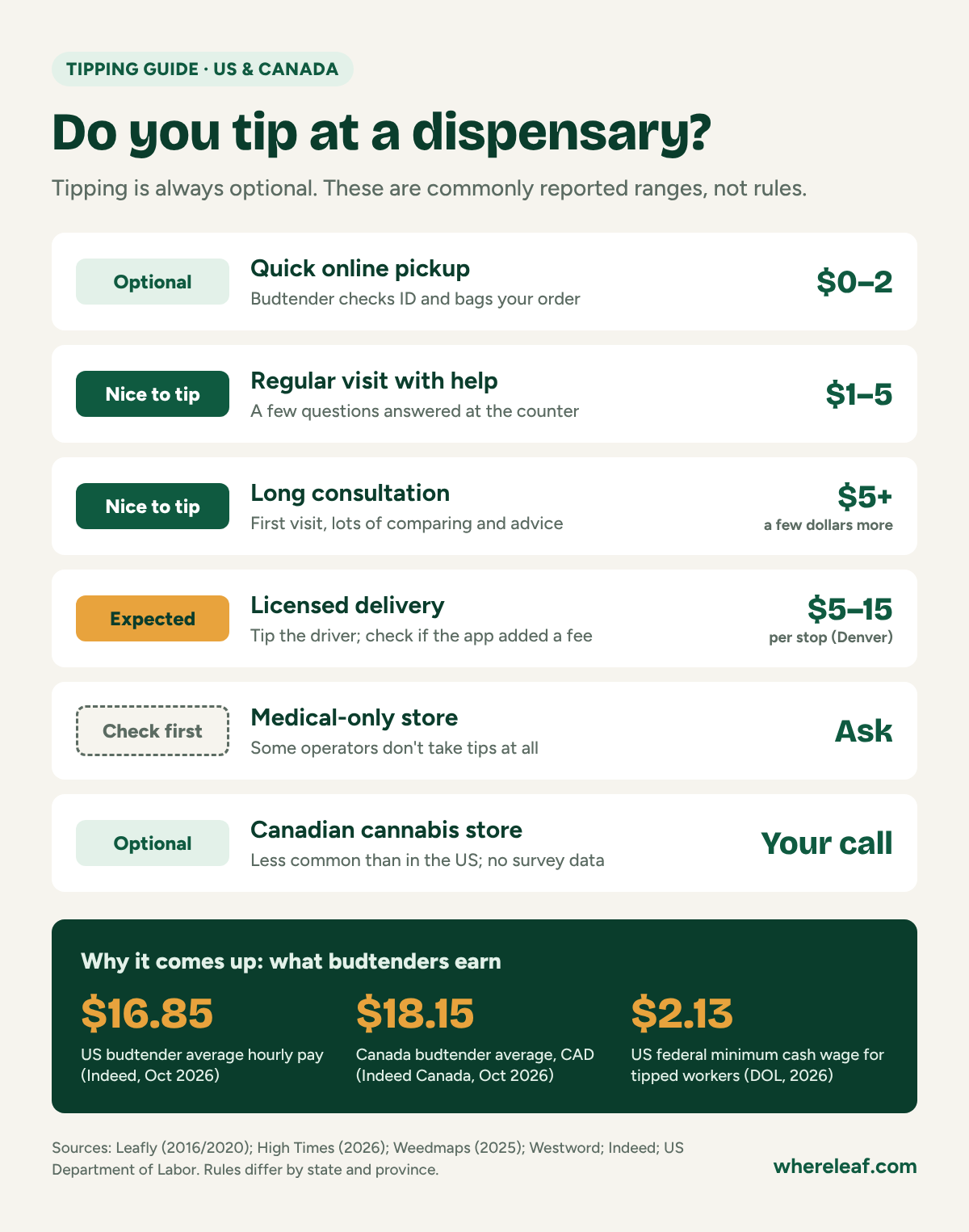
When to tip: a quick decision table
Use this as a starting point. Amounts are the reported ranges above, not rules.
| Situation | Tip? | Reported range |
|---|---|---|
| Online order, quick in-store pickup | Optional | $0 to $2 |
| Regular visit, a few questions answered | Nice if you can | $1 to $5 |
| Long consultation, first visit, lots of help | Yes, if you are happy with it | A few dollars or more |
| Large order or big group purchase | Nice if you can | $5 or more |
| Licensed home delivery | Most expected | $5 to $15 per stop (Denver report) |
| Medical-only store | Check first | Some stores do not take tips |
| Canadian cannabis store | Optional, less common | No reliable data |
| Bad or rushed service | No | $0 |
Do any states restrict tipping at dispensaries?
As of October 2026, we could not find any US state that currently bans tipping at licensed adult-use dispensaries. But there is history, and some rules shape how tips work.
Washington banned tips, then allowed them
Washington’s cannabis regulator, now called the Liquor and Cannabis Board, did not allow tipping in licensed stores at first. Its concern was that stores could lower posted prices and shift money into “tips” to avoid the state’s cannabis excise tax. On March 14, 2016, after a tax law change, the board announced that tipping was allowed, effective immediately, with three conditions:
- A tip can’t be required or made a condition of sale.
- Tips can’t be tied to product prices to dodge taxes.
- Stores that allow tips must handle any tax duties that come with them.
Connecticut: tips can’t replace minimum wage
Connecticut’s 2026 labor law, signed May 11, 2026, says cannabis workers must be paid at least the state minimum wage. The legislature’s analysis of the matching bill says tips can’t be counted toward that minimum. So in Connecticut, your tip is truly extra, not part of the base wage.
Medical-only stores may skip tip jars
Some operators choose not to accept tips at medical-only locations. A Colorado retail executive told High Times her company generally stopped tipping in medical-only states. If you don’t see a jar or a tip prompt, don’t push it.
Tips are taxable
For budtenders, tips are income. The IRS says employees must report cash tips of $20 or more in a month to their employer, and all tips belong on their tax return. That is the worker’s job, not yours.
Tipping dispensary delivery drivers and pickup orders
Delivery: tip the driver
Licensed cannabis delivery is the situation where tipping is most expected, much like food delivery.
Real data is limited. Denver’s alt-weekly Westword asked three local delivery services, which said their drivers typically get $5 to $10 per stop at two companies and $10 to $15 at a third. Weedmaps suggests 15% to 20% of the order. On an $80 delivery, that means anything from $5 to $16 is in the normal range.
Before you tip, check whether the app already added a tip or service fee, and ask whether a tip on the card goes to the driver. If you’re new to delivery, our cannabis delivery guide covers how licensed services check ID, where delivery is legal and how to spot unlicensed sellers.
Pickup orders: optional
Tipping on pickup orders is optional, and many people skip it. You chose your products online, so the budtender mainly checks your ID, bags the order and takes payment. A dollar or two is a nice touch if they double-checked your order or helped you swap an item. Canadian survey data points the same way: in a May 2025 Research Co. poll, 57% of Canadians said a tip isn’t necessary when picking up food themselves.
Is tipping expected at cannabis stores in Canada?
Less so than in the US. We could not find any survey of tipping at Canadian cannabis stores, so here is what we can say honestly:
- It is optional. Some stores have tip jars or tip prompts at the counter. Others don’t ask at all.
- Budtender pay is close to other retail jobs. Indeed Canada’s job-posting average for budtenders is $18.15 an hour (October 2026), so tips are an extra, not the main paycheck.
- Canadians are pushing back on tip prompts in general. In a March 2026 H&R Block Canada survey, 67% said Canada should do away with tipping culture and 79% said they enter their own tip amount instead of picking a suggested percentage when they can.
A practical Canadian approach: no tip is needed for a quick sale, a couple of dollars is a friendly extra for great help, and delivery drivers deserve a tip like any other delivery. Remember that the legal age and buying rules differ by province (18 in Alberta, 21 in Quebec and 19 in most others), and cannabis can’t cross the Canada–US border in either direction.
Dispensary etiquette beyond the tip
Good manners matter more to budtenders than the size of your tip. These habits make every visit smoother. For a step-by-step walkthrough, see our first dispensary visit guide.
- Have your ID out. Expect an ID check at the door or the counter, every time, even if you look older. Out-of-state IDs are fine in many US states but check the store’s rules.
- Know roughly what you want. Browse the menu online or in our strain library first. Questions are welcome, but have a budget and a format in mind (flower, edibles, vapes).
- Don’t open, sniff or touch product unless offered. Many stores use display jars or sample cases. Ask before you handle anything.
- Don’t consume on site. Unless the store has a licensed consumption lounge, using cannabis in the store or parking lot can get you banned and may break local law.
- Respect purchase limits. Every state and province caps how much you can buy at once. If the budtender says no, that is the law, not their choice.
- Bring a payment backup. Many dispensaries take cash or debit only, so carry cash in case the card system isn’t available.
- Keep the line moving. Save long chats for quieter times.
- Be kind if they say no. Budtenders can’t bend the rules, even for regulars.
And the safety basics: adults only, start low and go slow with anything new, don’t drive after using cannabis and keep products locked away from kids and pets.
Your dispensary tipping checklist
- Is this a licensed store? Check before you go using WhereLeaf’s dispensary finder.
- Did the budtender spend real time helping you? If yes, consider $1 to $5 or more.
- Was it a quick online pickup? A tip is optional.
- Is it a delivery? Plan on tipping the driver, roughly $5 to $15 per stop or 15% to 20% of the order.
- Is it a medical-only store or a Canadian store with no tip prompt? Look for a jar or prompt first; don’t force it.
- Paying by card? Check whether a tip or service fee is already included.
- Want tips to reach the right person? Cash in the jar or a direct hand-off is the clearest route.
- Can’t tip today? Say thanks, come back and leave a good review that names the budtender.
For dispensary owners: tips, tip jars and fair pooling
A clear tip policy helps staff and customers. Keep tipping voluntary and separate from pricing, as Washington’s rules require. Pay at least minimum wage before tips. If you pool tips, keep managers and supervisors out of the pool, since tip-sharing lawsuits against cannabis retailers have produced settlements in several states.
Post a short sign that says tips are optional and go to staff. Customers are more likely to tip when they trust where the money goes. Then make sure shoppers can find you: list your dispensary on WhereLeaf for free, or see our featured packages to show up first in local searches.
Frequently asked questions
Are you supposed to tip at a dispensary?
No, you are not required to. Tipping is optional and can’t be a condition of sale. Many people leave $1 to a few dollars when a budtender gives helpful service.
Is it rude not to tip your budtender?
No. Budtenders and managers quoted in the press describe tips as a bonus, not an expectation. Being polite and prepared matters more than a tip.
Do you tip on a dispensary pickup order?
It is optional. Since you chose your products online, many people don’t tip on pickup. A dollar or two is a nice extra if the budtender fixed a problem or helped with a swap.
How much do you tip a weed delivery driver?
Denver delivery services have reported their drivers usually get $5 to $15 per stop, and Weedmaps suggests 15% to 20% of the order. Tip more for bad weather, long distances or large orders, and check if the app already added a tip.
Can I tip with a card at a dispensary?
Some dispensaries add a tip option to their payment screen, and others accept tips in cash only. If you want to be sure the tip reaches the person who helped you, ask the store how card tips are shared.
Do people tip at cannabis stores in Canada?
Some do, but it is less common than in the US, and we found no survey on cannabis-store tipping in Canada. Tipping is optional, and a small tip for great help or for a delivery driver is always welcome.
Sources
- Leafly: The Etiquette of Budtender Tipping (2016, updated 2020)
- High Times: Counter Culture: The Tip Jar at Your Dispensary Has a Problem. Several, Actually. (2026)
- Weedmaps: Should You Tip Your Budtender? What Cannabis Workers Want You To Know (2025, updated 2026)
- Oaksterdam University: Budtender Tipping: What Customers and Dispensaries Should Know (2024, updated 2025)
- Kent Reporter: State to allow customers to tip retail marijuana store staff (2016)
- Ganjapreneur: Washington Regulators Legalize Tips for Budtenders (2016)
- Connecticut General Assembly, Office of Legislative Research: Bill Analysis, SB 352 (2026)
- CT Mirror: Lamont touts labor bill as he pursues nomination for 3rd term (2026)
- Indeed: Budtender salary in the United States (2026)
- Indeed Canada: Budtender salary in Canada (2026)
- US Bureau of Labor Statistics: Occupational Outlook Handbook, Retail Sales Workers (2025 data)
- US Department of Labor: Minimum Wages for Tipped Employees (2026)
- IRS: Topic No. 761, Tips: Withholding and reporting (2026)
- Westword: Ask a Stoner: What’s a Good Tip for Marijuana Deliveries? (undated)
- Research Co.: Canadians Irked by “Suggested Tips” at Sit-Down Restaurants (2025)
- Daily Hive: Majority of Canadians are fed up, want to “abolish” tipping culture (2026)
Last updated: October 2026. Laws and prices change; always check your state or provincial regulator.