The best budtender interview questions test four things: whether the candidate will check every ID, whether they know products well enough to explain them clearly, whether they can handle cash and pressure, and whether they will avoid medical advice. Below are 25 questions grouped by purpose, with what a strong answer sounds like and the red flags to watch for.
A budtender is often the only person a customer talks to at your store. One sale to a minor or one careless health claim can put your license at risk, while an honest, confident budtender keeps people coming back.
This guide is for dispensary owners and hiring managers in legal US markets. It covers job descriptions, permits, pay, the questions, scoring and training.
Key takeaways
- Candidates from retail or bars often learn fastest, because they already check IDs, handle cash and say no politely.
- Ask every candidate how they would answer a customer looking for help with a health concern. The right answer is “I can’t give medical advice,” followed by facts about format, dose and the label.
- Some states license or register each budtender, while others put the screening duty on the business. Know which kind of state you’re in before you post the job.
- Pay data for budtenders is thin and self-reported, so compare general retail wages with local job posts when you set a rate.
- Rules differ by state and province. Always check your local regulator before you hire.
What does a budtender do? (Job description basics)
A budtender helps adult customers choose legal cannabis products, checks ID, rings up sales and keeps the floor in line with state rules. It is retail work with a far heavier compliance load.
Core duties to put in your budtender job description
- Check ID at the point of sale and refuse anyone under the legal age or with a doubtful ID.
- Explain product formats, potency, serving sizes and onset times in plain language.
- Track purchase limits and record every sale correctly in the point-of-sale and state tracking systems.
- Handle cash accurately, follow drawer counts and security procedures.
- Restock, check packaging and labels, and keep the floor clean and secure.
- Avoid health claims and refer medical questions to a doctor or pharmacist.
Requirements to list
List the minimum age (21 in the states below), any state permit and a background check. Add soft skills: clear speaking, patience and comfort saying no. Retail or bar experience transfers well, since those workers already check IDs and handle cash.
Do budtenders need a state permit or badge?
It depends on the state. Some states license or register each worker. Others put the duty on the business to screen, train and record its staff. Here is how four major markets handle it as of October 2026.
| State | Worker credential | Minimum age | What the employer must do |
|---|---|---|---|
| Colorado | MED employee license (often called a “badge”). $170 total at application; renewal $120. | 21 | Hire only licensed employees. Since January 5, 2026, fingerprints are no longer required for employee license applications (HB25-1209). |
| Massachusetts | Cannabis Control Commission agent registration card, valid one year from issue | 21 | The business applies for each agent, submits a CORI report and notifies the Commission within one business day after an agent leaves. Agents who handle or sell cannabis complete Responsible Vendor Training within 90 days of hire. |
| Michigan | Employer-managed. Staff are entered in the statewide monitoring system. | 21 (adult-use) | Run a criminal background check before hiring, enter the employee within 7 business days, and train from a written employee manual. |
| Washington State | Employer-managed for retail staff. Stores with a medical endorsement may use Department of Health certified medical cannabis consultants. | 21 | Never employ anyone under 21. The person making the sale is responsible for checking ID. |
Colorado’s employee license is open to people who live anywhere in the US.
For Washington State and Michigan, the rules we reviewed place duties on the business rather than spelling out a separate state card for each budtender. Confirm current rules with Washington State’s Liquor and Cannabis Board or Michigan’s Cannabis Regulatory Agency. In any state, ask candidates whether they hold the right permit or whether anything would stop them from getting one.
How much do budtenders make?
Budtender pay is usually hourly plus tips where the state and store allow them. The US Bureau of Labor Statistics does not list budtenders as a separate job, so most owners use retail wage data and pay sites as a guide.
Glassdoor shows budtender base pay of roughly $34,000 to $45,000 a year, plus $10,000 to $18,000 in additional pay. PayScale’s smaller sample (June 2026) puts the average base rate near $16.89 an hour. Both are self-reported and vary by city, so check local job posts too.
In the interview, give the base hourly rate first and explain tips separately, so candidates don’t count on income that changes week to week.
How to hire a budtender: the process
A repeatable process keeps interviews fair and compliance steps from slipping. This six-step flow works for most single stores and small chains.
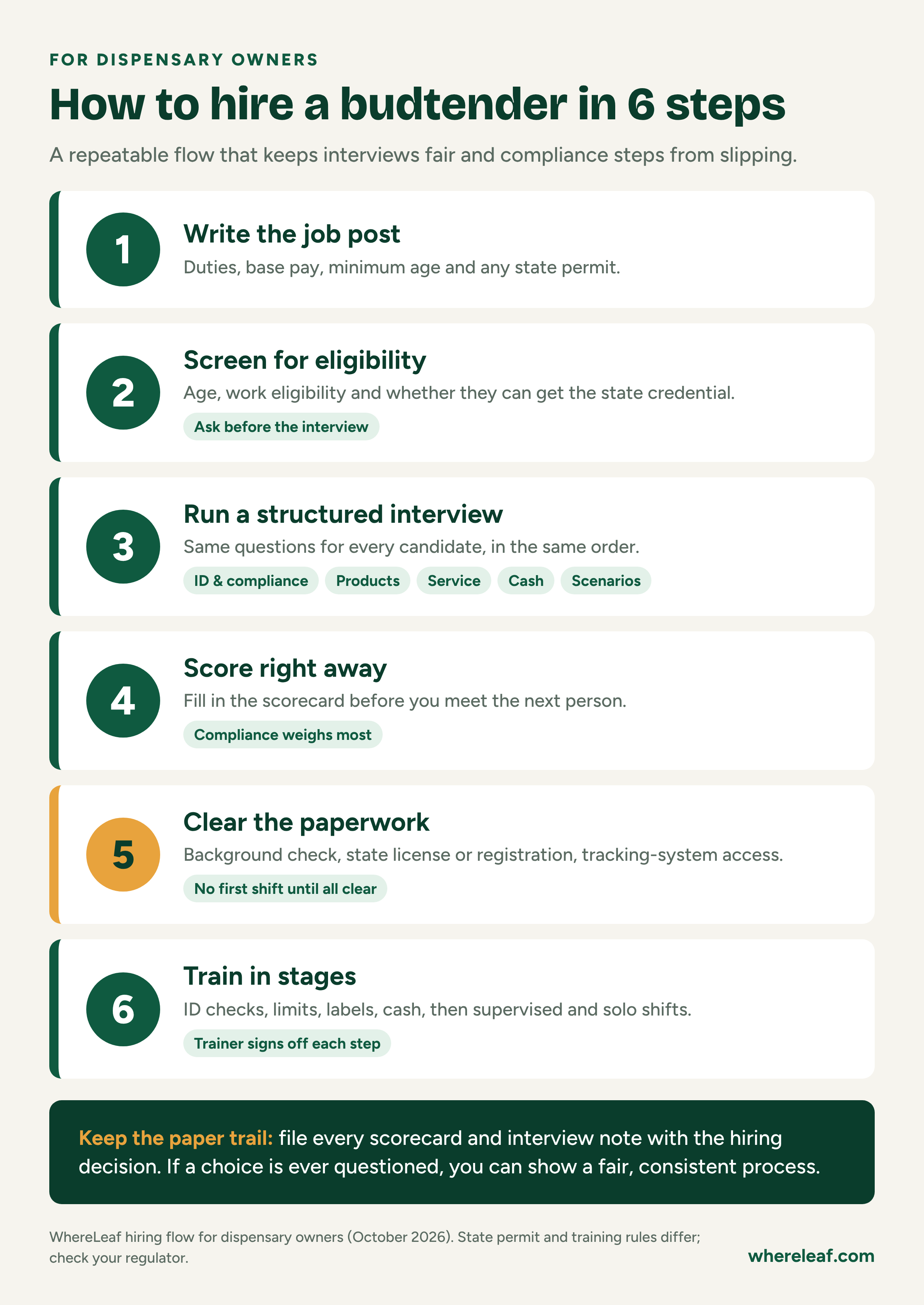
Two steps matter most. Score each candidate right after the interview, before you meet the next one, and don’t schedule a first shift until the background check, state credential and tracking-system access are complete.
25 budtender interview questions and answers
Health claims deserve special attention. Washington State, for example, bars cannabis ads claiming curative effects (WAC 314-55-155), and other states have similar limits. Use all 25 questions in a 45-minute interview, or pick a few per group. Listen for specifics, not what sounds nice.
Compliance and ID checks
- Walk me through how you’d check a customer’s ID. Good answer: checks the photo, birth date, expiration date and security features, and scans it if the store has a scanner. Red flag: “I’d just glance at it if they look old enough.”
- A customer’s ID is expired by one day. What do you do? Good answer: follows store and state policy, which usually means no sale. Red flag: makes an exception to be nice.
- Someone buys, then hands the bag to a person who looks under 21 outside. What now? Good answer: recognizes a possible sale to a minor, stops further sales and tells a manager. Red flag: “Not my problem once they leave.”
- How would you answer a customer asking what helps with sleep? Good answer: explains kindly that budtenders can’t give medical advice and suggests talking to a doctor. Then describes products by format, dose per serving, onset time and what the label says. Red flag: names a strain or product “for” any condition.
- What do purchase limits mean for you at the register? Good answer: knows limits exist, that they differ by product type, and that the POS should be followed, never overridden. Red flag: suggests splitting a sale into two visits.
Product knowledge
- Explain the difference between flower, vapes, edibles and concentrates to a first-time buyer. Good answer: simple, accurate and mentions that edibles take longer to kick in. Red flag: heavy slang. Our format comparison is a good benchmark.
- How do you read a product label and a lab report? Good answer: finds THC per serving, total THC, batch number and test date. Red flag: only talks about potency.
- What would you tell a customer who has never had an edible? Good answer: start low and go slow, wait before taking more, keep it away from children and pets, and don’t drive. Red flag: recommends a high dose.
- How do you talk about indica and sativa? Good answer: explains these are common labels and that effects vary by person, product and terpenes. Red flag: promises a specific experience.
- How do you keep up with new products? Good answer: reads vendor sheets, lab results and asks managers. Red flag: relies only on what friends say.
Customer service
- A line is forming and one customer wants a long chat. How do you handle it? Good answer: gives clear help, offers a menu or follow-up, and keeps the line moving. Red flag: rushes or ignores either side.
- Tell me about a time you said no to a customer. Good answer: calm, polite and firm. Red flag: has never said no or got into an argument.
- How would you help someone who seems nervous on their first visit? Good answer: explains the process, asks open questions, and never pressures. Red flag: jokes about it.
- What does good upselling look like to you? Good answer: suggests items that fit what the customer asked for. Red flag: pushes the most expensive item every time.
- How do you handle a complaint about a product? Good answer: listens, follows the return policy and logs the batch number for managers. Red flag: blames the customer.
Cash handling and security
- How do you count back change and close a drawer? Good answer: describes a clear, step-by-step count. Red flag: vague or careless.
- Your drawer is $20 short. What do you do? Good answer: recounts, reports it right away and doesn’t cover it from their pocket. Red flag: hides it.
- A coworker asks you to skip the camera check for one delivery. What happens? Good answer: says no and tells a manager. Red flag: goes along “just once.”
- What would you do during a robbery? Good answer: stays calm, complies, and doesn’t try to be a hero. Red flag: talks about fighting back.
- Why does every product need to be recorded in the tracking system? Good answer: understands state seed-to-sale tracking and that missing inventory is a serious violation. Red flag: sees it as busywork.
Situational questions
- A regular asks for a discount you’re not allowed to give. Good answer: explains the policy and offers a current deal or loyalty option. Red flag: gives it quietly.
- A customer seems impaired and plans to drive. Good answer: politely suggests they don’t drive and tells a manager. Red flag: ignores it.
- A friend wants you to hold a product for them after close. Good answer: no, and explains why. Red flag: thinks it’s harmless.
- A regulator walks in for an inspection during a rush. Good answer: stays polite, gets a manager and follows store procedure. Red flag: nervous dodging.
- You’re unsure if a product is still allowed for sale after a recall notice. Good answer: stops selling it and checks with a manager. Red flag: “I’d sell it until someone tells me.”
How to score budtender candidates
A scorecard keeps decisions fair and leaves a record. Score each area from 1 to 5 right after the interview.
| Area | Weight | Score 5 looks like | Score 1 looks like |
|---|---|---|---|
| Compliance and ID | 30% | Clear ID steps, refuses medical advice, respects limits | Bends rules to please customers |
| Product knowledge | 20% | Accurate, simple explanations, reads labels | Guesses or makes promises |
| Customer service | 20% | Warm, patient, firm when needed | Pushy or dismissive |
| Cash and security | 20% | Exact counts, reports problems | Hides mistakes |
| Situational judgment | 10% | Escalates when unsure | Acts alone on risky calls |
Worked example: A candidate scores 5 on compliance, 3 on product knowledge, 4 on service, 4 on cash and 4 on situations. Their weighted score is (5×0.3) + (3×0.2) + (4×0.2) + (4×0.2) + (4×0.1) = 4.1 out of 5. That’s a strong hire, because product knowledge is easy to teach. Set a rule that any score below 3 on compliance means no offer.
Your 30-day budtender training checklist
Use this as a sign-off sheet that the new hire and trainer initial. If your state requires formal training, such as Massachusetts’ Responsible Vendor Training, schedule it early.
- Day 1: Confirm state credential, background check and tracking-system access are complete.
- Days 1-3: Review the employee manual, security rules, emergency plan and camera policy.
- Days 2-5: ID checking: accepted IDs, scanner use, fake ID signs and how to refuse politely.
- Days 3-7: Purchase limits, POS steps and why staff never override the system.
- Week 2: Product formats, reading labels and lab results, serving sizes and onset times.
- Week 2: Compliance language: no health claims, how to redirect medical questions, and responsible-use notes.
- Week 2: Cash handling: drawer counts, drops, and how to report a variance.
- Week 3: Shadow a lead, then serve customers with a lead nearby.
- Week 3: Role-play five tough scenarios from the interview list.
- Week 4: Solo shifts with spot checks on ID and sales records.
- Day 30: Review the scorecard areas again, set goals and confirm any state training is done or scheduled.
For dispensary owners: help customers find your trained team
Good budtenders build loyalty, but customers have to find your store first. List your dispensary on WhereLeaf so people searching nearby see your hours, menu and location. For more visibility, compare our listing packages, and see our dispensary marketing and local SEO guide for ways to turn reviews about your staff into new visits.
Frequently asked questions
What questions are asked in a budtender interview?
Most interviews cover ID checks, product knowledge, customer service, cash handling and tricky scenarios. Strong interviewers also ask how the candidate would handle a customer asking for medical advice. The answer shows whether they understand compliance.
Do you need experience to be a budtender?
Not always. Many stores hire people with retail or restaurant experience and train them on products. Reliability with ID checks, cash and state rules matters most.
How old do you have to be to work at a dispensary?
In Colorado, Massachusetts, Michigan’s adult-use market and Washington State, workers must be 21. Other states set their own rules, so check with your regulator.
Can a budtender recommend products for medical conditions?
No. Budtenders should not give medical advice or claim a product helps with any condition. They can describe format, dose, onset time and what the label says, and suggest the customer talk to a doctor.
How does a Colorado budtender get a badge?
The candidate applies to Colorado’s MED for an employee license and pays the fee shown in the table above. The license works only in Colorado, and MED warns it may affect federal immigration status, so tell candidates before they apply.
What should a budtender job description include?
List duties like ID checks, product guidance, sales tracking and cash handling. Add the minimum age, any state permit, background check, pay and schedule.
Sources
- Colorado Marijuana Enforcement Division: Employee License Application (2026)
- Colorado Revised Statutes: C.R.S. 44-10-307, Persons prohibited as licensees (2025)
- Cornell LII: 935 CMR 500.030, Registration of Marijuana Establishment Agents (2025)
- Massachusetts Cannabis Control Commission: Responsible Vendor Training FAQ (2024)
- Cornell LII: Michigan Admin. Code R. 420.602, Employees; requirements (2025)
- Washington State Legislature: RCW 69.50.357, Retail outlets (2023)
- Washington State Liquor and Cannabis Board: Responsible Cannabis Sales (2019)
- Washington State Department of Health: Medical Cannabis Consultant (2026)
- Washington State Legislature: WAC 314-55-155, Advertising requirements (2025)
- US Bureau of Labor Statistics: Occupational Outlook Handbook, Retail Sales Workers (2026)
- Glassdoor: Budtender Salaries in the United States (2026)
- PayScale: Budtender Hourly Pay (2026)
- NORML: State-legal cannabis sales held firm in 2025 (Vangst and Whitney Economics jobs data) (2026)
- Massachusetts Cannabis Control Commission: Adult-use cannabis sales generated $1.65 billion in 2025 (2026)
Last updated: October 2026. Laws and prices change; always check your state or provincial regulator.