Cannabis delivery lets adults in some legal markets order from a licensed retailer and have products brought to their door. A store employee (or a licensed delivery business) checks your government ID at handoff, confirms your age, and gives you sealed, labeled products that came from the regulated supply chain. It works a lot like food delivery, with stricter rules.
Whether you can use cannabis delivery depends on where you live. Some states and provinces allow it statewide, some let each city or county decide, and some don’t allow home delivery for adult-use buyers at all. This guide explains how licensed delivery works, gives real examples of places that allow it as of October 2026, and shows you how to spot an illegal service before you hand over any money.
If you just want to order now, start by finding licensed retailers near you on our dispensary and delivery finder, then check the license with your state or provincial regulator.
Key takeaways
- Licensed delivery always includes an ID check at the door. You must be 21+ in US adult-use states, and 19+ in Ontario and British Columbia.
- Rules differ a lot by location. California, Colorado, Massachusetts, Michigan, New York, Ontario and British Columbia are examples of places that allow some form of delivery, each with its own limits.
- Many places let cities or counties opt out or opt in, so delivery may be legal in your state but not on your street.
- Illegal services often skip ID checks, take cash or crypto only, and can’t show a state license. Always verify a license with the regulator.
- Delivery windows, order minimums and fees are set by each retailer within the law, so compare a few before you order.
How licensed cannabis delivery works
Licensed delivery is a regulated retail sale that happens at your door instead of at a counter. The product is the same tested, labeled product sold in stores. What changes is how it reaches you and how your age is checked.
Who actually delivers
In most legal markets, delivery is done by employees of a licensed retailer or by a business with a specific delivery license. In California, for example, all deliveries must be made by people directly employed by the licensed retailer, and those employees must be at least 21. Ontario goes further: only the store’s authorization holder or its employees may deliver, and third-party delivery is not permitted.
Some states created separate delivery licenses. Massachusetts has Marijuana Courier and Marijuana Delivery Operator licenses. New York allows both retail dispensaries authorized for delivery and separate delivery licensees.
The ID check at the door
Expect the driver to look at your physical government-issued photo ID and match it to the name on the order. California lists a driver’s license, a military photo ID or a passport as accepted forms. New York says products may go only to the person named in the order. In Ontario, anyone who appears under 25 must show ID, and in British Columbia the recipient must give a name and signature or the order goes back to the store.
Have your ID ready before the driver arrives. If you can’t show valid ID, or you appear intoxicated, a licensed driver should refuse the handoff. British Columbia’s rules say directly that licensees must not deliver to anyone intoxicated.
Delivery windows
Every market sets hours. California retailers can sell between 6 a.m. and 10 p.m., and cities or counties can set tighter hours. Ontario and British Columbia both allow delivery between 9 a.m. and 11 p.m., and BC also applies local government limits. Most stores then offer their own time slots inside those legal hours, such as two-hour windows or “next available.”
Minimums and fees
Order minimums and delivery fees are business choices, not state rules, so they vary by store and distance. A common setup is a lower minimum close to the store and a higher one in outlying zones, or a flat fee that drops once you pass a certain order size. British Columbia requires that delivery fees be disclosed when you order, which is a good habit to look for everywhere.
Your total will also include state and local cannabis taxes, which are often shown only at checkout. Look at the final total, not the menu price, before you confirm.
Rules for the driver and vehicle
Behind the scenes, drivers follow rules most customers never see. California caps the retail value of cannabis a delivery employee can carry at $10,000 at any time. New York allows up to $20,000 in an enclosed vehicle and $5,000 on a bike, scooter or on foot. Massachusetts has required two agents in any delivery vehicle along with body cameras. These rules exist for safety and tracking, and they are one reason licensed delivery can take longer than you’d expect.
Where cannabis delivery is legal: examples (as of October 2026)
There is no single national rule in the US or Canada. Below are examples verified against official sources. This is not a complete list, and rules change, so always check your own regulator before ordering.
United States
- California: Licensed retailers can deliver to a physical address in California. State rules say a delivery employee may deliver to any jurisdiction in the state, but not to schools, day care centers, youth centers or publicly owned land. Cities and counties can still limit hours and control whether delivery businesses operate within their borders.
- Colorado: A 2019 law (HB19-1234) created delivery permits, with adult-use delivery permits starting January 2, 2021. Delivery is only allowed in places where the local government or voters have opted in, and deliveries are limited to private residences, with none to college campuses.
- Massachusetts: Licensed delivery businesses may deliver in their home municipality, in municipalities that allow adult-use retail, or in municipalities that have told the Cannabis Control Commission they allow delivery.
- Michigan: The Cannabis Regulatory Agency says delivery can occur in municipalities that have opted out of cannabis businesses, because a municipality may not restrict the transportation of marijuana through it.
- New York: Licensed retailers authorized for delivery and delivery licensees can deliver to residences and private businesses in New York State, but not to parks, schools, houses of worship, public buildings or someone sitting in a vehicle.
Not every legal state allows home delivery. In Illinois, for example, state law has barred dispensaries from transporting cannabis to residences, and bills to allow limited delivery have been introduced. Adult-use buyers there generally shop in store, with pickup or drive-through where offered.
Canada
- Ontario: Licensed cannabis retail stores may deliver to a residence or private place in Ontario (a hotel room counts as a private place) between 9 a.m. and 11 p.m., to people 19 or older.
- British Columbia: Licensed retailers may deliver within BC from 9 a.m. to 11 p.m. Delivery people must be 19+ and hold a Selling It Right certificate, and payment must be collected before the order leaves the store.
Other provinces have their own models, including government online stores that ship by mail. Check your provincial regulator for current options.
Local opt-outs: why your address matters
Even in states that allow delivery, local rules can change the answer. Colorado uses an opt-in model, so delivery is legal only where a town or county has approved it. California and Michigan lean the other way and protect delivery across city lines, while still letting localities limit businesses based inside them. Before you order, enter your exact address on the retailer’s site. A licensed store will tell you if it can’t deliver there.
How to spot an illegal cannabis delivery service
Unlicensed delivery services are common in many markets. They often advertise on social media, messaging apps or flyers and can look professional. The problem is that their products are not tested under state rules, and you have no consumer protection if something goes wrong.
Red flags
- No license number on the website or menu, or a number that doesn’t show up in the regulator’s license search.
- No ID check, or a driver who doesn’t care how old you are.
- Ordering only by text, DM or a messaging app, with no real storefront or website.
- Cash, payment apps or crypto only, sent before the driver arrives.
- Prices far below licensed stores, or “tax-free” offers.
- Products without state-required labels, universal symbols or batch information.
- Delivery across state or provincial lines, or deliveries late at night outside legal hours.
How to verify a license
Use your regulator’s tools. California’s Department of Cannabis Control offers a license search, and licensed retailers must display a license certificate with a QR code you can scan to check its status. California delivery drivers must carry a copy of the retailer’s license and the QR code certificate and show them if you ask. New York created a “Licensed Cannabis Dispensary” verification tool with a QR code, and a similar version for licensees that deliver. If a driver can’t or won’t show proof of licensing, don’t accept the order.
Delivery vs pickup vs in-store: which is right for you?
Each option uses the same licensed products. The best choice depends on your schedule, how much help you want choosing products, and what’s allowed where you live.
| Factor | Delivery | Order-ahead pickup | In-store shopping |
|---|---|---|---|
| Availability | Only where state and local rules allow | Widely offered by licensed stores | Any licensed storefront |
| ID check | At your door | At the counter or curbside | At the entrance and/or counter |
| Extra cost | Often a fee and/or order minimum | Usually none | None |
| Speed | Same day in many areas; depends on time slots | Often ready within the hour | Immediate, but lines vary |
| Product advice | Limited (menu info, chat or phone) | Limited | Face-to-face with staff |
| Privacy | No trip to a store, but a driver comes to your address | Quick in-and-out | Most visible |
| Best for | Busy schedules, no car, planned orders | Knowing what you want, avoiding fees | First-timers and browsing |
New to cannabis? In-store shopping lets you ask questions and read labels before you buy. You can also browse our strain library ahead of time to learn the terms you’ll see on a menu.
How to order cannabis delivery safely: step by step
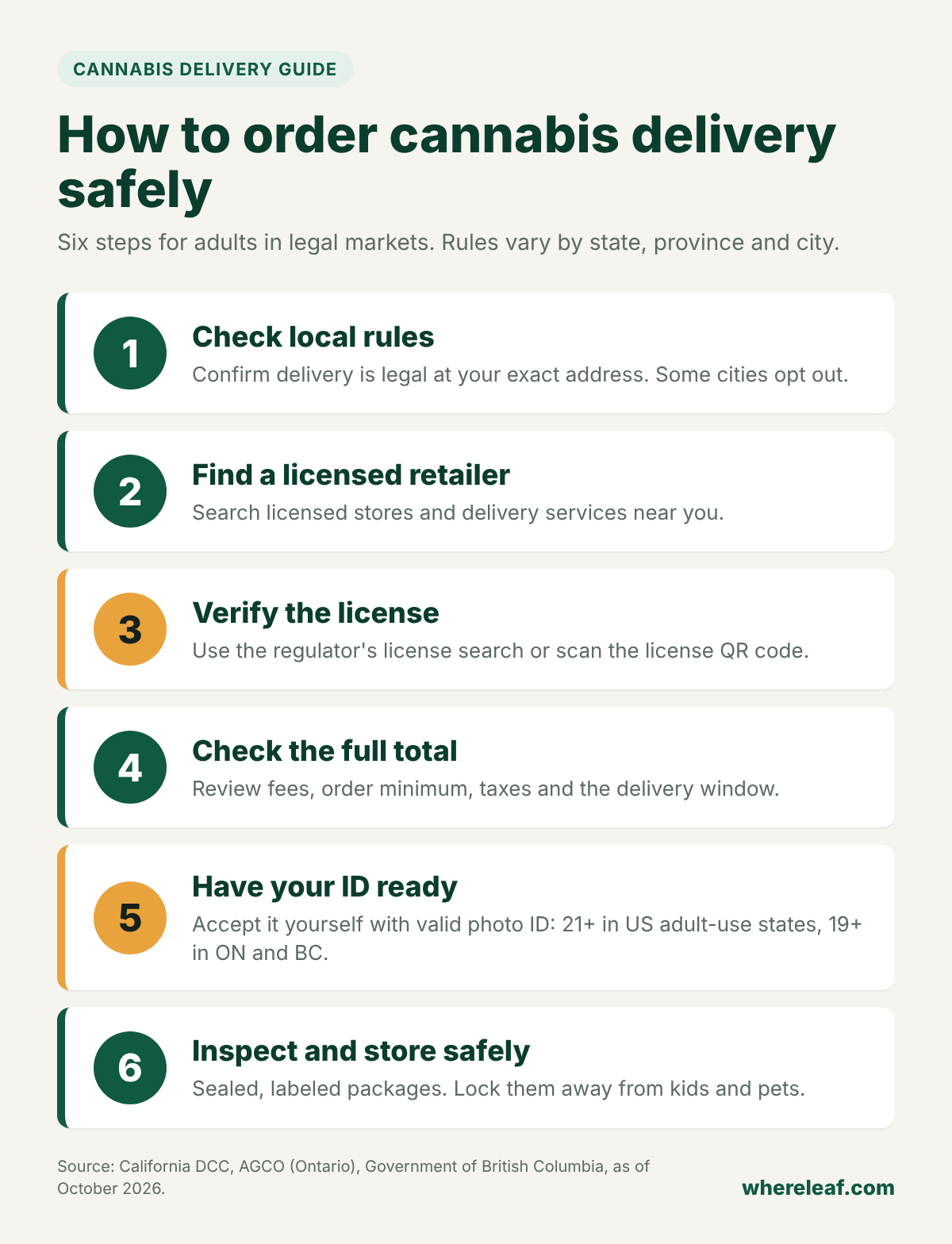
- Confirm delivery is legal at your address. Check your state or provincial regulator, then enter your exact address on a retailer’s site.
- Find a licensed retailer. Use our dispensary finder to see licensed stores and delivery services near you.
- Verify the license. Look up the business in the regulator’s license search or scan its license QR code where available.
- Build your order and check the total. Review the order minimum, delivery fee, taxes and the delivery window before you pay.
- Be home with your ID. The person named on the order should accept it in person with a valid, unexpired government photo ID.
- Inspect and store it. Make sure packages are sealed and labeled, then store them locked and out of reach of children and pets.
Quick pre-order checklist
- I’m of legal age in my state or province (21+ in US adult-use states).
- Delivery is allowed at my address.
- The business has a license I’ve checked with the regulator.
- I know the fee, minimum, taxes and delivery window.
- My ID is valid and matches the name on the order.
- I’ll be sober and home to accept it.
Tipping your cannabis delivery driver
There’s no official tipping rule for cannabis delivery, and norms vary by region and store. Many customers tip the way they would for other home deliveries, adjusting for order size, distance and weather. Some apps let you add a tip at checkout; others accept it at the door.
Before you tip, check the store’s policy. Some retailers include a service charge, and some don’t let drivers accept cash tips. Remember that the driver can’t speed up the ID check or bend the rules for a bigger tip, and they shouldn’t ask you to.
Responsible use after delivery
Licensed delivery makes access easier, so a few simple habits matter. Store products in their original child-resistant packaging, locked away from kids and pets. If you’re new or trying an edible, start low and go slow, since effects can take time to show up. Never drive after using cannabis, and don’t take cannabis across state, provincial or national borders, even between two legal places.
Run a dispensary or delivery service? You can list your business on WhereLeaf or compare our listing packages. Suppliers can join our supplier directory.
Frequently asked questions
Is cannabis delivery legal everywhere weed is legal?
No. Many legal states and provinces allow delivery, but some don’t allow home delivery for adult-use buyers, and others let cities opt in or out. Check your regulator and your exact address.
Can someone else accept my cannabis delivery?
Usually not. In New York, products may only go to the person named on the order. Plan to accept it yourself with valid ID unless your local rules clearly say otherwise.
What ID do I need for cannabis delivery?
A valid, government-issued photo ID that shows you’re of legal age, such as a driver’s license or passport. California also accepts a military photo ID.
Can cannabis be delivered to a hotel or office?
It depends. Ontario counts a hotel room as a private place where delivery is allowed. New York allows delivery to private businesses but not public buildings. California does not allow delivery to publicly owned land.
How much should I tip a cannabis delivery driver?
There’s no set rule. Many people tip as they would for other deliveries. Check the store’s policy, since some retailers don’t allow cash tips.
How do I know a delivery service is licensed?
Look up its license in your regulator’s online search, scan a license QR code if your state uses one, and expect an ID check at the door. No license and no ID check are both warning signs.
Sources
- NCSL: State Medical Cannabis Laws (2026)
- California Department of Cannabis Control: Retail (2026)
- California Department of Cannabis Control: What’s legal (2026)
- Cornell LII: Cal. Code Regs. tit. 4, § 15415, Delivery Employees (2026)
- Cornell LII: Cal. Code Regs. tit. 4, § 15416, Delivery to a Physical Address (2026)
- Cornell LII: Cal. Code Regs. tit. 4, § 15418, Cannabis Goods Carried During Delivery (2026)
- Colorado General Assembly: HB19-1234 Regulated Marijuana Delivery (2019)
- Massachusetts Cannabis Control Commission: Marijuana Delivery Operator license types now available (2021)
- Michigan Cannabis Regulatory Agency: Can delivery occur in municipalities that have opted out? (2026)
- Justia: N.Y. Comp. Codes R. & Regs. tit. 9, § 123.20, Delivery (2025)
- New York Governor’s Office: Licensed cannabis dispensary verification tool (2022)
- Illinois General Assembly: HB2926, 104th General Assembly (2025)
- AGCO: Delivery and curbside pick-up (2026)
- Government of British Columbia: Delivering cannabis (2026)
Last updated: October 2026. Laws and prices change; always check your state or provincial regulator.