An eighth of weed is one-eighth of an ounce, which dispensaries sell as 3.5 grams of flower. As of September 2026, the average packaged eighth in US legal markets sold for $20.23 before tax, according to Headset point-of-sale data, but state averages ran from about $13 in Oregon to almost $30 in Ohio.
That range is why “how much is an eighth of weed” has no single answer. Where you live, which taxes your state stacks on top, how strong or premium the flower is and what deal is running that day can easily double or halve the price.
This guide covers the measurements (gram, eighth, quarter, half, ounce), a 2026 price table by state built only from dated, sourced data, the main things that move the price and a worked example of what you actually pay at the register.
Key takeaways
- An eighth is a standard flower size, and the label always shows its exact weight in grams.
- Your state matters more than anything else. Mature, crowded markets sell eighths far cheaper than newer ones.
- The menu price is rarely what you pay. Taxes are usually added at the register, so ask for the out-the-door total.
- Buying a bigger size lowers the price per gram, but only buy what you will use and stay within your state’s limits.
- Rules differ by state and province. Always check your local regulator for current taxes, purchase limits and who can buy.
How many grams are in an eighth?
An eighth has about 3.5 grams of cannabis flower. The math is simple: NIST lists one ounce as about 28.35 grams, and 28.35 divided by 8 is about 3.54 grams. Cannabis sellers round that down to 3.5 g, and the other common sizes are rounded to match.
Your receipt and package label will show the weight in grams, even if the menu says “eighth” or “quarter.” Some states use slightly different package sizes, so read the label. Ohio, for example, sells flower in tenth-ounce and fifth-ounce packages rather than 1-gram units, according to Cannabis Business Times.
Weed measurements chart
| Name | Fraction of an ounce | Grams on the label | Common slang |
|---|---|---|---|
| Gram | About 1/28 | 1 g | “A G” |
| Eighth | 1/8 oz | 3.5 g | “An 8th” |
| Quarter | 1/4 oz | 7 g | “A Q,” “a quarter” |
| Half | 1/2 oz | 14 g | “A half O” |
| Ounce | 1 oz | 28 g | “An O,” “a zip” |
The 28-gram ounce is a trade convention. A true avoirdupois ounce is 28.35 grams, which is why an eighth is sometimes written as 3.54 g. In practice, the package is weighed and labeled at 3.5 g.
How much is an eighth of weed in 2026?
Across 12 tracked US legal markets, the average packaged eighth sold for $20.23 in September 2026. That figure comes from Headset, a cannabis data company that collects register transactions from licensed retailers. Its averages are net of discounts and exclude sales taxes, so they show the shelf price after deals but before tax.
For context, here are Headset’s other national averages for the same month:
Those numbers tell you two things. First, the “typical” eighth is now far cheaper than it was a few years ago in most mature markets. Michigan’s regulator reported an average of $419 per ounce in 2020, compared with about $60 in 2026. Second, the package size you choose matters as much as the store: per gram, a single gram cost more than four times as much as flower bought by the ounce.
Eighth price by state (2026)
The table below uses Headset’s September 2026 average for a packaged eighth in each state it tracks, plus the state-level retail cannabis tax. We only list states where we could find a current, sourced figure. States without solid 2026 data, including the newer markets and every Canadian province, are left out rather than estimated.
| State | Average eighth, before tax (Sept. 2026) | Retail cannabis tax at the register |
|---|---|---|
| Oregon | $12.74 | 17% state, plus local up to 3% |
| Arizona | $14.12 | 16% excise, plus 5.6% state TPT and local |
| Michigan | $14.32 | 10% excise, plus 6% sales tax |
| Colorado | $15.14 | 15% retail marijuana sales tax, plus local |
| Washington State | $15.81 | 37% excise, plus state and local sales tax |
| Massachusetts | $17.68 | 10.75% excise, 6.25% sales, local up to 3% |
| California | $21.28 | 15% excise, plus sales and local taxes |
| Nevada | $21.80 | 10% excise, plus sales and local taxes |
| Missouri | $24.93 | Check the Missouri Department of Revenue |
| Illinois | $25.99 | 10% on flower (25% if over 35% THC), plus sales and local |
| Maryland | $29.30 | 12% sales tax |
| Ohio | $29.54 | 10% excise, plus sales and local taxes |
Sources: eighth prices from Headset, September 2026 (published October 3, 2026). Tax rates from the Marijuana Policy Project’s state tax breakdown, checked against the Massachusetts Cannabis Control Commission, Michigan Department of Treasury, Colorado Legislative Council Staff, Washington State Department of Revenue and California CDTFA where those agencies publish rates. Local rates vary by city and county.
What state regulators report
Some regulators publish their own average prices, usually per ounce or per gram across all flower sold rather than per packaged eighth. These figures run lower than Headset’s eighth prices because they include cheaper bulk sizes.
- Michigan: $60.33 per ounce for adult-use flower in August 2026, per the Cannabis Regulatory Agency’s monthly data. That is about $7.54 for 3.5 grams’ worth.
- Massachusetts: a record-low average of $3.81 per gram ($108.01 per ounce), based on Cannabis Control Commission data reported in September 2026. That is about $13.34 for 3.5 grams’ worth.
- Oregon: a median of $3.33 per gram in December 2025, based on Oregon Liquor and Cannabis Commission data reported by OPB in January 2026.
- California: an all-time low of $62.25 per ounce in November 2025, per Department of Cannabis Control data reported by Cannabis Business Times.
Read the “3.5 grams’ worth” numbers as a per-gram comparison, not a shelf price. You usually can’t buy an eighth at the ounce rate.
How much is a gram, a quarter, a half or an ounce?
Headset’s national averages for a single gram, an eighth and an ounce are in the stat row above. Worked out per gram, the eighth comes to about $5.78 and the ounce to about $1.71, so the gram package is by far the most expensive way to buy.
We could not find a current, sourced national average for quarters or halves, so we won’t make one up. As a rule, they land between the eighth and ounce price per gram. To compare, divide the price by the grams on the label. A $35 quarter (7 g) is $5 a gram, which beats a $20.23 eighth at $5.78 a gram.
Bigger is not always better for you, though. An ounce is a lot of flower for an occasional user, and most states cap how much an adult can buy or carry at once. Check your state’s purchase and possession limits before buying in bulk, and see our comparison of flower, edibles, vapes and concentrates if you’re not sure flower is the right format.
What changes the price of an eighth?
Two eighths in the same store can be $15 apart. Here are the main reasons.
Taxes
Taxes are the biggest hidden cost. Most menus show prices before tax, and state cannabis taxes range from about 10% to 37% in the states above, often with regular sales tax and local taxes on top. Washington State’s 37% excise is the highest in the table. Colorado exempts adult-use cannabis from its regular 2.9% state sales tax but charges a 15% retail marijuana sales tax instead.
Taxes also act further up the supply chain. Michigan added a 24% wholesale tax in 2026 on top of its existing 10% retail excise and 6% sales tax, according to the Michigan Department of Treasury. Taxes like that can show up in shelf prices even though you never see them on your receipt.
Quality tier
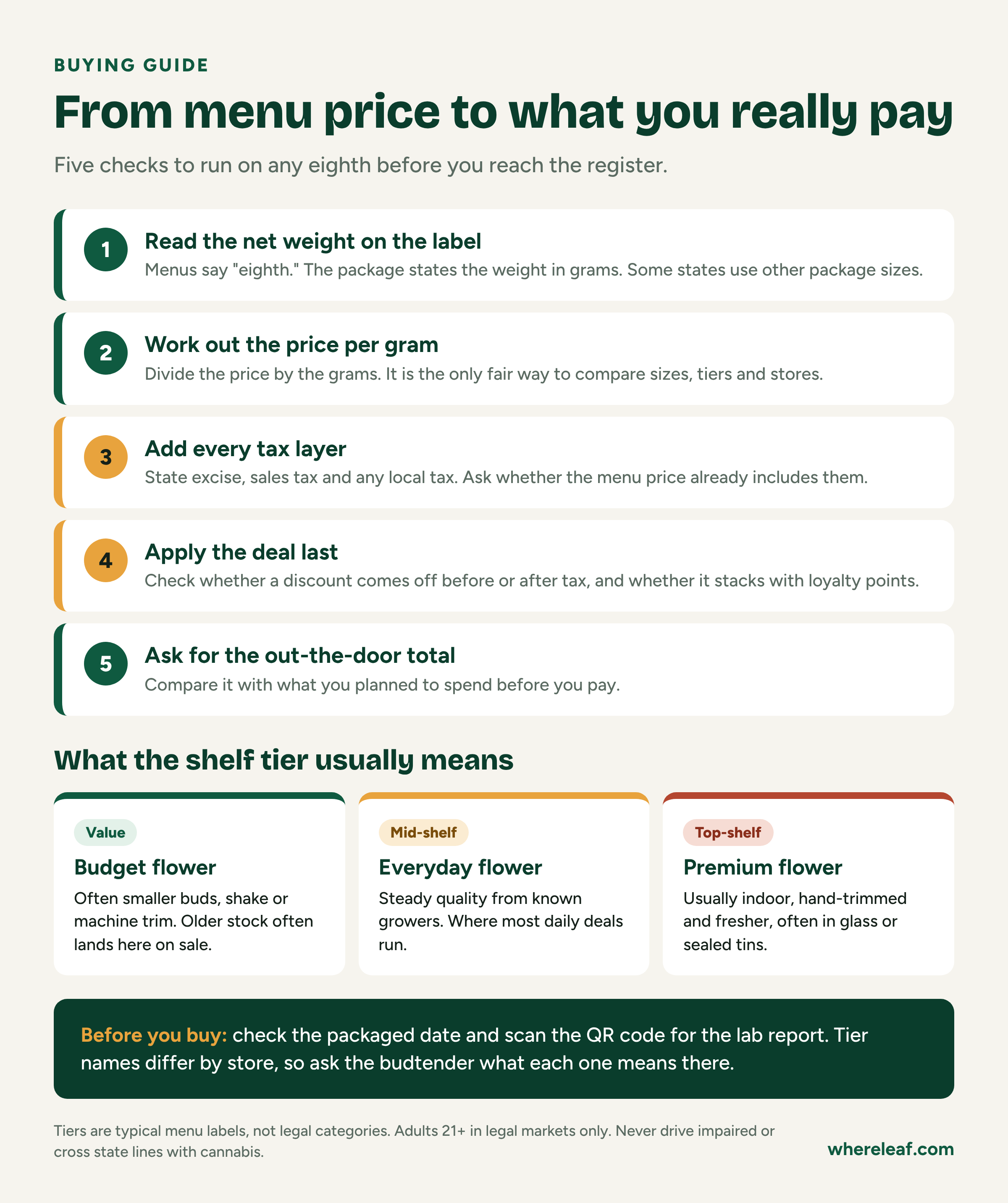
Most dispensaries sort flower into tiers, often called value, mid-shelf and top-shelf (or “premium”). Top-shelf flower is usually indoor-grown, hand-trimmed, fresher and more fragrant. Value flower may be machine-trimmed, smaller buds or “shake.” Labels and menus describe this differently, so ask the budtender what each tier means at that shop.
THC percentage also drives price, even though it’s only one part of what people say they like about a strain. Look at the full label and the lab results; our guide on how to read cannabis lab results explains the numbers.
Brand and packaging
Well-known brands, small-batch craft growers and special packaging (glass jars, nitrogen-sealed tins) usually cost more than house brands sold in simple pouches. A strong brand doesn’t guarantee better flower, but consistency is part of what you pay for.
Deals and discounts
Daily specials, first-time customer discounts, loyalty points and bundle prices can cut the price a lot. Headset’s averages are already net of discounts, which is one reason they look lower than many full menu prices. Compare the final price per gram, not the “percent off” sign.
Market maturity and supply
Older, crowded markets like Oregon, Michigan and Colorado have the lowest averages. Newer or tightly licensed markets such as Ohio, Maryland and Illinois sit at the top. More licensed growers and stores usually mean more competition on price.
What will an eighth cost out the door? A worked example
Here is what you’d pay for an average eighth in Massachusetts, using September 2026 data and the state’s published tax rates. We assume a town that charges the full 3% local option tax.
| Line on the receipt | Rate | Amount |
|---|---|---|
| Average eighth (shelf price) | n/a | $17.68 |
| State marijuana excise | 10.75% | $1.90 |
| State sales tax | 6.25% | $1.11 |
| Local option tax | 3% | $0.53 |
| Out-the-door total | 20% | $21.22 |
In a town with no local option tax, the total would be about $20.69. The quick rule: multiply the shelf price by 1 plus your combined tax rate. For Colorado, $15.14 × 1.15 = about $17.41 before any local marijuana tax.
Two things can change the result. Some stores build part of the tax into the posted price, and some states calculate a tax on a base that already includes another tax. If you want to know the exact total, ask for an out-the-door price before you pay.
How to tell if an eighth is a good deal
A low price is only a good deal if you get the weight and quality you paid for. Use these quick checks:
- Price per gram: divide the price by the grams on the label so you can compare sizes and tiers fairly.
- Packaged date: fresher flower usually smells stronger and burns more evenly. Old stock is often what ends up on sale.
- Lab results: licensed products are tested. Look for the certificate of analysis, often linked by a QR code.
- Licensed store: only buy from licensed retailers in states where adult-use sales are legal. Unlicensed shops skip testing and taxes, and buying there can carry legal risk.
You can compare menus and current deals at licensed shops near you on the WhereLeaf dispensary finder.
Your eighth-buying checklist
- Confirm you’re old enough to buy in your state or province and bring a valid ID.
- Check that the store is licensed by your state or provincial regulator.
- Look up your combined tax rate so the total at the register doesn’t surprise you.
- Compare price per gram across sizes and tiers, not just the sticker price.
- Read the label: weight in grams, THC and CBD, packaged date and batch number.
- Scan the QR code or ask for the lab results.
- Ask about first-time, loyalty or daily deals before you pay.
- Ask for the out-the-door price, including all taxes.
- Keep the product sealed in its child-resistant package on the way home, away from kids and pets, and never drive impaired or carry cannabis across state or national borders.
For dispensary owners: make your prices easy to find
Shoppers searching “how much is an eighth at a dispensary” want a real number before they leave home. Stores that show clear eighth prices, tiers and tax-inclusive totals make that decision easy.
List your dispensary on WhereLeaf so local adults can find your menu, hours and deals. Our listing packages add featured placement and room for weekly specials.
Frequently asked questions
How many grams are in an eighth?
The sizes are in the measurements chart above. One thing the chart doesn’t show: the label weight is what was packed. Flower keeps drying in the package, so an older jar weighed on a home scale can come in slightly light. If a sealed package looks clearly short, take it back to the store with your receipt.
How much is an eighth at a dispensary?
It depends mostly on your state and the shelf tier. The state table shows typical averages. Brand-name and top-shelf eighths often sell well above those, while value-tier flower and daily deals can come in below.
Is $20 for an eighth a good price?
Compare it with your state’s average, then check the price per gram, the packaged date and the lab results. A cheap eighth of old, dry flower is not a bargain, and a pricier eighth can be fair if it is fresh and well tested.
How much is a quarter of weed?
We couldn’t find a current, sourced national average for quarters. They usually fall between the eighth and ounce prices per gram. Divide the price by the grams on the label to see where a quarter lands at your store.
Why is weed cheaper by the ounce?
Larger packages cost less to pack, label and test per gram, and stores price them to move volume. Bulk flower may also be a value tier or shake, so check what you are getting, and remember that state purchase and possession limits still apply.
Does the menu price include tax?
Usually not, but some stores fold part of the tax into the posted price. Look for “tax included” on the menu, or ask for the out-the-door price before you pay.
Sources
- Headset: How Much Does Weed Cost in 2026? Cannabis Prices (2026)
- NIST: Approximate Conversions from U.S. Customary Measures to Metric
- The Marijuana Herald: Michigan Legal Marijuana Sales Surpass $17 Billion (2026)
- The Marijuana Herald: Massachusetts Marijuana Sales Top $1.25 Billion in 2026 as Prices Hit Record Low (2026)
- OPB: Demand for Cannabis Remains Steady in Oregon as Production Hits Record, Driving Prices Lower (2026)
- Cannabis Business Times: How Much Does a Gram, Ounce of Cannabis Flower Cost in 2026? (2026)
- Massachusetts Cannabis Control Commission: Taxes and Fees
- Michigan Department of Treasury: Wholesale Marihuana Tax FAQ (2026)
- Colorado Legislative Council Staff: Marijuana Taxes
- Washington State Department of Revenue: Taxes Due on Cannabis
- California CDTFA: News Release 25-09 on the Cannabis Excise Tax Rate (2025)
- Marijuana Policy Project: Breakdown of Taxes in Adult-Use States (2026)
Last updated: October 2026. Laws and prices change; always check your state or provincial regulator.