

Cannabis and driving laws are simple at the core: driving while impaired by cannabis is illegal in every U.S. state and every Canadian province, even where buying weed is legal. What changes from place to place is how the law proves impairment, from an officer’s observations to a fixed amount of THC in your blood.
That difference matters. In some states a blood test above a set number is enough for a conviction on its own, while in others, a few states punish any trace of THC at all. Canada uses a federal system with several blood limits, and provinces add their own licence penalties on top.
This guide explains the three ways U.S. states write their cannabis DUI laws, shows the THC thresholds in states that use one (checked October 2026), walks through Canada’s rules, and covers the open-container rules that apply to cannabis sitting in your car.
Key takeaways
- Driving high is a crime everywhere cannabis is legal. A legal purchase never makes impaired driving legal.
- U.S. states use one of three models: proof of impairment, a set THC blood limit, or zero tolerance for any detectable amount.
- THC can stay in your blood after you stop feeling effects, so a test result and how you feel may not match.
- Most legal states also restrict open cannabis packages in the passenger area, so carry it sealed or in the trunk.
- Rules differ by state and province. Check your local regulator and motor vehicle agency before you drive with cannabis in the car.
Is it illegal to drive high if weed is legal?
Yes. Legalization covers buying, possessing and using cannabis in private. It does not cover operating a car, boat or other vehicle while impaired. The National Conference of State Legislatures (NCSL) notes that every state has a law addressing marijuana-impaired driving, and the federal Criminal Code covers all of Canada.
A medical card doesn’t change that either. In most places, being a registered patient is not a defense to driving while impaired. A few zero-tolerance states make limited exceptions for patients, which we explain below.
The three models U.S. states use
- Impairment-based (effect-based). Prosecutors must show your driving ability was impaired, using the officer’s observations, field sobriety tests, a drug recognition evaluation and lab results. California works this way.
- Per se limit. A THC blood level at or above a set number is itself the offense, no other proof of impairment needed. NCSL lists five states with per se THC limits.
- Zero tolerance. Any detectable amount of THC, and in some states a THC metabolite, is enough. These laws often date from before legalization.
Some states use a middle path. Colorado and Illinois set a THC number that creates an inference or presumption of impairment, which a driver can try to rebut in court.
What are the cannabis DUI THC limits by state?
The table below compares how major states write their cannabis and driving laws, from the strictest numeric limits to impairment-only rules. Numbers are nanograms of THC per milliliter of blood (ng/mL) unless noted.
| State | Legal model | THC threshold | Worth knowing |
|---|---|---|---|
| Washington State | Per se | 5.00 ng/mL in blood | The blood sample must be taken within a set time after driving. |
| Montana | Per se | 5 ng/mL in blood | Applies to delta-9 THC, the active compound. |
| Ohio | Per se | 2 ng/mL in blood or 10 ng/mL in urine | Separate, higher limits apply to THC metabolites. |
| Nevada | Per se (limited) | 2 ng/mL in blood | NCSL says Nevada’s limit now applies only to felony cases. |
| Illinois | Presumption | 5 ng/mL in blood or 10 ng/mL in other bodily fluid | Above the line, the law presumes you were under the influence. |
| Colorado | Permissible inference | 5 ng/mL in blood | A jury may infer impairment, but the driver can rebut it. |
| California | Impairment-based | None | Prosecutors must prove impairment with evidence beyond a number. |
| Zero-tolerance states (12, per NCSL) | Zero tolerance | Any detectable amount | Includes Pennsylvania, Arizona and Wisconsin. Some states carve out exceptions for medical patients. |
Even in per se states, a reading under the limit doesn’t guarantee you’re in the clear. Officers can still charge you under the general impaired-driving law if your driving or behavior shows impairment.
Why THC limits are controversial
Alcohol leaves the blood at a fairly steady rate, so a blood alcohol number tracks impairment reasonably well. THC doesn’t behave that way. Frequent consumers can carry measurable THC long after the effects fade, while an occasional consumer can be impaired at a low reading. That’s why many states, including California, have stuck with impairment-based laws instead of a single number.
How do Canada’s cannabis-impaired driving laws work?
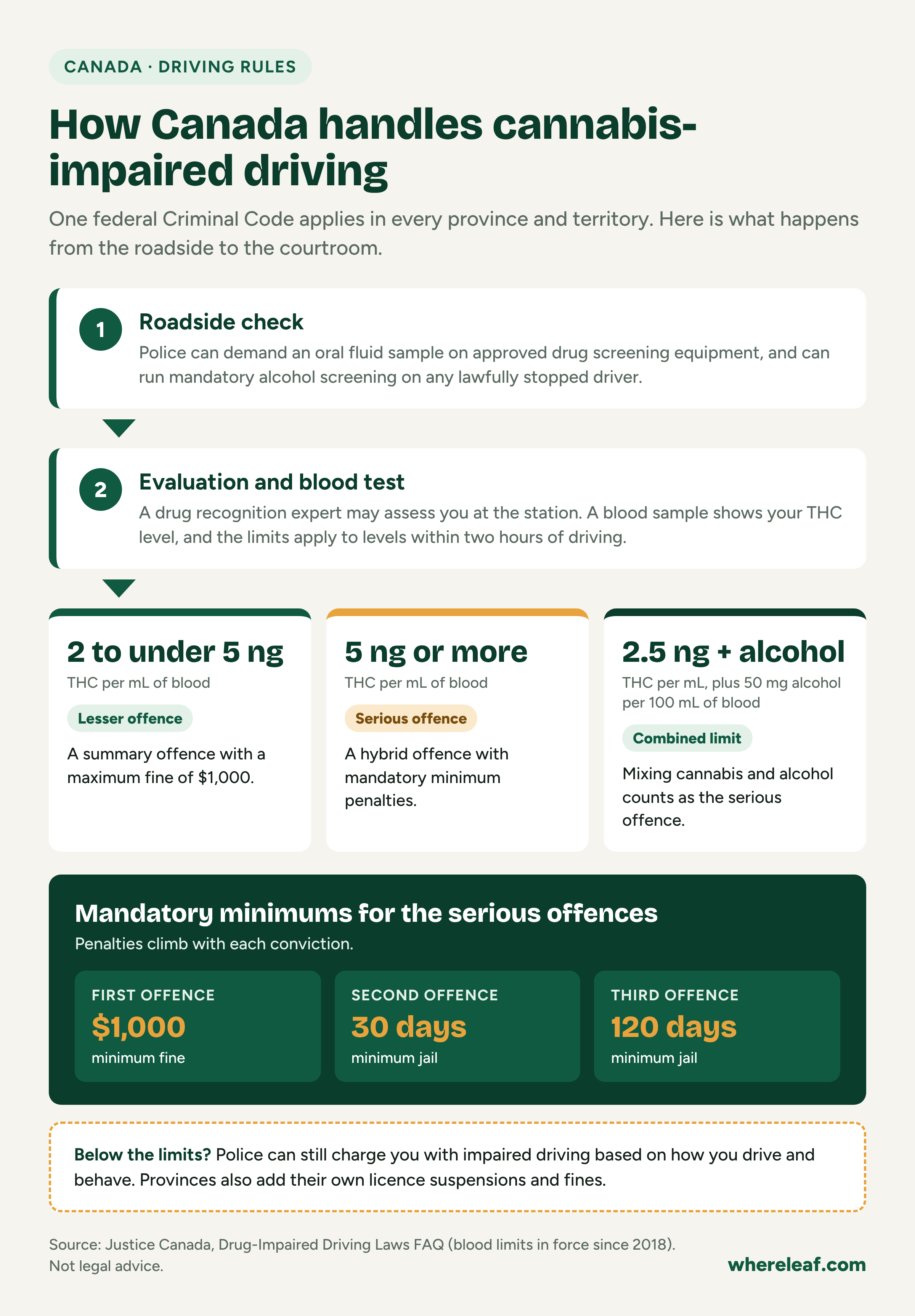
Canada set national blood drug limits in 2018, the same year adult-use cannabis became legal. The Criminal Code creates tiers: a lower-level offense, a more serious offense, and a combined limit for drivers who mixed cannabis with alcohol. The limits apply to blood levels within a set window after driving. The graphic below lays out each tier and its penalties.
Provinces add their own penalties
Provinces stack licence consequences on top of the criminal law. Ontario, for example, has a zero-tolerance rule for drivers 21 and under, drivers with G1, G2, M1 or M2 licences, and commercial drivers: they may not have any cannabis in their system. Penalties include licence suspensions and fines, with longer suspensions and mandatory education programs for repeat offenders.
If you’re driving in another province, check its rules before you go. Our Canada cannabis laws by province guide covers ages, possession and where you can use cannabis.
Can police test you for THC at the roadside?
There’s no breathalyzer for THC that courts widely accept, so police rely on a mix of tools.
- Officer observations. Driving behavior, odor, speech and how you handle your documents.
- Standardized field sobriety tests. The same walk-and-turn and balance tests used for alcohol.
- Drug recognition experts (DREs). Specially trained officers run a structured evaluation, usually at the station.
- Oral fluid (saliva) screening. NCSL reports that Alabama and Indiana have permanent or active roadside oral fluid programs, while Michigan has run a pilot. In Canada, police can demand a roadside oral fluid sample on approved screening equipment.
- Blood tests. The most common way to measure THC for per se and presumption laws, taken at a hospital or station.
Implied consent applies to drugs too
Under implied consent laws, holding a driver’s license means you’ve agreed to chemical testing if lawfully arrested for impaired driving. Refusing a test can bring its own license suspension, separate from any DUI charge. The rules for drug tests vary by state, so ask a local lawyer if you’re ever in that situation.
How common is cannabis use among drivers?
Research shows THC is often found in drivers, though finding it doesn’t prove impairment. The stats below come from U.S. trauma-center data and Health Canada’s national survey.
NHTSA is careful to say its data can’t show whether people were impaired at the time of a crash. Still, the gap in Canada between believing cannabis impairs driving and still driving soon after using it is exactly what police campaigns target.
Can you have weed in your car? Open-container rules
Separate from impaired driving, most legal states regulate how cannabis is stored in a moving vehicle. These are usually traffic infractions or civil fines rather than DUI charges, but they can lead to a search and a bigger problem. Here’s how a few states handle it, according to NCSL’s summary of state laws:
United States examples
- California: Driving with an open package of cannabis or loose flower is an infraction with a fine of up to $100. Cannabis in the trunk is exempt.
- Colorado: An open container is one with a broken seal, partly removed contents and evidence of use in the vehicle. It’s a class A traffic infraction with a $50 fine.
- Washington State: Cannabis must be in the trunk or in a package that hasn’t been opened. Using cannabis in a vehicle on a public highway is also an infraction.
- Illinois: Cannabis in a vehicle must be in a sealed, odor-proof, child-resistant container. Using it in the passenger area is a Class A misdemeanor.
- Massachusetts: An open container in the passenger area brings a civil penalty of up to $500. The trunk and a locked glove compartment are allowed.
- New Jersey: Unsealed cannabis items in the vehicle carry a $200 fine for a first offense.
Canada example
In Ontario, it’s illegal to carry cannabis in a car or boat if it’s open and out of its original packaging, or if it isn’t packed in baggage and is within reach of anyone in the vehicle. Other provinces have similar rules.
The simplest habit anywhere: keep cannabis in the sealed package from the licensed store, and put it in the trunk. And never drive across a state or national border with it. Our guide on bringing weed across the border explains why.
What are the penalties for a cannabis DUI?
In most U.S. states, a cannabis DUI is charged under the same statute as an alcohol DUI, so the penalties look the same: license suspension, fines, possible jail, higher insurance costs, and sometimes an ignition interlock or education program. Penalties rise for repeat offenses, crashes that injure someone, or having a child in the car.
A conviction also follows you. It can affect jobs that require driving, a commercial driver’s license, professional licenses and travel to other countries. In Canada, a conviction under the Criminal Code is a criminal record, which can make crossing into the United States harder.
How long should you wait to drive after using cannabis?
There’s no safe number of hours that applies to everyone. Effects depend on the product, the amount, how you took it and your own experience. Edibles in particular can take hours to kick in, so you may feel fine when you start the car and feel effects later. The safest plan is not to drive on the day you use, and to line up a ride before you start.
Your cannabis and driving checklist
Screenshot this and keep it handy.
- Decide how you’re getting home before you use cannabis: a sober driver, rideshare, taxi or transit.
- If you feel any effects, don’t drive. Wait, or get a ride.
- Remember that edibles are slow. Feeling nothing now doesn’t mean you’ll feel nothing later.
- Never mix cannabis and alcohol before driving. Canada has a separate, stricter combined limit.
- Keep cannabis sealed in its original package and stored in the trunk.
- Don’t let passengers use cannabis in the car; it can be an offense for them and for you.
- Know your state’s model: impairment-based, per se limit or zero tolerance.
- If you’re a young, new or commercial driver, check for zero-tolerance rules that apply to you.
- Never carry cannabis across a state line or an international border.
For dispensary owners: promoting safe rides
Dispensaries are in a good position to remind customers not to drive high. Many shops post safe-ride messages at the counter, add a “plan your ride” note to receipts, or point customers to delivery as an option. Training budtenders to mention that edibles are slow to take effect is one of the simplest safety steps you can add.
Customers who don’t want to drive often search for delivery or a nearby store. List your dispensary on WhereLeaf so they can find your hours, address and delivery options, and compare our listing packages to feature your shop in local searches. Shoppers can use our dispensary finder to find licensed stores close to home.
Frequently asked questions
Can you get a DUI for weed if you’re not high?
In some states, yes. Zero-tolerance and per se states can convict based on a blood level alone, even if you no longer feel effects. In impairment-based states, prosecutors must show your driving ability was affected.
Is there a breathalyzer for weed?
Not one that’s in wide legal use. Companies are developing THC breath devices, but police mostly rely on observations, drug recognition evaluations, saliva screening devices and blood tests.
Can passengers smoke weed in a car?
Generally no. Most legal states ban using cannabis anywhere in a vehicle on a public road, including by passengers, and open-container rules usually cover the whole passenger area.
Does a medical marijuana card protect you from a DUI?
No, impaired driving is illegal for patients too. A few zero-tolerance states give registered patients limited exceptions to the “any amount” rule, but they can still be charged if they’re impaired.
How is a cannabis DUI in Canada different from the U.S.?
Canada uses one federal Criminal Code for the whole country, so the blood limits are the same in every province. Provinces then add their own licence suspensions and fines. In the U.S., each state writes its own law.
Can you drive with cannabis in the car?
Usually yes, if it’s legally purchased, within possession limits and stored the way your state requires, typically sealed or in the trunk. Rules vary, so check yours before a road trip.
Sources
- NCSL: Drugged Driving, Marijuana-Impaired Driving (2025)
- NCSL: Driving With Cannabis in a Vehicle (2025)
- Washington State Legislature: RCW 46.61.502, Driving Under the Influence
- Montana Legislature: MCA 61-8-411, Driving Under the Influence of Delta-9-Tetrahydrocannabinol (2019)
- Colorado Department of Transportation: Drugged Driving FAQs
- Ohio Revised Code: Section 4511.19, Operating Vehicle Under the Influence
- Illinois General Assembly: 625 ILCS 5/11-501.2, Chemical and Other Tests
- Justice Canada: Frequently Asked Questions, Drug-Impaired Driving Laws (2018, current 2026)
- Government of Ontario: Cannabis and Driving (2026)
- NHTSA: Alcohol and Drug Prevalence Among Seriously or Fatally Injured Road Users (2022)
- Health Canada: Canadian Cannabis Survey 2024, Summary (2024)
Last updated: October 2026. Laws and prices change; always check your state or provincial regulator.


