
Can you bring weed across the border between Canada and the United States? No. As of October 2026, taking cannabis into or out of Canada is a federal crime under the Cannabis Act, and bringing it into the US breaks US federal law, even if you bought it legally and are driving between two places where it is legal, like British Columbia and Washington State.
That surprises a lot of travelers, because cannabis is legal for adults across Canada and in many US states. But the border is controlled by federal law on both sides, and neither country’s federal law allows personal cannabis to cross. The same goes for CBD oil, vapes and edibles.
This guide explains the law only: what each country says, what happens at the booth, how a cannabis admission can affect your ability to visit the US, and how CBD, hemp and medical cannabis are handled. It is not advice on getting anything past an officer. If you want cannabis at your destination, buy it there from a licensed store and leave it there.
Key takeaways
- Cannabis can’t legally cross the Canada–US border in either direction, in any form or amount, without a government permit.
- Being legal at home and legal at your destination makes no difference. Federal law governs the crossing.
- Honesty matters at the booth. Undeclared cannabis brings extra penalties in Canada, and lying to a US officer can cause bigger problems than the cannabis itself.
- A cannabis problem at the US border can follow you for life, so the safest plan is to cross with none at all.
- Rules differ by state and province, and federal rules sit above both. Always check the official border agency before you travel.
Can you bring weed across the Canada–US border legally?
No. There is no personal amount you can carry across, and no exception for a medical card, a prescription or a sealed product from a legal store. The only way cannabis crosses legally is with a permit or exemption from Health Canada on the Canadian side, which is issued in very limited cases such as scientific research or industrial hemp.
That rule holds for every type of crossing: land ports, airports, ferries, cruise ships, private boats and mail. Canada Border Services Agency (CBSA) puts it plainly: transporting cannabis across the border in any form is a “serious criminal offence,” whether you are entering or leaving.
What if both places are legal?
It still doesn’t matter. A trip from Vancouver to Seattle or from Windsor to Detroit starts and ends in places where adults can buy cannabis, but the border in between is federal territory on both sides. Canadian law bans exporting cannabis, and US federal law bans importing it.
What does Canadian law say about cannabis at the border?
Section 11 of the Cannabis Act says that, unless authorized, “the importation or exportation of cannabis is prohibited.” It is also illegal to possess cannabis for the purpose of exporting it, so packing it for a trip south can be an offence before you reach the booth.
You must declare it
Anyone entering Canada with cannabis in any form, including CBD oil, must declare it to CBSA. Declaring doesn’t make it legal to bring in, but failing to declare adds a separate problem: CBSA can detain the undeclared cannabis “with no terms of release,” meaning you won’t get it back.
Administrative penalties
Since 2021, CBSA has been able to fine travelers who don’t declare cannabis or give false information, without going to court. CBSA says the amount depends on three things: the type of contravention, how serious it was (including whether the cannabis was hidden and how much there was), and your history with the agency.
The penalty is due the day the notice is served, and interest starts if it’s unpaid after 30 days. If you think it was issued in error, you have 90 days to ask for a correction or a formal review. Serious cases can still go to criminal prosecution.
What does US federal law say about bringing weed into the US?
US Customs and Border Protection (CBP) applies federal law, not state law. In its statement on Canada’s legalization, CBP said US laws “will not change” and that the sale, possession, production and distribution of marijuana “remain illegal under U.S. Federal Law,” even in states that allow it.
CBP also says federal law prohibits importing marijuana, and that a violation may lead to “denied admission, seizure, fines, and apprehension.” Officers decide each case based on the facts in front of them.
Did rescheduling change anything?
No. In April 2026, the DEA moved marijuana covered by a state medical license and FDA-approved marijuana products to Schedule III. All other marijuana, including adult-use products and anything bought in Canada, is still Schedule I, and the broader rescheduling case is on hold. Even a Schedule III drug is still a controlled substance, so importing it without federal authorization stays illegal.
US preclearance at Canadian airports
If you fly to the US from a major Canadian airport, you clear US customs before you board. US federal law applies in that preclearance area, so the US rules hit before you leave Canadian soil.
Canada vs US: border cannabis rules compared
Here is how the two sides handle the same situation. Each country applies its own rules on entry, so a crossing can involve both.
| Question | Entering or leaving Canada (CBSA) | Entering the US (CBP) |
|---|---|---|
| Main law | Cannabis Act and Customs Act | Controlled Substances Act and Immigration and Nationality Act |
| Legal-store cannabis allowed? | No, in either direction | No |
| Medical document or card | Not an exemption | State medical cards are not recognized |
| CBD and hemp | Counted as cannabis; permit needed | Hemp at or under 0.3% delta-9 THC is not marijuana; stricter total-THC rules start Dec. 11, 2026 |
| If not declared | Cannabis detained, plus a penalty of $200 to $2,000 CAD | Seizure; civil penalty up to $10,000 USD for a personal-use amount |
| Maximum criminal penalty | 14 years (indictment), or $5,000 and/or 6 months (summary) | 1 year and a fine of at least $1,000 USD for a first simple-possession offense |
| Cannabis industry workers | Legal industry in Canada | Generally admissible if the trip is unrelated to the industry; may be inadmissible if it is related |
What happens if you’re caught with weed at the border?
Every case is different, and officers on both sides have discretion. The graphic below shows the general sequence most travelers go through, from the first question at the booth to the record that stays on file.
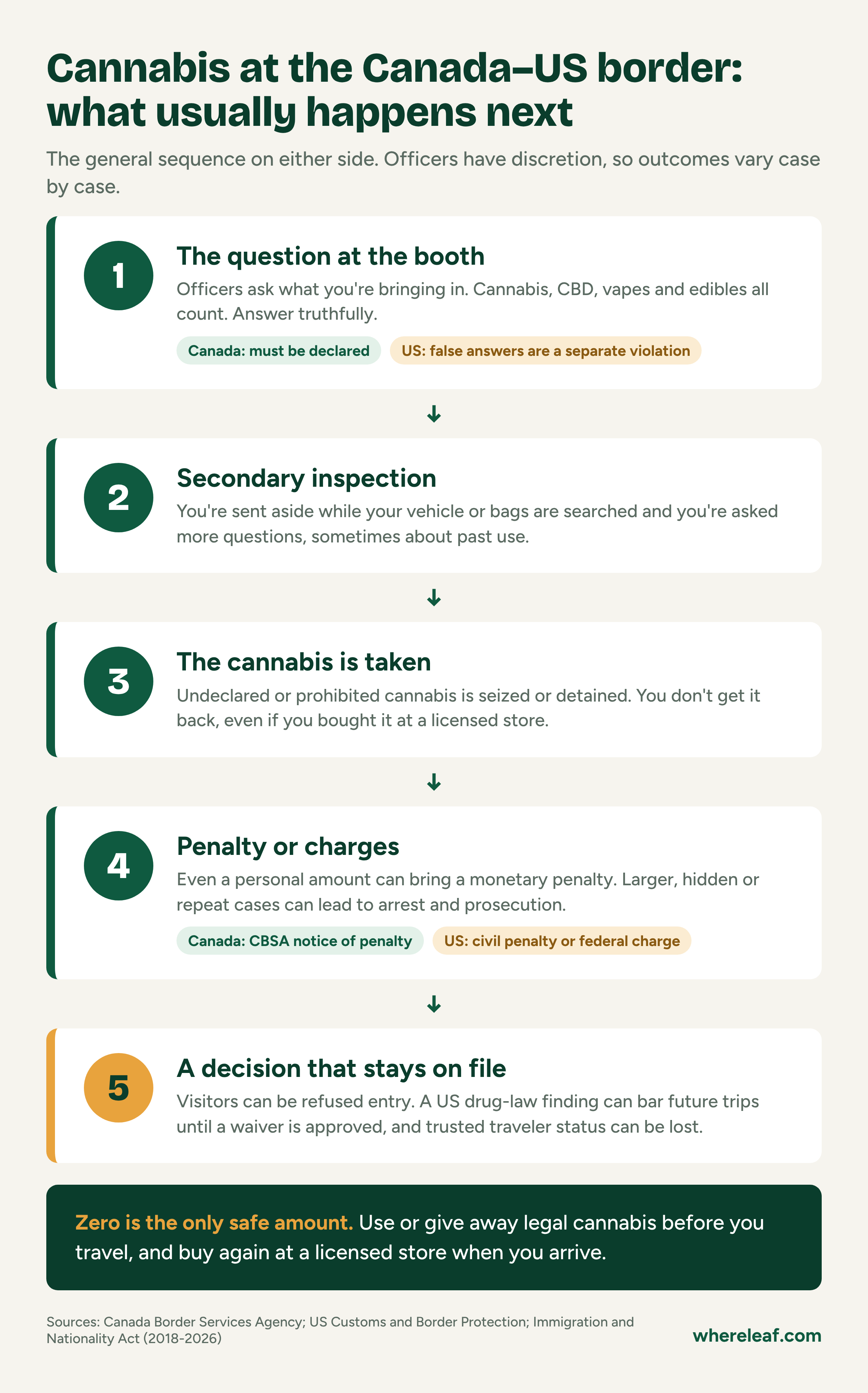
The step that catches people off guard is the last one. A seized vape cart is a small loss, but a record that you broke a drug law, or admitted to it, can shape every future crossing.
Can you get a lifetime ban from the US for weed?
Yes, it can happen, and it is the biggest risk for Canadians and other non-US citizens. Under the Immigration and Nationality Act, a foreign national who has been convicted of, or who admits to, acts that make up a controlled-substance violation is generally inadmissible. That ground has no expiry date, which is why people call it a lifetime ban.
Can a border officer ask if you’ve ever used cannabis?
Yes. CBP officers can ask about past use, and the law covers violations of any country’s drug laws, so past use where it was illegal at the time can count. CBP’s own statement notes that someone who admits to acts meeting the elements of a drug violation is generally inadmissible. Lying is not a fix: misrepresenting a material fact to a US officer is its own permanent ground of inadmissibility. If you’re unsure how to handle questions about your past, talk to a US immigration lawyer before you travel.
How a waiver works
A Canadian found inadmissible can apply for a waiver on Form I-192 through CBP’s online e-SAFE system. After filing, applicants must visit a designated port of entry for fingerprints and a photo within 45 days, or the application is considered abandoned. An approved waiver lasts only until its expiry date, so it must be renewed.
Americans heading into Canada
Canada has its own admissibility rules. Drug possession and trafficking offences, and driving under the influence of drugs or alcohol, can make a visitor inadmissible. Depending on how much time has passed, options include deemed rehabilitation, applying for criminal rehabilitation at least five years after the sentence ends, or a temporary resident permit. Canada now classes impaired driving, including drug-impaired driving, as serious criminality.
What about CBD, hemp and medical cannabis at the border?
Canada makes no distinction: CBD products derived from cannabis or hemp need a permit or exemption to cross, just like THC products. A CBD tincture from a US pharmacy shelf is still cannabis to CBSA.
The US side is more complicated. Hemp products that meet the federal hemp definition are not marijuana under federal law, but that definition is changing. Under the late-2025 law, most hemp-THC products will be capped at 0.4 mg of total THC per container once the new rules start. Because a border officer can’t lab-test your gummies on the spot, the simplest choice is to leave THC and CBD products at home.
Medical cannabis gets no exception. CBSA says a medical document is not an exemption, and a US state medical card has no weight under federal law. Patients should plan to buy legally at their destination where they qualify. Our guide to where cannabis is legal in 2026 shows which states and provinces sell to visitors.
Can you travel with weed inside Canada or inside the US?
Within Canada, yes, within limits. Adults can carry up to the federal public possession limit across provincial lines and on domestic flights, but each province’s age and public-use rules apply when you arrive. Our guide to Canada’s cannabis laws by province compares all 13.
Within the US, it’s riskier. Carrying cannabis across state lines is illegal under federal law, even between two legal states, and federal land, national parks and airports follow federal rules. Our article on bringing weed on a plane covers TSA screening.
Your border-crossing checklist
- Search your car, bags, jackets and toiletry kit for any cannabis, vapes, edibles, CBD or rolling leftovers before you leave.
- Give away leftover legal cannabis to an adult or dispose of it before the border, following local law.
- Don’t pack CBD or hemp products, even if a store told you they’re “legal everywhere.”
- Answer every question from a border officer truthfully, and declare anything you find late.
- If you’ve had a cannabis conviction, or have questions about past use, speak to an immigration lawyer before booking.
- Remember that NEXUS and FAST cards can be lost over a single cannabis penalty.
- Don’t mail or ship cannabis across the border, which counts as importing or exporting.
- At your destination, buy only from a licensed store and use it there.
For cannabis businesses near the border
Stores close to crossings see a steady flow of visitors who ask what they can take home. Train staff to answer clearly: nothing crosses the border, and products should be used before the trip back. Clear signs at the counter help too. Make sure travelers can find you when they arrive: list your store on WhereLeaf for free, or boost visibility with our featured listing packages. Suppliers can also join our supplier directory.
Frequently asked questions
Can I drive from Canada to Washington State or Michigan with weed if both are legal?
No. Washington State and Michigan allow adult-use cannabis under state law, but the border crossing is controlled by federal law on both sides. You would be exporting from Canada and importing into the US at the same time.
Can I bring CBD oil into Canada from the US?
Not without a Health Canada permit or exemption. CBSA counts CBD made from cannabis or hemp as cannabis, so it must be declared and can be detained if you don’t.
What if I forgot cannabis in my car?
Tell the officer before they find it. In Canada, declaring avoids the extra penalty for failing to report, although the cannabis can still be refused entry. Hiding it makes every outcome worse.
Can I fly from Canada to the US with weed in my checked bag?
No. International flights fall under the same import and export bans as land crossings, and many flights to the US clear US customs in Canada before departure.
Does a cannabis penalty affect my NEXUS card?
It can. CBSA says a penalty can lead it to refuse a NEXUS or FAST application or cancel an existing membership, which means losing faster crossings for both countries.
Can I order cannabis online from Canada to the US, or the other way?
No. Licensed retailers in both countries sell under provincial or state licences, and any cross-border shipment of cannabis is illegal importing and exporting.
Sources
- Canada Border Services Agency: Cannabis and the border (2026)
- Canada Border Services Agency: Penalties for cannabis-related offences (2026)
- Canada Border Services Agency: CBSA sets new penalties for crossing the border with cannabis (2021)
- Canada Border Services Agency: CBSA reminds Canadians of cannabis border laws (2022)
- Justice Laws Website: Cannabis Act, section 11, Importing and exporting (2026)
- Department of Justice Canada: Cannabis Legalization and Regulation (2021)
- US Customs and Border Protection: CBP statement on Canada’s legalization of marijuana and crossing the border (2018)
- US Customs and Border Protection: e-SAFE fact sheet (2020)
- Cornell LII: 21 U.S. Code 844, Penalties for simple possession
- Cornell LII: 21 U.S. Code 844a, Civil penalty for possession of small amounts
- Cornell LII: 8 U.S. Code 1182, Inadmissible aliens
- Federal Register: Schedules of Controlled Substances, final order on marijuana (2026)
- DEA: Marijuana Rescheduling Regulatory Actions (2026)
- Foley Hoag: A Temporary Reprieve for Hemp-THC Products (2026)
- Immigration, Refugees and Citizenship Canada: Overcome criminal convictions (2026)
- American Bar Association: Criminal inadmissibility to Canada, cannabis and impaired driving offences (2025)
- Statistics Canada: Focus on Canada and the United States, Travel (2025)
Last updated: October 2026. Laws and prices change; always check your state or provincial regulator.


