Can you grow weed in Ohio? Yes. As of October 2026, adults 21 and older can legally grow up to 6 cannabis plants each at their primary residence, with a cap of 12 plants per household. The plants must be in a secured, enclosed area that people under 21 cannot get into and that cannot be seen from a public space.
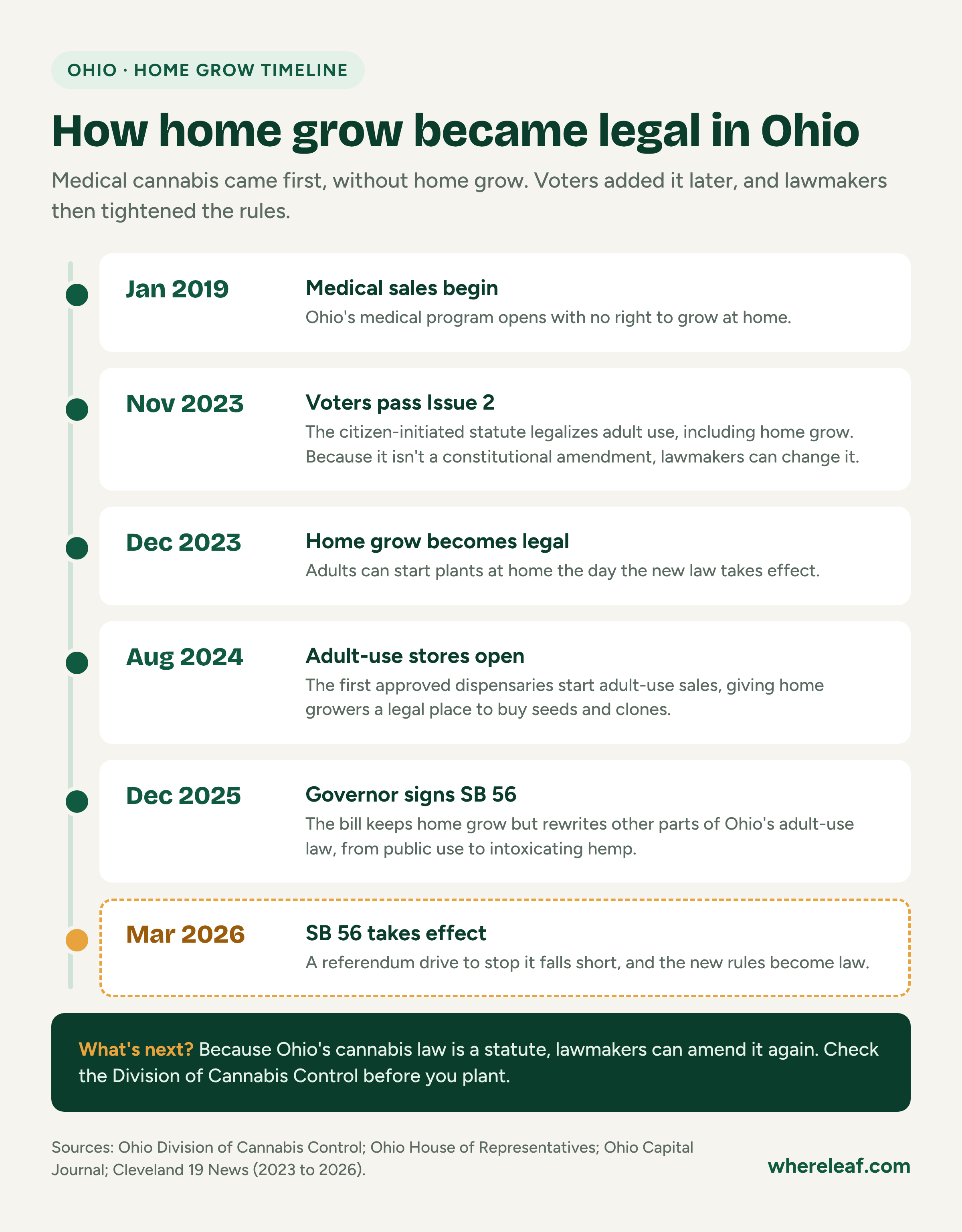
Home grow has been legal since Issue 2 took effect on December 7, 2023. Senate Bill 56, which took effect on March 20, 2026, kept the plant counts but added new limits on where you can grow, including rentals whose lease forbids it. Getting the details wrong can turn a legal hobby into an illegal cultivation charge.
This guide explains the law only: how many plants you can have, where they can be, what landlords can do, what SB 56 changed and what the penalties are. It is not a growing guide. Last checked: October 13, 2026, against the Ohio Division of Cannabis Control (DCC) and Ohio Revised Code Chapter 3796.
Key takeaways
- No paperwork needed: any adult of legal age can grow at home without a license or medical card.
- Location matters as much as plant count: a grow in the wrong place can be charged the same way as one with too many plants.
- Renters, read your lease first: your landlord’s rules can decide whether your grow is legal at all.
- It’s for you only: you cannot sell homegrown cannabis, grow for someone else or process it with hydrocarbon (butane-type) extraction.
- Rules differ by state and province. Always check your local regulator, and never carry cannabis or plants across state lines.
Can you grow weed in Ohio legally?
Yes. Ohio Revised Code section 3796.04 lets an adult-use consumer, meaning anyone 21 or older, “cultivate, grow, and possess homegrown marijuana plants” at their primary residence. The DCC’s FAQ says the law “permits adults aged 21 and over to grow, store, and use their own cannabis at home.”
You do not need a license, permit or registration to grow at home in Ohio. That sets Ohio apart from neighbors like Illinois, where only registered medical patients may grow. You also do not need a medical card. Ohio’s medical program, which began sales on January 14, 2019, never included home grow; the right comes from the adult-use law.
Who cannot grow at home?
- Anyone under 21.
- Anyone growing somewhere other than their own primary residence, such as a vacation cabin, a friend’s house or a storage unit.
- Renters whose lease prohibits growing.
- People living in a type A or type B family child care home, a halfway house, community transitional housing, a community residential center or a similar facility.
How many plants can you grow in Ohio?
The limit is 6 plants per adult and 12 plants per residence. The DCC puts it this way: “A maximum of 6 plants can be cultivated or grown per individual,” with “a maximum of 12 plants per household if there are two or more adults 21 and over.”
How the household cap works
- One adult living alone: up to 6 plants.
- Two adults 21+ in the same home: up to 12 plants, 6 each.
- Three or more adults: still 12 plants in total. A third roommate does not add six more.
Ohio’s home grow section sets no size cutoff for what counts as a plant, unlike Illinois, which counts only plants taller than 5 inches. The safe reading is that every plant counts, including seedlings and clones. If you are unsure, stay under the number.
Do homegrown buds count toward the possession limit?
Yes. Ohio’s possession limit is 2.5 ounces of plant material and 15 grams of extract, and it covers homegrown and store-bought cannabis together. Seeds, live plants and clones you are growing under the home grow law do not count toward the 2.5 ounces. After harvest, anything over the limit can create legal risk, so check ORC 3796.221 and the DCC’s guidance.
Ohio home grow rules: where and how plants must be kept
The law sets four conditions for where plants can be. All four must be true at the same time.
- At your primary residence. ORC 3796.04 bans growing “except at the person’s primary residence.”
- In a secured, enclosed area. The statute names “a secured closet, room, greenhouse, or other enclosed area in or on the grounds of the residence.”
- Locked off from anyone under 21. The area must prevent access by people younger than 21.
- Out of public view. Plants must not be “visible by normal unaided vision from a public space,” such as a sidewalk, street or park.
Can you grow outside in Ohio?
Yes, but only within the same rules. The law allows a greenhouse or “other enclosed area in or on the grounds of the residence,” so an outdoor grow is legal if it is secured, enclosed, kept away from anyone under 21 and not visible from a public space. An open garden bed that people can see from the street, or that anyone can walk into, does not appear to meet the “secured” and “enclosed” requirements.
Neighbors also matter in practice. The law focuses on public spaces, but a homeowners association or local property rules may add their own limits. Read your HOA covenants before planning anything outdoors.
Can renters grow weed in Ohio?
Only if the lease allows it. Under Issue 2, a landlord could ban home grow by putting the ban in the lease. SB 56 kept that idea and wrote it directly into the home grow section: you cannot grow at “a residential premises occupied pursuant to a rental agreement that prohibits the activities.”
- Read your lease first. Look for clauses about cannabis, controlled substances, plants or smoking.
- Get permission in writing if the lease says nothing and you want to be sure.
- Expect bans in federally subsidized housing. Cannabis is still illegal under federal law, and federal housing rules follow federal law.
- Remember smoking rules too. SB 56 limits smoking and vaping to private residential or agricultural property and not where a lease forbids it.
Breaking a lease ban is not just a landlord problem. Because SB 56 makes the rental restriction part of the legal definition of lawful home grow, growing in breach of the lease can fall outside the law’s protection.
What did SB 56 change for home grow?
Voters approved Issue 2 on November 7, 2023, with 57% voting yes. Because it was a statute, not a constitutional amendment, lawmakers could change it. Governor Mike DeWine signed SB 56 on December 19, 2025, a referendum drive against it fell short in March 2026, and it took effect on March 20, 2026.
| Home grow rule | Under Issue 2 | Under SB 56 (current) |
|---|---|---|
| Plants per adult | 6 | 6 (no change) |
| Plants per residence | 12 with two or more adults | 12 (no change) |
| Location | Secured, enclosed area, not visible from a public space | Same, at your primary residence |
| Rentals | Landlord may ban it in the lease | Growing not allowed where the lease prohibits it |
| Care facilities | Not specifically listed | Banned in family child care homes, halfway houses and similar facilities |
| Penalty for breaking the rules | Illegal cultivation or trafficking | Illegal cultivation under ORC 2925.04 |
SB 56 also changed other rules that affect home growers. Public use is banned, smoking and vaping are limited to private residential or agricultural property, and carrying cannabis that was not bought at an Ohio dispensary or grown at home in Ohio is now a minor misdemeanor. Our guide to Ohio cannabis purchase limits covers the shopping side of SB 56.
What is not allowed with homegrown cannabis?
Section 3796.04 lists several things a home grower may not do, even within the plant limits.
- Sell it or profit from it. Homegrown cannabis is for personal use only.
- Grow for someone else. You cannot grow, cultivate or keep plants “on behalf of another person.”
- Use hydrocarbon extraction. The DCC says processing “by manual or mechanical means is permissible,” but hydrocarbon-based extraction is banned.
- Share with anyone under 21. Transfers are adult to adult only.
- Use it in public. Consumption in a public place is illegal.
Adults may give other adults small amounts for free, up to 2.5 ounces of plant material and 15 grams of extract to the same person in a day, but only on private residential or agricultural property. No money or trade can be involved.
What are the penalties for growing too many plants in Ohio?
Growing outside the rules in ORC 3796.04, such as too many plants, the wrong location or a visible grow, is charged as illegal cultivation of marijuana under ORC 2925.04, according to ORC 3796.99. The penalty mostly depends on the amount of marijuana involved.
| Amount | Typical charge under ORC 2925.04 |
|---|---|
| Under 100 grams | Minor misdemeanor |
| 100 to under 200 grams | Fourth-degree misdemeanor |
| 200 to under 1,000 grams | Fifth-degree felony |
| 1,000 to under 5,000 grams | Third-degree felony |
| 5,000 grams or more | Third- or second-degree felony, with prison presumed or required at the top tiers |
Charges are more serious near a school or a juvenile. For a fifth-degree felony charge, the law lets a person argue the marijuana was solely for personal use, which can reduce it to a misdemeanor. Every case depends on its facts, so talk to an Ohio attorney if you face a charge.
How two nearby states handle home grow
| State | Who can grow at home | Plant limit |
|---|---|---|
| Michigan | Adults 21+ | 12 per residence |
| Illinois | Registered medical patients only | 5 plants over 5 inches per household |
Moving from Ohio to Illinois with a home grow habit is a common mistake. In Illinois, growing even a few plants without a medical card brings a fine, and more than 5 plants is a felony. See where cannabis is legal in 2026 for other states.
Your Ohio home grow legal checklist
- Every grower is 21 or older.
- Plants are at your primary residence, not a second home or someone else’s property.
- You have no more than 6 plants per adult and 12 in the household, counting seedlings and clones.
- Plants are in a secured, enclosed area that people under 21 cannot get into.
- No plant can be seen from a sidewalk, street, park or other public space.
- Your lease does not ban growing, and the home is not a child care home, halfway house or similar facility.
- Your total harvest plus store-bought cannabis stays within 2.5 ounces of plant material and 15 grams of extract.
- You never sell homegrown cannabis or grow for someone else.
- Seeds and clones come from a licensed Ohio dispensary (up to 6 per day).
- Everything stays away from children and pets, and nothing crosses state lines. See how to store cannabis.
For dispensaries and suppliers in Ohio
Ohio dispensaries can sell seeds, clones and live plants, up to 6 units per customer per day, and home growers often search for stores that carry them. If your store stocks genetics, say so clearly on your listing. List your dispensary on WhereLeaf for free, see our featured listing packages, or connect with licensed brands through our supplier directory.
Frequently asked questions
How many plants can you grow in Ohio?
See the table above for the per-adult and per-home counts. A third or fourth adult in the home does not raise the household cap, and every plant counts, including seedlings and clones, so stay under the number if you’re unsure.
Do you need a license to grow weed in Ohio?
No. Adults 21 and older can grow at their primary residence without a license, permit or medical card. You do have to follow the plant count, location and security rules in ORC 3796.04.
Can you grow weed outside in Ohio?
Yes, if the plants are in a secured, enclosed area on the grounds of your primary residence, such as a locked greenhouse. They must not be visible from a public space and must be kept away from anyone under 21.
Can my landlord stop me from growing weed?
Yes. Since SB 56 took effect on March 20, 2026, growing is not allowed in a rental if the rental agreement prohibits it. Check your lease before you start.
Did SB 56 ban home grow in Ohio?
No. SB 56 kept home grow, but it also made carrying cannabis that wasn’t bought at an Ohio dispensary or grown at home in Ohio a minor misdemeanor, and it limits smoking and vaping to private residential or agricultural property.
Where can I buy seeds or clones in Ohio?
Only from a licensed Ohio dispensary, and not every store carries genetics. Use WhereLeaf’s dispensary finder to find stores near you, and call ahead to check stock. Don’t order seeds or clones from another state.
Sources
- Ohio Revised Code: Section 3796.04, Adult-use consumer home grow (2026)
- Ohio Division of Cannabis Control: Ohio Cannabis FAQ (2026)
- Ohio Revised Code: Section 3796.99, Penalties (2026)
- Ohio Revised Code: Section 2925.04, Illegal manufacture of drugs or cultivation of marihuana (2025)
- Ohio Revised Code: Section 3796.221, Adult-use consumer protections (2026)
- Ohio Division of Cannabis Control: Program Update, By the Numbers (2026)
- Ohio House of Representatives: Rep. Brent celebrates Ohio’s first day of adult-use cannabis sales (2024)
- Ohio General Assembly: Senate Bill 56 status (2025)
- Ohio State University Drug Enforcement and Policy Center: Ohio reforms, SB 56 and Issue 2 compared (2026)
- Ohio Capital Journal: DeWine signs intoxicating hemp ban, new marijuana regulations into law (2025)
- Cleveland 19 News: Overhaul to Ohio cannabis laws on the way after group fails to stop SB 56 (2026)
- Michigan Legislature: MCL 333.27955, home cultivation (2026)
- State of Illinois: Cannabis in Illinois, Frequently Asked Questions (2026)
- Illinois General Assembly: 720 ILCS 550/8, production of cannabis plants (2026)
Last updated: October 2026. Laws and prices change; always check your state or provincial regulator.