
A pre-roll is a ready-to-smoke joint made by a licensed producer: ground cannabis flower packed into a rolling paper or cone, usually with a filter tip, and sold sealed at a dispensary. In short, what is a pre-roll? It’s a joint someone else has already rolled, weighed, tested and labeled for you.
Pre-rolls come in many forms, from single 1-gram joints to multipacks of minis and infused pre-rolls coated or filled with concentrate. They’re now one of the best-selling product types in both the U.S. and Canada, which is why most dispensary menus give them their own section.
This guide explains common pre-roll sizes and types, how infused pre-rolls differ, how pre-rolls are made, how to read the label and how to store them, plus a quick cost comparison with rolling your own. Market data is current as of October 2026.
Key takeaways
- A pre-roll is a factory-made joint, sold sealed with a label showing weight, cannabinoid content and the producer.
- Regular pre-rolls hold only flower; infused pre-rolls add concentrate, kief or oil and are usually much stronger.
- Multipacks of smaller joints are popular because they’re easier to share and finish in one session.
- Check the label for what’s inside, the packaging date and, for infused products, how much added THC there is.
- Rules differ by state and province. Check your local regulator for product, labeling and possession limits.
What is a pre-roll?
“Pre-roll” is the industry word for a joint that comes already rolled. Licensed producers grind cannabis, fill paper cones by machine or by hand, close them and package them in child-resistant tubes or tins. Because they’re made in a licensed facility, pre-rolls go through the same lab testing and labeling rules as other cannabis products in your state.
People choose them for convenience. There’s no grinder, no rolling skill and no loose flower to carry around. They also let you try a new strain without buying a whole eighth. Browse strain profiles in our strain library before you pick one. If you’re unsure whether a strain is described as an indica, sativa or hybrid, our indica vs sativa vs hybrid guide explains what those labels do and don’t tell you.
Pre-roll vs joint vs blunt
- Joint: cannabis rolled in thin paper, usually made of hemp, rice or wood pulp.
- Pre-roll: any joint sold already rolled. The term also covers blunt-style products.
- Blunt: cannabis rolled in a thicker wrap. Traditional blunts use tobacco leaf, but dispensary blunts usually use hemp or other tobacco-free wraps, since many states bar mixing cannabis and tobacco in licensed products.
Pre-roll sizes and types
Pre-rolls vary by size, what’s inside and how they’re packaged. Here’s how the main types compare.
| Type | What’s inside | Common sizes | Who it suits |
|---|---|---|---|
| Standard pre-roll | Ground flower only, often from one strain | 0.5 g or 1 g | Most shoppers; easy to compare strains |
| Mini multipack | Small flower-only joints sold several to a pack | About 0.3 g to 0.5 g each | Sharing, or smaller single sessions |
| Infused pre-roll | Flower plus added concentrate, kief, hash or distillate | 0.5 g to 1 g | Experienced consumers looking for higher potency |
| Blunt-style pre-roll | Flower, sometimes infused, in a hemp or other tobacco-free wrap | 1 g to 2 g | Group sessions; slower burn |
| Empty cones | Paper only, for filling at home | Sold by paper size | People who want to roll their own flower |
What size pre-roll should you buy?
If you’re new or trying a strain for the first time, start with a half gram or a mini. You can put out a pre-roll and save it for later, but a large joint is easy to over-smoke in a group. Headset data shows the 1-gram single is still the top-selling U.S. size, at 40.2% of pre-roll sales in the first quarter of 2026, so it’s the size you’ll see most often.
Infused vs regular pre-rolls: what’s the difference?
A regular pre-roll contains only cannabis flower. Its potency depends on the flower itself, and the label shows a THC percentage like any other flower product.
An infused pre-roll adds a concentrated cannabis product. Common styles include:
- Kief-coated: rolled in kief, the resin powder sifted from flower.
- Concentrate-filled: a line of live resin, rosin or hash inside the joint. Our guide on live resin vs rosin explains those extracts.
- Distillate-dipped: the outside is coated in distillate and often rolled in kief.
Infused pre-rolls are typically far stronger than flower-only joints, so go slowly with them. Take a puff or two and wait, especially if you’re used to regular flower.
How infused pre-rolls are regulated
Because infused pre-rolls mix two product types, states often have special label rules. California requires infused pre-roll packages to show either the total cannabinoid content in milligrams, or the flower’s cannabinoid percentage plus the added cannabinoids in milligrams.
Canada regulates them differently from flower. Health Canada considers a pre-roll fortified with kief or concentrate to be a cannabis extract, so infused pre-rolls follow extract rules, including a cap of 1,000 mg of THC per package. In the 2024 Canadian Cannabis Survey, about 43% of people who bought pre-rolls said they’d bought at least some infused ones.
How are pre-rolls made?
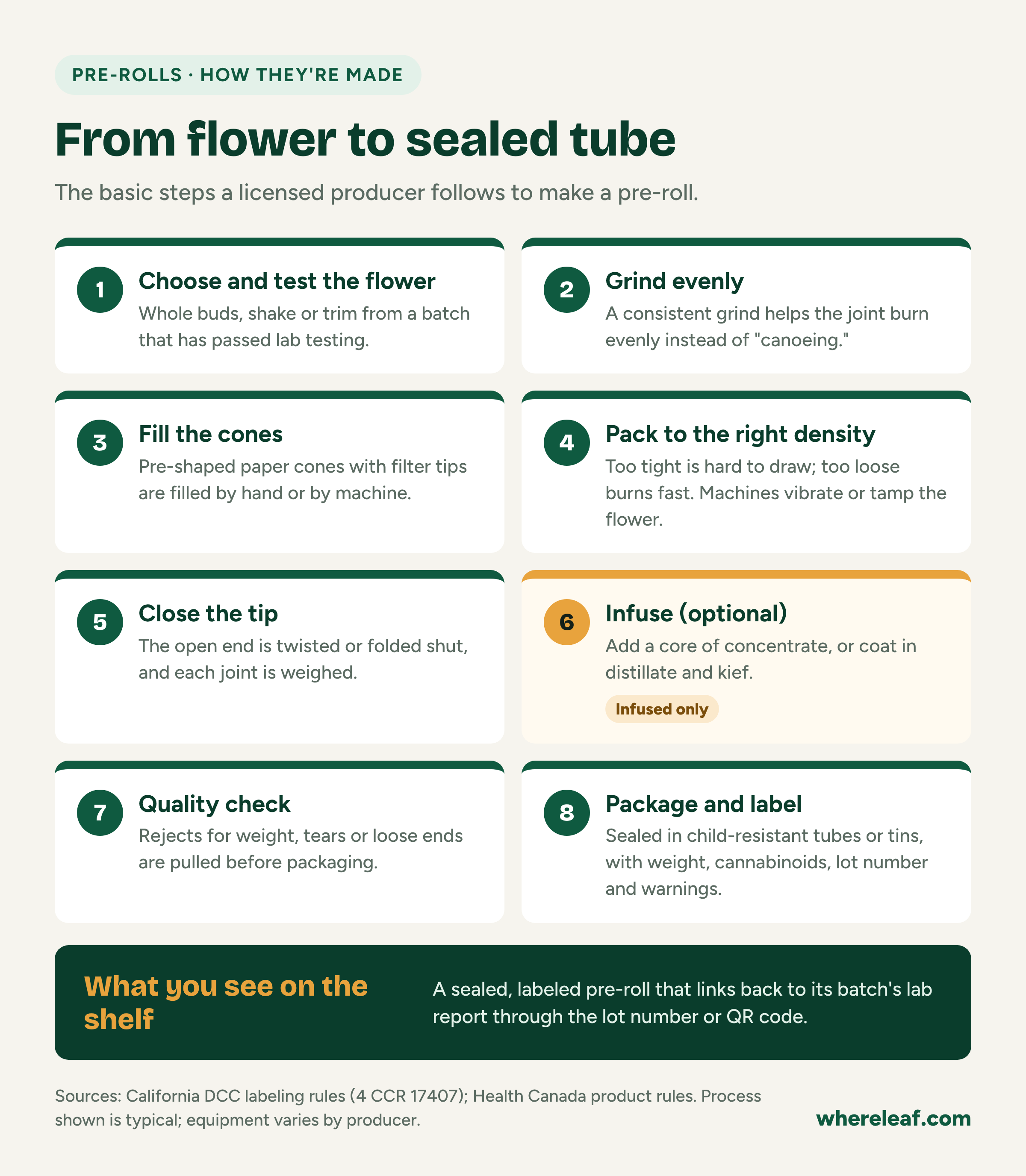
Most licensed pre-roll makers follow the same basic process, though the equipment ranges from hand-held funnels to machines that fill hundreds of cones at once. The graphic below shows each step from flower to sealed tube.
Whole flower vs shake and trim
Some pre-rolls are made from whole buds ground just for rolling. Others use “shake,” the small pieces that break off buds during handling, or trim, the leaves cut away from buds. Shake from good flower can be perfectly fine, but trim-heavy pre-rolls are usually cheaper and less potent. Many brands now advertise “whole flower” on the package. If the label doesn’t say, ask your budtender.
Why packing matters
A joint packed too tightly is hard to pull through; one packed too loosely burns fast and unevenly, a problem known as “canoeing.” Machine-made pre-rolls are usually consistent, which is a big part of their appeal.
Pre-roll papers, filters and tips
The paper and tip change how a pre-roll smokes and tastes, so many brands list them on the package or their website.
- Hemp paper: the most common choice. It’s fairly thin, burns at a steady pace and has a mild taste.
- Rice paper: very thin and light, with little flavor of its own, though it can burn quickly.
- Wood pulp paper: thicker and easier to handle, which is why it often shows up in machine-made cones.
- Unbleached vs bleached: unbleached papers are brown; bleached papers are white. The difference is mostly look and taste.
- Paper filter tips (crutches): a rolled piece of card at the mouth end that keeps flower out of your mouth and holds the joint’s shape.
- Glass or wood tips: a reusable-style tip found on some premium pre-rolls, mostly for a sturdier feel.
None of these is “best”; it comes down to preference. If you find a brand you like, note the paper and tip so you can find something similar next time.
Sharing pre-rolls
Pre-rolls are popular for groups, which is one reason multipacks sell so well. If you’re sharing, only share with adults of legal age, in a private place where use is allowed, and let newer consumers know whether a joint is infused before they take a puff. Our dispensary etiquette guide covers the shopping side of things.
How popular are pre-rolls?
Pre-rolls used to be an afterthought, often made from leftovers. Now they’re a major category, and shoppers are buying more infused and multipack options. The numbers below come from Headset’s retail sales data and Health Canada’s national survey.
Canada leans even harder into pre-rolls. Headset found they made up 32.4% of sales in the Canadian provinces it tracks, and multipacks are the default format there. Health Canada’s survey found that 20% of flower consumers bought all of their flower as pre-rolls. At the other end, 30% said pre-rolls made up less than a tenth of their flower purchases, so many people buy both.
How to read a pre-roll label
Labels vary by state, but most pre-roll packages show the same core details. Look for:
- Net weight: per joint and for the whole pack. Multiply to check a multipack’s total.
- THC and CBD content: a percentage for flower-only pre-rolls; for infused ones, milligrams or a percentage plus added milligrams.
- Strain or blend: a named strain, or a “blend” or “house” mix.
- Packaged or harvest date: fresher is better, since pre-rolls dry out over time.
- Lot number or QR code: links to the lab report. Our guide on how to read cannabis lab results walks through it.
- The THC symbol and warnings required in your state or province.
Some brands also list the paper type, whether there’s a glass or paper filter tip, and the terpene profile. Our terpenes guide explains what those names mean for aroma and flavor.
Are pre-rolls worth it vs rolling your own?
It depends on what you value. Pre-rolls save time and skill, while loose flower is often cheaper per gram. Headset puts the average U.S. pre-roll price at $5.74 per gram equivalent in the first quarter of 2026, and CAD 7.90 in Canada, though shop prices vary widely.
A worked example
Here’s a simple way to compare, using made-up shelf prices:
- A 1-gram pre-roll costs $12, so you pay $12 per gram.
- An eighth (3.5 grams) of the same strain costs $35. Divide $35 by 3.5 and you pay $10 per gram.
- Rolling your own saves $2 per gram here, minus the cost of papers or cones.
- A 5-pack of half-gram minis at $25 works out to the same $10 per gram, with no rolling.
Run the same math on your local menu. Our guide to how much an eighth costs gives typical price ranges.
How to store pre-rolls
Keep pre-rolls in their original sealed tube, in a cool, dark place, away from heat and sunlight. A half-smoked joint dries out and picks up a stale smell, so store it in its tube and use it soon. Keep all cannabis locked up and out of reach of children and pets. Our cannabis storage guide has more tips.
Your pre-roll buying checklist
Screenshot this before your next dispensary visit.
- Decide on size: a mini or half gram if you’re new, a full gram if you know the strain.
- Choose regular or infused. If infused, check the added THC on the label.
- Look for “whole flower” or ask what’s inside.
- Check the packaged date and pick the freshest option.
- Compare the price per gram with loose flower of the same strain.
- Scan the QR code or lot number for the lab report.
- Start with a puff or two and wait before having more.
- Store leftovers in the original child-resistant tube.
- Never drive after smoking, and keep cannabis in the state or province where you bought it.
For dispensary owners: merchandising pre-rolls
Pre-rolls are often the first product a new customer tries, so make them easy to shop. Group them by type on your menu: singles, multipacks, infused and blunts. Show price per gram next to each one, and train staff to explain the difference between flower-only and infused options. Many shoppers will also ask whether a pre-roll is made from whole flower. Because pre-rolls dry out faster than jarred flower, rotate stock by packaging date, sell older lots first and keep display units away from windows and warm lights.
Make sure local shoppers can see your selection. Add your dispensary to WhereLeaf, compare our listing packages to feature your pre-roll menu, and find brands and packaging vendors in our supplier directory. Shoppers can find licensed stores with our dispensary finder.
Frequently asked questions
How much weed is in a pre-roll?
It’s printed on the package, usually as net weight per joint. Most singles hold half a gram to a gram, while minis in multipacks are smaller.
Are pre-rolls stronger than joints you roll yourself?
A regular pre-roll is about as strong as the flower inside it. Infused pre-rolls are much stronger because they include concentrate, so read the label before you light one.
Do pre-rolls contain tobacco?
Dispensary pre-rolls generally don’t. Blunt-style products sold in licensed stores typically use hemp or other tobacco-free wraps. Check the ingredients if you want to be sure.
How long do pre-rolls stay fresh?
Sealed pre-rolls stay fresh longer than opened ones, but they do dry out over time. Buy the most recently packaged option and keep it sealed in a cool, dark spot.
Why do some pre-rolls burn unevenly?
Uneven packing, dry flower or a breeze can cause one side to burn faster. Rotating the joint as you light it helps, and fresher, evenly packed pre-rolls tend to burn better.
Can you buy pre-rolls online?
In many legal states you can order online for pickup or delivery from licensed stores, and in Canada provinces run online stores. See our cannabis delivery guide for how it works.
Sources
- Headset: From Afterthought to Front of Shelf, a Pre-Roll Deep Dive (2026)
- Health Canada: Canadian Cannabis Survey 2024, Summary (2024)
- Cornell LII: Cal. Code Regs. Tit. 4, § 17407, Cannabinoid Content Labeling
- Health Canada: Backgrounder, Final Regulations on New Cannabis Products (2019)
- MJBizDaily: Sales of Infused Pre-Rolls Light Up Canadian Cannabis Market (2022)
- Ganjapreneur: Report, Pre-Rolls Become Largest Cannabis Industry Product Category (2026)
Last updated: October 2026. Laws and prices change; always check your state or provincial regulator.