
New York dispensary and delivery rules are written and enforced by the Office of Cannabis Management (OCM), with the Cannabis Control Board (CCB) voting on regulations, license actions and penalties at its public meetings.
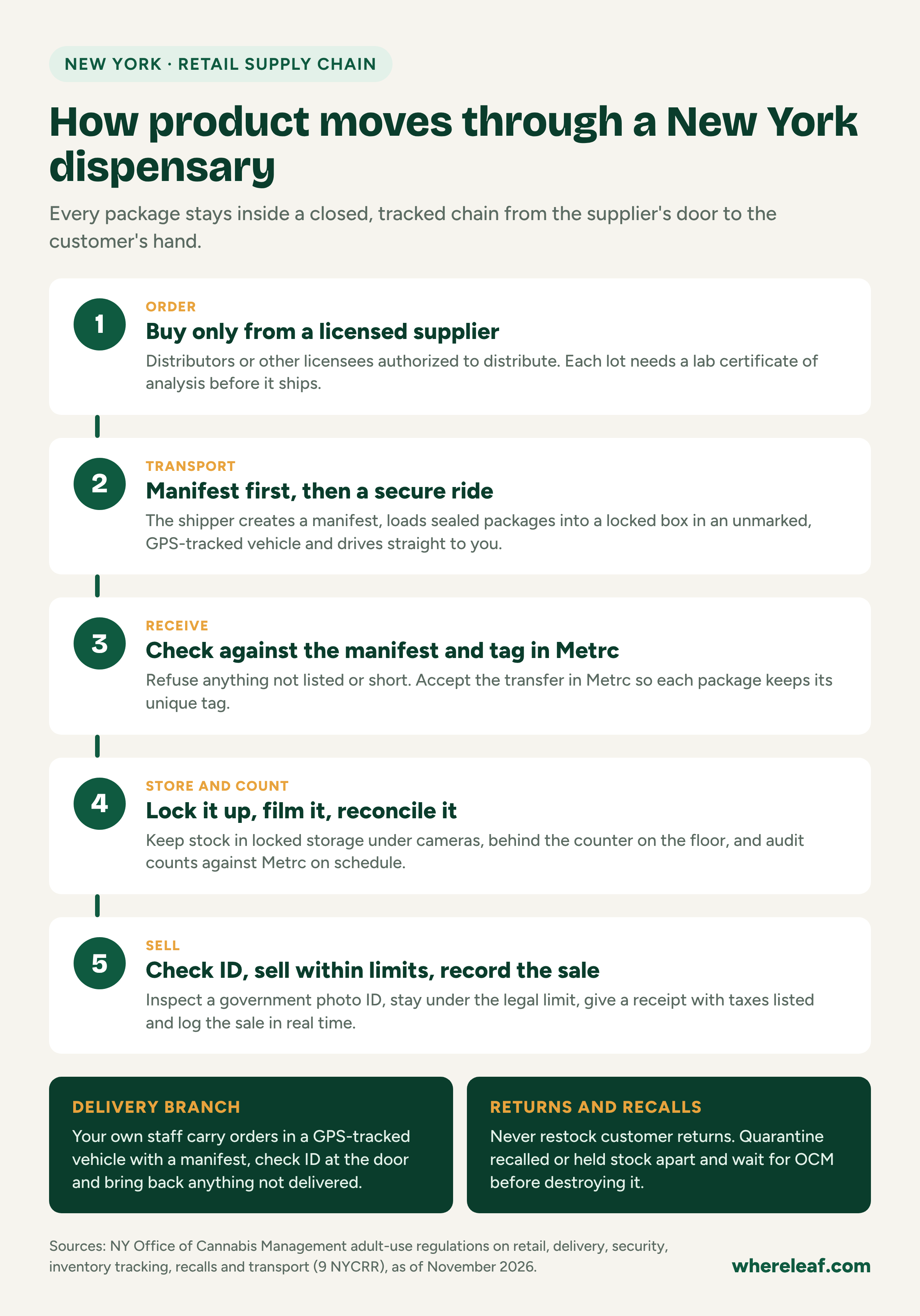
The core idea is a closed, tracked supply chain. Every package you sell must come from a licensed source, arrive on a manifest, carry a Metrc tag, sit in locked and filmed storage, and leave the store only after an ID check and a recorded sale.
This guide covers day-to-day operating rules for adult-use retail dispensaries, including CAURD and ROD stores, and for delivery, checked in November 2026. If you still need a license, start with how to get a cannabis license in New York. This guide is general information, not legal advice. Confirm current rules with the New York State Office of Cannabis Management.
Key takeaways
- Buy only from licensees authorized to distribute, and never accept a lot that arrives without a lab certificate of analysis.
- Metrc is now New York’s seed-to-sale system, and OCM uses its data to run recalls and spot diversion, so keep your counts reconciled.
- Delivery is done by your own trained employees in unmarked, GPS-tracked vehicles, only to homes and private businesses.
- Paying suppliers late can put your store on the state’s cash-on-delivery list, which cuts off credit from every supplier.
- Rules differ by state and change often. Confirm anything you’re unsure of with OCM before acting.
Who enforces New York’s dispensary rules?
OCM regulates adult-use, medical and hemp businesses under the Cannabis Law. Its adult-use rulebook is in Title 9 of the New York Codes, Rules and Regulations (9 NYCRR). The parts a store uses most:
- Part 123: license-specific rules, including retail operations (§ 123.10) and delivery (§ 123.20).
- Parts 124 and 125: general business and operating rules, including security, inventory tracking, recalls, transport, waste and records. These were readopted effective November 5, 2025.
- Parts 128 and 129: packaging, labeling, marketing and advertising, effective December 3, 2025.
- Part 133: violations, hearings and enforcement.
Cities, towns and villages can set some time, place and manner rules under Part 119, such as hours and parking, but not their own licenses or cannabis-specific fees. In October 2025 the CCB rejected extra local buffers and permit rules in Riverhead and Southampton.
Buying inventory as a New York retailer
Under 9 NYCRR § 123.9(a), a retail dispensary may buy cannabis products from any licensee authorized to distribute them, which in practice means licensed distributors, microbusinesses and certain registered organizations. Retail owners cannot hold an interest in a cultivator, processor, distributor or lab (§ 123.9(j)), so you cannot supply yourself. Buying from an unlicensed source is banned under § 123.10(g).
Orders, manifests and transfers
The shipper must create a manifest before transport under § 125.10(g). Check every delivery against it. You may not take possession of items that are not on the manifest or whose quantities do not match, unless a reconciliation resolves the difference. Manifest data must be entered in your tracking system.
Testing and COAs
Every shipment to a retailer must come with a certificate of analysis for each lot, on paper or electronically. Selling untested product is prohibited.
Credit terms and payment
Suppliers may sell on credit, but under § 124.2 you must pay in full by the end of the payment period after delivery. If you do not, the supplier reports you and OCM adds you to its weekly C.O.D. list, which allows only cash at delivery from every supplier until all reported debts are paid. Since September 15, 2026, credit transfers are tracked through Metrc.
Returns, recalls and destruction
- Customer returns: never restock or resell them. Quarantine them for disposal (§ 123.10(g)).
- Recalls: keep written recall procedures, notify OCM and every licensee that supplied or received the product, and hold recalled stock in quarantine until OCM authorizes the next step (§ 125.9).
- Expired product: you cannot sell anything past its printed expiration date.
- Destruction: follow § 125.11 waste rules and record each disposal in Metrc.
How product moves through a New York dispensary
Seed-to-sale tracking in Metrc
Section 125.8 requires a real-time electronic tracking system chosen by OCM. New York first picked BioTrack, but after BioTrack and Metrc announced a partnership in August 2025, OCM moved the state to Metrc. Licensees credentialed in late 2025, and retailers had until January 12, 2026 to enter existing inventory. Processors received Metrc retail item IDs at no cost.
- What to log: every receipt, adjustment, sale, return, delivery and disposal, with product type, weight or count, date, lot ID and the employee involved.
- Tags: every package carries its system-generated unique identifier.
- Outages: if you lose access, keep manual records, enter them once access returns and do not transfer product to other licensees without OCM approval.
- Reconciliation: compare physical stock to Metrc’s expected inventory and report a significant discrepancy to OCM (thresholds in the table).
Our seed-to-sale tracking explainer shows how tags, manifests and sales records connect.
Selling to customers
ID checks
Under § 123.10(d), staff must inspect a valid government-issued photo ID and refuse anyone who appears underage or visibly intoxicated. ID scanning is optional. Online and phone orders need an age attestation, with a full check at pickup or the door.
Limits you must enforce
New York sets no separate per-transaction cap for retailers. Instead, you may not knowingly sell an amount that would put a customer over the Penal Law possession limit, or daily purchases that exceed legal limits or suggest diversion. Post the possession and purchase limits inside the store. Medical patients buy at Registered Organization dispensaries under their own 60-day supply rules.
Sales floor rules
- Post your hours and license, and keep products behind a counter or barrier.
- No prominent displays in storefront windows. Price-tag every item and show the tax-inclusive total separately on menus.
- Samples may be shown in locked cases and handed over for inspection, but customers cannot use or keep them.
- No consumption on the premises unless you have an approved consumption facility, and no vending machines or nicotine products.
- Selling hemp products needs a separate cannabinoid hemp retail license.
Receipts, discounts and exit bags
Offer a receipt listing your name, address, license number, date and time, items, the employee’s first name and last initial, and taxes shown separately. Discounts, loyalty programs and bundles are allowed under § 129.3 if you don’t sell below market value, calculate tax on the pre-discount price and market only to adults. Free cannabis giveaways are banned. Exit bags are optional and may show only your name, logo and branding; any storage container you offer must lock and be child-resistant.
Delivery rules in New York
Delivery is legal. Retail dispensaries can deliver using their own employees under § 123.20, following a written delivery plan. The rules also cover standalone delivery licensees, but OCM’s statewide license totals list no delivery licenses as of October 2026, and no application window has been announced. Third-party apps and couriers cannot carry product.
- Drivers: employees old enough to deliver to consumers, carrying ID and the manifest.
- Vehicles: owned or leased with exclusive use, temperature-controlled, with a locked enclosed box, live GPS and no cannabis markings (§ 125.10(e)).
- Value and prepayment: limits on product value per vehicle and a minimum prepaid share apply (see the table). Drivers may not leave until they have at least one order.
- Manifests: update after every drop, and collect the customer’s signature on the invoice.
- Where you can’t deliver: outside New York, to anyone in a vehicle, or to public buildings, parks, schools, day-care centers, community centers or houses of worship. Homes, including short-term rentals, and private businesses are allowed. Federal land is off-limits because cannabis is federally illegal there.
- At the door: hand the order only to the person named on it after an ID check.
- Refused deliveries: bring the product back. It can be restocked only if new, unopened and handled without compromise.
- Hours: not set separately in the rules; deliveries follow your store’s permitted hours. Ask OCM if unsure.
New York operating rules at a glance
| Rule | Requirement | Where it comes from |
|---|---|---|
| Per-customer sale limit | No sale that would exceed the possession limit of 3 oz of cannabis and 24 g of concentrate | Penal Law § 222.05; 9 NYCRR § 123.10(g) |
| Store hours | No sales from 2 a.m. to 8 a.m. unless the municipality allows it; towns cannot cut you below 70 hours a week | 9 NYCRR § 119.2(a) |
| Product in a delivery vehicle | Up to $20,000 in an enclosed vehicle; $5,000 on a bike, scooter or on foot | 9 NYCRR § 123.20(d)(3) |
| Prepaid orders before leaving | At least 30% of the product value on board | 9 NYCRR § 123.20(e) |
| Delivery licensee staffing | No more than 25 full-time-equivalent delivery workers per license | 9 NYCRR § 123.20(c)(7) |
| Supplier credit | Pay in full within 30 days of delivery | 9 NYCRR § 124.2 |
| Camera footage | Keep at least 60 days, longer if an investigation is pending | 9 NYCRR § 125.3(c)(2) |
| Security system backup | Alarm and video run at least 8 hours in a power outage; failure alerts within 5 minutes | 9 NYCRR § 125.3(c)(3)-(4) |
| Lock and security tests | At least every 30 calendar days | 9 NYCRR § 125.3(c)(6) |
| Security incident | Notify OCM within 24 hours; written report within 10 days | 9 NYCRR § 125.3(e) |
| Inventory audits | Monthly audit plus a full audit every year | 9 NYCRR § 125.8(d) |
| Inventory discrepancy | Report within 24 hours if off by 5% or more (2% above 1,000 products) | 9 NYCRR § 125.8(e) |
| Metrc entries after an outage | Within 3 calendar days of regaining access | 9 NYCRR § 125.8(b) |
| Recall or adverse event | Notify OCM within 24 hours | 9 NYCRR § 125.9(a)-(b) |
| Record retention | 5 years, including manifests, invoices and visitor logs | 9 NYCRR §§ 125.3(d), 125.10(g), 125.13 |
| Staff age | 21+ to deal with customers or deliver; 18+ for licensee-to-licensee transport | 9 NYCRR §§ 123.10(e), 125.10(c) |
| Staff training | Within 30 days of starting; 4 hours a year after that for full-time staff | 9 NYCRR § 125.5 |
| Verification seal | At eye level within 3 feet of the main entrance | 9 NYCRR § 125.16 |
| Retail ownership cap | No more than 3 retail licenses per true party of interest | 9 NYCRR § 123.9(h) |
Packaging and labeling
Under § 128.2, retail packages must be child-resistant for the product’s useful life, tamper-evident and resealable if they hold more than one serving. Required label items (§ 128.5) include:
- THC and CBD per serving and per package for non-inhaled products, or as a percentage for inhaled ones, plus servings and serving size.
- Ingredients, allergens, expiration date, the processor’s license number, a lot number and a QR code linked to the COA.
- New York’s universal symbol and the required warnings, including the adults-only and keep-away-from-children statements, pregnancy warning, Poison Center number and a rotating health warning.
Orally consumed products are capped at 10 mg of THC per serving and 100 mg per package, tinctures at 1,000 mg per package, and drinks must be single-serving (§ 123.6(f)). Packaging cannot appeal to anyone underage, make health claims or promote overconsumption. See our guide to packaging and labeling requirements.
Advertising and marketing
Part 129 sets the marketing rules. What’s banned:
- Content that appeals to people under 21, including cartoons, or that shows consumption.
- Medical or wellness claims, potency boasts and anything false or misleading.
- Ads within or visible from 500 feet of a school ground, playground, child day care, public park or library, and ads on public transit or public property.
- Billboards. Outdoor signs may show only your name, address, contact details, directions and licensed activity.
- Giveaways of cannabis, and advertising on vehicles, with limited exceptions.
Every ad must reach an audience whose share of adults 21 and over at least matches the state’s population, and must carry the 21+ statement or a rotating warning plus HOPEline information. Your website needs an age gate, and social media profiles must show your license number and a 21+ notice; paid social ads can target only verified adults. Our guide to dispensary marketing and local SEO covers compliant ways to be found.
Security, staff and records
Section 125.3 requires commercial-grade cameras covering storage, entrances, sales areas, cash spots and parking, a monitored perimeter alarm, locked storage, ID badges and visitor logs. Every new hire must complete OCM’s two designated courses, implicit bias training and other job training on paid time, in English and their primary language (§ 125.5). Report firing anyone for diversion or cash theft to OCM. See our guides to dispensary security requirements and budtender training requirements.
Taxes your store collects and remits
Retailers charge a 13% cannabis retail tax (9% state plus 4% local) on each adult-use sale and remit it to the NYS Department of Taxation and Finance. Cannabis itself is exempt from sales tax, but you still need a regular sales tax Certificate of Authority if you sell taxable items like papers, lighters or pipes. Your distributor pays a 9% wholesale tax, built into your cost.
- Registration: an Adult-Use Cannabis Certificate of Registration, with a $600 fee at application and renewal.
- Filing: quarterly returns for quarters ending in February, May, August and November, due on the 20th of the following month, even with no sales, through Web File.
- Penalties: up to $500 a month for recordkeeping failures, and up to $7,500 for a first violation of holding product without a certificate.
Inspections and penalties for businesses
OCM can inspect any time you are open, and vehicles count as part of your premises. Part 133 sorts violations into five categories, from immediate threats to public safety down to conduct that undermines orderly operation, but sets no dollar range per category. Sanctions include civil penalties, corrective action plans (due within 24 hours for the most serious categories, 15 days otherwise), summary suspension, revocation and non-renewal. Under Cannabis Law § 132, refusing an inspection can cost up to $8,000, and making false statements in an application up to $2,000.
Recent examples: the CAURD licensee Gotham Buds was fined in October 2026 for an operating agreement that broke ownership-control rules, and OCM recalled lots tied to Keystone State Testing in February 2026 after finding falsely reported mold and metal results. On the illicit side, OCM said in August 2026 that a seizure in Greece, New York, topped $17 million.
New York compliance at a glance
Your New York compliance checklist
- Daily: check every ID, confirm cameras and alarms are recording, match deliveries to manifests, log sales and transfers in Metrc in real time, and lock stock after hours.
- Weekly: check the C.O.D. list status, review recall notices and pay supplier invoices on time.
- Monthly: run the inventory audit, test locks and security equipment, and review Metrc user access.
- Quarterly: file and pay the cannabis tax return.
- Yearly: run the full inventory audit, deliver ongoing staff training, renew your tax registration and start license renewal early.
Use our dispensary compliance checklist and seed-to-sale guide to build your own routine.
Get found on WhereLeaf
WhereLeaf lists licensed stores and delivery services so shoppers can tell them apart from unlicensed shops. Add your listing for free, or see our featured packages for more visibility. Share our consumer guide, New York cannabis laws, with customers who ask about limits, and browse our cannabis license guides for licensing in other states.
Frequently asked questions
Can a dispensary buy from another dispensary in New York?
No. Retailers buy from licensees authorized to distribute, not from other stores, and they cannot sell to other businesses. Moving stock between your own stores still needs a manifest and Metrc transfer; ask OCM how it applies to your licenses.
Can delivery drivers carry cash?
The delivery rules don’t set a separate cash cap. Security rules require safe cash handling and bank transport, so put cash drop procedures in your delivery plan.
Can we use DoorDash or a courier app?
Not to carry product. Only your licensed employees can transport and hand over cannabis.
Can we hold events or pop-ups?
Cannabis showcase events are governed by Part 117, which took effect in April 2026, so read it and check with OCM before planning one. Selling off your licensed premises without authorization counts as unlicensed activity.
Sources
- Cornell LII: 9 NYCRR § 123.10, Retail dispensary operations (2026)
- Cornell LII: 9 NYCRR § 123.9, Retail dispensary authorizations and prohibitions (2026)
- Justia: 9 NYCRR § 123.20, Delivery operations (2026)
- Cornell LII: 9 NYCRR § 123.6, Processor operations and THC limits (2026)
- Cornell LII: 9 NYCRR § 125.3, Security and storage (2026)
- Cornell LII: 9 NYCRR § 125.5, Responsible workforce training (2026)
- Cornell LII: 9 NYCRR § 125.8, Inventory and tracking (2026)
- Cornell LII: 9 NYCRR § 125.9, Quarantine and recalls (2026)
- Cornell LII: 9 NYCRR § 125.10, Transport (2026)
- Cornell LII: 9 NYCRR § 125.13, Record keeping (2026)
- Cornell LII: 9 NYCRR § 125.16, Licensed premises verification tools (2026)
- Justia: 9 NYCRR § 119.2, Municipal time, place and manner rules (2026)
- NY Office of Cannabis Management: Packaging, labeling, marketing and advertising regulations, Parts 128 and 129 (2025)
- NY Office of Cannabis Management: Part 133, Violations, hearings and enforcement (2024)
- NY Office of Cannabis Management: Regulations (2026)
- New York Cannabis Law § 132, Penalties (2026)
- NY Office of Cannabis Management: Delinquent payments guidance (2026)
- NY Office of Cannabis Management: December 2025 CCB press release (2025)
- NY Office of Cannabis Management: October 2026 CCB release (2026)
- NY Office of Cannabis Management: Product recall related to Keystone lab (2026)
- NY Office of Cannabis Management: Greece enforcement action (2026)
- NYS Department of Taxation and Finance: Adult-use cannabis taxes (2026)
- Foley Hoag: CCB and OCM advisory opinion on local laws (2025)
- MJBizDaily: New York delays cannabis track and trace after BioTrack-Metrc deal (2025)
- NewsNation: New York recalls 37 cannabis products over pesticide levels and licensing concerns (2025)
- Meadow: How to start a cannabis delivery service in New York (2026)
Last updated: November 2026. Laws and prices change; always check your state or provincial regulator.