
Washington, DC dispensary and delivery rules are set by the DC Council and the Alcoholic Beverage and Cannabis Board (ABC Board), and enforced day to day by the Alcoholic Beverage and Cannabis Administration (ABCA). Every licensed store in the District is a medical cannabis retailer or internet retailer, because Congress still bars the city from licensing adult-use sales. Your customers are registered patients and caregivers, including the many adults and visitors who self-certify.
The core idea is a closed, tracked supply chain. Product comes only from licensed District cultivation centers and manufacturers, passes lab testing, is tracked in Metrc from receipt to sale, and leaves the store only through a recorded sale to a verified patient or caregiver. Most enforcement trouble starts where that chain breaks.
Everything here was checked against the D.C. Code, Title 22-C of the D.C. Municipal Regulations (DCMR) and ABCA guidance in November 2026. This guide is general information, not legal advice. Confirm current rules with ABCA.
Key takeaways
- Stock must come from licensed District cultivation centers and manufacturers, pass testing and be logged in Metrc before it reaches your shelf.
- Every sale is a medical sale, so check the photo ID, the ABCA registration and the remaining allowance for each customer, every time.
- Delivery is allowed for internet retailers and for retailers with a delivery endorsement, inside the District only, with unmarked vehicles and locked compartments.
- Unlicensed gifting shops face padlocks, large civil fines and arrests, and their landlords can be fined too.
- Rules differ by state and change often, and the District relies heavily on emergency acts. Confirm the version in force with ABCA before you act.
Who enforces Washington, DC dispensary rules?
ABCA runs inspections, investigations and patient registration. The ABC Board votes on licenses, endorsements, fines, suspensions and revocations, approves settlement agreements with Advisory Neighborhood Commissions (ANCs), and adopts the rules. The Metropolitan Police Department works with ABCA on closures of unlicensed shops.
The rulebook has two layers:
- D.C. Code Title 7, Chapter 16B: the medical cannabis statute, including § 7-1671.06 (business operations), § 7-1671.06c (safe-use endorsement), § 7-1671.06e (delivery) and § 7-1671.08 (penalties). Chapter 16C covers landlords of illegal shops.
- 22-C DCMR: Chapter 10 (enforcement), Chapter 13 (fees), Chapter 56 (general operating requirements), Chapter 57 (prohibited and restricted activities), Chapter 58 (advertising), Chapter 59 (records and reports), Chapters 61 to 63 (revocation, hearings, penalties), Chapter 65 (testing) and Chapter 67 (couriers).
ANC settlement agreements on hours, trash or security become license conditions. For license types and fees, see how to get a cannabis license in Washington, DC.
Buying inventory as a Washington, DC retailer
Under D.C. Code § 7-1671.06(a), cultivation centers and manufacturers may distribute to retailers and internet retailers, and retailers may possess cannabis to dispense it to patients and caregivers. Product from out of state or from a gifting shop can never enter your inventory.
Orders, transport and receiving
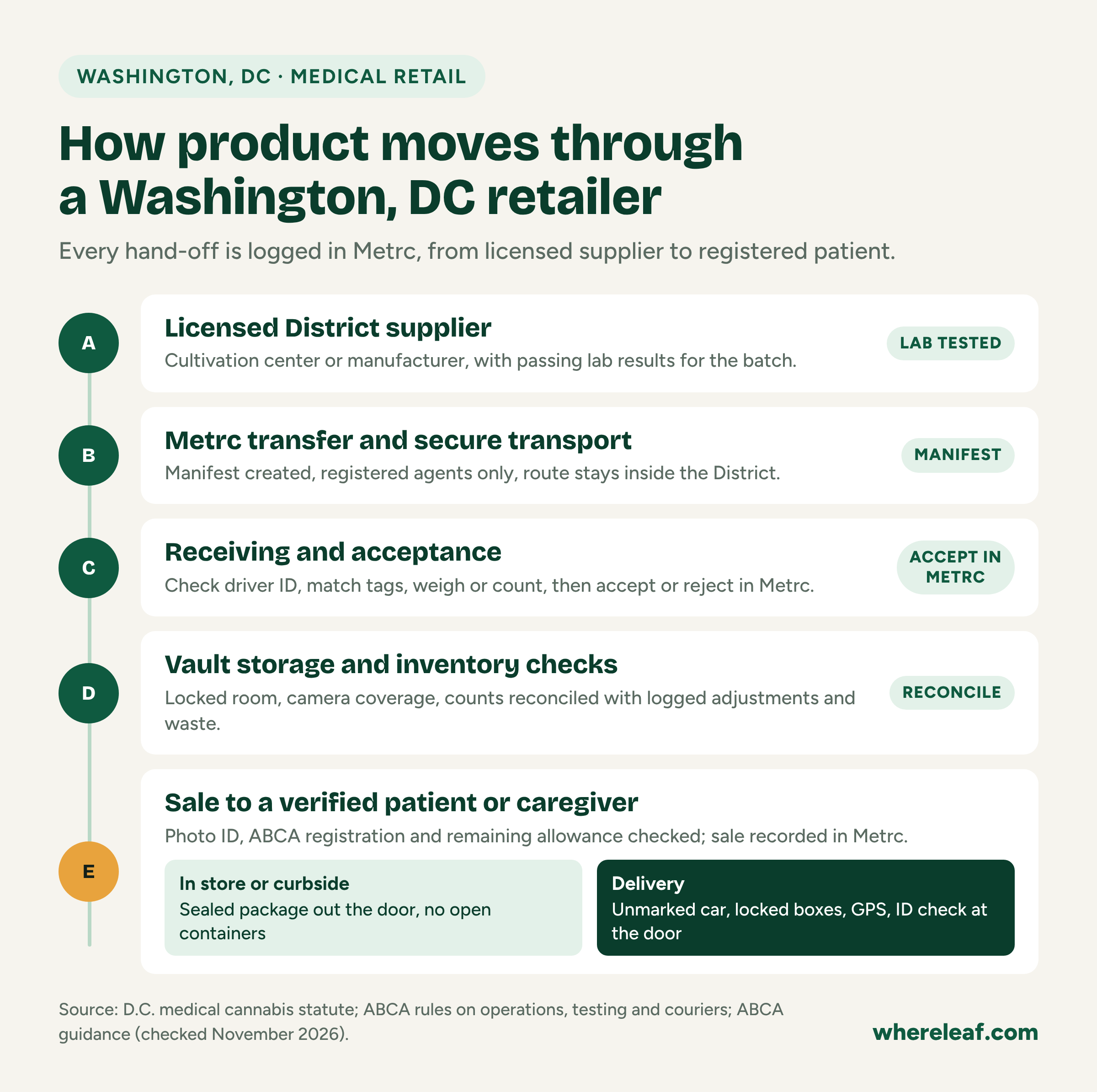
Transfers between licensees move under the transport rules in Chapter 56 and must be recorded in Metrc. A practical receiving routine:
- Check the driver’s ABCA identification and match every package tag to the transfer manifest.
- Note any shortage, damage or broken seal before you accept the transfer in Metrc.
- Keep received product in a restricted area until it is accepted and labeled for sale.
ABCA does not publish a standalone manifest form or a deadline for accepting transfers. That detail is not set in the rules we reviewed, so ask ABCA and follow current Metrc bulletins.
Testing and certificates of analysis
Chapter 65 requires cannabis products to be tested by a licensed testing laboratory before patients receive them. Under rules the ABC Board adopted on December 3, 2025, a batch that fails a microbial, mycotoxin, heavy metal or residual solvent test may be remediated and retested (22-C DCMR § 6510). A batch that fails a pesticide test can’t be remediated. See our guide to reading lab results.
Recalls, returns and waste
Quarantine anything recalled, failed or damaged, record the adjustment in Metrc and destroy it only under your written waste procedure. ABCA’s rules do not set out a detailed recall process, so ask ABCA before you return or destroy product. No order minimums or purchasing caps for retailers are set in the rules.
How product moves through a Washington, DC retailer
Seed-to-sale tracking in Washington, DC: Metrc
The District uses Metrc (dc.metrc.com) as its tracking system, and ABCA’s rules call it the real-time electronic records system. Key points:
- Patient allowance checks: the system checks each patient’s 30-day purchase limit at the register, and sales must stop while it is down (22-C DCMR § 503.4).
- Item setup: Metrc’s District bulletins in 2026 added a beverage category (August 4), flagged misconfigured items (June 30) and added genetics and retail seed items (April 20).
- Reconciliation: match physical counts to Metrc and fix gaps with logged adjustments and reasons. ABCA does not publish a required count frequency, so ask ABCA and write your schedule into your procedures.
See our seed-to-sale tracking explainer.
Selling to customers
ID and registration checks
Only registered patients, caregivers and non-resident cardholders may buy (§ 7-1671.06(a)(6)). For each sale, check a valid government photo ID and a valid ABCA registration, or a card from a reciprocity state, and confirm the details match. A licensee who checked a convincing fake ID has an affirmative defense (22-C DCMR § 1007.4), so record what you checked.
Floor rules
- Limits: the store must enforce each patient’s 30-day caps, shown in the table below. Some higher-dose edibles are for patients with a practitioner’s recommendation only.
- Minors: may enter or buy only as registered patients with a parent or guardian.
- On-site use: not allowed unless you hold a safe-use, summer garden or education tasting endorsement (§ 1008.1). Safe-use rooms admit only patients and caregivers and ban alcohol and tobacco (§ 7-1671.06c).
- Exit packaging: no one may leave with an open or unsealed container (§ 1009.1).
- Visibility: cannabis and paraphernalia must not be visible from public property (§ 7-1671.06(p)).
- Discounts: income-qualified patients get the sliding scale discount under Chapter 98, and it must go to every qualifying patient. Other loyalty and discount rules are not set in the rules; ask ABCA.
- Samples and gifts: no rule permitting free cannabis samples was found. Don’t give cannabis away; ask ABCA first.
- Non-cannabis goods: a rule proposed in October 2025 would let stores sell prepackaged food and merchandise, but not tobacco, nicotine, non-cannabis vapes or alcohol, and never to anyone under 18. Ask ABCA whether it is final.
Washington, DC cannabis delivery rules
Delivery is legal under D.C. Code § 7-1671.06e. Internet retailers deliver without an endorsement but may not offer curbside pickup. Storefront retailers need a delivery endorsement, which also allows curbside pickup. Either may use its own employees or a licensed courier (22-C DCMR Chapter 67).
- Vehicles: no markings, images or words that suggest cannabis; a secure, locked compartment for product and a separate one for cash; and an active GPS device that stays with the driver.
- Route: drive only within the District, never through Maryland or Virginia.
- At the door: check the photo ID and ABCA registration, and don’t leave the order without verifying the recipient. Delivery may go anywhere on the residential property but not to the sidewalk or curb (§ 5624.7).
- Where you can’t deliver: outside the District, to District or federal government property, to school grounds, or to parks. Follow any posted landlord or property owner ban, which matters for hotels and apartment buildings.
The statute leaves delivery frequency per patient, overnight storage, vehicle numbers and the value or weight a vehicle may carry to ABC Board rules. No dollar or weight cap per vehicle is set in the rules we reviewed, so ask ABCA. ABCA’s internet retailer page allows delivery to people aged 21 or older at colleges and universities, which the statute’s school grounds ban doesn’t spell out, so confirm before delivering to a campus.
Washington, DC dispensary operating rules at a glance
| Rule | Requirement | Where it comes from |
|---|---|---|
| Per-patient dried cannabis limit | 8 oz in any 30-day period, including caregiver purchases | D.C. Code § 7-1671.06(o)(1) |
| Per-patient concentrate and THC limits | 240 g of concentrate (60 g for patients aged 18 to 20); 600,000 mg THC in all forms combined, per 30 days | 22-C DCMR § 301.1 |
| Retailer operating hours | Between 7:00 a.m. and 11:00 p.m., unless ABCA approves other hours or a settlement agreement is stricter | ABCA retailer license guidance |
| Delivery and curbside hours | 9:00 a.m. to 9:00 p.m., 7 days a week | D.C. Code § 7-1671.06e |
| Camera coverage and footage | 24 hours a day, 7 days a week; keep video at least 30 days | ABCA cannabis facilities checklist |
| Staff age and registration | Every employee 21 or older and registered with ABCA before working | ABCA cannabis facilities checklist |
| Minimum staffing | At least 2 employees, including 1 manager, on site while open | ABCA cannabis facilities checklist |
| Security plan training | Within 30 days of hire | ABCA cannabis facilities checklist |
| Industry training certificates | Valid for 3 years, then renew | 22-C DCMR § 5105.7 |
| Records on request | Electronic records allowed; physical copies within 48 hours of an inspection notice | 22-C DCMR § 1001.4 |
| Contact information changes | Report to ABCA within 30 days | 22-C DCMR § 5402.7 |
| Exterior cannabis signs | No more than 10 sq ft in total, not counting trade-name-only signs | 22-C DCMR § 5800.1 |
| Window signs | Inside the glass only, covering no more than 25% of window space | 22-C DCMR § 5800.2 |
Packaging and labeling
D.C. Code § 7-1671.06(c) requires child-resistant packaging that meets the federal standard at 16 C.F.R. Part 1700. ABCA accepts tamper-proof or tamper-evident packaging that is significantly difficult for young children to open. Packages and labels may not:
- show a person under 21 consuming cannabis or promote overconsumption;
- use cartoons, cartoon-like fonts or designs that resemble non-cannabis products;
- use the word “candy” or “candies,” or otherwise appeal to people under 21.
Bright colors are allowed again since ABCA dropped its old color limits in 2023. Required label contents are in 22-C DCMR § 5607, and high-THC ingestible products follow § 5608. ABCA’s online materials do not spell out a per-serving cap or a universal symbol, so check the current text with ABCA before you approve new packaging. Our packaging guide compares other states.
Advertising and marketing rules
ABCA’s final sign and advertising rules were approved on December 3, 2025. The sign limits are in the table above, and in addition:
- No cannabis signs on any side of an exterior entrance or exit door (§ 5800.3), and remove any sign that doesn’t comply (§ 5800.4).
- No business, licensed or not, may claim its sales comply with Initiative 71 (§ 5801.4 and D.C. Code § 7-1671.06(c-1)).
- Under the proposed non-cannabis goods rule, those goods could not be advertised on or facing the outside of the store.
No audience-age percentage for digital ads is set in the rules we reviewed. Keep ads away from minors, make no health claims and skip cannabis giveaways. Our local marketing guide covers safe channels such as search listings and email to registered patients.
Security, staff and records
Before opening, ABCA checks for controlled access, a vault or secure room for cannabis, a safe for cash and records, a professionally monitored alarm and outdoor lighting from sunset to sunrise. The statute also requires a security plan and storage in a locked room open only to authorized people (§ 7-1671.06(s)).
- Staff: wear ABCA identification at all times, and present it to police or ABCA investigators on request.
- Training: staff need training on District law, security and theft prevention, and managers need an ABC Board-approved course. See our budtender training guide.
- Records: keep books on the premises unless the Board approves another District location (§ 1001.3). No retention period in years appears in the rules we reviewed, so ask ABCA and keep at least as long as your tax records.
For a full setup list, read our dispensary security requirements guide.
Taxes the business collects and remits
Retailers charge the District’s 6% sales tax on medical cannabis (D.C. Code § 47-2002(a)(7)(A)) and the general sales tax rate on paraphernalia and other goods. File and pay through MyTax.DC.gov with the Office of Tax and Revenue (OTR), on the schedule OTR assigns your account. There is no separate cannabis excise tax.
The Council rejected a proposed rate increase on June 9, 2026.
Inspections and penalties for businesses
ABCA runs scheduled and unannounced inspections and must issue investigative reports within 90 days of an incident (22-C DCMR § 1002.1).
Licensed businesses
- Fines: set by a civil penalty schedule (§§ 1000.2 and 1003.1). For a violation not on the schedule, the Board may fine up to $2,000 and also suspend or revoke (§ 1003.2).
- Selling to someone not allowed to buy: a first violation brings a $2,000 to $3,000 fine under the 2023 rules, rising with repeat violations up to revocation (§ 1009.4).
- Mandatory revocation: for repeated violations, certain felonies and assaults on ABCA investigators (§ 1010.1).
- Straw ownership: a civil penalty of up to $30,000 (§ 7-1671.06(j)(2)).
- Summary closure: since July 2026, ABCA or MPD may padlock a licensed store that poses an imminent danger, such as selling Schedule I substances like psilocybin. You have 5 business days to request a hearing.
Unlicensed gifting shops
Shops that hand out cannabis with a paid item are unlicensed sellers. D.C. Code § 7-1671.08(f) sets civil fines of $10,000, $20,000 and $30,000 for first, second and later violations, plus $10,000 if a remediation plan isn’t filed or is rejected. ABCA can padlock shops that pose an imminent danger,. Since July 15, 2024, ABCA and MPD have padlocked 113 illegal shops. In one June 2026 operation they closed three stores and made six arrests. Commercial landlords get a warning first, then fines of up to $10,000 per later violation (D.C. Code § 7-1675.01).
Washington, DC compliance at a glance
Your Washington, DC dispensary compliance checklist
- Daily: confirm Metrc is online before the first sale; check ID, registration and allowance for every customer; verify every delivery recipient; review camera status; lock cash and product separately; record waste and adjustments with reasons; close out deliveries and returns.
- Weekly: count high-value inventory against Metrc; review new Metrc bulletins and ABCA notices; check signs and window coverage.
- Monthly: file sales tax with OTR if that is your schedule; review discount and sliding scale records; test alarm and camera retention.
- Annually: pay the annual license fee; review settlement agreement terms; renew staff training before certificates expire; update your security plan and SOPs.
Build yours from our dispensary compliance checklist and seed-to-sale tracking guide.
Get found on WhereLeaf
Patients and visitors in the District often can’t tell a licensed retailer from a gifting shop. A clear listing that shows your ABCA license, self-certification help and delivery area helps them choose the legal option. Add your store to WhereLeaf and compare our listing packages. Share our consumer guide to Washington, DC cannabis laws with new customers, and browse our cannabis license guides for other markets.
Frequently asked questions
Can a dispensary buy from another dispensary?
The statute only describes retailers receiving product from cultivation centers and manufacturers, and no rule we found authorizes retailer-to-retailer transfers. Ask ABCA in writing before moving product between stores, even ones you own.
Can delivery drivers carry cash?
Yes, but cash must sit in its own locked compartment, apart from the product.
Can a retailer sell hemp or CBD products?
Ask ABCA first. A new federal hemp definition due to start in December 2026 will remove many hemp THC products from legal sale, and ABCA’s 2026 emergency act lets investigators test products for THC.
Can we sell while our retailer application is in its comment period?
Only with a stipulated license, which requires written support or no objection from the affected ANC. If a protest is found valid at the roll call hearing, you must stop selling and delivering.
Can patients consume cannabis in our store?
Only in an approved safe-use room or summer garden, or during approved education tastings. Combustible products need a ventilation system and a smoke-free area for staff to monitor the room.
Does a courier need its own license?
Yes. A third-party delivery company needs an ABCA courier license and follows ABCA’s courier rules, while a retailer’s own employees can deliver under its endorsement.
Sources
- D.C. Code: § 7-1671.06, Medical cannabis business operations (2026)
- D.C. Code: § 7-1671.06e, Delivery endorsement and internet retailer delivery (2026)
- D.C. Code: § 7-1671.06c, Safe-use endorsement (2026)
- D.C. Code: § 7-1671.08, Penalties and enforcement (2026)
- D.C. Code: § 7-1675.01, Penalties for commercial property owners of illegal cannabis businesses (2026)
- D.C. Code: § 47-2002, Sales tax rates (2026)
- DC Council: D.C. Act 26-391, Medical Cannabis Licensing and Unlicensed Establishment Enforcement Clarification Emergency Amendment Act of 2026 (2026)
- DC Regulations: Title 22-C DCMR chapter list (2026)
- ABCA: Medical Cannabis Notice of Final Technical Rulemaking (2025)
- ABCA: Signs and Advertising Notice of Final Rulemaking (2025)
- ABCA: Remediation and Testing Notice of Final Rulemaking (2025)
- ABCA: Medical Cannabis Emergency and Proposed Technical Rulemaking (2023)
- ABCA: Medical Cannabis Second Proposed and Emergency Rulemaking (2023)
- ABCA: Proposed Rulemaking on Non-Cannabis Product Retail (2025)
- ABCA: Cannabis Facilities Checklist (2024)
- ABCA: Medical Cannabis Retailer License (2026)
- ABCA: Medical Cannabis Internet Retailer License (2026)
- ABCA: The Changing Cannabis Landscape presentation (2025)
- ABCA: Medical Cannabis Program Report, June 2026 (2026)
- ABCA: Three Stores Padlocked, Six Arrested (2026)
- Metrc: District of Columbia partner page and bulletins (2026)
- NORML: District of Columbia Council Rejects Budget Proposal to Raise Marijuana Sales Tax (2026)
- Nutritional Outlook: Federal Hemp Limit Delayed to December 11 (2026)
Last updated: November 2026. Laws and prices change; always check your state or provincial regulator.