
Delaware dispensary and delivery rules are set and enforced by the Office of the Marijuana Commissioner (OMC), which licenses every adult-use store and, since 2024, also runs the medical program. Its investigators at the Division of Alcohol and Tobacco Enforcement (DATE) handle inspections, seizures and arrests, and the Division of Revenue collects the marijuana tax.
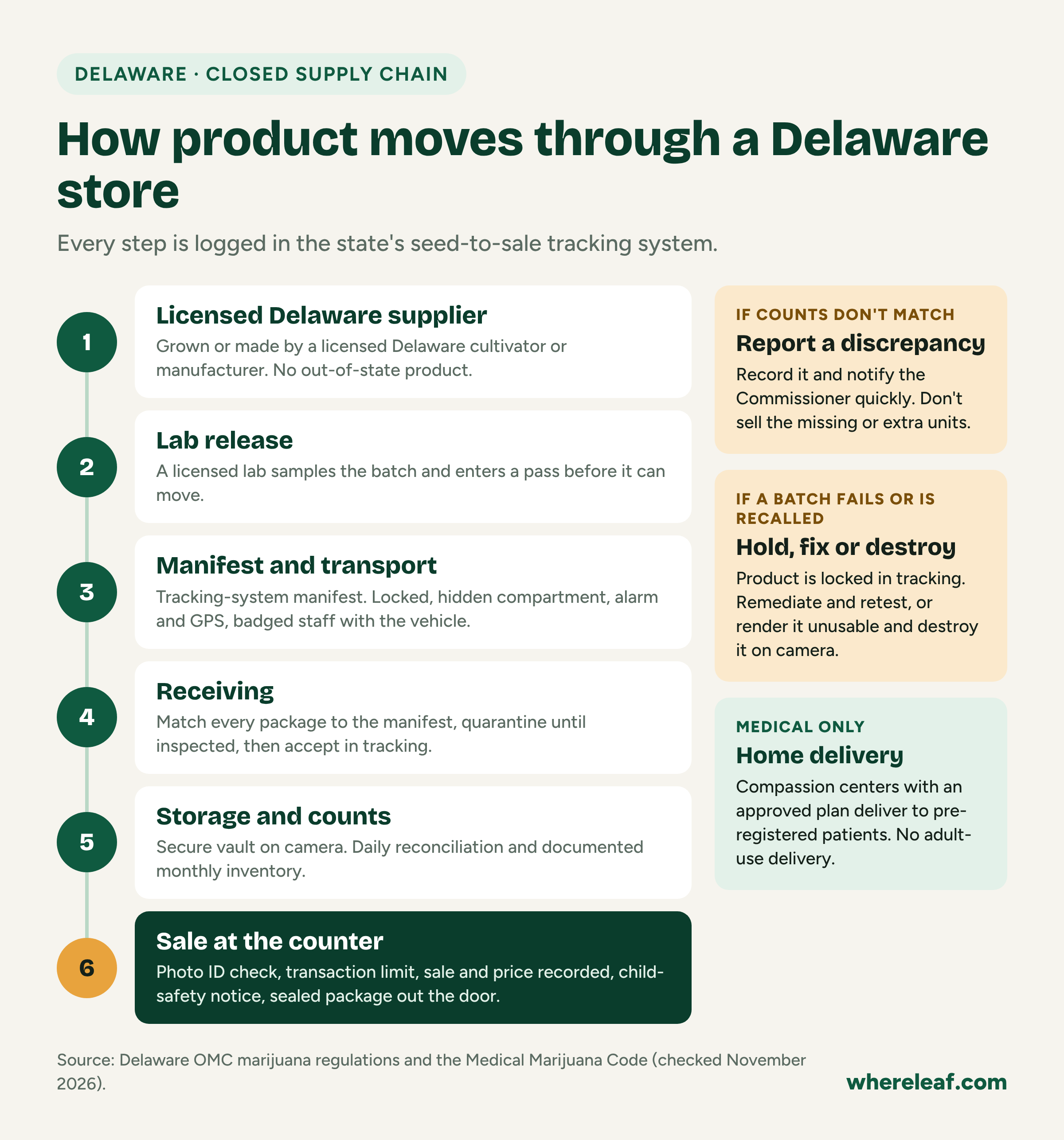
The core idea is a closed, tracked supply chain. A Delaware store may only sell cannabis that was grown, made and tested by licensed Delaware businesses, and every plant, package, transfer and sale is logged in the state’s seed-to-sale system. Adult-use stores sell in person only. The only delivery allowed is from compassion centers to registered medical patients.
We checked everything against the Marijuana Control Act and OMC regulations in November 2026. This guide is general information, not legal advice. Confirm current rules with the Delaware Office of the Marijuana Commissioner.
Key takeaways
- Stock must come from licensed Delaware growers and manufacturers, and it can’t move until a licensed lab has entered a passing result.
- The seed-to-sale system is the official record. Your point-of-sale software can sit on top, but the state data wins any dispute.
- Adult-use stores can take pre-orders but can’t sell online or deliver. Medical home delivery needs an OMC-approved plan.
- Advertising is tightly limited: no billboards, no free product, and only channels with a mostly adult audience.
- Rules differ by state and change often. Re-check OMC bulletins whenever a new law takes effect.
Who enforces Delaware’s dispensary rules?
The Office of the Marijuana Commissioner, inside the Department of Safety and Homeland Security, licenses and disciplines all marijuana establishments. House Bill 425 moved the Medical Marijuana Program to the OMC in 2024, so one office now oversees both adult-use stores and compassion centers.
The rulebook has four layers:
- Statute: the Delaware Marijuana Control Act, 4 Del. C. Chapter 13. Retail store duties are in § 1332, labelling and advertising powers in § 1331, and conversion licenses in §§ 1335A to 1335D.
- Adult-use regulations: 4 Del. Admin. Code 5001. Sections 6.0 to 14.0 cover operations, tracking, products, packaging, advertising, testing, waste, tax and enforcement.
- Medical rules: the Medical Marijuana Act (16 Del. C. Chapter 49A) and the Medical Marijuana Code (16 Del. Admin. Code 4470), which still govern compassion center dispensing and home delivery.
- Local rules: towns can ban cannabis businesses inside their limits. Counties can regulate time, place and manner, but Senate Bill 75, enacted over the governor’s veto on July 1, 2026, caps how far they can go on zoning and opening hours.
Two other agencies matter. DATE’s Marijuana Enforcement Unit investigates violations of Title 4, Chapter 13, and the Alcohol Beverage Control Commissioner shares oversight of THC-infused beverages under House Bill 373. For licensing, see our Delaware license guide.
Buying inventory: where Delaware stores get product
Delaware has no state wholesaler. Stores buy directly from licensed marijuana cultivation facilities and product manufacturing facilities, and transport is allowed only between licensed establishments (5001-7.6.1.1). Converted compassion centers mostly stock their own product; retail-only stores buy from other licensees.
Orders, manifests and transfers
Every transfer needs a manifest generated in the seed-to-sale system before the product leaves (7.6.1.2). The receiving store checks each package against the manifest, records any difference, and keeps the shipment segregated from sellable inventory until it has been inspected (7.6.5, 7.6.7.8). A discrepancy that can’t be fixed on the spot goes to the Commissioner.
Testing before sale
All marijuana and marijuana products must be tested by a licensed lab before transfer to a store, and the sending establishment is responsible for that (5001-11.1). Tests cover potency, microbes, heavy metals and pesticides, with solvent and additive checks for concentrates and vapes. A batch is released only after the lab enters a pass in the tracking system (11.5.4). See how to read cannabis lab results.
Failed tests, recalls and destruction
Failed batches can be remediated and retested, except for pesticide failures, and batches that can’t be fixed must be destroyed (11.6). The Commissioner can order a recall for unauthorized pesticides, failed tests, bad packaging or labels, product from unlicensed sources or any safety risk. The product is then locked in the tracking system and buyers must be notified (14.2.6). Waste must be ground and mixed with non-cannabis material so it is unusable, logged out of inventory, held in quarantine, and destroyed on camera after notice to the Commissioner (12.2).
Purchasing limits and supply
The rules set no minimum order or cap on how much a store can buy. Supply is the real constraint, since new growers have been slow to open. Infused beverages follow a separate path, entering the state only through licensed importers and an in-state warehouse (4 Del. C. § 1335G).
How product moves through a Delaware store
Seed-to-sale tracking in Delaware
The regulations require a seed-to-sale system approved by the Commissioner without naming a vendor. Delaware has used BioTrack, and the state added NCS Analytics in 2023 to scan tracking data for suspicious activity. Confirm your current system credentials and training with the OMC before opening.
What a store must log:
- Every package received, with manifest matching and any discrepancy (7.6.5).
- Every sale, including the actual retail price charged (7.1.2.8, 7.5.1.7).
- Inventory removed for destruction, logged immediately (12.2.2.1).
Third-party point-of-sale software is allowed, but the tracking system is the primary record (7.4). Reconciliation deadlines and count frequency are in the operating rules table below. Our seed-to-sale tracking explainer covers how these systems work.
Selling to customers
ID checks and limits
Staff must check a valid, unexpired government photo ID before every sale and must be trained to spot fake IDs (§ 1332(f); 5001-6.5.3). A sale made in good faith on a fraudulent ID is not grounds for suspension, and staff may keep a suspected fake. The register must stop any single transaction above one personal use quantity. Customers under the legal age can only buy with a valid medical card.
Sales floor rules
- Keep the retail area locked, with entry controlled by staff and a reception check where IDs are verified. The waiting area must be staffed whenever you are open (6.5.7).
- Don’t let product be seen from outside the building (6.5.2.6).
- Don’t sell to anyone visibly intoxicated, and never sell alcohol, cigarettes or non-cannabis edibles such as candy or soda (6.5.2).
- No consumption anywhere on the premises (§ 1332(m)).
- Pre-orders are fine, but the sale is completed in the store after the ID check. No internet sales (6.5.2.8).
Samples, discounts and loyalty
Free product is banned (6.5.2.3, 10.4.1). Discounts and loyalty deals are allowed unless tied to buying a non-marijuana product, and must follow the advertising rules; medical cardholder promotions are exempt (10.4).
Medical and adult-use counters
Converted compassion centers must keep serving patients, including tax-free sales. Patient purchases run against the medical allowance tracked by the program, not the adult-use transaction cap, and the store must keep records of each tax-exempt sale.
At checkout
Give every customer the written child-safety notice and offer a lockable storage container (9.8).
Delivery rules in Delaware
Adult-use delivery is not allowed. State law bars retail stores from delivering to anyone not physically on the licensed premises (§ 1332(j)(3); 5001-6.5.2.9), and there is no delivery license to apply for.
Medical home delivery
Compassion centers may deliver to registered patients. Under the Medical Marijuana Code (4470 Section 7.12), a center must:
- Get a written delivery plan approved before starting.
- Pre-register each patient for delivery.
- Set protocols to identify the patient and take payment at the door.
- Use a full manifest and invoicing program tied to the tracking system.
Vehicles and drivers
The adult-use transport rules show what the OMC expects of any vehicle carrying product: an enclosed, locked compartment hidden from view, insurance, an alarm and GPS tracking, and badged staff who stay with the vehicle at every stop (5001-7.6). The rules we reviewed don’t set a cash limit, a maximum product value per vehicle or delivery hours, so those are set through your approved plan. Ask the OMC. Never deliver onto federal property, and if the patient’s card or ID can’t be verified, bring the order back and log the return.
Operating rules at a glance
| Rule | Requirement | Where it comes from |
|---|---|---|
| Sale limit per transaction | One personal use quantity: 1 oz flower, 12 g concentrate or 750 mg THC in products | 4 Del. C. § 1332(f)(1) |
| Hours counties must allow | At least 9 a.m. to 9 p.m. Monday to Saturday and noon to 8 p.m. Sunday, per the bill synopsis | SB 75 (2026), county zoning code |
| Inventory reconciliation | Daily in the tracking system by 11:59 p.m. | 5001-7.3.1 |
| Full inventory count | Monthly, plus an initial count on opening day | 5001-6.4.1 |
| Reporting a discrepancy or lost badge | Within 24 hours | 5001-6.4.1.3, 6.4.4.6 |
| Surveillance footage | 90 days routine; up to 36 months if significant | 5001-6.3.2 |
| Visitor logs | Kept 1 year | 5001-6.4.7.3 |
| Transport manifests | Kept 5 years | 5001-7.6.10 |
| Staff age and badge | Badge holders must show they are 21 or older; badges renew every 2 years | 5001-6.4.4 |
| Hiring or termination notice | Within 5 business days | 5001-7.2.4 |
| Suspected fake ID | Hand to police within 72 hours | 4 Del. C. § 1332(f) |
| Ad audience | At least 85% reasonably expected to be 21 or older | 5001-10.1.3 |
| Exterior sign size | No larger than 75 sq ft, or a lower local limit | 5001-10.2.3.2 |
| Edible THC caps | 10 mg per serving; 100 mg per multi-serving package | 4 Del. C. § 1331(13)(c), from Oct. 21, 2026 |
Note the edible conflict: the published packaging regulation (5001-9.3) still lists a lower package cap than the statute that took effect in October 2026. Until the OMC updates its rules, ask which cap it will enforce for new products.
Packaging and labelling
Packaging must be opaque, resealable and continually child-resistant under federal standards (§ 1331(13); 5001-9.1). Soft packages need a seal that shows tampering and can’t be resealed, and rigid packages need a seal that stays visibly broken. Labels must be in English, legible and include:
- Net weight, batch number, producer and seller names, and the production date.
- Cannabinoid and terpene amounts, and for edibles the THC and CBD per serving and per package, the serving count, ingredients and a nutrition panel.
- The Delaware Poison Control Center number and warnings about age, children, driving and medications. Edibles must warn that effects can be delayed by hours.
- The state’s universal symbol on the front, unaltered and at least half an inch square (9.2.4).
Packages and labels can’t use cartoons, neon colors, fruit, human or animal shapes, celebrity likenesses, images of minors, the word “candy,” or anything imitating a branded snack (9.7). See our packaging guide.
Advertising and marketing
Delaware’s advertising rules (5001-10.0) are among the stricter ones in the region:
- Audience: electronic, print and sponsorship ads only where the audience is reliably adult, with data you must show the OMC on request. Websites need an age gate, and social posts must state the age rule.
- Required warnings on public-facing ads covering children, health risks, the age limit and an FDA disclaimer.
- Banned content: anything false or misleading, anything that appeals to minors, depictions of use, promoting overconsumption, and any health or wellness claim.
- No outdoor ads: no billboards, posters, freestanding signboards or ads on the side of buildings, apart from your own identification sign, which can’t show a realistic leaf.
- No giveaways of product, ever.
Local search listings and your own site do most of the work; see dispensary marketing and local SEO.
Security, staff and records
Every establishment needs an approved security plan with alarms and video covering access points, sales areas and storage, and give regulators the access your approved security plan requires. Keep service and maintenance records for your alarm and video systems, log every visitor to non-public areas, and document any alarm or breach (5001-6.3, 6.4.7).
Every employee, contractor and volunteer needs a Commissioner-issued badge after a fingerprint background check, worn visibly at work (6.4.4). Renewal of most licenses also requires a labor peace agreement. Retention periods are in the table above. For training and security planning, see budtender training requirements and dispensary security requirements.
Taxes the business collects and remits
Each retail store collects Delaware’s 15% marijuana tax on adult-use sales, holds it in trust and is treated as the taxpayer (4 Del. C. § 1382; 5001-13.0). File the Retail Marijuana Tax Form monthly through the Delaware Taxpayer Portal, with payment due by the 15th of the following month. You must file even for a month with no sales. Sales to medical cardholders are exempt, and each exempt sale needs a record of the card number, product, units and price.
THC-infused beverages carry a separate $0.50 per container tax from February 1, 2027, collected at the distributor level. Check your gross receipts tax obligations with the Division of Revenue. See cannabis tax rates by state.
Inspections and penalties for businesses
DATE conducts administrative inspections and gives the business a summary of deficiencies, often with a deadline for a corrective action plan and a follow-up visit (5001-14.1). Inspectors look at the areas the rules stress most: tracking records, manifests, camera coverage, badges, packaging and sales limits.
After a hearing, the Commissioner can fine, suspend, cancel a license, order corrective action or require a recall (14.2). Fines run from a $250 minimum up to 10% of the store’s estimated average gross monthly sales over the prior year, and are due within 30 days. Selling during a suspension leads to a cancellation hearing. Product can be placed on an administrative hold for 45 days, renewable during an investigation. House Bill 373 adds fines of up to $10,000 for repeat sales of marijuana or infused beverages to people under the legal age within five years.
Recent public cases target unlicensed sellers. In December 2025, Wilmington police and DATE seized about 9.57 pounds of marijuana and THC products from a smoke shop, and in May 2026 DATE charged the owner of an unlicensed Townsend farm after seizing nearly 60 pounds and 32 plants. We found no published fine against a licensed store as of November 2026.
Delaware compliance at a glance
Your Delaware compliance checklist
Daily:
- Check ID on every sale and keep each cart inside the transaction limit.
- Match deliveries to manifests and keep new stock segregated until inspected.
- Reconcile inventory and sales in the tracking system before the deadline.
Weekly:
- Review discount and social posts against the advertising rules.
- Check badge expirations and report staff changes.
Monthly and annually:
- Complete the documented monthly inventory and file the retail marijuana tax return.
- Test alarms, retrain staff on ID checks and recalls, and confirm your labor peace agreement before renewal.
Use our dispensary compliance checklist as a printable version.
Get found on WhereLeaf
Shoppers often don’t know which stores are licensed or have medical counters. A clear listing with your hours, counters and ID rules answers that before they drive. Add your store to WhereLeaf and compare our listing packages. Share our guide to Delaware cannabis laws with customers, and see all our cannabis license guides.
Frequently asked questions
Can a dispensary buy from another dispensary in Delaware?
The transport rules allow transfers only between licensed establishments, and retail stores normally buy from cultivation and manufacturing licensees. Moving stock between locations of the same company, or between unrelated stores, isn’t spelled out in the rules, so get written OMC guidance first.
Can delivery drivers carry cash?
Medical delivery plans must include a payment protocol, but the rules set no specific cash limit. Your approved plan sets the rules DATE will check, so build cash handling into it.
Can we sell THC drinks?
Yes, licensed retail stores can sell infused beverages under House Bill 373, as can liquor stores with authorization. Beverages must come through a licensed importer and in-state warehouse, and hemp shops are not part of that channel.
Can we host a vendor day with free samples?
No. Free product is banned in every form, including vendor giveaways. Use on the premises is banned too, so events can’t include tasting.
Can counties limit our hours further?
Not below the floor that the 2026 county zoning law set (see the table). Towns are a separate matter: municipal ordinances can still restrict or ban stores inside town limits, so check both before you change hours.
Sources
- Delaware Code: Title 4, Chapter 13, Subchapter III, Marijuana Control Act Licenses (2026)
- Delaware Administrative Code: 4 Del. Admin. Code 5001, Marijuana Control Act Regulations, Sections 1.0 to 8.0
- Delaware Administrative Code: 5001-9.0, Packaging and Labeling Requirements
- Delaware Administrative Code: 5001-10.0, Advertising
- Delaware Administrative Code: 5001-11.0, Testing and Sampling
- Delaware Administrative Code: 5001-12.0, Waste and Disposal
- Delaware Administrative Code: 5001-13.0, Retail Marijuana Tax
- Delaware Administrative Code: 5001-14.0, Enforcement, Fines, and Penalties
- Delaware Administrative Code: 16 Del. Admin. Code 4470, Medical Marijuana Code
- Delaware General Assembly: House Bill 373 (2026)
- Plural Policy: Delaware Senate Bill 75 Text and Actions (2025)
- State of Delaware: OMC Legislative Updates, 153rd General Assembly (2026)
- Delaware Office of the Marijuana Commissioner: Frequently Asked Questions (2026)
- State of Delaware: OMC Reports Strong First Month of Recreational Cannabis Sales (2025)
- MJBizDaily: Delaware Taps NCS Analytics to Help Monitor Marijuana Tracking System (2023)
- WHYY: Delaware Retail Marijuana Sales Reached Record $5.6 Million in July, Yet Remain Far Below Projections (2026)
- Delaware Public Media: Veto Override Means Localities Will Have to Relax Zoning on Cannabis Stores (2026)
- WDEL: Townsend Woman Charged With Illegal Sales of Marijuana (2026)
- MyChesCo: Police Raid Smoke Shop, Seize Pounds of Marijuana in Wilmington Probe (2025)
Last updated: November 2026. Rules change; always confirm with the Delaware Office of the Marijuana Commissioner.