Getting a cannabis license in New York is possible, but most doors are closed to new applicants right now. As of October 2026, the Office of Cannabis Management (OCM) accepts new applications year-round only for Processor Type 3 licenses, which are open to licensed cultivators, and it opens a first window for nursery licenses on November 5, 2026. Retail dispensary, microbusiness, distributor and most other license types aren’t taking new applications.
OCM reviews applications and runs the program, and the Cannabis Control Board (CCB) votes to approve licenses at public meetings. The last general application window closed on December 18, 2023, and OCM has been working through that pool since. Future windows for delivery, cooperatives and on-site consumption are planned, with no dates announced.
This guide covers every New York license type and its fees, what is open, the steps from planning to opening day, and the rules on location, ownership and equity, all checked against OCM sources in October 2026.
Key takeaways
- Most New York license types are closed to new applicants, so watch OCM announcements for the next window before you spend money on a site.
- Retail and supply-side businesses are kept separate: a retail owner can’t hold a grow, processing or distribution license, with limited exceptions.
- Social and economic equity applicants get priority and reduced fees, and the state aims to give them half of all adult-use licenses.
- Location rules are strict and are measured from entrances, so confirm a site’s distances and the town’s opt-out status before signing a lease.
- Rules differ by state and change often. Always confirm the current requirements with OCM before you apply.
Who regulates cannabis businesses in New York?
The Office of Cannabis Management oversees adult-use, medical and cannabinoid hemp in New York. The Cannabis Control Board sets regulations and votes on licenses. Both were created by the Marihuana Regulation and Taxation Act (MRTA) of 2021, which is codified as the Cannabis Law. Adult-use rules are in Title 9 of the New York Codes, Rules and Regulations (9 NYCRR), including Part 119 on retail location rules.
New York has two tracks:
- Adult-use: Separate licenses for each step of the supply chain, plus microbusinesses and the earlier CAURD program.
- Medical: Run by Registered Organizations (ROs), long-standing companies that grow, process and dispense for registered patients. Some ROs can join the adult-use market through ROD and ROND licenses.
Cities, towns and villages are the third layer. They could opt out of retail dispensaries and on-site consumption, and they control zoning, hours and building codes, but they can’t issue their own cannabis licenses.
What cannabis license types are there in New York?
New York keeps the supply side (growing, processing, distributing) separate from the retail side. The table shows every license type, what it allows and OCM’s published fees, which date from March 2024. Every adult-use application fee is nonrefundable and paid when you apply; the licensing fee is paid after the CCB approves you and before the license is issued.
| License type | What it lets you do | Application fee | Licensing fee (after approval) |
|---|---|---|---|
| Retail dispensary | Sell to adult customers from a storefront, deliver from it and run cannabis events | $1,000 | $7,000 per premises; a limited retail consumption add-on is $3,000 more |
| Microbusiness | Grow, process, distribute and sell your own products on a small scale | $1,000 | $4,500 |
| Delivery | Deliver adult-use products to customers’ homes | $1,000 | $4,500 |
| Distributor | Buy from cultivators and processors and sell to retailers | $1,000 | $7,000 per premises; $2,500 for processor licensees |
| Cultivator (outdoor, mixed light, indoor or combination) | Grow cannabis, with canopy tiers by growing method | $1,000 | Base fee plus a charge per 500 sq ft of canopy; indoor runs from Tier 1 at $1,750 plus $450 to Tier 5 at $100,000 plus $2,000 |
| Nursery | Grow and sell clones, immature plants and seeds to licensees | $1,000 | $750 to $2,000, depending on growing method and canopy |
| Processor (full or partial) | Extract, infuse, blend, package and brand cannabis products | $1,000 | $7,000 with extraction; $2,000 for infusing and packaging only |
| Processor Type 3 (Flower and Branding) | Let a licensed cultivator package, label and brand its own flower and pre-rolls | $1,000 | $2,000 per premises; $500 for Tier 1 or Tier 2 cultivators |
| Cooperative or collective | Let a group of small growers cultivate, process and sell together | $1,000 | Base of $15,000 to $50,000 by tier and method, plus a per-sq-ft canopy charge |
| On-site consumption | Let adults consume cannabis at a licensed venue | Not published; ask OCM | Not yet set by OCM |
| Registered Organization with Dispensing (ROD) | Let a medical RO grow, process and sell adult-use products at its dispensaries | $10,000 | $175,000, plus the Tier 5 cultivator fee, plus a $20 million special fee paid over time |
| RO Non-Dispensing (ROND) | Let a medical RO grow, process and distribute adult-use products without retail | $10,000 | Tier 5 cultivator fee plus processor and distributor fees |
| CAURD (Conditional Adult-Use Retail Dispensary) | Retail stores for justice-involved owners; closed to new applicants | Not open; ask OCM | Not published; ask OCM |
| Cannabis laboratory permit | Test cannabis products for potency and contaminants | Not published on OCM’s adult-use fee page; ask OCM | Not published; ask OCM |
| Registered Organization (medical) | Grow, process and dispense for registered medical patients | Not published; ask OCM | Not published; ask OCM |
Fee rules to know: qualified social and economic equity (SEE) applicants pay half of both the application fee and the licensing fee. OCM’s fee page lists initial licensing fees only and doesn’t publish separate renewal amounts. Renewal applications must go in 60 to 120 days before your license expires, so ask OCM what you will owe at renewal. Our guide to dispensary license costs by state compares these fees with other markets.
Are New York cannabis licenses open right now?
Mostly no. Here is where each path stood as of October 2026:
- Open year-round: Processor Type 3 Flower and Branding licenses, which only licensed adult-use cultivators can get.
- Opening soon: The first nursery window opens November 5, 2026, at 10 a.m. Only the first 50 applications received will be considered, reviewed in the order they arrive, and later applicants get their fees back. OCM says more nursery rounds will follow.
- Closed to new applicants: Retail dispensary, microbusiness, cultivator, processor and distributor licenses. These were part of the general window that closed on December 18, 2023, and OCM is still approving applicants from that pool at monthly CCB meetings.
- Not yet launched: Delivery, cooperative and on-site consumption licenses. OCM says future windows are expected but hasn’t set dates.
Many applicants from the 2023 window hold provisional licenses, meaning they were approved before securing a site. On October 1, 2026, the CCB gave provisional CAURD and adult-use licensees until December 31, 2028, to submit their remaining information for final approval.
A short history of CAURD
New York’s first legal adult-use sales took place on December 29, 2022, at a CAURD store. The CAURD program reserved the first retail licenses for people with past cannabis convictions, or a qualifying family member, who also had business experience. It no longer takes applications, and its grant program closed after its funding ran out.
Can you buy an existing license?
Any change in ownership or control needs OCM approval through an amendment request, and new owners must pass the same eligibility and true party of interest review as an applicant. Ownership limits still apply, so a buyer can’t use a purchase to get around the retail and supply-side split.
How do you apply for a New York cannabis license?
When a window is open, you apply online through New York Business Express. The graphic below shows the full path for a new business, from checking what is open to opening day.
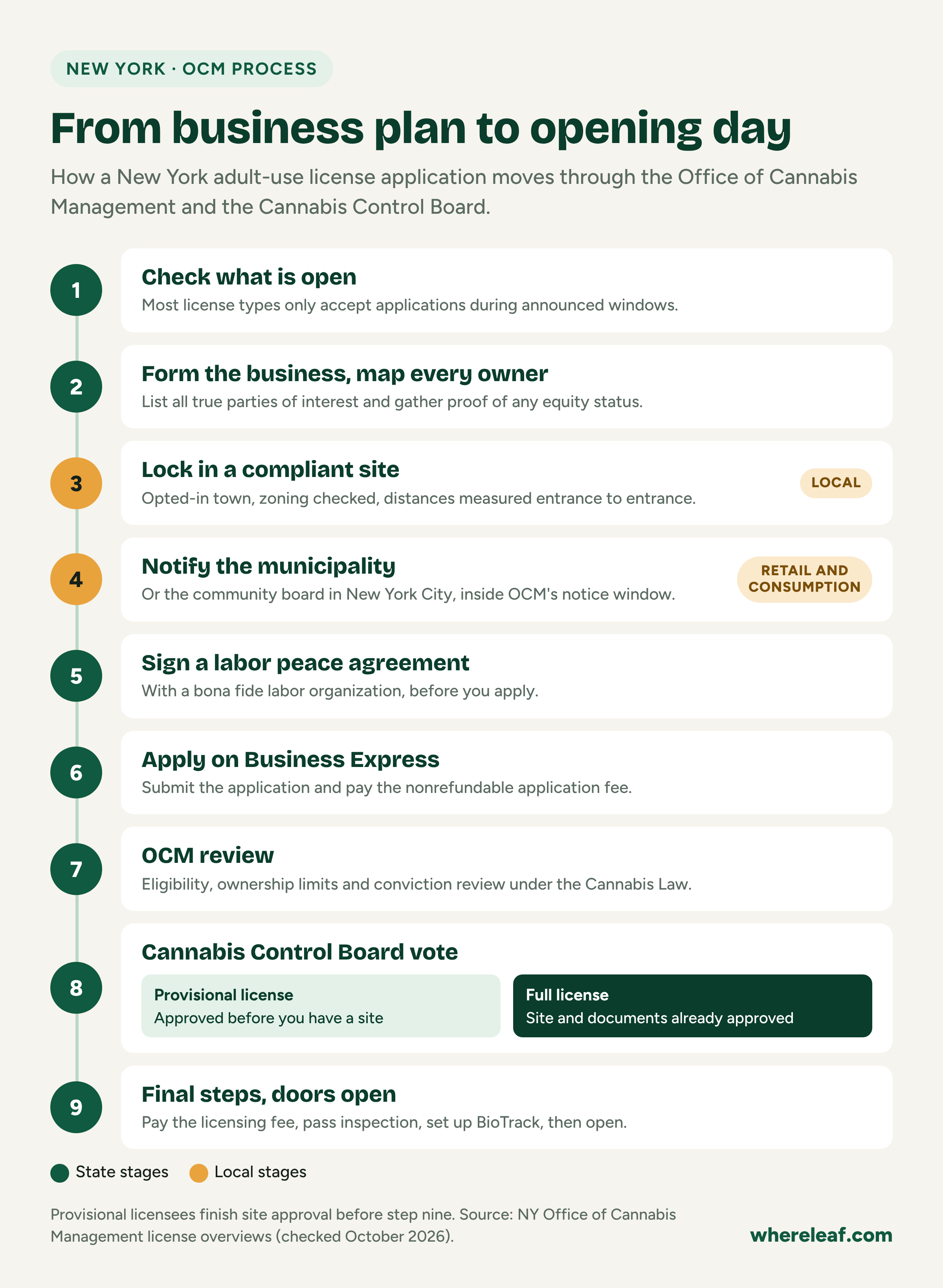
For retail, ROD, microbusinesses with retail and on-site consumption, you must notify the municipality, or the community board in New York City, between 30 and 270 days before filing the final application. Retail applicants without a site can receive a provisional license and then have up to 12 months to submit proof of control of a property.
What requirements do you need to meet?
Ownership and residency
Applicants must be at least 21, and the business must be formed before you start the application. OCM’s Type 3 Flower overview also requires a business location in New York and that applicants be U.S. citizens or lawful permanent residents; check each license overview for its exact rules. A person other than a passive investor can hold an interest in no more than three retail dispensaries, and a retail owner can’t hold any interest in a cultivator, processor, distributor, microbusiness, cooperative, ROD or ROND.
True parties of interest
OCM looks past the applicant to every true party of interest (TPI): owners, managers, lenders and others with financial control or a share of profits. Each TPI must be disclosed, and anyone who could not hold a license can’t sit behind one.
Background checks and disqualifying offenses
Section 137 of the Cannabis Law governs how past non-cannabis convictions are weighed, so a record is reviewed case by case rather than being an automatic bar. A past cannabis conviction is not a bar and can help you qualify for SEE priority.
Capital and bonds
OCM doesn’t publish a minimum capital requirement or bond amount for adult-use licenses. Retail owners often face rent during review, so budget for months of carrying costs.
Real estate and buffer distances
Proof of control means a lease, deed, mortgage, or an option to lease or buy. Retail locations must be at least 500 feet from a school and 200 feet from a building used only as a house of worship, when both are on the same street. In municipalities with 20,000 or more people, dispensaries must be at least 1,000 feet apart; in smaller places, 2,000 feet. A 2026 state law sets how distance is measured, from entrance to entrance in a straight line, and protects licensees issued before February 11, 2026, from losing their site over proximity alone, according to the industry site Purple Ocean. Some sites near other dispensaries need a Public Convenience and Advantage (PCA) request, and OCM amended its PCA rules in 2026.
Labor peace
OCM requires applicants to have a labor peace agreement with a bona fide labor organization. Get this signed early, since it is part of eligibility.
Security, SOPs and insurance
Expect alarms, cameras, secure storage and written procedures for receiving, selling and disposing of products, which OCM checks before final licensing. OCM doesn’t publish a set insurance amount, but landlords and lenders will expect coverage. Our dispensary security requirements guide shows what inspectors usually look for.
Staff training
OCM offers Responsible Workforce Training for licensees’ staff. Pair it with our budtender training requirements guide.
Local approval and zoning in New York
Municipalities had until December 31, 2021, to pass a local law opting out of retail dispensaries, on-site consumption or both. They can’t opt out of other license types, and those that opted out can opt back in at any time by repealing the law. OCM’s LOCAL map shows which places allow what.
Towns, cities and villages that allow cannabis businesses can still set zoning, hours and building code rules, as long as they don’t make operating unreasonably impracticable. A 4% local excise tax applies to retail sales, with 25% of the revenue going to the county and 75% to the cities, towns and villages that host sales.
Social and economic equity programs
The Cannabis Law sets a goal of awarding 50% of adult-use licenses to SEE applicants. You qualify if the people with sole control of the business belong to one of these groups:
- Individuals from communities disproportionately impacted by cannabis prohibition
- Minority-owned businesses
- Women-owned businesses
- Distressed farmers
- Service-disabled veteran-owned businesses
Extra priority goes to applicants who meet three tests: they belong to an impacted community, have income below 80% of their county’s median and were convicted of a cannabis offense before March 31, 2021, or have a qualifying family connection to someone who was. SEE applicants also get the half-price fees described above, and OCM’s PATH hub offers free training through its CHIP Academy.
New York cannabis market at a glance
After you’re licensed: staying compliant
- Renewals: File your renewal 60 to 120 days before expiration through OCM’s renewal form.
- Seed-to-sale tracking: Licensees report inventory in BioTrack, New York’s tracking system. Our seed-to-sale tracking explainer covers how these systems work.
- Annual reporting: OCM sets a yearly resource reporting deadline; the next is August 31, 2027.
- Amendments: Ownership changes, moves and floor plan changes need approval before you act.
- Enforcement: The CCB can fine, suspend or revoke licenses for violations, including improper ownership arrangements.
- Marketing and packaging: Follow OCM rules that bar appeals to minors. See our packaging and labeling guide and dispensary compliance checklist, and train staff on New York purchase limits.
Your New York cannabis license checklist
- Check OCM’s licensing page to see which license types are open.
- Pick a license that fits the retail and supply-side split.
- Form your business and list every true party of interest.
- Gather proof of any SEE status you plan to claim.
- Check your municipality’s opt-out status and zoning on the LOCAL map.
- Measure distances from schools, houses of worship and other dispensaries.
- Secure a lease or option that you can exit if you aren’t approved.
- Notify the municipality or community board within the required window.
- Sign a labor peace agreement.
- Prepare SOPs, a security plan and insurance quotes.
- Apply through New York Business Express and keep copies of everything.
- After approval, pay the licensing fee, pass inspection and set up BioTrack.
For new cannabis businesses: get found on WhereLeaf
Once your license is final and you are open, customers need to find you. Add your business to WhereLeaf so shoppers using our dispensary finder see your address, hours and menu, and compare our listing packages for more visibility. We can’t promise rankings or sales, but an accurate listing helps people choose a licensed business.
Comparing markets? See all our cannabis license guides by state and province.
Frequently asked questions
How much does a cannabis license cost in New York?
The table above lists each OCM fee, and SEE applicants pay half. State fees are usually the smaller part of the bill; rent while you wait, build-out, security and legal help usually cost much more.
Can I get a delivery license in New York?
Not yet as a stand-alone license, since OCM hasn’t opened a delivery window. Licensed retail dispensaries can already deliver from their own premises, and a retail owner may also hold a delivery license once those become available. See our guide on how to start a cannabis delivery business.
Do I need to live in New York?
The OCM license overviews we reviewed don’t list a New York residency rule for owners, but the business needs a New York location, and some overviews require U.S. citizenship or lawful permanent residency. Confirm the rule for your license type with OCM. Out-of-state investors still count as true parties of interest and face the same ownership limits.
How long does it take to get a New York cannabis license?
OCM doesn’t publish a standard review time. Applicants from the 2023 window are still being approved in 2026, and provisional licensees now have until the end of 2028 to finish. Plan for a long wait and keep fixed costs low until approval.
When will New York open new retail dispensary applications?
OCM hasn’t announced a date. Sign up for OCM’s email updates and watch CCB meeting agendas, since new windows are approved there.
Can I open a cannabis lounge in New York?
Not yet as a separate license. On-site consumption licenses are planned but have no window or fees. Retail dispensaries can add a limited retail consumption facility, which has its own fee. See our guide to where you can smoke weed in NYC.
This guide is general information, not legal advice. Rules and fees change, so confirm everything with the New York Office of Cannabis Management before you apply.
Sources
- NY Office of Cannabis Management: Licensing (2026)
- NY Office of Cannabis Management: Adult-Use Application and Licensing Fees (2024)
- NY Office of Cannabis Management: Adult-Use Retail Dispensary License Overview (2026)
- NY Office of Cannabis Management: Adult-Use Nursery License (2026)
- NY Office of Cannabis Management: Adult-Use Processor Type 3 Flower License Overview (2024)
- NY Office of Cannabis Management: Cannabis Control Board Meeting Release (2026)
- NY Office of Cannabis Management: Proximity Protected Locations Map Guidance (2024)
- NY Office of Cannabis Management: Social and Economic Equity
- NY Office of Cannabis Management: Local Government
- NY Office of Cannabis Management: BioTrack Inventory Tracking System FAQs (2025)
- New York Governor’s Office: First Adult-Use Cannabis Retail Sales in State History (2022)
- Purple Ocean (industry site, backup source): NY Cannabis 500-Foot Rule, 2026 Update (2026)
Last updated: October 2026. Laws and prices change; always check your state or provincial regulator.


