
You can’t get a cannabis license in Wisconsin right now, because the state has no legal marijuana market of any kind. As of November 2026, Wisconsin has neither an adult-use nor a medical marijuana program, so no state agency issues dispensary, cultivation or processing licenses for marijuana.
What is legal is hemp. Farmers can grow hemp under a federal license from the U.S. Department of Agriculture (USDA), processors need no license at all, and stores sell CBD and other hemp products under state and federal hemp rules. A narrow state law also lets people possess CBD oil with a doctor’s certification. Those hemp rules are about to get much tighter, because a federal change to the definition of hemp takes effect in December 2026.
This guide covers what Wisconsin allows today, how it got here, what could come next and what a business can legally do now. We checked it against the Wisconsin Legislature’s bill records, Department of Agriculture, Trade and Consumer Protection (DATCP) pages, USDA rules and dated news coverage in late October and early November 2026.
Key takeaways
- Wisconsin has no state marijuana business license, adult-use or medical, and no agency is accepting applications.
- Hemp is the only legal path: growers hold a federal USDA license, processing needs no license, and CBD retail runs on ordinary business registrations.
- Both a Republican medical cannabis bill and a Democratic legalization bill died when the legislative session ended in spring 2026, so any new law would have to start over in the next session.
- A federal rewrite of the hemp definition will push most intoxicating hemp THC products off the legal market late this year unless Congress acts again.
- Cannabis rules differ by state and change often, so check current Wisconsin and federal rules before you invest.
Who regulates cannabis businesses in Wisconsin?
Nobody, in the sense of a marijuana regulator. Marijuana is a controlled substance under Chapter 961 of the Wisconsin Statutes. A first possession offense is a misdemeanor, and a repeat offense can be charged as a felony. Selling it is a crime at any amount.
The agencies that matter for a business today are about hemp:
- USDA: Since DATCP ended its state hemp program, Wisconsin growers have been licensed directly by the USDA’s Domestic Hemp Production Program.
- DATCP: Still handles general food and consumer-protection rules, but it no longer licenses hemp growers or processors.
- Congress: Federal law defines what counts as legal hemp, and that definition is changing in late 2026.
- Cities and counties: They can’t license marijuana, but some set local rules on hemp THC sales and lower local fines for small amounts of marijuana.
Tribal nations are a separate layer. The Ho-Chunk Nation decriminalized cannabis on its lands in 2024, but a Marquette University Law School professor told Wisconsin Public Radio that marijuana “remains illegal under state law and federal law,” and state police can still enforce state law on most reservations.
What cannabis license types are there in Wisconsin?
None for marijuana. The table shows what is and isn’t allowed for a business as of November 2026, and the hemp licenses or registrations that do exist.
| License or activity | What it lets you do (or why you can’t) | Application fee | Annual or renewal fee |
|---|---|---|---|
| Adult-use marijuana business (retail, grow, processing, delivery, lounge) | Not legal. No state law creates these licenses | Not available | Not available |
| Medical marijuana business | Not legal. Wisconsin has no medical program, and the 2025-26 medical bill failed | Not available | Not available |
| Marijuana testing lab or research license | Not available under state law | Not available | Not available |
| USDA hemp producer license | Grow hemp in Wisconsin; you must report acreage to your local Farm Service Agency office and have crops sampled and tested before harvest | No fee for the license itself; you pay for sampling and lab testing | No renewal fee; the license expires December 31 of the third year after it is issued and must be renewed by a new application |
| Hemp processing | Process hemp into extracts and products. No state or USDA processing license has been required since DATCP’s program ended | No license required | No license required |
| Hemp and CBD retail | Sell hemp products that meet the federal hemp definition. No hemp-specific state retail license exists | No hemp-specific state fee; general business and sales tax registration still apply (ask the Wisconsin Department of Revenue) | No hemp-specific state fee |
| Intoxicating hemp THC products (delta-8, THCA flower, hemp THC drinks and gummies) | Sold under state law today. Most fall outside the new federal hemp definition on December 11, 2026, and Milwaukee already bars sales to anyone under 21 | No state license or fee | No state license or fee |
With no state license, a hemp business’s real costs are testing, compliance, insurance and legal advice. For comparison with states that do license dispensaries, see our guide to dispensary license costs by state.
Are Wisconsin cannabis licenses open right now?
No. As of November 2026 there is no marijuana licensing window, no waitlist and no agency that could open one, because no law authorizes it. You can’t buy or transfer a Wisconsin marijuana license, since none exist.
The last real chance in this legislative term ended in March 2026. Senate Bill 534, the Republican medical cannabis bill, cleared the Senate Health Committee in February and then “failed to pass” on March 23, 2026, under the joint resolution that closes the session, according to the Legislature’s bill history. Democrats’ broader bill met the same end. The next regular session begins in January 2027, and any bill would have to be filed again.
If a medical or adult-use law passes in the future, it would set its own application process. A law firm that tracks the state, Cannabis Industry Lawyer, estimated that building a framework could take 12 to 18 months after passage. That is the firm’s view, not a state timeline.
A history of cannabis law in Wisconsin
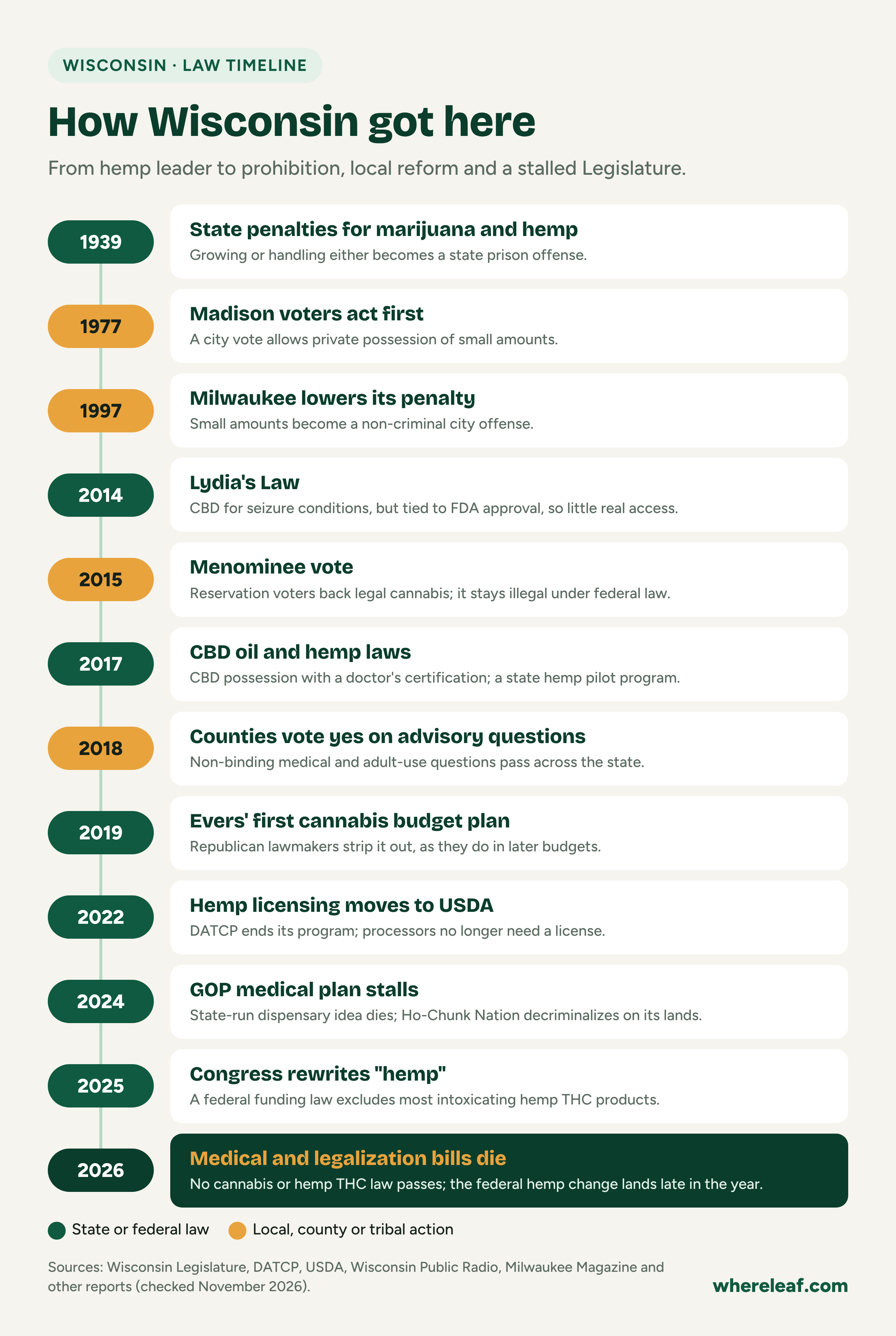
Wisconsin’s story is unusual: it once led the country in hemp, banned cannabis for decades, and has since seen cities, counties and voters push for change while the Legislature held firm. The timeline below shows the major turns.
Prohibition and early penalties
Wisconsin grew hemp on state experimental farms in the early 1900s and led U.S. hemp production in the 1940s. A 1939 state law made growing or handling marijuana or hemp a prison offense, and the state’s modern drug law followed in 1970.
City-level change
Local governments moved first. Madison voters approved a private-possession exception in 1977, Milwaukee made small amounts a non-criminal offense in 1997, and later Eau Claire, Madison, Milwaukee County, Oshkosh and Green Bay cut local fines to a token amount or removed them. These ordinances lower local penalties only; state law still applies.
CBD and hemp laws
Lydia’s Law, passed in 2014, nominally allowed CBD for seizure conditions but tied prescribing to FDA approval, so it did little in practice. A 2017 law let people possess CBD oil with a doctor’s certification, and a separate 2017 law created a state hemp pilot program. The federal 2018 Farm Bill then legalized hemp nationwide, and DATCP handed grower licensing to the USDA at the start of 2022, saying processors would no longer need a license.
Bills by session
Rep. Melissa Sargent filed legalization bills in 2013, 2015 and 2017; none passed. Gov. Tony Evers has put legalization in every budget since 2019, and Republican lawmakers have removed it each time. In 2024, Assembly Republicans proposed a narrow medical program with five state-run dispensaries, but Assembly Speaker Robin Vos said that February it was unlikely to pass because the Senate wanted a broader version. In the 2025-26 session, SB 534 and the Democrats’ SB 1045 both died, and no hemp THC bill reached a floor vote.
Voters and courts
Wisconsin has no statewide citizen initiative, so voters have spoken through non-binding county and city advisory questions, which passed in 2014, 2018 and 2022. Menominee voters approved legalization on their reservation in 2015. In 2023, the Wisconsin Supreme Court ruled in State v. Moore that the smell of cannabis can give police probable cause.
What a business can legally do now
A legal cannabis-adjacent business in Wisconsin today means hemp. Here is what each route involves, and what to watch.
Growing hemp
Apply for a USDA hemp producer license through the USDA’s online Hemp eManagement Platform. Applications are accepted year-round. Each applicant, or each key participant in a company, must send a criminal history report dated within 60 days of applying, and anyone with a state or federal controlled-substance felony in the past decade is generally barred. USDA has delayed until December 31, 2026, the rule that compliance tests come from a DEA-registered lab.
Processing and making products
Wisconsin doesn’t license hemp processors. You still need to meet general food, labeling and consumer-protection law, and federal rules on what you can put in food. Keep certificates of analysis for every batch; our guide to reading cannabis lab results explains what they show.
Selling CBD and hemp products
Retailers need ordinary business registrations, but no hemp license. Two rule changes are close:
- Federal: The November 2025 federal funding law redefined hemp so that most finished products with more than a trace of total THC per container no longer count as hemp. A later stopgap law delayed most of that change, but not for cannabinoids the plant can’t make naturally.
- Local: Milwaukee’s Common Council unanimously passed an age limit on hemp-derived THC sales in July 2025, and other cities have discussed similar rules.
Don’t plan to “serve” Wisconsin from a neighboring legal state. Carrying marijuana across state lines is illegal under federal law and Wisconsin law, even from Illinois, Michigan or Minnesota. A Wisconsin resident can lawfully work for or invest in a licensed business in one of those states under that state’s rules.
Local approval and zoning in Wisconsin
Because there’s no marijuana license, there’s no local marijuana permit either. For hemp businesses, local zoning decides where you can grow, process or open a store, and city ordinances can add rules, such as Milwaukee’s age limit. Before you sign a lease, ask the city or village whether your use is permitted in that zoning district and whether any hemp sales ordinance applies.
Social equity and small-business programs
Wisconsin has no cannabis social equity program because it has no cannabis market. The Democrats’ SB 1045 would have put cannabis regulation in a new division within DATCP, created a medical registry at the Department of Health Services, and let localities ban sales. Past Democratic bills included ways to clear old convictions. The Republican SB 534 would have required owners to be Wisconsin residents and blocked local zoning limits on medical businesses. Neither became law, so read these as signals of what a future bill might include.
What could change in Wisconsin
Several forces could reshape the market. Here is what named sources say, without predictions of our own:
- The governor’s race: Gov. Evers isn’t running again. At an October 2026 debate covered by Marijuana Moment, Republican nominee Tom Tiffany said the state should start with medical marijuana and then take “a step-by-step approach,” while Democratic nominee David Crowley said the state has “to go towards full legalization.” The election is November 3, 2026, and the result is pending.
- The Legislature: In February 2026, Speaker Vos called the Senate medical bill “way too broad” and said the votes weren’t there in the Assembly. Evers has said he’d sign a modest medical bill, though he prefers broader reform. Seats in both chambers are on the November ballot.
- Hemp: Rep. Rob Swearingen and Sen. Patrick Testin drafted competing bills to regulate hemp THC, and Rep. Lindee Brill proposed banning it. Milwaukee Magazine reported in October 2026 that none advanced past a public hearing. In Congress, bills to delay, repeal or regulate the new hemp definition were all in committee as of mid-October, according to Hemp Law Group.
- Neighbors: Illinois, Michigan and Minnesota all allow adult-use sales, and Illinois now tracks how much it sells to out-of-state visitors.
Wisconsin cannabis market at a glance
After you’re licensed: staying compliant as a hemp business
- USDA reporting: Report planted acreage to the Farm Service Agency, schedule pre-harvest sampling and dispose of any crop that tests over the limit under USDA rules.
- Renewal: USDA licenses don’t renew automatically. Reapply before expiry and update USDA when owners, key participants or growing sites change.
- Product testing and labels: Keep batch lab results and clear labels. Our packaging and labeling guide covers good practice.
- Inventory records: Wisconsin doesn’t require a seed-to-sale system for hemp, but tracking lots from farm to shelf makes recalls and audits easier. Our seed-to-sale tracking explainer shows how licensed states do it.
- Store operations: Check IDs where local rules require it, never market to minors, and use our dispensary compliance checklist and security requirements guide as a model for routines.
- The federal deadline: Review every product against the new federal hemp definition before December, and stop selling anything that no longer qualifies.
Your Wisconsin cannabis license checklist
- Accept that no marijuana license exists, and decide whether to wait, run a compliant hemp business or work in a neighboring legal state.
- Follow SB 534’s and SB 1045’s successors when the next session opens in January 2027.
- If you’ll grow, open a USDA Hemp eManagement Platform account and gather criminal history reports for every key participant.
- If you’ll make or sell products, audit each one against the new federal hemp definition.
- Check city and county ordinances, including age limits, before choosing a location.
- Line up a lab, an insurer and a Wisconsin attorney who handles hemp.
- Build records, training and ID-check habits now; they carry over if a medical or adult-use law passes. Our budtender training guide shows what licensed states expect.
For new cannabis businesses: get found on WhereLeaf
WhereLeaf lists licensed cannabis businesses, so a Wisconsin marijuana storefront can’t be listed until the state creates a license. If you run a licensed business in a legal state, add your business to WhereLeaf so customers using our dispensary finder can see your hours and menu, and compare our listing packages. Suppliers can join our supplier directory. We don’t promise rankings or sales, just an accurate listing.
Comparing markets? See all our cannabis license guides by state and province.
Frequently asked questions
How much does a cannabis license cost in Wisconsin?
There’s no state marijuana license, so there’s no fee to pay. The table above shows the hemp side, where the main costs are testing, legal work and insurance rather than license fees. If a future law creates licenses, it would set the fees.
Is medical marijuana legal in Wisconsin in 2026?
No. Wisconsin has no medical marijuana program as of November 2026. The 2017 CBD law lets people possess CBD oil with a doctor’s certification, but it doesn’t create dispensaries or a patient registry.
Can I open a dispensary on tribal land in Wisconsin?
Not legally under current law. Except for the Menominee, Wisconsin has state criminal jurisdiction on reservations under federal Public Law 280, and marijuana remains illegal federally. Any tribal plan would need its own legal review.
Is delta-8 legal in Wisconsin?
Wisconsin hasn’t banned it, so it’s still sold. That changes when the new federal hemp definition takes effect. Products with cannabinoids the plant can’t make naturally lose federal hemp status first, on November 12, 2026, and most others follow on the later date shown in the table.
Will Wisconsin legalize marijuana in 2027?
No one can say. Both governor nominees support at least medical cannabis, but the Legislature must pass any bill, and its makeup depends on the November 3 election. Watch for new bills when the session opens.
Can I bring cannabis home from Illinois or Michigan?
No. It’s legal to buy there as an adult, but bringing it into Wisconsin breaks state law, and crossing state lines breaks federal law. Our guide to where cannabis is legal in 2026 explains the patchwork.
This guide is general information, not legal advice. Rules and fees change, so confirm everything with the Wisconsin Legislature, DATCP and the USDA Domestic Hemp Production Program before you apply.
Sources
- Wisconsin Legislature: 2025 Senate Bill 534, bill history (2026)
- Wisconsin Legislature: 2025 Assembly Bill 680, intoxicating hemp products (2026)
- Wisconsin DATCP: Hemp Program Data and end of state program (2021)
- USDA Agricultural Marketing Service: Hemp production program (2026)
- 7 CFR § 990.21: USDA hemp producer license (via Cornell LII)
- NC State Extension: How to get a USDA license to grow hemp (backup source on USDA fees)
- Wisconsin Public Radio: What you should know about Wisconsin referendums (2018)
- Marijuana Moment: Wisconsin senators approve GOP-led medical marijuana bill (2026)
- Marijuana Moment: Wisconsin governor candidates agree on legalizing marijuana in some form (2026)
- Foley Hoag (law firm, backup source): Wisconsin introduces bill to legalize cannabis (2026)
- Milwaukee Magazine: The Wisconsin hemp industry is set to collapse this year (2026)
- FOX 11: Inside Wisconsin’s hemp, THC industry and battle over federal ban (2025)
- Wisconsin Examiner: Medical marijuana likely dead this session, according to Assembly speaker (2024)
- Spectrum News 1: Milwaukee ordinance will prohibit sale of THC products to anyone under 21 (2025)
- Wisconsin Public Radio: Ho-Chunk Nation decriminalizes cannabis (2024)
- Hemp Law Group (law firm, backup source): Federal hemp ban 2026, where things stand (2026)
- Akerman (law firm, backup source): Congress approves one-month delay of federal hemp THC restrictions (2026)
- Cannabis Equipment News: Over two-thirds of Wisconsin voters approve legalizing cannabis (Marquette Law School Poll, 2025)
- Illinois IDFPR: Adult use cannabis sales figures for November-December 2025 (2026)
- Cannabis Industry Lawyer (law firm, backup source): How to open a dispensary in Wisconsin, the 2026 reality check (2026)
- Wikipedia: Cannabis in Wisconsin (history backup, 2026)
Last updated: November 2026. Laws and prices change; always check your state or provincial regulator.


