

You can’t get a cannabis license in Kansas, because the state doesn’t issue one. As of November 2026, Kansas has no medical or adult-use marijuana program, so no agency licenses dispensaries, growers, processors or delivery services, and selling marijuana remains a crime.
What is legal is narrower. Hemp with no more than 0.3% delta-9 THC can be grown under a USDA license and processed under a State Fire Marshal registration, and CBD products are sold in shops across the state. A small legal defense also exists for people with a qualifying diagnosis who possess a specific type of CBD oil with a doctor’s letter. None of these is a marijuana license.
This guide covers what a business can legally do today, the law changes that led here, the bills that died in 2025-26 and what named sources expect next, checked against Kansas statutes, regulators and dated news in November 2026.
Key takeaways
- Kansas has no state cannabis (marijuana) business license of any kind, medical or adult-use, and the Legislature hasn’t created one.
- The only legal cannabis-plant businesses are hemp businesses: USDA licenses growers, the State Fire Marshal registers processors, and CBD retail needs no special state license.
- Kansas bans several hemp product forms outright, including smokable and vapable hemp, and state agents raided shops selling products they considered illegal THC.
- Kansas voters can’t put legalization on the ballot themselves, so any change has to come from the Legislature and the governor.
- Cannabis and hemp rules differ from state to state and change often, so check current Kansas rules before you invest.
Who regulates cannabis businesses in Kansas?
No Kansas agency regulates marijuana businesses, because none can legally exist. Marijuana is a controlled substance under the Kansas criminal code, and enforcement falls to local police, county attorneys, the Kansas Bureau of Investigation (KBI) and the Attorney General.
Hemp is handled by three different bodies:
- USDA: Since January 1, 2025, the U.S. Department of Agriculture has licensed hemp growers in Kansas. You must hold a USDA license before you plant.
- Office of the State Fire Marshal (KSFM): Registers hemp processors under K.S.A. 2-3907 and inspects their facilities.
- Kansas Department of Agriculture (KDA): No longer licenses growers but still runs the Industrial Hemp Advisory Board and fields questions about CBD foods and ingestibles.
Hemp grown on Prairie Band Potawatomi Nation or Iowa Tribe of Kansas and Nebraska land needs that tribe’s license, according to KDA. Cities and counties can’t license cannabis businesses.
What’s legal and what licenses exist in Kansas?
The table shows what Kansas allows and the only registrations tied to the hemp plant, with fees from the State Fire Marshal and USDA’s hemp rule.
| License or activity | What it lets you do | Application fee | Annual or renewal fee |
|---|---|---|---|
| Marijuana dispensary, grow, processor, delivery or lounge | Not legal. No state license of any kind exists | Not available | Not available |
| Medical marijuana patient or business program | Not legal. Kansas has no patient cards and no medical dispensaries | Not available | Not available |
| USDA hemp producer license | Grow hemp in Kansas, with official sampling and testing before harvest | No fee set in USDA’s hemp rule; confirm with USDA | Licenses must be renewed before they expire; no fee set in the rule |
| KSFM processor registration: extraction | Extract cannabinoids such as CBD from hemp, or process extracted cannabinoids | $1,000 a year, nonrefundable, paid at final approval | $1,000 each year; registration expires June 30 and renewals are due by June 1 |
| KSFM processor registration: drying, grinding or separating | Dry, grind or separate hemp plant parts without extracting | $500 a year, nonrefundable, paid at final approval | $500 each year on the same renewal cycle |
| Infusing compliant extract into finished products | Blend THC-free CBD oil, or a hemp extract within the legal THC limit, into a finished product | No KSFM registration needed; check KDA for food rules | None from KSFM |
| CBD and hemp retail store | Sell hemp products that Kansas law doesn’t ban | No hemp-specific state license | None |
| Tribal hemp license | Grow hemp on Prairie Band Potawatomi or Iowa Tribe land | Not published; ask the tribe’s regulator | Not published; ask the tribe’s regulator |
One fee rule matters: KSFM fees are nonrefundable, and first-time applicants pay only when the registration is finally approved. State law caps processor fees, and the Fire Marshal sets the actual amounts by regulation. For other states’ marijuana license costs, see our guide to dispensary license costs by state.
Are cannabis licenses open in Kansas right now?
No. As of November 2026 there is no marijuana license to apply for, no waitlist and no announced round. A license would only become possible if the Legislature passed a medical or adult-use law, and that law would have to set up a regulator, rules and an application process from scratch.
Hemp paperwork is open year-round: USDA’s rule lets you apply for a producer license at any time, and KSFM accepts processor registrations throughout the year.
How did Kansas cannabis law get here?
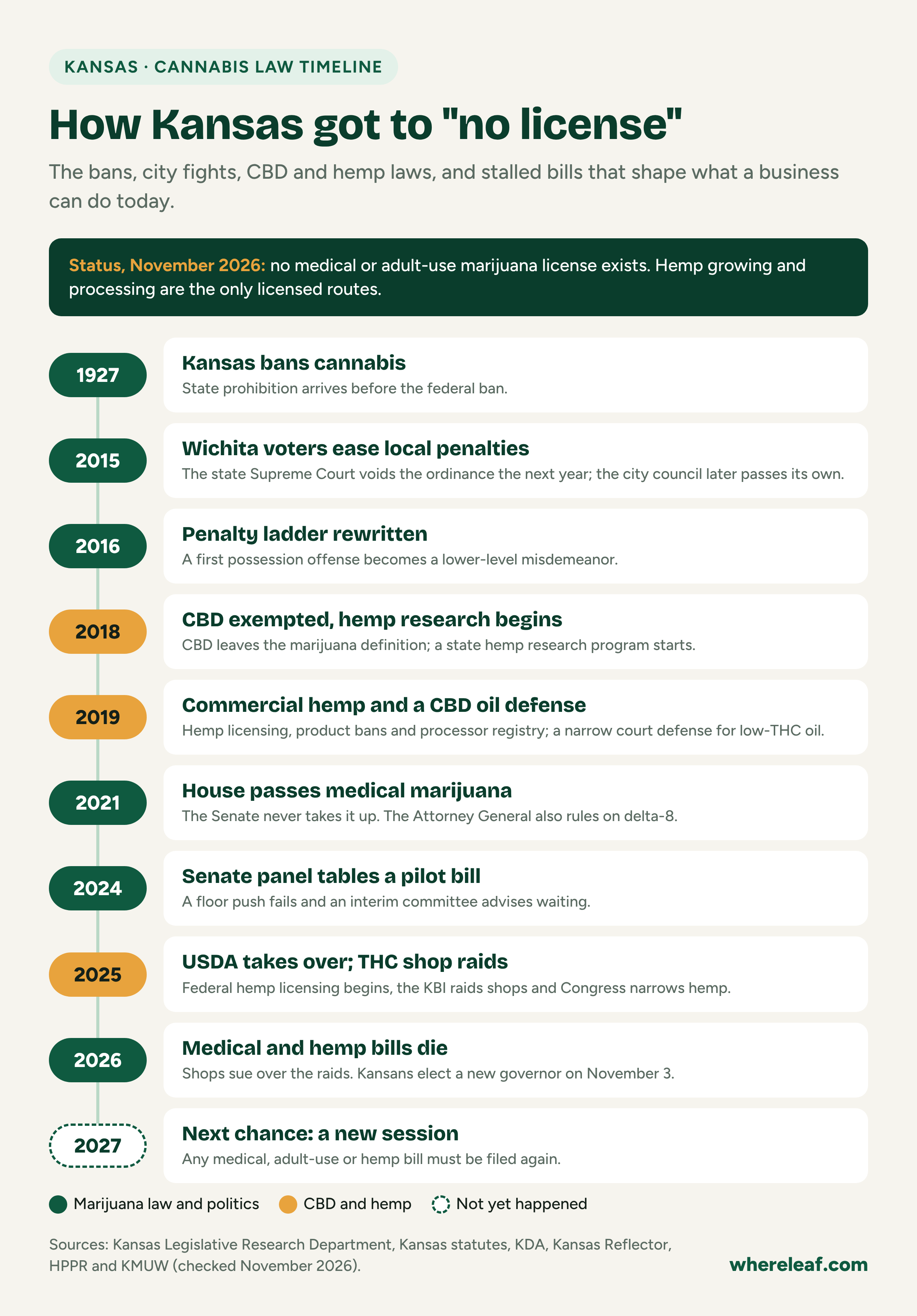
The timeline shows the main steps, and the sections after it fill in the details.
Early bans and penalties
Kansas banned cannabis in 1927, years before federal prohibition. Under current law, a first possession offense is a class B misdemeanor punishable by up to six months in jail, a second is a class A misdemeanor, and a third becomes a felony. That ladder dates to House Bill 2462 in 2016, and Senate Bill 112 eased some paraphernalia penalties in 2017.
City-level fights
Wichita voters approved lower penalties for small-amount possession in April 2015. The Attorney General sued, and in January 2016 the Kansas Supreme Court voided the ordinance on procedural grounds. In June 2017 the Wichita City Council passed a similar ordinance itself, setting a fine of up to $50 for a first offense under 32 grams by adults 21 and older. Lawrence followed in March 2019, cutting its fine for first and second offenses under 32 grams to $1.
CBD and low-THC oil
Senate Bill 282, signed by Governor Jeff Colyer in 2018, removed CBD from the state’s definition of marijuana. In 2019, Senate Bill 28, known in part as Claire and Lola’s Law, created an affirmative defense for people with a qualifying diagnosis, or parents of a child with one, who possess a CBD oil whose THC content is no more than 5% of its CBD content, verified by an independent lab. They must carry a Kansas doctor’s signed letter dated within the past 15 months. It is a defense in court, not a program, and it doesn’t let anyone sell such oil.
Hemp
The Alternative Crop Research Act (Senate Bill 263, 2018) started a state hemp research program. The Commercial Industrial Hemp Act (2019) set up commercial licensing, banned hemp cigarettes, cigars, chew, teas and vaping products, and created the Fire Marshal’s processor registry. In December 2021, Attorney General Derek Schmidt issued an opinion that delta-8 THC is a Schedule I substance unless it comes from hemp and sits in a hemp product with no more than 0.3% total THC. KDA later stepped back from grower licensing, and USDA took over on January 1, 2025.
Medical marijuana bills
The Kansas Legislative Research Department counted 23 medical marijuana or CBD bills over 16 years by 2021, with two enacted. The closest a medical program came was in 2021, when the House passed one 79-42, its first-ever floor vote on the issue. The Senate never took it up.
A special committee held hearings in 2022. In 2024 the Senate Federal and State Affairs Committee tabled a limited pilot bill, and an attempt to force it to the floor fell short, gathering 12 of the 24 votes needed, according to The Beacon. That October, an interim committee voted against recommending legalization for 2025, calling it premature while federal rescheduling played out. In the 2025-26 session, Senate Bill 294 never got a hearing, and House Bill 2678, the Kansas Medical Cannabis Act, died after introduction.
The 2025-26 hemp crackdown
On October 1, 2025, the KBI and Attorney General Kris Kobach announced raids on smoke and vape shops in eight cities, seizing products they said were illegal. In March 2026, three shops sued, claiming the warrants failed to separate legal hemp from contraband. The KBI said it would defend its duty to enforce state law. Senate Bill 292, which would have set an age-21 minimum and packaging rules for hemp-derived cannabinoid products, had a February 2026 committee hearing but didn’t pass before the session ended.
What can a cannabis-related business legally do in Kansas now?
Grow hemp
Apply through USDA’s Hemp eManagement Platform before you plant. You must report acreage to the Farm Service Agency and use a certified sampling agent and testing lab.
Process hemp
Register with KSFM before you dry, grind, separate or extract. The Fire Marshal reviews your building against fire codes and visits on site.
Sell CBD and hemp products
A shop selling lawful hemp products needs no hemp-specific state license, but it must follow K.S.A. 2-3908. That statute bans selling hemp cigarettes, cigars, chew, dip, teas and vaping products, plus hemp foods with ingredients banned under Kansas food law. Buds, ground flower and unfinished extracts may only go to registered processors or licensed producers. The statutes we reviewed set no hemp-specific age-21 rule, which is why Senate Bill 292 proposed one, though news reports describe THC drinks being sold only to adults 21 and older.
Watch the federal change
A federal funding law enacted in November 2025 narrows the definition of hemp so most intoxicating hemp THC products become illegal nationwide. In September 2026, Congress pushed the start date back to December 11, 2026, according to law firm Akerman. Many THC drinks and gummies sold in Kansas today could lose their legal footing then.
What you can’t do
Don’t buy marijuana in Missouri or Colorado to resell in Kansas, and don’t ship or carry it across the state line. Licensed businesses in those states can only sell inside their own borders, and federal law still bars interstate marijuana commerce.
What requirements apply to Kansas hemp businesses?
Ownership and background checks
Kansas sets no residency rule for hemp processors in the statute we reviewed. USDA won’t license anyone with a state or federal controlled-substance felony conviction in the past ten years, and USDA applicants submit a recent criminal history report for every key participant. Kansas disqualifies processors convicted of a felony under the state’s drug crimes article in the past ten years, and people who extract cannabinoids must be fingerprinted.
Capital, bonds and insurance
Neither USDA nor KSFM requires a capital minimum, bond or set insurance amount in the sources we checked, but landlords and banks will ask.
Real estate and facility
Processors need a building that passes Fire Marshal review, which can grant case-by-case variances under K.A.R. 22-26-8. Shops follow local zoning.
Security, SOPs and records
KSFM rules cover processor security, inventory, records, waste and transport, so write SOPs for each. Keep a certificate of analysis for every product you sell; our guide to reading lab results explains what to check.
Staff
Every processor employee needs a background check before starting. There’s no budtender permit, but train staff on banned products and ID checks.
Local approval and zoning in Kansas
With no marijuana license, there’s no local opt-in or opt-out vote. For a hemp or CBD business, check city zoning, any local business license and any local vape or smoke shop rules, and get answers in writing before you sign a lease.
Social equity or small-business programs
Kansas has no cannabis social equity program, reserved licenses or fee waivers. Any future program would be set by a new law.
What could change in Kansas?
None of this is settled.
- The governor’s race: Kansas elects a governor on November 3, 2026. Democratic nominee Cindy Holscher told Marijuana Moment in late October 2026 that federal rescheduling has changed some colleagues’ views and blamed Republican nominee and Senate President Ty Masterson for stopping the medical bill. Masterson called medical legalization a “nonstarter” in 2024. The result isn’t known as we publish.
- The outgoing governor: Governor Laura Kelly, who is term-limited, said in 2025 that it was time for lawmakers to legalize medical marijuana.
- Federal moves: The federal government has moved to reclassify marijuana, and the 2024 interim committee said lawmakers should watch that process. The hemp limits arriving in December may also push lawmakers to revisit Senate Bill 292’s ideas.
- Neighboring markets: Missouri and Colorado allow adult-use sales, Oklahoma has a broad medical program and Nebraska voters approved medical cannabis in 2024. Unlike Nebraska, Kansas has no citizen initiative process.
Holscher has claimed close to 70% support for legalization, but that’s her own estimate; independent survey numbers are in the stat row below.
Kansas cannabis market at a glance
After you’re registered: staying compliant
- Renewals: Put the KSFM renewal deadline on your calendar, since the Fire Marshal sends a reminder but processing without a valid registration is a crime. Track your USDA license expiry too.
- Tracking: Kansas has no seed-to-sale system, but our seed-to-sale tracking explainer shows how licensed states do it.
- Product checks: Pull banned product forms and recheck inventory before the federal hemp limits start.
- Marketing and labels: Avoid packaging or ads that appeal to minors, make no health claims, and see our packaging and labeling guide. Our dispensary compliance checklist and security requirements guide are useful models for hemp shops.
Your Kansas cannabis business checklist
- Accept that Kansas has no marijuana license, and decide whether to build a hemp business, work in a nearby legal market or wait for a law change.
- For growing, open a USDA Hemp eManagement Platform account and get criminal history reports for every key participant.
- For processing, register with the State Fire Marshal and schedule employee background checks.
- Check your product list against K.S.A. 2-3908, and drop smokable, vapable and tea products.
- Confirm local zoning and any city business license in writing.
- Plan for the federal hemp limits starting in December.
- Talk to a Kansas attorney before selling any THC product.
For new cannabis businesses: get found on WhereLeaf
WhereLeaf lists licensed cannabis businesses, so Kansas marijuana businesses can’t be listed until the state licenses them. If you hold a license in a nearby legal state such as Missouri or Colorado, or supply licensed businesses, you can add your business to WhereLeaf and compare our listing packages. Suppliers can join our supplier directory. We can’t promise rankings or sales, but an accurate listing helps people find a licensed business.
Comparing markets? See all our cannabis license guides by state and province.
Frequently asked questions
Is weed legal in Kansas in 2026?
No. Marijuana is illegal for any use in Kansas as of November 2026, and even small amounts can lead to jail time. Only hemp and CBD products that meet state and federal limits are legal. See our map of where cannabis is legal in 2026.
How much does it cost to open a CBD store in Kansas?
Kansas doesn’t charge a hemp-specific retail fee, so your costs are mostly rent, inventory, lab reports, insurance and legal advice.
Can I open a dispensary in Kansas?
No. There’s no dispensary license for medical or adult-use sales. A store calling itself a dispensary in Kansas can only sell legal hemp and CBD products.
Can Kansans use a Missouri medical card at home?
No. A Missouri card lets you buy in Missouri only. Bringing marijuana back into Kansas is illegal under Kansas law,. Never drive after using cannabis; see our guide on crossing borders with cannabis.
Is delta-8 legal in Kansas?
Only in narrow cases. The Attorney General’s 2021 opinion says delta-8 is legal only when it comes from hemp and sits in a product within the total THC limit, and smokable or vapable forms are banned regardless. Federal limits coming in December will narrow this further. Read our explainer on THCA flower for related rules.
When could Kansas legalize medical marijuana?
Not before the 2027 session, which starts in January 2027. Bills that died in 2026 must be refiled, pass both chambers and get past the new governor.
This guide is general information, not legal advice. Rules and fees change, so confirm everything with the Kansas State Fire Marshal, the Kansas Department of Agriculture and USDA before you apply.
Sources
- Kansas Department of Agriculture: Industrial Hemp (2025)
- Kansas Office of the State Fire Marshal: Industrial Hemp Processing FAQ
- Kansas Revisor of Statutes: K.S.A. 2-3907, Hemp processor registration
- Kansas Revisor of Statutes: K.S.A. 2-3908, Unlawful hemp products
- eCFR: 7 CFR Part 990 Subpart C, USDA hemp producer licensing
- Kansas Legislative Research Department: Legalization of Medical and Recreational Marijuana and Industrial Hemp (2021)
- Kansas Legislature: Summary of SB 28 (2019)
- Kansas Legislature: Supplemental Note on HB 2168, hemp fees (2024)
- Kansas Legislature: HB 2678, Kansas Medical Cannabis Act (2026)
- Kansas Legislature: SB 292, hemp-derived cannabinoid products (2026)
- Kansas Legislature: Senate Public Health and Welfare testimony on SB 292 (2026)
- Fort Hays State University: Docking Institute releases 2025 Kansas Speaks survey (2025)
- Marijuana Moment: Kansas Democratic governor candidate on rescheduling and medical access (2026)
- Marijuana Policy Project: Kansas Legislature convened, let’s put cannabis on the agenda (2026)
- HPPR/The Beacon: Kansas lawmakers could vote on medical marijuana again this year (2025)
- KCUR/Kansas Reflector: Thousands of Kansans are buying medical marijuana in Missouri (2024)
- Kansas Reflector: Kansas smoke shops sue state alleging illegal search and seizure during THC raids (2026)
- HPPR/Kansas Reflector: THC-infused drinks have flown under Kansas lawmakers’ radar, until now (2025)
- Ganjapreneur: Kansas Attorney General: Delta-8 Is Illegal (2022)
- KMUW: Kansas Supreme Court strikes down Wichita marijuana ordinance (2016)
- NORML: Kansas laws and penalties
- Akerman (law firm, backup source): Congress approves one-month delay of federal hemp THC restrictions (2026)
- Wikipedia: Cannabis in Kansas (background on the 1927 ban)
Last updated: November 2026. Laws and prices change; always check your state or provincial regulator.


