
Is THCA flower legal? As of October 2026, THCA flower is still legal under federal law only if it meets the 2018 Farm Bill’s hemp definition, which measures delta-9 THC alone, but that window closes on December 11, 2026. On that date a new federal definition takes over that counts THCA toward the 0.3% THC limit, which means almost all THCA flower sold today will no longer qualify as hemp.
That change matters if you have seen “hemp flower” or “THCA flower” in smoke shops, gas stations or online stores and wondered how it can be sold outside licensed dispensaries. Many states have already closed the door on their own, and others are writing new rules, so the answer also depends on where you live.
Below we explain the loophole in plain English, what Congress changed in November 2025 and again in September 2026, how states handle THCA, and what this all means for shoppers. This is general information, not legal advice.
Key takeaways
- THCA flower has been sold as “hemp” because the old federal test looked only at delta-9 THC, not at THCA, which turns into THC when heated.
- A federal law signed in November 2025 rewrites the hemp definition to count total THC. After a short delay, that part now starts in December 2026.
- Once it applies, typical THCA flower will be classified as marijuana under federal law, even if a state still allows it.
- Many states already ban or tightly regulate intoxicating hemp, so a product’s legal status can change when you cross a state line.
- Rules differ by state and province. Always check your local regulator before you buy, carry or travel.
What is THCA flower?
THCA (tetrahydrocannabinolic acid) is the form THC takes in a living or freshly dried cannabis plant. On its own, THCA is not known for producing the typical high. When you heat it, by smoking, vaping or baking, it loses part of its molecule and becomes delta-9 THC, the main intoxicating compound in cannabis. Chemists call this decarboxylation.
“THCA flower” is cannabis bud grown and sold as hemp. Plant by plant, it can look, smell and test almost exactly like the flower in a licensed dispensary. The difference is legal, not botanical: it was labeled hemp because of how its THC was measured.
Is THCA the same as delta-8 or delta-9?
No. Delta-9 THC is the compound THCA turns into. Delta-8 THC is a different compound that occurs only in tiny amounts in the plant, so most delta-8 products are made in a lab by converting CBD. That difference matters under the new federal law, which handles lab-made cannabinoids on a separate, earlier schedule (see the timeline below).
How did the 2018 Farm Bill create the THCA loophole?
The 2018 Farm Bill took hemp out of the Controlled Substances Act. It defined hemp as Cannabis sativa L. with no more than 0.3% delta-9 THC on a dry-weight basis. Anything above that was still marijuana.
The loophole came from that one word, “delta-9.” The law did not mention THCA. A plant could hold a large amount of THCA and still be called hemp, as long as its delta-9 reading on a lab report stayed at or under 0.3%.
Didn’t farmers already have to test total THC?
Yes, but only in the field. The U.S. Department of Agriculture’s final hemp rule, published in January 2021, requires crops to be sampled within 30 days before harvest and tested for total THC using post-decarboxylation or a similar method. USDA describes total THC as the sum of THC and THCA content. Under the rule, a crop that tests up to 1.0% counts as a negligent violation rather than a crime.
The gap was after harvest. Federal law did not clearly require dried flower sitting on a store shelf to be retested for total THC. Sellers relied on lab reports showing low delta-9 numbers, and a national market for high-THCA “hemp” grew from there.
A worked example: reading a THCA flower lab report
Labs convert THCA to its THC equivalent with a standard factor: total THC = delta-9 THC + (THCA × 0.877). The 0.877 reflects the weight THCA loses when it turns into THC. Here is how that plays out on a typical label.
- The certificate of analysis (COA) shows 0.2% delta-9 THC and 22% THCA.
- Under the delta-9-only test, the product reads 0.2%, which is under 0.3%, so it was sold as hemp.
- Under a total THC test: 0.2 + (22 × 0.877) = 0.2 + 19.3 = 19.5% total THC.
- 19.5% is about 65 times the 0.3% line. Under the new federal definition, this flower is marijuana.
Want to check a COA yourself? Our guide on how to read cannabis lab results shows where to find each number.
What did the November 2025 federal law change?
On November 12, 2025, the President signed the bill that ended the federal government shutdown: the Continuing Appropriations, Agriculture, Legislative Branch, Military Construction and Veterans Affairs, and Extensions Act, 2026 (Public Law 119-37). Section 781 of Division B rewrote the federal hemp definition in 7 U.S.C. 1639o.
The table below compares the old and new definitions side by side.
| Question | 2018 Farm Bill definition | New definition (Section 781) |
|---|---|---|
| Which THC counts toward the limit? | Delta-9 THC only | Total THC, including THCA and other THC isomers |
| Limit for plants and flower | 0.3% delta-9 THC, dry weight | 0.3% total THC, dry weight |
| Limit for finished consumer products | No milligram cap | 0.4 mg total THC per container |
| Cannabinoids made outside the plant (e.g., delta-8 converted from CBD, HHC) | Not addressed; widely sold | Excluded from the hemp definition |
| Typical THCA flower (high THCA, low delta-9) | Sold as hemp | Counts as marijuana |
| What happens to non-compliant products | Marijuana only if delta-9 exceeds 0.3% | Fall under the Controlled Substances Act as marijuana |
The law also directed the FDA to publish lists of naturally occurring cannabinoids and THC-class cannabinoids, plus a definition of “container,” within 90 days. As of early September 2026, the FDA had not published them, according to the Hemp Law Group. That leaves open questions for some products, but not for THCA flower, because THCA is plainly part of total THC.
When does the new hemp definition take effect?
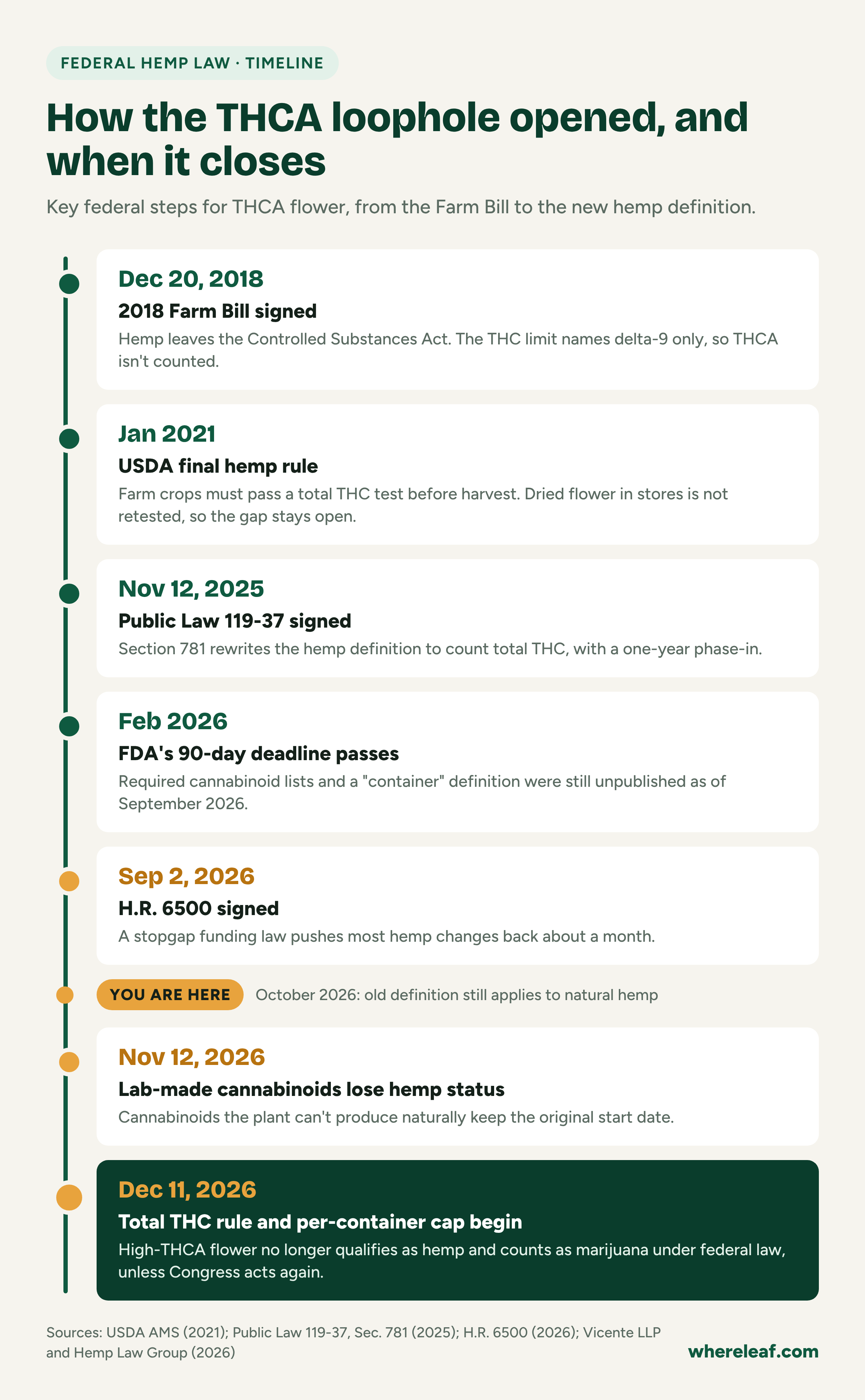
The 2025 law gave the industry 365 days, which pointed to November 12, 2026. Then, on September 2, 2026, the President signed H.R. 6500, the Continuing Appropriations and Extensions Act, 2027. It funds the government through December 11, 2026, and moves most of the hemp changes to that same date.
The delay is partial. Products with cannabinoids the plant does not make naturally still lose hemp status on the original November date. The total THC standard and the per-container cap, the two parts that reach THCA flower, now apply from December 11. The timeline below shows each step.
Could the date move again?
Possibly, but don’t count on it. The Senate passed the stopgap bill 90 to 6 after voting down an amendment to strip the hemp language, and the House passed it 370 to 48, according to the Hemp Law Group. The same source reports that the White House called this the last extension it would support.
Other bills are pending in committee as of October 2026. They would push the deadline to 2028, repeal Section 781, or set up a federal rulebook for hemp products. Congress could act in the session after the November election or in the next funding bill due in December. Until something passes, December 11 is the date to plan around.
Which states already ban or restrict THCA flower?
Federal law sets the floor. States can be stricter, and a federal appeals court confirmed in 2025 (Bio Gen LLC v. Sanders, 8th Circuit) that states may ban hemp products that federal law allows.
The April 2026 report from the American Trade Association for Cannabis & Hemp (ATACH) found that nearly every state with a regulatory framework already measures total THC, which captures THCA. Only Georgia, Kentucky and New Mexico still used a delta-9-only standard. In practice, that meant those three states were among the few where high-THCA flower could still pass a state test.
Examples of how states handle it
- Effective bans: ATACH lists Arkansas, Arizona, Idaho, Indiana, Kansas, Montana, North Dakota, South Dakota, Vermont, Wyoming and the District of Columbia among the jurisdictions that prohibit intoxicating hemp products.
- Cannabis-only states: Colorado, Oregon, Washington State, Nevada, Michigan, Ohio and Maryland channel intoxicating products into their licensed marijuana systems.
- California: AB 8, signed October 2, 2025, classifies a hemp product with any detectable THC as intoxicating and lists hemp flower and inhalable hemp products as prohibited. From January 1, 2028, intoxicating hemp must be made, tested and sold like regulated cannabis.
- Tennessee: Since July 1, 2026, hemp-derived cannabinoid products are licensed by the state’s alcohol commission and measured by total THC.
- Texas: State rules adopted in 2026 include a total THC standard, and parts of them are being challenged in court, so check the latest before relying on any summary.
State laws move fast in this area. Use any list, including this one, only as a starting point and confirm with your state’s agriculture department, cannabis regulator or attorney general.
Is THCA flower legal in states with legal weed?
In adult-use states, the simplest answer is that high-THC flower belongs in licensed dispensaries. Those stores sell flower that is tested, labeled and tracked by the state, and its legal status does not hinge on how THC is measured. After December 11, that is also the only clear path, since federal hemp status will no longer cover THCA flower anywhere.
Not sure which states allow adult-use sales? See our guide to where cannabis is legal in 2026. Remember that licensed marijuana is still illegal under federal law, so taking it across state lines, onto federal land or onto a plane remains off-limits.
What changes for shoppers after December 11, 2026?
For most people, the change will show up as products disappearing from non-dispensary shelves. Some practical effects to expect:
- Online and mail-order THCA flower: Shipping it across the country relied on federal hemp status. Once that status ends, it is shipping marijuana.
- Smoke shops and convenience stores: Unless a state creates its own legal channel, these stores would no longer have a federal basis for selling THCA flower, pre-rolls or vapes.
- Payment and shipping services: Payment processors and carriers often cut off products ahead of legal deadlines, so you may see items vanish before December.
- Products you already own: The law has no buy-back or grandfather clause for consumers. Possessing a product that counts as marijuana is governed by your state’s cannabis law, and federal law classifies it as marijuana too.
- Licensed dispensaries: Nothing changes for state-licensed stores, because they never relied on the hemp definition.
If you buy cannabis in a legal market, a licensed store is the safer bet both legally and for product testing. Use our guide to check if a dispensary is licensed before you buy.
Your THCA legality checklist
Use this list before buying, carrying or traveling with anything sold as THCA or hemp flower.
- Check where today’s date falls on the federal schedule in the timeline above.
- Look up your own state’s rule on intoxicating hemp with your agriculture department or cannabis regulator.
- Read the COA and calculate total THC (delta-9 + THCA × 0.877). If it tops 0.3%, it will not be federal hemp after December 11.
- Confirm the COA’s batch number matches the package and the lab is accredited.
- Prefer state-licensed dispensaries in adult-use states, where testing and labeling are required.
- Do not ship, mail or fly with THCA flower, and never cross state or national borders with it.
- Keep all cannabis products away from children and pets, and do not drive after using them.
- Recheck in December: Congress may still change the rules before or after the deadline.
For businesses: what the hemp change means for dispensaries and suppliers
For licensed retailers, the end of the THCA loophole removes a low-cost competitor that never had to follow state testing, tracking or tax rules. Shoppers who used to buy at smoke shops will start searching for a legal store nearby, and many will look online first.
Make sure they can find you. List your dispensary on WhereLeaf and compare our listing packages to show up when people search near you. Hemp brands planning to move into the licensed market can also connect with licensed partners through our supplier directory.
Frequently asked questions
Is THCA flower federally legal right now?
Until December 11, 2026, federal law still uses the 2018 delta-9-only definition for natural hemp products, so THCA flower that stays under the old delta-9 limit can meet it. That does not make it legal in your state, and many states already ban it. After December 11, flower over the new total THC limit is marijuana under federal law.
Will THCA flower show up on a drug test?
Very likely. Common drug tests look for THC metabolites in the body, and smoking THCA flower produces delta-9 THC. A test cannot tell whether the flower was sold as hemp or as marijuana.
Can I order THCA flower online and have it shipped?
Interstate shipping depended on federal hemp status, which ends for THCA flower on December 11, 2026. Many states already prohibit delivery of intoxicating hemp, and carriers can refuse it. WhereLeaf does not recommend buying THCA flower by mail.
Is THCA flower the same as weed?
Chemically, high-THCA hemp flower and dispensary flower are nearly identical once heated. The difference has been the legal label and the rules that come with it, such as testing, age checks and taxes in licensed stores.
Can you fly with THCA flower?
Don’t. Airport security looks for federal crimes, and after December 11 THCA flower is marijuana under federal law. Our guide on bringing weed on a plane explains the rules.
Does the new law ban CBD?
Not CBD itself. Non-intoxicating hemp products can stay legal if they stay under the total THC and per-container limits, though full-spectrum products with trace THC may need to be reformulated. Check labels after the change.
Sources
- Frier Levitt: Federal Hemp Redefinition 2026, THC Limits and Compliance (2026)
- Vicente LLP: Federal Hemp Update, Definition Change Delayed to December 11 (2026)
- Hemp Law Group: Federal Hemp Ban 2026, Where Things Stand (2026)
- NACS: House Votes to Delay Hemp Ban (2026)
- American Trade Association for Cannabis & Hemp: Hemp Intoxicants Report 2026 (2026)
- National Agricultural Law Center: Industrial Hemp Regulations Finalized (2021)
- USDA Agricultural Marketing Service: Laboratory Testing Guidelines, U.S. Domestic Hemp Production Program
- ACS Laboratory: Understanding Hemp Compliance and USDA Testing Standards
- California Department of Cannabis Control: Hemp (2026)
- Texas Policy Research: New THC Rules Take Effect July 31 (2026)
Last updated: October 2026. Laws and prices change; always check your state or provincial regulator.


