The best dispensary loyalty program ideas reward repeat visits with points, tiers or member pricing, then add birthday and referral perks that your state actually allows. Strong programs are easy to explain at the counter, run on consent-based text and email lists, and never rely on free cannabis in states that ban giveaways.
A loyalty program is often the cheapest marketing a dispensary has. You already know who buys from you, so a good program turns one-time shoppers into regulars without paying for ads that many platforms will not run for cannabis anyway.
This guide is for dispensary owners and marketing managers in legal markets. It compares the main program models, gives 12 practical ideas, walks through a cost example, and flags the state promotion rules and text-message laws that trip up stores most often.
Key takeaways
- Points programs are the easiest to launch. Tiers and paid memberships reward your top spenders more but take more planning and staff training.
- What you’re allowed to offer, and what you’re allowed to advertise, are two separate questions. Check both before you launch.
- Rewards work best as money off a priced sale. Free product is the reward most likely to break a state or provincial rule.
- Your contact list is only an asset if every member opted in. Consent records and fast opt-outs protect you from costly lawsuits.
- Rules differ by state and province. Always check your local regulator and a cannabis attorney before you launch a promotion.
What makes a good dispensary loyalty program?
A good program is simple, legal in your state and worth joining. If a budtender cannot explain it in one sentence at the register, most customers will not sign up.
The Bond Loyalty Report 2025 found that consumers belong to about 17.4 programs each, and only about one-third of programs are seen as delivering real value. Your program is competing for attention with coffee shops and airlines, so the reward has to be clear and reachable.
Four goals to set before you choose a model
- Visit frequency: get monthly shoppers to come in twice a month.
- Basket size: nudge a typical order up by a few dollars.
- Retention: win back customers who have not visited in 60 or 90 days.
- Data you can use: build an opt-in contact list you own, instead of relying on third-party platforms.
Pick one or two goals. Trying to do everything usually creates a confusing discount stack.
Points vs tiers vs visit punch cards: which rewards model fits?
Most cannabis rewards programs use one of four models. The right one depends on your margins, your point-of-sale software and how strict your state is about discounts.
| Model | How it works | Best for | Watch out for |
|---|---|---|---|
| Points | Customers earn points per dollar and redeem them for a set dollar amount off a future order. | New programs and single-store shops | Unredeemed points can pile up as a liability on your books. Set clear expiry terms. |
| Tiers | Spending levels (for example Green, Gold, Platinum) unlock bigger earn rates or perks. | Stores with a large group of weekly regulars | Customers who drop a tier may feel punished. Keep the rules simple. |
| Visit-based punch card | Every visit counts, no matter the spend. After a set number, the customer gets a reward. | Stores with lots of small baskets, such as pre-roll buyers | Easy to game with split transactions. Set a minimum purchase per visit. |
| Member pricing or paid membership | Members see a set price on certain items or pay a monthly fee for standing perks. | Multi-store chains with strong data | Advertised member pricing is a discount ad in strict states such as Massachusetts. |
Many stores start with points, then add a simple top tier once they know who their best customers are.
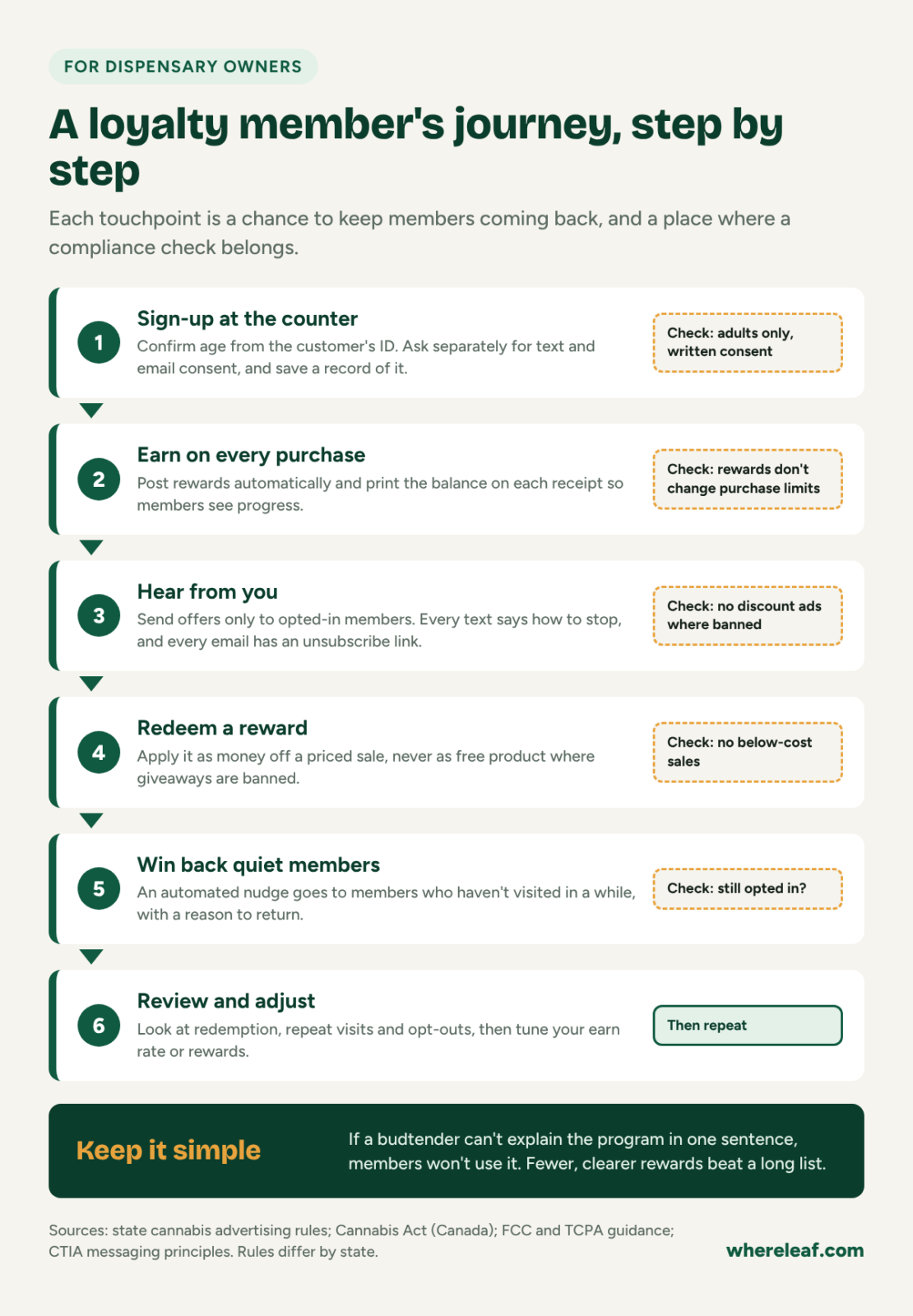
12 dispensary loyalty program ideas that work
Adapt these to your market. Where an idea involves a discount or perk, confirm your state allows it before you advertise it.
- Points that convert to dollars off. One point per dollar, with 100 points worth a fixed amount off. Show the balance on every receipt.
- Welcome reward on the second visit, not the first. This rewards the habit you want and cuts down on one-time sign-ups.
- Birthday month reward. A bonus points multiplier or a dollar amount off during the customer’s birthday month. Avoid “free” product where giveaways are banned.
- Referral credit. Both the existing customer and the new customer earn points after the new customer completes a first purchase and passes an ID check.
- Win-back message. An automated email or text to opted-in members who have not visited in 60 days, offering bonus points on their next trip.
- Double points on slow days. Shift traffic to quiet weekday afternoons instead of discounting your busiest hours.
- Category challenges. Bonus points for trying a new product category, such as topicals or beverages, so customers explore your menu.
- Top-tier perks that cost little. Early access to new drops, order-ahead priority or a dedicated pickup line.
- Education events for members. Product-format or terpene talks for adults 21+ where your state and local rules allow events.
- Branded take-away bags. Some states allow branded bags after a purchase even when other promotional items are banned. Massachusetts names this as an exception.
- Charity round-ups. Let members round up to donate to a local cause. Check that it is not structured as a discount or prize.
- Review and feedback points. Award points for completing a short survey. Do not tie rewards to positive reviews, since platforms and consumer-protection rules frown on incentivized reviews.
Pair any reward with clear terms: who can join (adults 21+, or 19+ or 18+ in parts of Canada), when points expire and how to opt out.
How do birthday rewards and referral programs work at a dispensary?
Birthday rewards
Collect the date of birth at sign-up, which your team already checks from the customer’s ID. Send the reward at the start of the birthday month and give a full month to use it, so customers do not feel rushed.
In states that ban giving away cannabis, structure the reward as bonus points or a dollar amount off a purchase, if discounts are allowed. In Canada, the federal Cannabis Act bans offering cannabis for free or offering a prize as an inducement, so a birthday freebie is off the table there.
Referral programs
Referral rewards should only pay out after the new customer completes a purchase and passes an ID check at your store. Never pay referral rewards for sign-ups alone, since that invites fake accounts.
Keep referrals personal. A customer sharing a code with a friend differs from a store-wide “refer a friend” social post, which may count as advertising.
Are dispensary loyalty programs legal? State promotion rules
Loyalty programs are common in many legal states, but some markets limit what you can offer or advertise. Here are examples of how different regulators handle promotions as of October 2026.
| Market | Rule | What it means for loyalty programs |
|---|---|---|
| California | Bus. & Prof. Code 26153 bars licensees from giving away any amount of cannabis, cannabis products or accessories as part of a business promotion. | No free product rewards. Rewards must be structured as a priced sale. |
| Washington State | WAC 314-55-155 bans promotional giveaways and coupons. The LCB holiday guide caps free incidental items at under $1 and bans “gift with purchase.” | Points and coupon-style programs need a careful legal review. Do not advertise “free” product. |
| Massachusetts | 935 CMR 500.105(4)(b)20 and the CCC’s May 21, 2024 bulletin classify advertised discounts, points-based rewards and loyalty programs as prohibited advertising for adult-use stores. | One-on-one conversations are not advertising, but menus, websites and social posts are. Medical-only discounts follow different rules. |
| Michigan | R 420.507 limits advertising to audiences where no more than 30% are expected to be under 21 for adult-use. | Make sure your sign-up and marketing lists are adults only. |
| Canada | Cannabis Act s. 24 bans offering cannabis free, offering things or services as an inducement, and contests or draws tied to purchase. | Classic points-for-perks programs are generally not allowed for cannabis. Provinces add their own rules. |
These are examples, not a full list. Many states regulate below-cost sales, bundles or ad content, and cities may add more. Ask your regulator or a cannabis attorney before you print anything.
Text and email marketing rules: TCPA consent for cannabis rewards
Most programs run on text and email, which brings in federal law, carrier rules and some state privacy laws.
Get prior express written consent for texts
The Telephone Consumer Protection Act lets people sue for $500 per unwanted marketing text or call, and a court can triple that for willful or knowing violations. Marketing texts sent with an automated system need prior express written consent: a clear, signed (an e-signature counts) agreement to receive marketing messages from your business.
In January 2025, the Eleventh Circuit vacated the FCC’s planned “one-to-one” consent rule in Insurance Marketing Coalition v. FCC. The core written consent requirement still applies, so keep your opt-in language clear and store a record of each consent.
Honor opt-outs fast
FCC rules effective April 11, 2025 say consumers can revoke consent by any reasonable means, including replying “stop,” “quit,” “end,” “revoke,” “opt out,” “cancel” or “unsubscribe.” You must honor the request within 10 business days.
Expect carrier and platform limits
Wireless carriers follow CTIA messaging guidelines, which ask senders to block unlawful content and meet age-gating requirements. Many texting platforms restrict cannabis campaigns as a result, so use a provider that works with licensed cannabis businesses and gate every sign-up at 21+.
State privacy laws
Some state privacy laws cover loyalty programs. In California, businesses covered by the CCPA that offer a financial incentive for personal data must give a Notice of Financial Incentive before customers opt in, including how they can leave the program.
Worked example: what does a points program cost?
This is an illustration, not a benchmark. Plug in your own numbers.
- Earn rate: 1 point per $1 spent.
- Reward: 100 points = $5 off a future order.
- Effective reward rate: $5 back for every $100 spent, or 5%.
Say a member spends $60 a visit, twice a month. That is $1,440 a year, earning 1,440 points, or $72 in rewards if every point is redeemed. If your gross margin on that $1,440 is 45%, you keep $648 before the reward and $576 after. The program pays off if it adds even one or two extra visits a year from that customer, or keeps them from switching to a competitor.
Not every point gets redeemed, so your real cost is usually below the full 5%. Track redemption in your point-of-sale reports and adjust after three months.
Simple guardrails
- Cap rewards per transaction so points cannot cover a whole order in states that ban free product.
- Never let rewards push a price below your cost where state rules ban below-cost sales, such as Washington State’s WAC 314-55-079.
- Do not let rewards affect purchase limits. Limits apply to the product, not the price.
Your dispensary loyalty program launch checklist
- Read your state’s advertising and promotion rules, and any city rules, and write down what is banned.
- Choose one model (points, tiers, visits or member pricing) and one or two goals.
- Confirm your point-of-sale and loyalty software can enforce age checks, caps and expiry.
- Write short terms: who can join, earn rate, expiry, how to leave, and that joining is not required to buy.
- Use written consent language for texts and a separate checkbox for email.
- Add “Reply STOP to opt out” to every text and an unsubscribe link to every email.
- Post a privacy notice, and a Notice of Financial Incentive if your state requires one.
- Train budtenders to explain the program in one sentence without promising free product.
- Review menus, website and social posts for discount language your state counts as advertising.
- Check redemption, repeat-visit rates and opt-outs after 90 days and adjust.
For dispensary owners: bring new members in the door
A loyalty program keeps customers coming back, but they have to find you first. A complete WhereLeaf listing puts your store in front of adults searching for dispensaries near them on our find a dispensary page. List your dispensary for free, or see our featured listing packages to show your hours, menu link and member perks where your state allows. For more ideas, read our guide to dispensary marketing and local SEO, and learn how payment options affect repeat visits in do dispensaries take credit cards.
Frequently asked questions
Do dispensaries have rewards programs?
Yes, many dispensaries in legal US states run points, tier or visit-based rewards programs. Some markets, such as Massachusetts for adult-use stores and Canada under the Cannabis Act, sharply limit how promotions and loyalty programs can work or be advertised.
Can a dispensary give away free weed?
In many places, no, and the promotion rules table above shows several examples. Even where some freebies are allowed, keep them to non-cannabis items your regulator approves, such as branded take-away bags in Massachusetts. When in doubt, turn the reward into a discount on a priced sale and confirm it with a cannabis attorney.
Is it legal for dispensaries to send text messages?
It can be, if customers give prior express written consent, you honor opt-outs and you follow carrier rules. Many carriers and texting platforms restrict cannabis content, so use a provider that supports licensed cannabis businesses.
What is a good reward rate for a dispensary points program?
There is no standard rate. Many stores aim for a few percent back in rewards, but you should set your rate based on your margins, then adjust after reviewing redemption data for a few months.
Can you use dispensary loyalty points across state lines?
Points are a store or brand program, so it depends on the company. You can never carry cannabis across state lines, even between two legal states, so any multi-state program only covers purchases made and used inside each state.
Do loyalty programs need a minimum age?
Yes. Only adults of legal age (21+ in US adult-use states, 18+ or 19+ in Canadian provinces) should be able to join. Verify age with a government ID at the first purchase and keep minors off marketing lists.
Sources
- California Business and Professions Code: Section 26153, Giving away cannabis (2026)
- Cornell LII: WAC 314-55-155, Advertising requirements and promotional items (2024)
- Washington State Liquor and Cannabis Board: Holiday Advertising Guide for Cannabis Licensees (2024)
- Massachusetts Cannabis Control Commission: Bulletin, Advertising Activities (2024)
- Cornell LII: Michigan Admin. Code R. 420.507, Marketing and advertising restrictions (2022)
- Justice Laws Website: Cannabis Act, Section 24, Inducements (2026)
- Cornell LII: 47 U.S.C. 227, Restrictions on use of telephone equipment (2026)
- Morrison Foerster: Eleventh Circuit Vacates FCC’s TCPA One-to-One Consent Rule (2025)
- Kelley Drye: FCC Sets Effective Date for TCPA Reasonable Consent Revocation Rules (2025)
- CTIA: Messaging Principles and Best Practices (2023)
- Cornell LII: 11 CCR 7016, Notice of Financial Incentive (2026)
- Bond Brand Loyalty: The Bond Loyalty Report, Released in Collaboration with Visa (2025)
Last updated: October 2026. Laws and prices change; always check your state or provincial regulator.