
Maryland dispensary and delivery rules are set and enforced by the Maryland Cannabis Administration (MCA), which licenses, inspects and fines every dispensary in the state. The Comptroller of Maryland collects the cannabis sales tax, and counties handle zoning. If you run a standard dispensary, a micro dispensary that delivers, or a store that partners with one, the MCA’s rulebook is what inspectors check you against.
The core idea is a closed, tracked supply chain. Every gram you sell must come from a Maryland licensee, arrive on a manifest, sit in Metrc from the moment you accept it, and leave only through a recorded sale to a verified adult or patient. Most fines start with a gap somewhere in that chain.
This guide covers buying stock, Metrc, selling, delivery, packaging, advertising, security, taxes and enforcement, checked against the statute, COMAR and MCA guidance in November 2026. This guide is general information, not legal advice. Confirm current rules with the Maryland Cannabis Administration.
Key takeaways
- Buy only from Maryland licensees, accept every transfer in Metrc, and never sell product that isn’t on your books.
- Adult-use delivery now runs through micro dispensaries, so standard stores need a delivery partner to reach adult-use customers at home.
- Inspectors look hardest at sales over the limit, unreported inventory gaps and green waste shortcuts.
- Advertising rules changed in 2026, so recheck your signage, social posts and event sponsorships.
- Rules differ by state and change often. Confirm anything you rely on with the MCA before you act.
Who enforces Maryland dispensary rules?
The MCA is the day-to-day regulator. It registers agents, approves vehicles and storage sites, runs inspections and issues consent orders and fines. Its power comes from Title 36 of the Alcoholic Beverages and Cannabis Article, created by the Cannabis Reform Act of 2023. The Alcohol, Tobacco and Cannabis Commission handles field enforcement against unlicensed products.
The rulebook is COMAR Title 14, Subtitle 17. The chapters store teams use most:
- 14.17.09: transport and manifests between licensees
- 14.17.12: dispensary operations, micro dispensary delivery, hours and remote ordering
- 14.17.13 and 14.17.18: cannabis products, packaging and labeling
- 14.17.14: complaints, recalls, records, inspections, discipline and advertising
- 14.17.15: agent registration and training
Counties handle zoning and can’t tax cannabis sales. For license types and rounds, see how to get a cannabis license in Maryland.
Buying inventory as a Maryland dispensary
Dispensaries buy from licensed Maryland growers and processors. A micro dispensary may also take stock from other dispensaries through licensed transfers. Home cultivation products, such as clones and seeds, must come from a licensed grower. Sales through unlicensed brokers, intermediaries or other third parties are banned under COMAR 14.17.12.08.
Orders, manifests and receiving
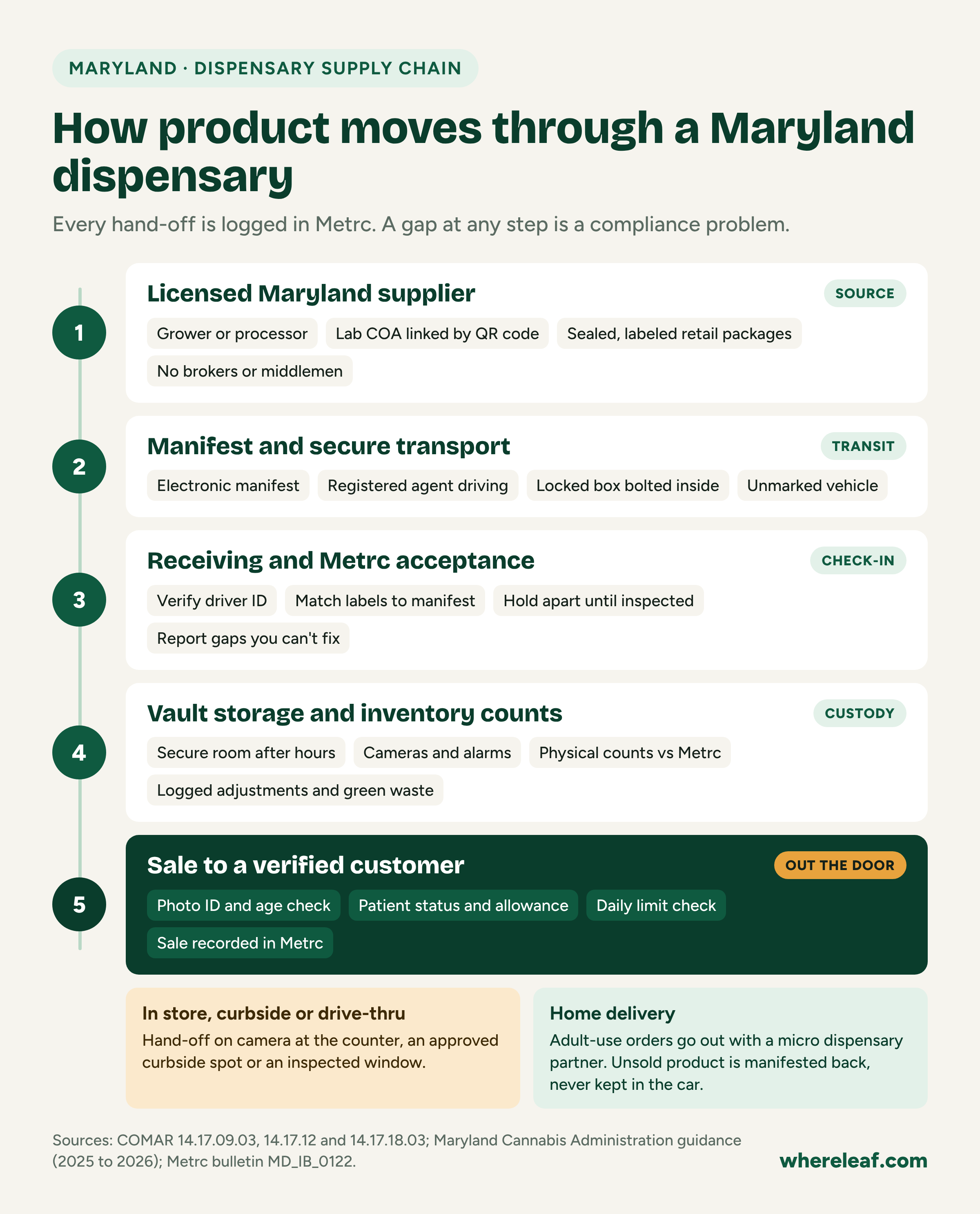
The shipping licensee creates an electronic manifest for every load, listing each package’s weight and description, the agents who prepared and loaded it, and the receiver. On arrival, your receiving agent must:
- Log in to the tracking system before taking custody.
- Check the driver’s ID, the packaging and that labels match the manifest.
- Record the hand-off time and the driver’s signature or ID number.
- Keep the product apart from sellable stock until it passes inspection.
A discrepancy you can’t fix on the spot must be reported to the MCA, and the shipper must investigate and file reports.
Testing, recalls and returns
Every package must link to a certificate of analysis from an independent lab through a QR code or link (COMAR 14.17.18.03), so don’t put a lot on the shelf until you can open its COA. If a batch fails testing or is tied to a serious adverse event, the producer recalls it and dispensaries must help notify buyers. Hold recalled product separately and destroy it only after the MCA authorizes disposal. Unsellable stock goes to green waste under your written procedure.
Shelf space and purchasing caps
Maryland requires a minimum share of your products to come from licensees you don’t own or control, or from social equity licensees, and the MCA has enforced this since July 1, 2025. Bulk flower transfers and on-hand bulk stock have weight caps too. There is no general order minimum in the rules.
How product moves through a Maryland dispensary
Seed-to-sale tracking in Maryland: Metrc
Maryland uses Metrc as its seed-to-sale system. The MCA’s guidance says all inventory, transfers, manifests and sales must be tracked in Metrc and logged daily. In practice, that means:
- Record each sale with the right customer type. Patient sales also go against the patient’s 30-day allowance in the MCA’s network.
- Record display jars, repackaging, adjustments and green waste with a reason. One 2026 consent order cited green waste adjustments made without explanations.
- For partnered delivery, the standard dispensary creates the sales delivery, names the micro dispensary as transporter, and marks it complete after the driver verifies ID (Metrc bulletin MD_IB_0122, effective April 14, 2026).
Reconcile physical counts against Metrc on schedule. Small gaps can be fixed with logged adjustments; larger gaps and any theft need an MCA report. Never “zero out” a gap with a fake sale. See our seed-to-sale tracking explainer.
Selling to customers
ID and limits
Check a valid, unexpired government photo ID with a birth date before every sale. Accepted IDs include any state or DC license, U.S. or foreign passports, U.S. military IDs and tribal cards. University IDs are not. Patients and caregivers also need their MCA ID number, and staff must check the patient’s registration, certification and remaining allowance in the MCA network. A certification that hasn’t been used within 120 days of issue is void.
Agents must log in with their own credentials, may not sell themselves product, and should refuse anyone who seems impaired, may be buying for resale, or is trying to exceed the limit. The per-customer limit and potency caps are in the table below.
Floor rules
- Who can enter: adults 21+, patients and caregivers. Children under 8 may enter only with a patient or caregiver, if you allow it.
- Patients: offer a daily patient-only hour or a dedicated patient line, and serve waiting patients first in good faith.
- Displays: keep display jars behind the counter, don’t let customers touch them, and log them in Metrc.
- Samples and gifts: free samples of cannabis are banned. Branded merchandise may go only to adults 21+.
- Discounts and loyalty: employee discounts must follow your written procedure. You can’t build a customer profile without express consent, and you can’t refuse a sale if a customer says no. Other discount rules are not set in the rules; ask the MCA.
- Exit packaging: products leave in the producer’s sealed, child-resistant package. No separate exit bag rule is set in the rules; ask the MCA.
Remote orders need a neutral age screen and payment only after the ID matches. Drive-thru windows need an MCA inspection first.
Maryland cannabis delivery rules
Since July 1, 2025, only a micro dispensary may deliver to adult-use customers (COMAR 14.17.12.08F). Standard and converted dispensaries may still deliver to medical patients and caregivers, and HB 622 extended that window to June 30, 2027. A standard store can reach adult-use customers at home by partnering with a micro dispensary, which carries the store’s inventory on its own vehicles.
- Drivers: registered agents with MCA badges, a valid driver’s license and proof of licensure. No cannabis-branded clothing in transit. The July 2026 guidance says body cameras are not required.
- Vehicles: enclosed, registered and insured, with GPS for the whole route, a locked container bolted inside (or an approved caged or trunk setup), and a motion-activated camera on every container. No signs, logos or licensee names. The MCA inspects each vehicle before use.
- Where: residences and medical facilities in your licensed service area only, never across state lines. Federal property is off limits under federal law.
- Hours: delivery is part of the sale, so it must finish within store hours. Late orders wait for the next day.
- At the door: no anonymous orders. Match the ID to the order’s name and birth date before taking payment.
- Refused orders: manifest them back to a compliant storage site. A vehicle is not storage, so no product overnight in a car.
- Cash: no cash limit is set in the rules; ask the MCA. The cap is on product value.
Our guide to starting a cannabis delivery business covers the business side.
Maryland dispensary operating rules at a glance
| Rule | Requirement | Where it comes from |
|---|---|---|
| Adult-use sale limit per customer | 1.5 oz flower, 12 g concentrate or 750 mg THC in infused products per day | COMAR 14.17.12.04B(7); Criminal Law 5-101 |
| Adult-use edible potency | 10 mg THC per serving, 100 mg per package | COMAR 14.17.12.04B(9) |
| Sales hours | No sales before 8 a.m. or after 11 p.m. | COMAR 14.17.12.09 |
| Secure room storage | Inventory in the vault except open hours plus 2 hours before and after | COMAR 14.17.12.02H |
| Delivery vehicle load | No more than $5,000 retail value per vehicle per trip | COMAR 14.17.12.03H |
| Micro dispensary staff | Up to 20 registered agents | HB 622 (2026); COMAR 14.17.07.07 |
| Curbside pickup spots | Within 100 feet of an entrance, on camera | COMAR 14.17.12.02P |
| Camera footage | Keep 90 calendar days; hand over within 48 hours of a request | COMAR 14.17.12.02L |
| Physical inventory | At least monthly; gaps over 0.5% investigated within 1 business day | COMAR 14.17.12.04D, 14.17.12.10 |
| Complaints and adverse events | Notify the MCA and the producer within 24 hours | COMAR 14.17.14.01 |
| Record retention | 2 years for MCA records; 4 years for sales tax records | COMAR 14.17.14.02; Comptroller tax alert |
| Shelf space for unaffiliated brands | At least 25% of products | COMAR 14.17.12.06 |
| Staff age and registration | Agents at least 21; registration valid 2 years | Alc. Bev. and Cannabis 36-501 |
| Ad audience | 85% reasonably expected to be 21+ | Alc. Bev. and Cannabis 36-903 |
Packaging and labeling
Growers and processors package each item before it reaches you, but you can’t sell anything that fails the rules. Under COMAR 14.17.18, retail packaging must be tamper evident, child resistant, plain and opaque. Soft bags must be at least 4 mil thick, and multi-serving packages must be resealable.
Labels need the four required warnings, the Maryland Poison Center number, net weight, lot number, packager and manufacturer, cannabinoids, allergens, ingredients and dates. Text can’t be smaller than 1/12 inch. The MCA’s universal symbol goes on the front, unaltered. Higher-strength edibles and larger concentrates are medical-only, and drinks count as one serving per container. See our packaging and labeling guide.
Advertising and marketing rules
Ads may not target people under 21 or use anything that appeals to them: cartoons, animals, mascots, celebrities, neon colors, candy or snack imagery, or the word “candy.” Ads can’t show cannabis use or promote it as an intoxicant. The MCA’s guidance doesn’t list a separate health-claim rule, so avoid any such claims and ask the MCA if unsure. Updated MCA guidance (August 24, 2026) reflects SB 594:
- Audience proof: back your audience share with recent data. The MCA accepts current audience data and offers an alternative method.
- Social media: every post needs its own 21+ notice. A pinned post or bio line isn’t enough.
- Websites: use a neutral age gate where visitors type a birth date. Yes/no buttons don’t comply.
- Exterior signs: name and logo, plus small operational signs by the entrance (up to 900 square inches each and 1,200 in total) for contact, adverse-event and ownership details.
- Events and mail: sponsorships need an audience attestation emailed to the MCA. Direct mail must go to named adults in a sealed envelope.
Fines run up to $1,000 for a first violation, then up to $10,000, $25,000 and $50,000 for repeats within 24 months. You’re responsible for agencies and influencers using your brand. See dispensary marketing and local SEO.
Security, staff and records
Standard dispensaries need a concrete-type vault with one locked entrance, a monitored alarm with panic buttons and backup power, and motion-activated, date-stamped cameras covering exits, entrances to cannabis areas and every dispensing spot. Split the premises into public and operations zones, and log visitors with a copy of their ID. More detail is in our dispensary security requirements guide.
Every owner or worker in operations must be a registered agent, with fingerprints and a background check. Tell the MCA when an agent leaves. Under HB 622, responsible vendor training became “Cannabis Agent Training,” which new agents start soon after hiring and repeat on a set cycle. Keep training materials and attendance records. See budtender training requirements.
Keep distribution, batch, testing and visitor records, with an off-site backup copy.
Taxes the business collects and remits
Charge 12% sales and use tax on adult-use cannabis and cannabis products. Accessories like papers and glass pipes take the regular 6% rate, and certain vape devices have their own rate. Qualifying patient sales within the certified amount are exempt. Record the patient’s ID number, and tax any amount above the certification.
File Form 202 with the Comptroller on the schedule it assigns, usually monthly, due by the 20th of the next month. File on time to claim the timely filing discount of up to $500 per return. Each location needs its own sales and use tax license, and you also need a county trader’s license.
Inspections and penalties for businesses
MCA inspectors can arrive without notice. Under COMAR 14.17.14.05, a violation of the discipline or prohibited-acts rules can bring a fine of up to $10,000, and each day it continues counts as a new violation. The MCA can also summarily suspend a license when public safety requires it. You have 30 days to request a hearing.
Common violations in recent consent orders:
- Sales over the daily limit and sales to patients with expired certifications
- Medical-only edibles sold to adult-use customers
- Inventory gaps hidden with false transactions instead of reports
- Green waste handled outside procedure
In one case, the Curio dispensary in Timonium was fined $26,000 in 2024 for selling about 224 grams of cannabis that staff had pulled from a dumpster. A February 2026 consent order against Rise Joppa cited nine rule areas, from over-limit sales to unreported agent terminations.
Maryland compliance at a glance
Your Maryland dispensary compliance checklist
Daily
- Check IDs, patient status and limits on every sale.
- Reconcile Metrc sales, transfers and adjustments before close.
- Review delivery GPS and vehicle camera footage, and confirm no product stays in a vehicle overnight.
- Lock inventory in the vault within the allowed window.
Weekly
- Check new lots for COA links and medical-only potency.
Monthly and annually
- Run the full physical count, and investigate and report gaps.
- File and pay the sales tax return.
- Check your shelf-space mix of unaffiliated brands.
- Renew agent registrations and training, update SOPs, and test recall and green waste procedures.
Our dispensary compliance checklist has a printable version.
Get found on WhereLeaf
Customers use WhereLeaf to find licensed stores and delivery. Add your Maryland dispensary for free, or compare listing packages to feature your menu, patient hours and delivery area. Send customers to our Maryland cannabis laws guide for the shopper rules, and see all our cannabis license guides.
Frequently asked questions
Can a dispensary buy from another dispensary in Maryland?
A micro dispensary may take inventory from other dispensaries through licensed Metrc transfers, and it may store stock at a standard dispensary. For a standard dispensary buying from another standard dispensary, the rules aren’t clear; ask the MCA before you order.
Can delivery drivers carry cash?
The rules let customers pay at the door once the ID matches, and they set no cash cap, so confirm your plan with the MCA. Put your cash procedure in your SOPs.
Can a standard dispensary deliver to adult-use customers?
Not with its own drivers. It needs a delivery partnership with a micro dispensary. A fully licensed micro partner needs no MCA pre-approval unless the deal affects ownership or control, but a conditional micro licensee does.
Can we give away free pre-rolls at an event?
No. Free cannabis samples are banned, and a “gift” with a purchase counts as a sale. You can give branded merchandise to adults at a compliant sponsored event.
Do we need a separate tax license for each store?
Yes. The Comptroller issues a sales and use tax license per location, and stores under common ownership may also need a county chain license.
This guide is general information, not legal advice. Confirm current rules with the Maryland Cannabis Administration.
Sources
- COMAR 14.17.12.02: Standard Cannabis Dispensary (via Cornell LII, 2025)
- COMAR 14.17.12.03: Micro Dispensary (via Cornell LII)
- COMAR 14.17.12.04: Dispensary Operations (via Cornell LII, 2025)
- COMAR 14.17.12.08: Online, Telephone, or Other Remote Ordering (via Cornell LII)
- COMAR 14.17.12.09: Hours of Operations (via Cornell LII)
- COMAR 14.17.09.03: Transport Operations (via Cornell LII)
- COMAR 14.17.14.01: Complaints, Adverse Events, and Recall (via Cornell LII)
- COMAR 14.17.14.02: Records (via Cornell LII)
- COMAR 14.17.14.05: Fines and Suspension Proceedings (via Cornell LII)
- COMAR 14.17.15.02: Agent Registration (via Cornell LII)
- COMAR 14.17.15.05: Training (via Cornell LII)
- COMAR 14.17.18.02: General Packaging Requirements (via Cornell LII)
- COMAR 14.17.18.03: General Labeling Requirements (via Cornell LII)
- Maryland General Assembly: Alcoholic Beverages and Cannabis 36-501, Agent Registration
- Maryland Cannabis Administration: Micro Dispensary Guidance, Version 6 (2026)
- Maryland Cannabis Administration: Dispensary Guidance (2025)
- Maryland Cannabis Administration: Advertising Guidance (2026)
- Maryland Cannabis Administration: 2026 Legislative Updates (2026)
- Maryland Cannabis Administration: Meshow, LLC (Rise Joppa) Consent Order (2026)
- Maryland Cannabis Administration: 2025 End of Year Director’s Message (2025)
- Metrc: Maryland Bulletin MD_IB_0122, Micro Dispensary Delivering for Standard Dispensary (2026)
- Maryland Cannabis Administration: licensed dispensary list (October 2026)
- Comptroller of Maryland: Quarterly Cannabis Update, Q2 2026 (2026)
- Comptroller of Maryland: Tax Alert, Questions and Answers for Cannabis Businesses (2023)
- University of Maryland Carey School of Law: Tobacco and Cannabis Legislative Summary (2026)
- CBS News Baltimore: Maryland Dispensary Fined $26,000 for Selling Cannabis Retrieved From Dumpster (2024)
Last updated: November 2026. Laws and prices change; always check your state or provincial regulator.