Walk down a busy street in many cities and you may see three or four cannabis shops in a few blocks. Some hold a state or provincial license. Others don’t, even if they look just as polished. So how do you tell if a dispensary is licensed? The fastest answer: look up the business on your regulator’s official license search, and confirm the name and address match the shop in front of you.
It takes about two minutes, and it matters. Licensed stores must sell products that passed lab testing, are tracked from plant to shelf, and carry required labels. Unlicensed shops don’t answer to anyone. In Canada, buying from an unauthorized seller can even carry fines for the customer.
Below: where to check, red flags to watch for, and a checklist for every new shop.
Key takeaways
- Looks prove nothing. A polished storefront, a slick website or a “medical” sign is not evidence that a shop holds a license.
- Verifying a store is a quick habit, so repeat it at every new shop and delivery service, not just the first one.
- Check the product as well as the store. The package is your second line of defense if a shop slips past you.
- Directories are handy for finding shops, but double-check any new store against the official record.
- Rules differ by state and province. Always check your local regulator before you buy.
Why buying from a licensed dispensary matters
A license isn’t just paperwork. It’s the thing that ties a store to testing rules, packaging rules, age checks and inspections.
Lab testing you can actually check
In legal markets, cannabis must be tested by an approved lab before it can be sold. New York’s Office of Cannabis Management, for example, says all products must pass lab testing before sale at licensed dispensaries, and labels should include a QR code or link to the product’s Certificate of Analysis (CoA). Health Canada says legal products are tested for harmful levels of contaminants and that THC and CBD levels are tested so you know what you’re buying.
Unlicensed products skip all of that. A 2023 study in the Journal of Cannabis Research, by researchers affiliated with Health Canada, tested flower for 327 pesticides. Residues showed up in about 92% of the 24 illicit samples, compared with about 6% of the 36 licensed samples (and those were at trace levels). If you want to learn how to read a CoA, see our guide on lab results and browse product details in our strain library.
Tracking from seed to sale
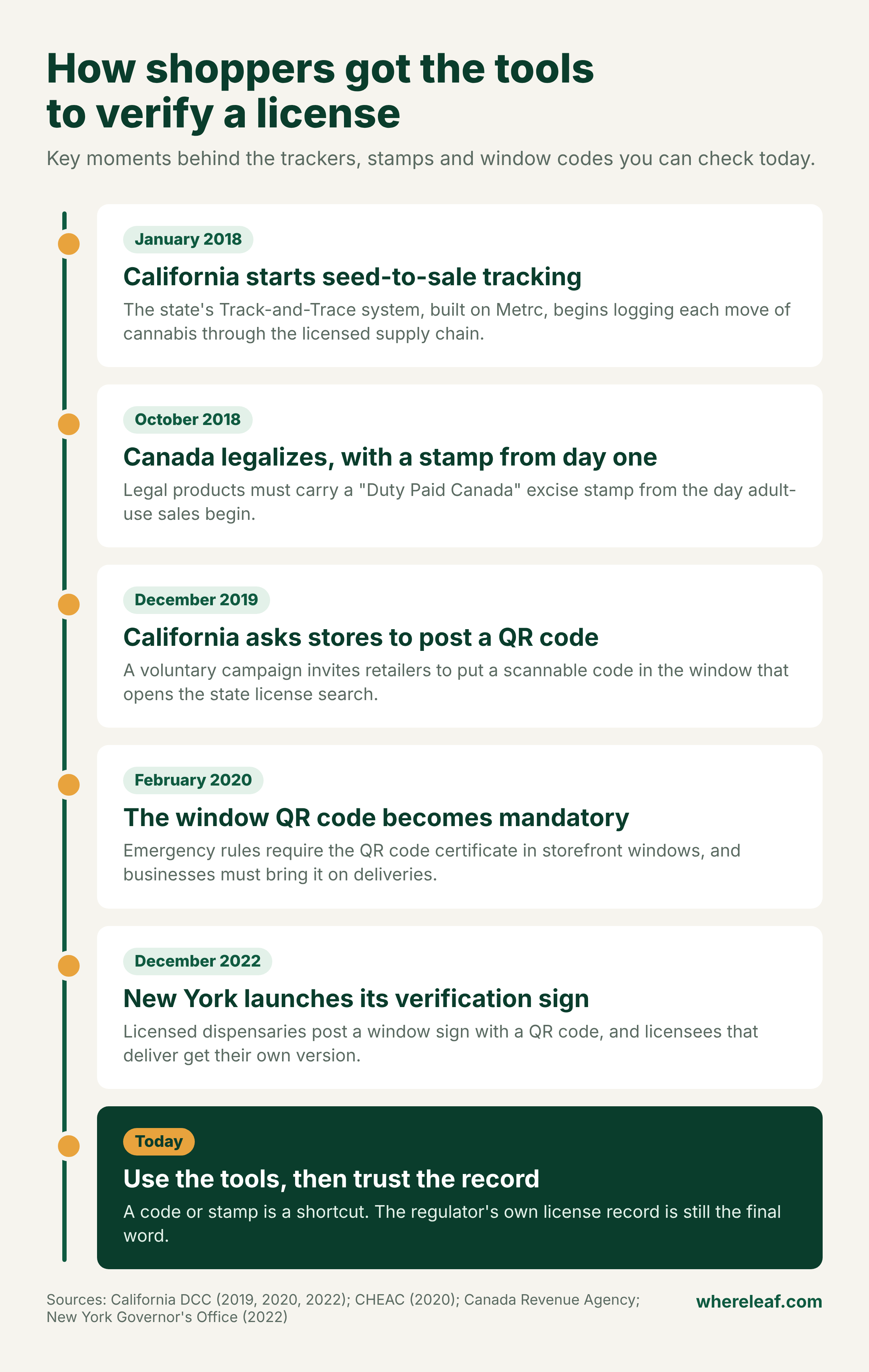
Most legal markets track every plant and package with a unique ID. California’s Cannabis Track-and-Trace system, launched in January 2018 and built on Metrc software, records each movement of cannabis through the licensed supply chain.
For you, this means a licensed product has a paper trail. If a batch fails a test or needs a recall, regulators can find it. Health Canada notes that legal products can be recalled by manufacturers, license holders or Health Canada itself.
Legal protection for you
Buying from an unlicensed seller can put you at legal risk, not just the seller. The Ontario government warns that buying cannabis from anyone other than the Ontario Cannabis Store or an authorized retailer can bring a fine of up to $100,000, up to one year in jail, or both. US rules vary by state, so check yours.
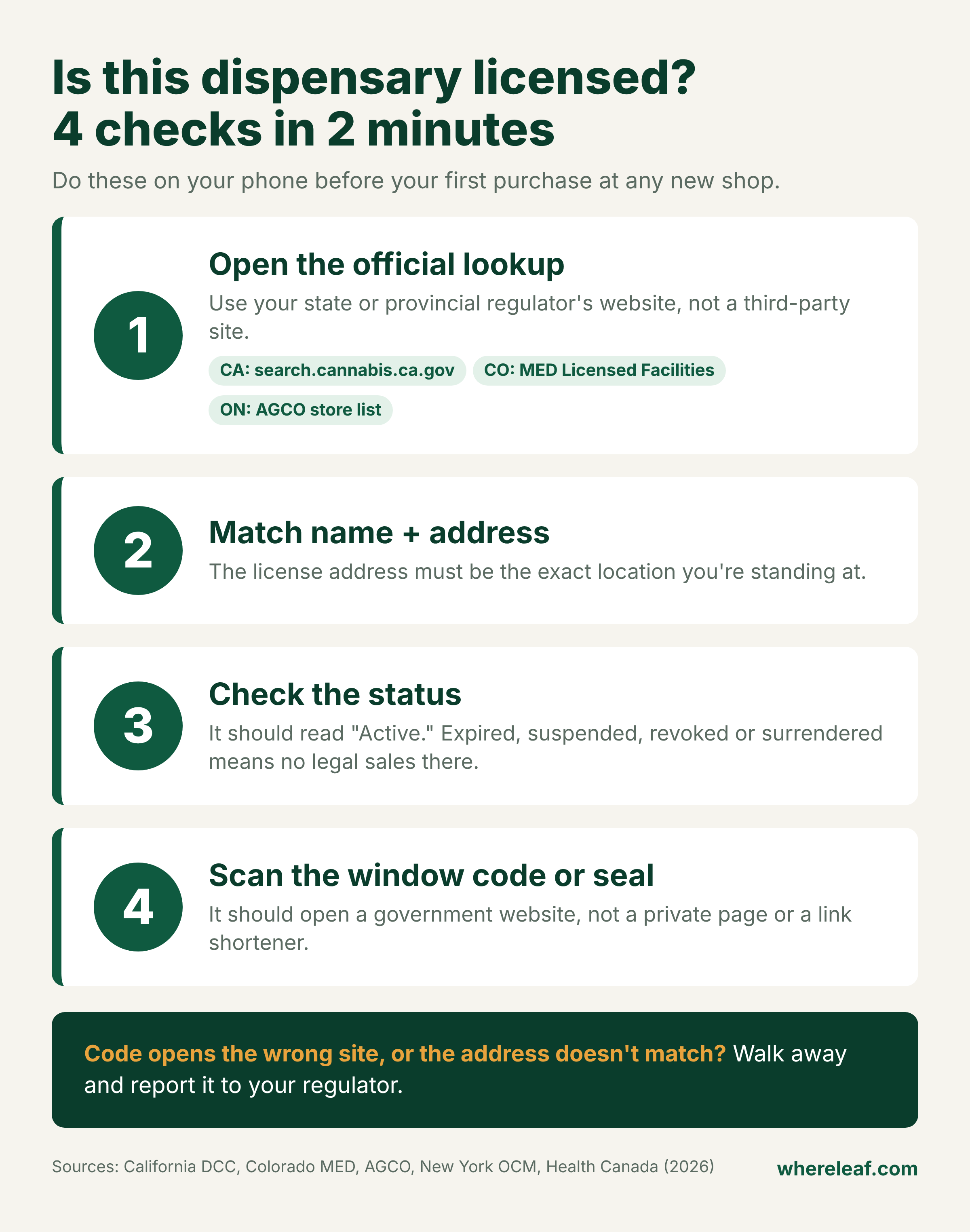
How to tell if a dispensary is licensed: 4 quick checks
These four checks work almost anywhere, right from your phone.
- Find the official license search. Go to your state or provincial regulator’s website, not a third-party site, and use its license lookup. We list several below.
- Match the name and address. Search the store’s name. Make sure the address on the license is the exact address you’re standing at. California’s regulator specifically tells shoppers to confirm the location matches the license.
- Check the status. In California, a license should say “Active.” Statuses like Expired, Suspended, Revoked or Surrendered mean the business can’t legally sell at that location.
- Scan the seal or code, then check the package. If the store displays a QR code or seal, scan it and confirm it opens the regulator’s real website. Then look for the required symbol, stamp and labels on the product itself.
Where to verify a license: real regulator lookup tools
Every legal market has its own regulator and its own tool. Here are official examples from several US states and Canadian provinces, verified as of October 2026. If your area isn’t listed, search for “[your state or province] cannabis regulator license search.”
United States
- California (Department of Cannabis Control): The DCC license search is updated daily. You can verify a business, find a retailer near you and file a complaint. Since February 2020, California has required licensed retailers to display a unique QR code certificate in the storefront window or near the entrance, and delivery drivers must carry it. Scanning it should take you to the state’s license record.
- Colorado (Marijuana Enforcement Division): The MED’s Licensed Facilities page offers spreadsheets of licensed stores, delivery businesses, testing labs and more. Most lists are updated monthly.
- New York (Office of Cannabis Management): Every licensed dispensary must post the Dispensary Verification Tool in its storefront. Scan its QR code to reach OCM’s list of licensed dispensaries. Products should also carry New York’s universal symbol.
- Michigan (Cannabis Regulatory Agency): The CRA’s Verify a License page links to separate searches for adult-use establishments, medical facilities and tribal businesses. The CRA also publishes monthly disciplinary action reports.
Canada
- Ontario (AGCO and OCS): The Alcohol and Gaming Commission of Ontario licenses private stores and publishes a list and map of retail store authorizations. Authorized stores must display the official cannabis retail seal. Online, the Ontario Cannabis Store (OCS.ca) is the only legal way to buy recreational cannabis, and its store locator shows authorized stores.
- British Columbia (Liquor and Cannabis Regulation Branch): B.C. offers an interactive map and a downloadable list of legal stores. Licensed stores show their licence number inside and a “licensed retailer” decal on the window.
- Anywhere in Canada: Health Canada keeps a page linking to authorized cannabis retailers in each province and territory.
Directories like WhereLeaf’s dispensary finder can help you discover shops nearby. Still, the regulator’s record is the final word, so double-check any new store there.
Red flags of an unlicensed dispensary
Unlicensed shops can look legit. Some copy logos, post fake certificates or call themselves “clubs.” Watch for these signs.
At the store
- No license on display. Many markets require a license number, QR code or seal near the entrance. If you can’t find one, ask. A licensed store will show you.
- No ID check, or a loose one. Licensed stores must verify age (21+ in US adult-use states, 19+ in most of Canada, 18+ in Alberta and 21+ in Quebec). Skipping this is a big warning sign.
- A QR code that goes to the wrong place. A real code should open the regulator’s government website, not a private page.
- “Membership,” “donation” or “gift” pricing. These setups are often used to dodge licensing rules.
- Cash only, no receipt. Many licensed stores do take cash, but a refusal to give a receipt is a red flag.
On the products
- Missing state symbol or excise stamp. In Canada, the Canada Revenue Agency says a product with no excise stamp is contraband and shouldn’t be bought or used.
- No batch number, test date or CoA link. Legal labels must tell you what’s inside.
- Packaging that copies candy or snack brands. The Ontario Cannabis Store lists packaging that looks like regular candy as a sign of unregulated product.
- Amounts above legal limits. In Canada, edibles are capped at 10 mg THC per package. A “500 mg gummy pack” is a giveaway.
- Prices far below every nearby store. Licensed stores pay for testing and taxes. Rock-bottom pricing can mean those steps were skipped.
Online and delivery
- Websites that ship across state lines or by regular mail. Cannabis can’t legally cross state or national borders.
- Sellers who take orders only through social media DMs or messaging apps.
- Drivers who can’t show a license or QR code. California, for example, requires delivery drivers to carry the business’s QR code certificate.
Licensed vs. unlicensed: side-by-side comparison
Here’s what you generally get at a licensed store compared with an unlicensed one. Exact rules vary by state and province.
| What to compare | Licensed dispensary | Unlicensed shop |
|---|---|---|
| Lab testing | Required before sale by an approved lab | None required, results can’t be verified |
| Potency label | THC and CBD amounts tested and listed | Often missing or unverified |
| Tracking | Tracked from seed to sale (e.g., Metrc in California and Michigan) | No tracking, unknown origin |
| Recalls | Regulators can recall bad batches | No recall system |
| Age checks | Required at entry or sale | Inconsistent or skipped |
| Packaging | Child-resistant, required warnings and symbols | May copy candy brands or lack warnings |
| Stamp or symbol | State universal symbol; Canadian excise stamp | Missing or counterfeit |
| Complaints | You can report to the regulator | Little or no recourse |
| Legal risk to you | Legal purchase for adults within limits | Can carry penalties (up to $100,000 in Ontario) |
How to check the product, not just the store
Checking the package is your second line of defense.
In the US
Look for your state’s required cannabis symbol, a batch or lot number, a packaging or test date, and a QR code or link to the CoA. New York tells shoppers to check both the storefront verification tool and the universal symbol on the label. Scan the CoA code and make sure the lab name and batch number match the package.
In Canada
Health Canada says a legal product should have all of these:
- An excise stamp with colors for your province or territory
- A yellow box with a health warning in English and French
- The standardized THC symbol
- Child-resistant packaging (not required for plants and seeds)
- A nutrition facts table on edibles
The Canada Revenue Agency describes the excise stamp as a small 20 x 40 mm sticker reading “Duty Paid Canada,” with a unique 9-character code. The OCS notes that warnings and symbols can be copied, so the stamp is the best check if you’re unsure.
Your licensed dispensary checklist
Screenshot this and use it at any new shop or delivery service.
- I looked up the business on my state or provincial regulator’s official website.
- The business name and street address match the license record.
- The license status is active (not expired, suspended or revoked).
- The store’s QR code or seal opens a real government website.
- Staff checked my ID before I could buy.
- The package has my state’s symbol or Canada’s excise stamp and THC symbol.
- The label lists THC and CBD amounts, a batch number and a test or CoA link.
- Packaging is child-resistant and doesn’t look like regular candy.
- I got a receipt.
- I know my local possession limit and won’t take products across state or national borders.
A few responsible-use reminders: cannabis is for adults only, start low and go slow with new products, never drive after using, and store everything locked away from kids and pets.
For dispensary owners: make your license easy to see
Post your QR code, seal or license number where people can see it from the sidewalk, and train staff to explain it. Link to your regulator’s record from your website and menus.
If you run a licensed store, delivery service or brand, you can add your business to WhereLeaf and include your license details. See our listing packages, and if you’re a grower or wholesaler, check out the suppliers directory.
Frequently asked questions
How do I check if a dispensary is licensed?
Use your regulator’s own license search. Traveling in Canada? Health Canada keeps one page linking to the authorized retailer lists for every province and territory.
Is a dispensary with a nice storefront and website always legal?
No. Unlicensed shops can look very professional and may even post fake certificates. The only reliable proof is the regulator’s own record, so look it up yourself instead of trusting a sign.
What if a store has no QR code or seal in the window?
Not every state or province requires one, so a missing code doesn’t prove a store is unlicensed. Ask staff for the license number, then look it up yourself on the regulator’s site. A licensed store should be happy to show you.
How can I tell if cannabis in Canada is legal?
Look for the provincial excise stamp, the standardized THC symbol, the yellow health warning box and child-resistant packaging. The Canada Revenue Agency says products without an excise stamp are contraband and shouldn’t be bought or used.
Does it matter if I buy from an unlicensed shop?
Yes. Prices at unlicensed shops are often low because they skip the testing and taxes that licensed stores pay, so the savings come with real unknowns about what you’re getting. If something goes wrong, you also have no regulator on your side.
How do I report an unlicensed dispensary?
Most regulators have a complaint form. California’s DCC accepts complaints through its license search site, and New York’s OCM has a “Report an Incident” form. Check your own regulator’s website for the right channel.
Sources
- California Department of Cannabis Control: Search for a licensed business (2026)
- California Department of Cannabis Control: BCC launches QR code campaign encouraging consumers to scan and verify licensed retailers (2019)
- California Department of Cannabis Control: California notices emergency regulations requiring QR code certificate (2020)
- CHEAC: QR Code Cannabis Regulations Approved (2020)
- California Department of Cannabis Control: Track-and-Trace System 5 Steps (2022)
- Colorado Marijuana Enforcement Division: Licensed Facilities (2026)
- New York Governor’s Office: Governor Hochul unveils licensed cannabis dispensary verification tool (2022)
- New York Office of Cannabis Management: Consumers (2026)
- Michigan Cannabis Regulatory Agency: Verify a License (2026)
- Michigan LARA: Cannabis Regulatory Agency releases disciplinary action report (2026)
- AGCO: Status of current cannabis retail store applications (2026)
- Government of Ontario: Buying recreational cannabis (2026)
- Ontario Cannabis Store: How to spot unregulated cannabis products (2026)
- Government of British Columbia: Cannabis store locations and buy legal information (2026)
- Health Canada: Authorized cannabis retailers in the provinces and territories (2026)
- Health Canada: Reduce your risk: Choose legal cannabis (2026)
- Canada Revenue Agency: Excise stamps, information for consumers (2026)
- Health Canada: Canadian Cannabis Survey 2024, key findings (2024)
- Journal of Cannabis Research: Gagnon et al., A study on high pesticide levels in illicit cannabis flower compared with licensed samples (2023)
- Pew Research Center: Nearly half of states have legalized recreational marijuana use (2026)
- Pew Research Center: Most Americans now live in a legal marijuana state, and most have at least one dispensary in their county (2024)
- Canada Revenue Agency: EDN54, General overview of the cannabis excise stamps (accessed 2026)
Last updated: October 2026. Laws and prices change; always check your state or provincial regulator.