Seed-to-sale tracking is the system regulators use to follow every legal cannabis plant and product from the moment it is planted until it is sold, destroyed or returned. Each licensed business, including every dispensary, must log what it receives, moves, sells and throws away in a state-run database such as Metrc, BioTrack or a state-built platform.
For a store owner, that database is the official record of your inventory. If your shelves, your point-of-sale (POS) system and the state system don’t match, inspectors see it as a red flag for theft or diversion, even when the cause is a simple typo.
This guide explains how seed-to-sale tracking works, which systems different states and Canada use, what a retailer actually has to log, what the tags cost and how to stay out of trouble. Everything was checked against regulator sources in October 2026.
Key takeaways
- Every licensed plant, package and sale in a legal U.S. market is tied to a unique ID in a state tracking system.
- Most states contract Metrc, a few use BioTrack, and Washington State runs its own reporting system.
- Retailers mainly log three things: deliveries they accept, every sale, and every adjustment or disposal.
- Canada works differently: retailers report to their province, and Ottawa has proposed ending retail reporting altogether.
- Rules differ by state and province. Always check your own regulator’s current bulletins before you change how you record inventory.
What is seed-to-sale tracking?
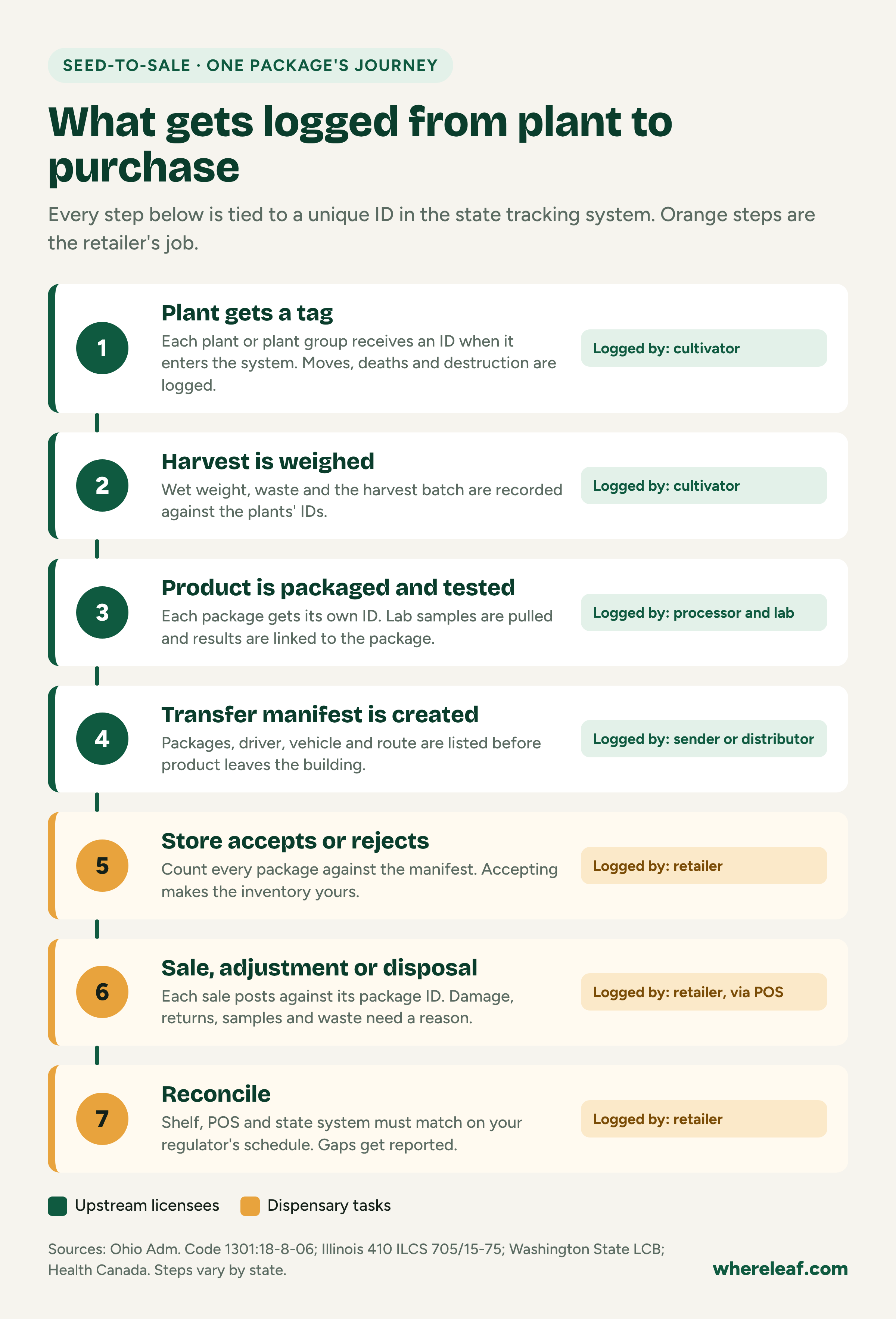
Seed-to-sale tracking (also called track-and-trace or traceability) is a chain of custody for cannabis. Each plant gets an ID when it enters the system. When it’s harvested, its flower is weighed and grouped into a batch. When that batch is packaged, each package gets its own ID. Every move after that, from lab sample to delivery van to sales counter, is recorded against those IDs.
Regulators use the data for three main jobs:
- Preventing diversion. If product leaves the legal market, the gap shows up as missing inventory.
- Recalls. A failed lab test or a contamination problem can be traced to every store that received the affected package.
- Taxes and audits. Sales records in the tracking system can be compared with the tax returns a business files.
The graphic below follows a single package through each step and shows what gets recorded along the way.
Which seed-to-sale systems do states use?
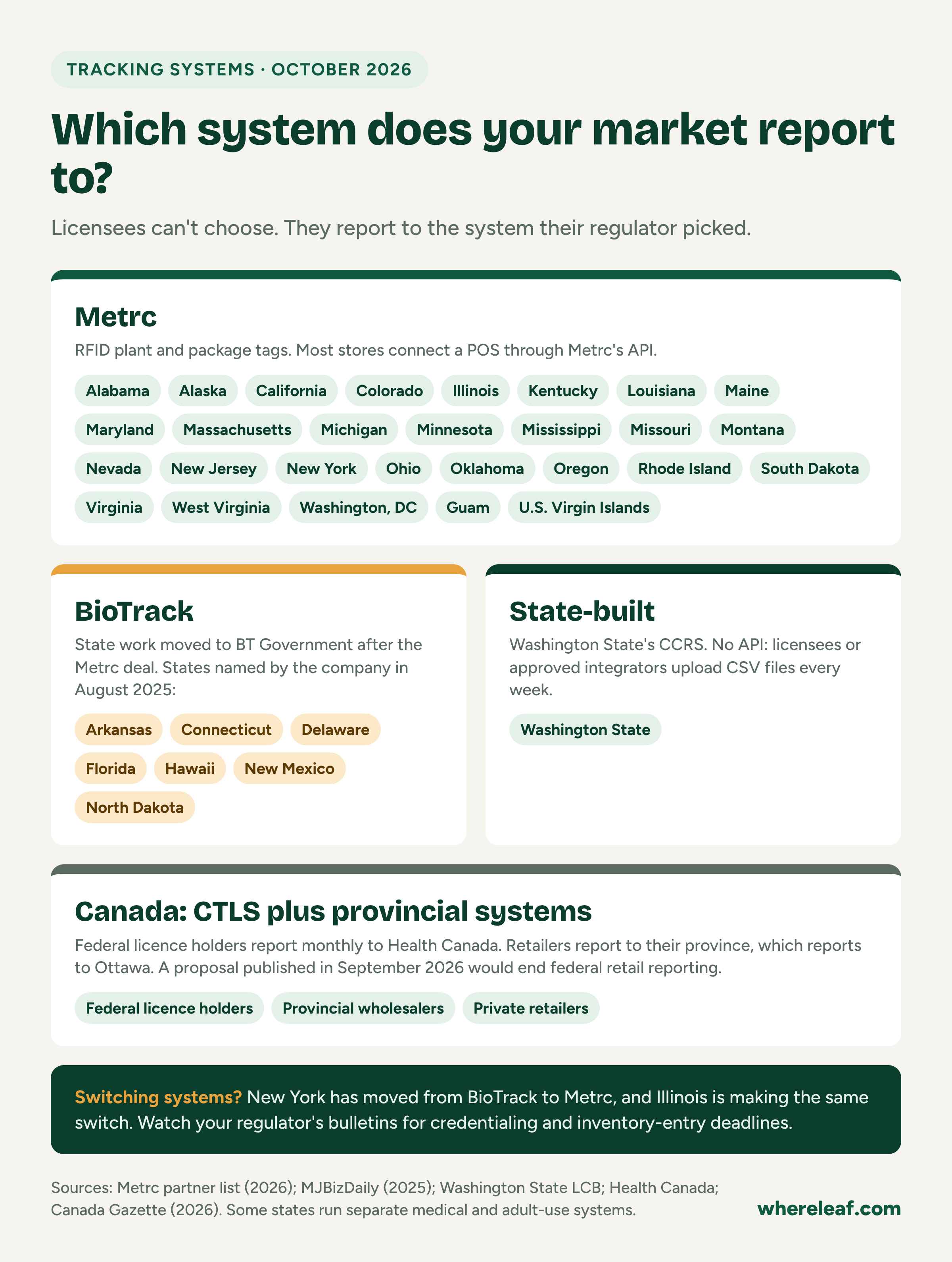
Each state picks one official tracking system by contract or builds its own. Licensees can’t choose; they must report to whatever the state uses. Many businesses connect a private POS or inventory app to the state system through an API (an automatic data link), so staff rarely type data into the state portal by hand.
Metrc
Metrc is the most widely used state system. It started with Colorado’s tracking program in 2011 and now lists partner jurisdictions across the country, from Alaska to West Virginia, plus Washington, DC and two U.S. territories. Metrc uses RFID tags: plastic plant tags and package labels with a barcode and a chip that hold the item’s unique ID.
BioTrack
BioTrack, run by Forian, has long handled state contracts in several medical and adult-use markets. In an August 2025 company statement, it named Arkansas, Connecticut, Delaware, Florida, Hawaii, New Mexico and North Dakota among the states using its system. That same month, Metrc and BioTrack announced a “strategic partnership,” with a new company called BT Government taking over BioTrack’s state work. The deal triggered changes in at least two big markets, covered below.
State-built systems
Washington State dropped its previous vendor and launched the Cannabis Central Reporting System (CCRS) in December 2021. CCRS has no API. Licensees, or approved integrators acting for them, upload CSV files, and reports are due weekly: each Sunday-to-Saturday week must be reported by the following Sunday.
Recent switches: New York and Illinois
New York had picked BioTrack, then suspended its integration deadline on August 5, 2025, after the Metrc deal. The Office of Cannabis Management (OCM) moved to Metrc instead. All licensees, including retailers, had to be credentialed in Metrc by December 17, 2025, and retailers had to enter all existing inventory with package IDs by January 12, 2026. Manual weekly retail reports were scheduled to end on May 5, 2026.
Illinois is also replacing BioTrack with Metrc. A February 2025 state bulletin said that, through state funding, businesses would not be charged for Metrc’s RFID tags, with some restrictions.
What does a dispensary have to log?
Growers and processors carry most of the data entry, but retailers have their own daily duties. The details come from your state’s rules, so here are two real examples that show the range.
Illinois: daily reconciliation
Illinois law requires dispensaries to record each sale at the time it happens, along with each day’s beginning inventory, acquisitions, sales, disposals and ending inventory. The agent-in-charge must reconcile every day, confirming the state system matches the POS and the physical product on hand. If an imbalance from a mistake can’t be explained within 2 calendar days, the store must notify the state in writing right away. Suspected theft must be reported to the state and the Illinois State Police within 24 hours. Most records must be kept for 5 years.
Ohio: weekly counts and an annual full count
Ohio’s dispensary inventory rule, effective October 9, 2025, requires every item to be “accurately and contemporaneously recorded” in the state system from receipt until it’s sold or destroyed. A responsible party must run a weekly inventory check, and once a year the store must do a full manual count and compare it with a report from the state system. Problems with incoming deliveries must be reported in writing within 48 hours.
The retailer’s core tasks
- Receive: Accept or reject each incoming transfer against its manifest, package by package.
- Sell: Record each sale against the right package ID, usually through your POS.
- Adjust: Log weight changes, damage, returns and lab samples with a reason.
- Destroy: Record waste and disposal using your state’s method.
- Reconcile: Compare the state system, the POS and the shelf on your state’s schedule.
Labels are part of this chain too. The package ID on the shelf ties to the lab report a shopper can look up, which is why our guide to packaging and labeling requirements and our explainer on reading lab results both point back to lot and package numbers.
How much do Metrc tags cost?
In most Metrc states the licensee buys tags and pays a monthly fee for each license. Some states fold the cost into license fees instead. Oklahoma’s medical cannabis authority compiled these figures in July 2025; prices change, so use them as a guide and check your state’s latest bulletin.
| State | Plant tag | Package tag | Monthly system fee |
|---|---|---|---|
| Colorado | $0.45 | $0.25 | $40, paid by licensee |
| Massachusetts | $0.46 | $0.26 | $41.50, paid by licensee |
| Ohio | $0.39 | $0.19 | $45, paid by licensee |
| Maryland | $0.40 | $0.40 | $40, paid by licensee |
| Louisiana | $0.40 | $0.40 | $50, paid by licensee |
| West Virginia | $0.45 | $0.25 | $42.80, paid by licensee |
| Michigan | $0.45 | $0.25 | Covered by the state from license fees |
| Montana | $0.55 | $0.32 | Included in license fees |
| California | Built into the annual license fee | Included in license fee | |
| Illinois | Built into licensing fees | Included in licensing fees | |
A quick cost example for a store
Retailers don’t tag plants, so their main costs are the monthly fee for each license and package tags for any product they repackage or create in-store, if their state allows that at all. A single-license store in a state with a monthly fee pays that fee twelve times a year, plus the cost of a POS that integrates with the state system. Ask POS vendors whether their integration is approved by your regulator before you sign; Washington State, for example, only accepts integrators on its approved list.
Shopping for software? Our supplier directory lists POS, compliance and inventory vendors that work with dispensaries.
How does cannabis tracking work in Canada?
Canada splits tracking between levels of government. Federal licence holders (growers and processors) report monthly to Health Canada through the Cannabis Tracking and Licensing System (CTLS). Provincial and territorial reporting authorities report on distributors and retailers no later than the 15th of each month. Private retailers report to their province first, on an earlier deadline the province sets, and the province passes the data to Ottawa.
In Ontario, for example, licensed stores must connect their POS to the Ontario Cannabis Store’s data reporting platform before they can open, and they must meet the AGCO’s reporting timelines. That’s covered in our guide on how to open a cannabis store in Ontario.
Ottawa’s 2026 proposal to cut reporting
On September 26, 2026, Health Canada published a proposed amendment to the Cannabis Tracking System Order in Part I of the Canada Gazette. It would:
- Repeal all federal reporting for provincial bodies and private distributors and retailers, starting when the final version is published.
- Cut federal licence holders’ reporting from 14 product classes to 7 and drop capacity and book value reporting, starting January 1, 2028.
The comment period runs 45 days from publication, so the proposal was still open in late October 2026. It is not law yet. Provinces can still require their own retail reporting, so Canadian stores should expect to keep sending data to their province either way.
What are the most common seed-to-sale mistakes?
Michigan’s Cannabis Regulatory Agency lists “METRC non-compliance” as its own violation category, and it shows up often in the agency’s monthly disciplinary reports. Most problems trace back to a few habits:
- Accepting a transfer without counting it. Once you accept, the shortage is yours.
- Selling from the wrong package ID. The POS shows one package as empty while another shows phantom stock.
- Undocumented adjustments. Every weight change or write-off needs a reason the state accepts.
- Late or missing uploads. If your POS integration fails, sales may never reach the state system.
- Label data that doesn’t match the record. Michigan cited one retailer after THC numbers on labels didn’t match the data in the statewide system.
- Staff using someone else’s login. Every user should have their own credentials so the audit trail shows who did what.
Your seed-to-sale compliance checklist
Screenshot this and keep it by the receiving desk.
- Confirm which system your state uses and bookmark its bulletins page.
- Give every employee who touches inventory their own state-system login.
- Use a POS with an integration your regulator approves, and test it after every update.
- Count every package against the manifest before accepting a transfer.
- Reject or note any package with a damaged tag, wrong weight or missing lab result.
- Record each sale against the exact package ID on the shelf.
- Log every adjustment, return, sample and disposal with a reason, the same day.
- Reconcile system, POS and shelf on your state’s schedule, and keep the reports.
- Report shortages and suspected theft within your state’s deadline.
- Keep records for as long as your state requires, in a secure place.
Tracking is one piece of a wider routine. Our dispensary compliance checklist and security requirements guide cover the rest.
For dispensary owners and suppliers
Clean inventory data does more than keep regulators happy. Accurate stock counts mean your online menu is right, which matters when shoppers use WhereLeaf’s dispensary finder to decide where to go. List your dispensary on WhereLeaf and see our listing packages to show your live menu. Software and compliance vendors can reach store owners through our supplier directory.
Frequently asked questions
Is Metrc required in every state?
No. Each state chooses its own system. Metrc is the most common, but some states use BioTrack and Washington State runs its own platform, so check your regulator’s website for the system you must use.
Can a dispensary use its own POS instead of Metrc?
You can use your own POS for daily work, but its data must reach the state system. Most stores connect the two through an approved integration so sales post automatically instead of being typed in twice.
Do customers’ names go into the tracking system?
In adult-use sales, the state system generally records the product, quantity, price and time rather than a shopper’s identity, though medical sales may be linked to a patient registry. Rules vary, so check your state’s privacy and record-keeping rules.
What happens if my inventory doesn’t match the state system?
Investigate right away, document the cause and fix it with a properly coded adjustment. If you can’t explain it within your state’s deadline, or you suspect theft, you usually must report it in writing. Repeated mismatches can lead to fines or license action.
Do Canadian cannabis stores use Metrc?
No. Canadian retailers report through their province’s own systems, and the province reports to Health Canada. Federal licence holders report directly to Health Canada.
Does seed-to-sale tracking apply to hemp-derived THC products?
Generally not in the same way. State cannabis tracking covers licensed marijuana businesses, while hemp follows separate state and federal rules. Colorado’s hemp program on Metrc is one exception. Read our guide to THCA flower laws for how hemp rules are changing.
Sources
- Metrc: Partner States (2026)
- MJBizDaily: Consolidation or ‘Partnership’? Cannabis Software Deal Leaves Industry Guessing (2025)
- Washington State Liquor and Cannabis Board: CCRS Frequently Asked Questions
- New York Office of Cannabis Management: Seed-to-Sale Bulletin (2025)
- New York Office of Cannabis Management: Seed-to-Sale System Updates (2026)
- Illinois Department of Agriculture: Informational Bulletin, Seed-to-Sale Tracking (2025)
- Illinois General Assembly: 410 ILCS 705/15-75, Inventory Control System
- Ohio Administrative Code: Rule 1301:18-8-06, Dispensary Inventory Control and Storage (2025)
- Oklahoma Medical Marijuana Authority: Metrc Plant Tag Costs by State (2025)
- Metrc: Montana Bulletin MT_IB_0050, Metrc Tag Prices (2024)
- Health Canada: Reporting Guide for Provincial and Territorial Reporting Authorities, Distributors and Retailers
- Canada Gazette, Part I: Order Amending the Cannabis Tracking System Order (2026)
- AGCO: Steps to Become a Cannabis Retailer
- Michigan Cannabis Regulatory Agency: Final Order, Emerald Bay Provisionary LLC (2025)
- Michigan LARA: Cannabis Regulatory Agency Takes Disciplinary Action Against Licensees (2025)
Last updated: October 2026. Laws and prices change; always check your state or provincial regulator.