The government fees on a dispensary license cost about $2,000 to $75,000 in the first year, depending on the state. As of October 2026, the cheapest state fees we checked were in Washington State (a $250 application plus a $1,781 annual fee) and the highest were in Ohio (a $5,000 application plus a $70,000 certificate of operation).
Those fees are only part of the bill. The bigger costs to open a dispensary are usually the building, security, staff, software and months of rent before opening. Many states also cap licenses or have stopped taking applications.
Below is a 2026 fee table for 10 states, Ontario and British Columbia, taken from each regulator’s own fee page or rule. Then we cover other startup costs, caps, equity discounts, local permits and a checklist.
Key takeaways
- State fees vary enormously from one market to the next, and the license fee is often a small share of what it costs to open.
- Many markets are closed or capped. Oregon and Missouri were not accepting new dispensary applications as of October 2026.
- Social equity programs can cut fees a lot for qualifying owners, so check eligibility before you budget.
- Budget for local costs too. Zoning hearings, building permits and city fees come on top of what the state charges.
- Rules and fees differ by state and province and change often. Always check your local regulator before you budget.
How much does a dispensary license cost by state in 2026?
This table lists the application fee and the license or renewal fee for a standard adult-use retail license. We only included a state if we could confirm its fees on the regulator’s own page or in the official rule. The “schedule” column shows the year or effective date of the fee schedule we used.
| State or province | Application fee | License / renewal fee | Schedule |
|---|---|---|---|
| Ohio | $5,000 | $70,000 certificate of operation; renewal $35,000 a year (or $70,000 at once) | OAC 1301:18-2-09, effective Oct. 8, 2026 |
| Illinois | $5,000 (lower for social equity) | $60,000 license; $60,000 renewal every two years | 410 ILCS 705, current 2026 statute |
| Michigan | $3,000 prequalification | $15,000 initial; $15,000 yearly renewal | CRA fee page, 2026 |
| Missouri | $3,083.40 (comprehensive) | $11,568.13 annual; $3,083.40 renewal | FY 2027 (July 1, 2026 to June 30, 2027) |
| Massachusetts | $1,500 | $10,000 annual | 935 CMR 500.005, amended Nov. 22, 2024 |
| New Jersey | $400 submission + $1,600 approval | $10,000 annual (less for microbusinesses) | CRC schedule, effective March 6, 2023 |
| New York | $1,000 | $7,000 license | OCM adult-use retail page, 2026 |
| Oregon | $250 | $4,750 a year | OLCC fee page, 2026 (new applications closed) |
| California | $1,000 | $2,500 to $96,000 a year, based on gross revenue | DCC retail fee page, 2026 |
| Washington State | $250 | $1,781 a year | WAC 314-55-079, effective July 1, 2026 |
| Ontario (CAD) | $6,000 operator licence + $4,000 store authorization | Renewals: $2,000 operator, $3,500 store (two-year term) | AGCO fee page, updated Jan. 2, 2025 |
| British Columbia (CAD) | $7,500 | $1,500 first year; $1,500 yearly renewal | LCRB page, updated Sept. 9, 2026 |
Fees are in US dollars unless marked CAD. Most application fees are non-refundable, even if you are turned down. Some states add fees for background checks, badges or ownership changes.
How to read the fee table
To estimate your first year, add the application fee to the first license fee. There are a few catches. New Jersey credits its application fees against the first annual fee, so you don’t pay both in full. California’s annual fee climbs with gross revenue, and the lowest tier applies only to stores with $500,000 or less in yearly sales. Ontario’s licence term runs two years, and every Ontario store also needs a licensed retail manager ($750) unless a sole owner runs it.
Dispensary license costs in Ohio, Illinois and Michigan
Ohio dispensary license cost
Ohio’s Division of Cannabis Control charges $5,000 to apply and $70,000 when it issues a certificate of operation. Renewal costs $35,000 a year, or one $70,000 payment before renewal. These numbers come from rule 1301:18-2-09, which took effect October 8, 2026.
Illinois dispensary license cost
Illinois charged $5,000 to apply for a conditional adult-use dispensing license, or $2,500 for social equity applicants, in its 2019 application round. When a conditional license turns into a full license, the state charges $60,000, prorated if issued partway through the term. Licenses expire March 31 of even-numbered years, and renewal costs another $60,000.
Michigan dispensary license cost
Michigan’s Cannabis Regulatory Agency (CRA) charges a $3,000 non-refundable prequalification fee. A marijuana retailer then pays $15,000 when it’s licensed and $15,000 every year to renew. Your city may add its own annual fee of up to $5,000 under state law.
Worked example: A new Michigan retailer in a city that charges the maximum local fee pays $3,000 + $15,000 + $5,000 = $23,000 in government license fees in year one. After that, plan on up to $20,000 a year ($15,000 state + $5,000 local) just to stay licensed.
How much does it cost to open a dispensary overall?
License fees are often the smallest big check you write. We couldn’t find reliable, regulator-backed cost ranges for the rest of a build-out, so we won’t quote a total. Here is what to budget for.
Real estate
Most states and cities limit where a dispensary can go. Common rules include buffers from schools and parks, zoning districts, and caps on stores per area. Some landlords also won’t rent to cannabis tenants because of federal law or their lender’s rules.
Security
States usually require video cameras that cover entrances, sales floors and storage areas, an alarm system, and a locked safe or vault for products and cash. Build these costs into your plan early, because inspectors check them before you open.
Compliance and professional help
Expect to pay for a cannabis lawyer, an accountant, and someone to manage state reporting. Most states require seed-to-sale tracking of every product. Federal tax rules are also in flux: as of September 2026, only state-licensed medical marijuana had moved to Schedule III, while adult-use cannabis was still Schedule I. Ask a cannabis tax expert how that affects your store.
POS, software and payments
Your point-of-sale (POS) system has to connect to your state’s tracking system, check IDs, enforce purchase limits and print compliant receipts. Many banks and card networks still limit cannabis payments, so plan for cash handling.
Everything else
- Opening inventory from licensed growers and brands (see our supplier directory)
- Payroll and training before opening day
- Insurance, which some states require
- Marketing within strict ad rules (our dispensary local SEO playbook covers what still works)
Are dispensary licenses capped or awarded by lottery?
In many places, yes, so check before you plan anything else.
- Oregon: As of October 2026, the OLCC says it is not accepting new retailer applications under a state moratorium. The only way in is usually buying an existing license.
- Missouri: Dispensary applications are closed, and state rules cap combined medical and comprehensive dispensary licenses at 27 per congressional district.
- Illinois: The state used lotteries to pick winners in 2021. In all, 185 conditional dispensary licenses went to social equity applicants, with the last ones issued in August 2022.
- New York: The Office of Cannabis Management takes applications in windows. Check its site for the current window and rules.
- Ohio: Check the Division of Cannabis Control’s site to see whether it is accepting new dispensary applications before you lease a space.
In a closed market, buying an existing license may be your only path. That usually costs far more than the state fee and needs regulator approval.
What social equity programs lower dispensary fees?
Several states lower costs for people from communities hit hardest by past cannabis enforcement. Who qualifies differs by state. Here are the fee breaks we verified:
| State | Fee break for qualifying applicants | Source year |
|---|---|---|
| Massachusetts | Retailer application fee waived; annual license fee cut 50% | 2024 rule |
| New York | Application and license fees cut 50% for social and economic equity applicants | 2026 |
| Illinois | Application fee cut to $2,500 for social equity applicants | 2019 round |
| New Jersey | Background investigation fees waived for social equity businesses; microbusiness license is $1,000 a year | 2023 schedule |
Some states also offer grants, loans or technical help to equity applicants. Check your regulator’s equity page.
Do you need a local permit to open a dispensary?
Almost always. A state license isn’t enough; your city or county decides whether a shop can open there.
- Michigan: Cities and townships can ban marijuana businesses completely or limit how many open. They can charge an annual fee of up to $5,000.
- California: State data compiled in 2022 found 62% of cities and counties ban all cannabis retail. You need local approval as well as a state license.
- Ontario: Municipalities had a one-time chance to opt out of private cannabis stores by January 22, 2019. Those that opted out can opt in later, but can’t opt out again. The AGCO publishes the current list.
- British Columbia: The local government or Indigenous Nation must recommend your store before the province can approve it. You’ll also need local zoning, development permits and a business licence.
Expect local costs like zoning hearings, building permits, inspections and a business license. Ask your city clerk for the fee list before you sign a lease.
How to open a dispensary in your state, step by step
Before you start, run through the go/no-go questions below. Each “no” is cheaper to fix now than after you’ve paid a non-refundable fee.
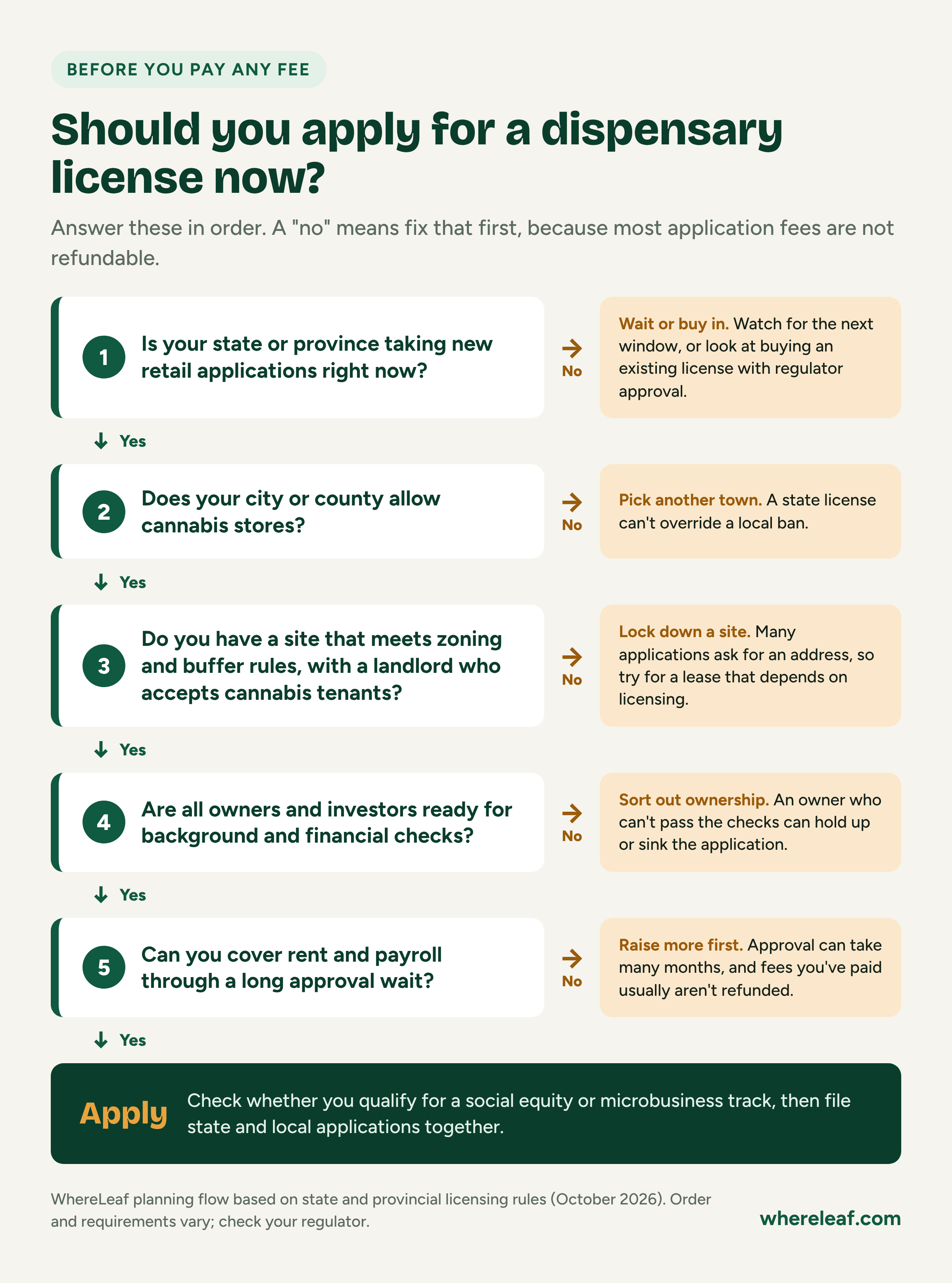
The order varies by state, but most projects follow these steps:
- Confirm the market is open. Check whether your state or province is taking applications, and whether there’s a cap, lottery or window.
- Confirm local rules. Make sure your city allows dispensaries and find out its zoning, buffers and local fees.
- Form your business and check owners. Every owner and investor will usually face background and financial checks.
- Secure a compliant location. Get a lease or option that depends on licensing, if possible.
- Write your plans. Security, inventory tracking, staffing and operations plans are common requirements.
- Apply and pay fees. Submit the state and local applications and pay the non-refundable fees.
- Build out and pass inspection. Install security and POS, then pass the state and local inspections.
- Get final approval and open. Pay the license fee, train staff and open your doors.
See where cannabis is legal in 2026 for which markets allow adult-use sales, and how shoppers check a dispensary’s license.
Your dispensary license-ready checklist
- Your state or province is accepting applications, and you know the deadline.
- You’ve read the full fee schedule, including background check and badge fees.
- Your city or county allows dispensaries, and you have its fee list in writing.
- Your location meets zoning and buffer rules, and the landlord accepts cannabis tenants.
- All owners and investors are listed and ready for background checks.
- You know whether you qualify for social equity or microbusiness fee breaks.
- You have a security plan covering cameras, alarms, a vault and access control.
- You’ve chosen a POS that connects to your state’s tracking system.
- You have a cannabis lawyer and accountant lined up.
- You have enough cash to cover rent and payroll through a long approval wait.
- You’ve budgeted for renewal fees every year (or every two years), not just the first one.
For dispensary owners: get found once you’re licensed
Once your doors open, customers need to find you. WhereLeaf lists licensed dispensaries and delivery services across the US and Canada. Add your listing for free so nearby shoppers can find your hours, location and menu on WhereLeaf’s dispensary finder. If you want more visibility, our featured packages put your store higher in local results.
Frequently asked questions
What is the cheapest state to get a dispensary license?
Of the states we checked, Washington State had the lowest state fees (see the table), with Oregon close behind. But Oregon isn’t taking new retailer applications, and low fees often go with closed or capped markets, so the cheapest state on paper may be one you can’t enter.
Is the dispensary application fee refundable?
Usually not. Ohio, Michigan, Ontario and British Columbia all call their application fees non-refundable, even if you’re denied. Apply only when your location, owners and paperwork are ready.
How long does it take to get a dispensary license?
It depends on the state, local approvals and whether there’s a lottery or application window. Approval often takes many months, so budget rent and payroll for a long wait.
Can I buy an existing dispensary license?
In many states, yes, but the regulator has to approve the change of ownership, and new owners go through background checks. Ontario, for example, charges a separate fee to transfer a store authorization. In closed markets like Oregon, buying an existing license may be the only way in.
How much does a dispensary license cost in Canada?
The table shows Ontario and British Columbia fees in Canadian dollars. In Canada, provinces license stores, while Health Canada licenses growers and processors. In Ontario, the operator licence and each store authorization are separate, so a chain pays per location. In British Columbia, the local government or Indigenous Nation must recommend your store first.
Do I need a separate license for delivery?
Often, yes. Many states make delivery its own license type or a separate permit with its own fees. Check your regulator’s license types, and see our cannabis delivery guide for how delivery works for customers.
Sources
- Ohio Administrative Code: Rule 1301:18-2-09, Fees (2026)
- Illinois General Assembly: 410 ILCS 705/15-36, Conditional license fee (2026)
- Illinois General Assembly: 410 ILCS 705/15-45, Renewal (2026)
- Illinois IDFPR: Conditional Adult Use Dispensing Organization License application instructions (2019)
- Cannabis Business Times: Illinois awards final round of adult-use cannabis dispensary licenses (2022)
- Michigan Cannabis Regulatory Agency: What is the cost of applying for an adult-use marijuana establishment license? (2026)
- Michigan Legislature: MCL 333.27956, Municipal ordinances (2026)
- Missouri Division of Cannabis Regulation: Fee schedule, FY 2027 (2026)
- Missouri Code of State Regulations: 19 CSR 100-1.020, License limits (2026)
- Massachusetts Cannabis Control Commission: 935 CMR 500.005, Fees (2024)
- New Jersey Cannabis Regulatory Commission: Fee Schedule (2023)
- New York Office of Cannabis Management: Adult-Use Retail Dispensary License (2026)
- Oregon Liquor and Cannabis Commission: Marijuana forms, publications and fees (2026)
- Oregon Liquor and Cannabis Commission: Marijuana licensing (2026)
- California Department of Cannabis Control: Retail license fees (2026)
- California Department of Cannabis Control: Data tool showcasing access areas for cannabis business (2022, updated 2025)
- Washington State Register: WSR 26-14-119, Liquor and Cannabis Board license fee rule (2026)
- Alcohol and Gaming Commission of Ontario: Licence and authorization fees (2025)
- Alcohol and Gaming Commission of Ontario: List of Ontario municipalities prohibiting or allowing cannabis retail stores (2026)
- Government of British Columbia, LCRB: Apply for a Cannabis Retail Store licence (2026)
- Ohio Division of Cannabis Control: Program Update, By the Numbers (2026)
- IDFPR: Cannabis Regulation Oversight Officer annual cannabis report release (2026)
- Cannabis Business Times: Where are we on cannabis rescheduling? (2026)
Last updated: October 2026. Laws and prices change; always check your state or provincial regulator.