
Yes, a new business can still get some types of cannabis license in Utah, but not all of them. As of October 2026, Utah allows only medical cannabis sales, and the Utah Department of Agriculture and Food (UDAF) licenses every cannabis business, from growers and processors to pharmacies, couriers and testing labs.
The catch is that the two most sought-after licenses are capped. UDAF says no more cultivation licenses are being offered, and new pharmacy licenses come only through rare, targeted rounds set by the Legislature. Processing, testing lab and courier licenses, on the other hand, have no fixed limit, and UDAF takes those applications through its licensing board.
This guide covers every license type and fee, which doors are open right now, the requirements you’ll need to meet and the steps from planning to opening day. We checked everything against UDAF pages, its fee schedule and the Utah Code in October 2026.
Key takeaways
- Utah is a medical-only market, and UDAF is the single state agency that licenses cannabis businesses.
- Cultivation licenses are closed, and pharmacy licenses open only in special rounds, so most newcomers look at processing, testing, courier work or buying into an existing company.
- Every production license goes before a state licensing board, and applicants must post a performance bond or cash account.
- State law sets distance buffers from schools, parks, churches and residential zones, so your site choice can make or break an application.
- Rules differ by state and change often. Always confirm current requirements with UDAF before you invest.
Who regulates cannabis businesses in Utah?
The Utah Department of Agriculture and Food runs the business side of the program through its Medical Cannabis program in the Division of Specialized Products. The main law is the Utah Medical Cannabis Act, with business rules in Utah Code Title 4, Chapter 41a (Cannabis Production Establishments and Pharmacies). The detailed rules sit in Utah Administrative Code R66, including R66-1 for cultivation, R66-2 for processing, R66-4 for labs, R66-5 for pharmacies and R66-6 for couriers.
Here is what is and isn’t in force as of October 2026:
- Medical cannabis: Legal. Cardholders buy only from licensed medical cannabis pharmacies, either in store or by home delivery.
- Adult-use cannabis: Not legal. No adult-use law has passed in Utah.
- Agency changes: Two 2026 laws, HB 389 and SB 121, move the patient-card side of the program from the Department of Health and Human Services (DHHS) to UDAF. The move could start July 1, 2026, and must be finished by January 1, 2027. After that, UDAF oversees the whole program.
License decisions are made by a state licensing board that UDAF supports, now called the Specialized Product Authority Licensing Board. Local governments form a second layer through zoning and business licenses.
What cannabis license types are there in Utah?
Utah calls growers, processors and labs “cannabis production establishments.” Pharmacies, couriers and research universities have their own licenses. The table uses UDAF’s Fiscal Year 2026 fee schedule, the latest posted, updated July 1, 2025.
| License type | What it lets you do | Application fee | Annual or renewal fee |
|---|---|---|---|
| Cultivation facility | Grow cannabis and sell it to processors | $2,500 establishment application fee | $95,000 license fee |
| Processor, Tier 1 | Process, formulate, package and label cannabis products | $2,500 establishment application fee | $95,000 license fee; $70,000 for a second integrated location |
| Processor, Tier 2 | Package and label cannabis products only | $2,500 establishment application fee | $35,000 license fee; $25,000 for a second integrated location |
| Medical cannabis pharmacy, urban | Sell to cardholders in Weber, Davis, Salt Lake or Utah County, in store or by home delivery | $2,500 establishment application fee | $67,000 license fee |
| Medical cannabis pharmacy, rural | Sell to cardholders in any other county, in store or by home delivery | $2,500 establishment application fee | $33,500 license fee |
| Courier (home delivery) | Deliver orders from licensed pharmacies to cardholders’ homes | $250 application fee | $2,500 license fee |
| Independent testing laboratory | Test cannabis and products for potency and contaminants | $2,500 establishment application fee | $15,000 license fee |
| Research university | Possess and study cannabis under a university research license | $250 application fee | $2,500 license fee |
| Agent cards and changes | Register staff and approve changes to an existing license | Agent card $150 with a background check or $100 without; owner background check $52 | Change of ownership $300; change of location $750 |
| Adult-use, lounge or microbusiness licenses | Not available in Utah | Not available | Not available |
A few fee rules matter. The application fee is separate from the license fee, which you pay once the board approves you and again each year when you renew, according to UDAF and local news coverage of the original fee plan. A renewal isn’t complete until every fee is paid and your bond is in good standing. Fees can change each fiscal year, so ask UDAF whether a newer schedule applies before you pay. Compare other states in our guide to dispensary license costs by state.
Are Utah cannabis licenses open right now?
It depends on the license. Here’s the status as of October 2026:
- Cultivation: closed. UDAF says no more cultivation licenses are being offered. It won’t go above eight unless DHHS projects more patient demand or a current licensee forfeits.
- Processing: open. UDAF says Utah does not currently restrict the number of processing licenses. Applicants still must appear before the licensing board.
- Testing labs: open. UDAF is accepting applications for independent testing laboratories.
- Couriers: open. Courier companies apply to UDAF by email with an operating plan and fees.
- Pharmacies: capped, with one round just closed. HB 54 (2025) required two new independent pharmacies in underserved areas. The first went to Boojum Medical in Moab in December 2025. The window for the second ran from August 3 to September 2, 2026, and UDAF must issue that license before January 1, 2027.
Board meetings and deadlines
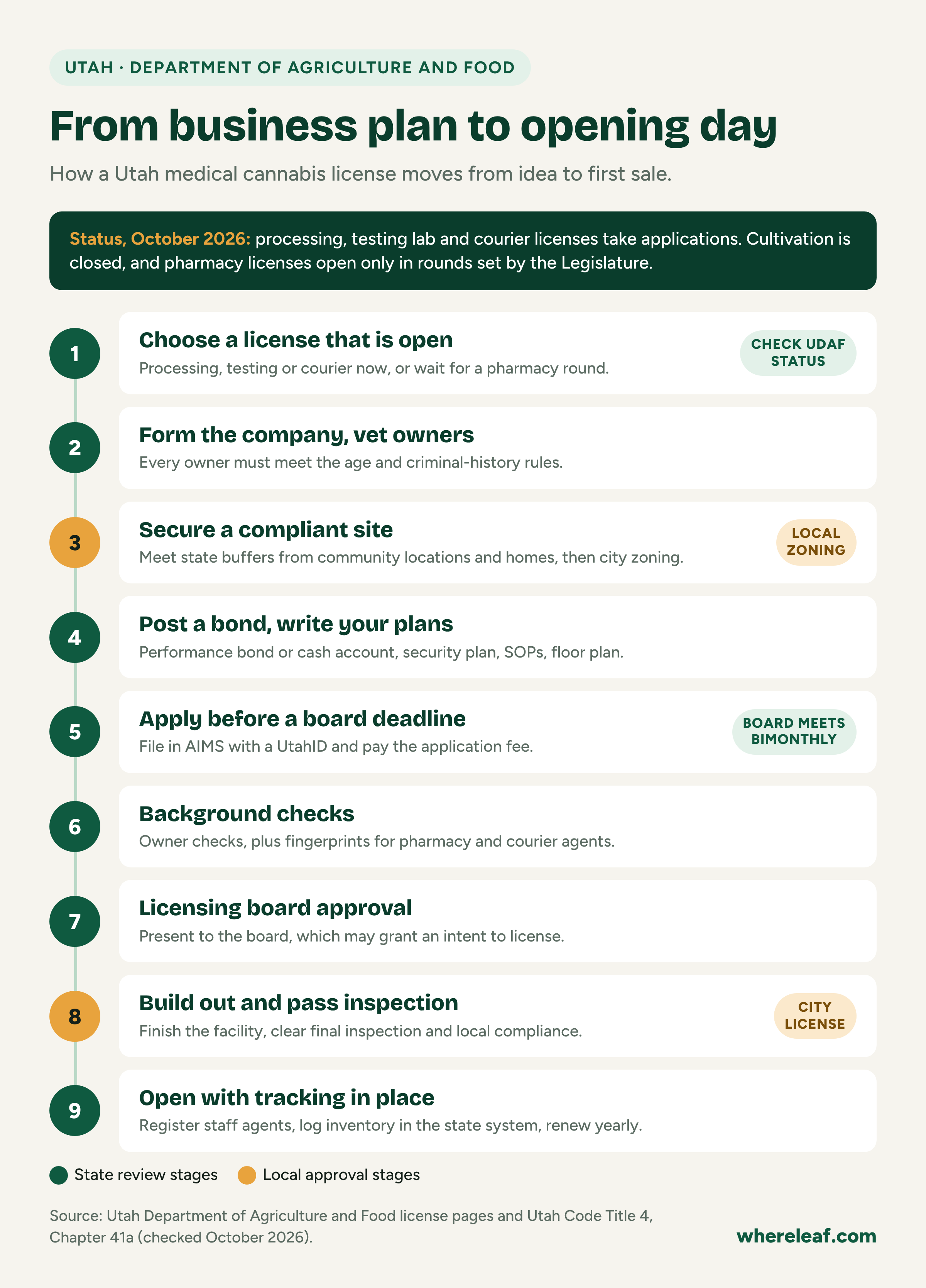
The board meets about every two months. In 2026 it met or meets on February 12, April 16, June 18, August 20, October 15 and December 17, and documents are due about a month before each meeting. For the December 17 meeting, the deadline is November 16.
Can you buy an existing license?
Ownership of a licensed company can change, but only with approval. Under the 2026 amendments, a change of 50% or more of ownership needs a new application, and the board must act on it within 60 days. Smaller changes still require a change-of-ownership filing and background checks for new owners. Talk to a Utah cannabis attorney before you sign anything.
How do you apply for a Utah cannabis license?
Production licenses run through UDAF’s online Agricultural Information Management System (AIMS), which needs a UtahID login. Pharmacy rounds use a separate UDAF portal, and couriers apply by email. The steps below show the full path.
What pharmacy rounds ask for
The 2026 independent pharmacy round asked for proof of financial resources, a facility layout and security plan, operating procedures for dispensing, inventory and patient consultation, and details on key staff, including pharmacists. UDAF screened applications for eligibility, and the board picked the winner.
What requirements do you need to meet?
Ownership and residency
Owners of production establishments and pharmacies must be at least 21 and can’t have a felony conviction in the past 10 years. The statute and UDAF pages we reviewed don’t set a Utah residency rule for owners. Independent pharmacy licensees can’t hold a financial interest in another pharmacy or certain ties to production companies.
Background checks and disqualifying offenses
Every owner submits a background check. Pharmacy agents and courier agents give fingerprints for state and FBI checks, and a courier agent can’t have a felony or a drug-distribution misdemeanor conviction.
Bond and capital
Production establishments post a performance bond or liquid cash account: $100,000 for each cultivation facility and $50,000 for each processing facility or independent lab. Pharmacies post $100,000. Pharmacy applicants must also show they have the money to open and run the business.
Real estate and buffer distances
A production establishment can’t be within 1,000 feet of a community location, such as a school, church, library, playground or park, or within 600 feet of a primarily residential district. Pharmacies also face a 600-foot residential buffer and a smaller community-location buffer. The board may reduce these distances by up to 20%. These buffers were amended in recent sessions, so confirm the current text before you lease.
Security plan and SOPs
Expect alarms, cameras, controlled access and written procedures for inventory, waste and recalls. Our dispensary security requirements guide covers what inspectors look for.
Insurance
The UDAF pages we checked don’t set an insurance amount. Landlords and lenders will expect coverage, so price it early.
Staff permits and pharmacy providers
Every worker registers with UDAF as an agent. Each pharmacy must keep a registered Pharmacy Medical Provider on site during business hours to consult with cardholders and review transactions. See our budtender training requirements guide for building a training plan.
Local approval and zoning in Utah
State law sets the buffer distances, and cities and counties apply them through their own zoning codes. Murray, for example, lists which of its zones count as primarily residential for the state buffer and requires production establishments to meet the land-use rules of their zone.
Before you sign a lease, confirm that your zone allows the use, measure the distance to every community location and residential district, and ask about local business licenses. UDAF requires courier companies to get a city business license after state approval, and processors can be held at “intent to license” until local compliance is done.
Social equity and small-business programs
Utah doesn’t run a social equity licensing program with reserved licenses or fee waivers. The closest thing is the HB 54 independent pharmacy track. It is limited to owners without a financial interest in other pharmacies and to medically underserved areas in counties with fewer than 260,000 residents, so smaller, local operators can compete without facing the largest companies.
Rural pharmacies also pay a lower license fee than urban ones, as the table shows.
Utah cannabis market at a glance
After you’re licensed: staying compliant
- Annual renewal: Licenses renew each year at a board meeting. File your documents by the deadline for the meeting before your license expires.
- Inventory tracking: Every plant, product and sale goes into the state’s inventory control system, and processors file monthly production reports. Read our seed-to-sale tracking explainer.
- Testing and labels: Products are tested by a licensed lab before sale, and labels and child-resistant packaging must meet R66-2-13 and Utah Code 4-41a-602.
- Agents and changes: Keep every staff agent card current, and get approval before changing owners or moving.
- Advertising: Pharmacies have strict limits on product advertising, and nothing may appeal to minors. Our packaging and labeling guide and dispensary compliance checklist help you build routines.
Your Utah cannabis license checklist
- Pick a license type that is actually open: processing, testing, courier, or a future pharmacy round.
- Create a UtahID and an AIMS account for your company.
- Form your entity and confirm that every owner meets the age and criminal-history rules.
- Line up your performance bond or liquid cash account.
- Shortlist sites, measure the state buffers and get local zoning answers in writing.
- Write your security plan, SOPs and floor plan.
- Mark the next board meeting and its document deadline on your calendar.
- Plan for agent cards, inventory tracking, lab testing and annual renewal.
- If buying in, budget for a change-of-ownership filing and legal review.
For new cannabis businesses: get found on WhereLeaf
Once you’re licensed and open, cardholders still need to find you. Add your business to WhereLeaf so people using our dispensary finder can see your location, hours and delivery options, and compare our listing packages if you want more visibility. We can’t promise rankings or sales, but an accurate listing helps people find a licensed business. Processors, labs and couriers can join our supplier directory.
Comparing markets? See all our cannabis license guides by state and province.
Frequently asked questions
How much does a cannabis license cost in Utah?
The table above lists the state fees. On top of them, you’ll tie up money in the required bond or cash account, plus rent, build-out, security, equipment and legal work. Budget for the license fee coming due again every year.
Is recreational weed legal in Utah in 2026?
No. Only registered medical cardholders can buy cannabis, and only from licensed pharmacies. Possessing it without a card is still illegal under state law.
Can I open a dispensary in Utah?
Utah calls dispensaries “medical cannabis pharmacies,” and you can’t apply for one whenever you like. New pharmacy licenses come only when the Legislature authorizes them, as it did with HB 54, so watch UDAF news releases for the next round.
Can I get a delivery license in Utah?
Yes. Courier licenses aren’t capped, and couriers deliver orders from licensed pharmacies. After approval, you’ll need background screening for every owner, an employee list and a city business license. See our guide on how to start a cannabis delivery business.
Do I need to live in Utah to get a license?
The sources we reviewed don’t require owners to be Utah residents. Owners must be 21 or older, pass background checks and have no felony conviction within the past decade.
How long does it take to get licensed?
UDAF doesn’t publish a standard timeline. Because the board meets about every other month, plan for at least one meeting cycle, plus build-out and inspection. The first HB 54 pharmacy winner had one year from its award to become fully operational.
This guide is general information, not legal advice. Rules and fees change, so confirm everything with the Utah Department of Agriculture and Food before you apply.
Sources
- Utah Department of Agriculture and Food: UDAF Fee Schedule, Fiscal Year 2026 (2025)
- Utah Department of Agriculture and Food: Medical Cannabis Cultivators (2026)
- Utah Department of Agriculture and Food: Medical Cannabis Processors (2026)
- Utah Department of Agriculture and Food: Medical Cannabis Laboratory License (2026)
- Utah Department of Agriculture and Food: Medical Cannabis Pharmacy Information (2026)
- Utah Department of Agriculture and Food: UDAF Opens Application to License New Independent Medical Cannabis Pharmacy (2026)
- Utah Department of Agriculture and Food: Utah Medical Cannabis Licensing Board Awards New Independent Pharmacy License in Moab (2025)
- Utah Medical Cannabis Program: 2026 Medical Cannabis Law Updates (2026)
- Utah Medical Cannabis Program: Monthly Report, April 2026 (2026)
- Utah State Legislature: S.B. 121, Medical Cannabis Amendments (2026)
- Utah State Legislature: H.B. 389 Cannabis Amendments, Fiscal Note (2026)
- Murray City Code: Cannabis Production Establishments and Medical Cannabis Pharmacies (via Zoneomics)
- Utah Public Radio: Utah is improving access to medical cannabis in rural and underserved areas (2026)
- Utah News Dispatch via States Newsroom: Utah eyes applications for new independent medical cannabis pharmacy in underserved area (2026)
- KUTV: Utah proposes medical marijuana grower fees upward of $100K (2019)
- Valley Journals: State binds city’s hands on medical cannabis (2019)
Last updated: October 2026. Laws and prices change; always check your state or provincial regulator.


