

Yes, you can get a cannabis license in New Mexico right now. As of October 2026, the Cannabis Control Division (CCD) of the New Mexico Regulation and Licensing Department (RLD) accepts applications for all of its license types, and the state sets no limit on the number of licenses of any type.
The CCD is the only state agency that issues cannabis business licenses, for both adult-use and medical activity. Cities and counties can’t ban licensed businesses outright, but they control zoning, hours and local business licenses, so your location still decides a lot. Growers also need proof of water rights before they apply, which is often the hardest piece.
Below you’ll find every license type and fee, how plant count limits work, the application steps in the state’s new NM-PLUS portal and a checklist, all checked against RLD sources in October 2026.
Key takeaways
- New Mexico is open for new cannabis business applications, with no statewide cap on any license type and no lottery.
- Annual state fees are low compared with many states, and microbusinesses pay the least, but growers also owe a fee for every mature plant.
- Producers must prove a legal right to their water before they apply, and towns control zoning even though they can’t ban cannabis businesses.
- Delivery, on-site consumption areas and research labs all have their own license types.
- Rules differ by state and change often. Always confirm current requirements with the Cannabis Control Division before you apply.
Who regulates cannabis businesses in New Mexico?
The Cannabis Control Division, part of the Regulation and Licensing Department, licenses and inspects every cannabis business in the state. Its authority comes from the Cannabis Regulation Act, which legalized adult-use cannabis in 2021, and its detailed rules are in Title 16, Chapter 8 of the New Mexico Administrative Code (NMAC). Adult-use sales started on April 1, 2022.
New Mexico runs one licensing system for two markets:
- Adult-use (commercial): Sales to adults 21 and older. Most licensees serve both markets.
- Medical: Sales to qualified patients, primary caregivers and reciprocal participants from other states. A business can hold a medical-only license, and retailers can be required to set aside part of their stock for medical sales.
Since 2025, the RLD also has an Enforcement Bureau, created by House Bill 10, whose certified peace officers investigate criminal violations of the Cannabis Regulation Act. Local governments form the third layer through zoning and business licensing.
What cannabis license types are there in New Mexico?
The CCD issues 10 license types. A vertically integrated license can bundle several activities, and an integrated microbusiness bundles them on a small scale. The table shows each type with its fees from 16.8.11 NMAC and the CCD’s fee page.
| License type | What it lets you do | Application fee | Annual or renewal fee |
|---|---|---|---|
| Retailer | Sell to adults 21 and older and to medical patients and caregivers | No separate application fee; the first annual fee is paid when you apply | $2,500, plus $1,000 for each additional premises |
| Producer | Grow cannabis and sell or transport it wholesale to other licensees, under an approved plant count | First annual fee, paid when you apply | $2,500, plus $1,000 per additional premises, plus $5.00 per mature commercial plant or $2.50 per mature medical plant |
| Producer microbusiness | Grow up to 200 mature plants at one premises | First annual fee, paid when you apply | $1,000; no per-plant fee |
| Integrated microbusiness | One grow, one manufacturing site and one store, plus transport and courier of your own products, with the same 200-plant limit | First annual fee, paid when you apply | $2,500; no per-plant fee |
| Manufacturer | Process cannabis into products such as edibles and concentrates, package them and sell wholesale | First annual fee, paid when you apply | $2,500, plus $1,000 per additional premises |
| Vertically integrated establishment | Act as producer, manufacturer, retailer and courier, with several sublicenses of each | First annual fee, paid when you apply | $7,500, plus $1,000 per additional premises and per-plant fees; total medical and commercial fees capped at $125,000 |
| Courier | Deliver cannabis products to patients, caregivers and adult consumers | First annual fee, paid when you apply | $250, plus $100 per additional premises |
| Consumption area | Run a licensed space where cannabis can be consumed on site; no alcohol | First annual fee, paid when you apply | Up to $2,500 |
| Testing laboratory | Test cannabis products for potency and contaminants | First annual fee, paid when you apply | $2,500, plus $1,000 per additional premises |
| Research laboratory | Grow or hold cannabis to study cultivation and characteristics; no product testing for sale | First annual fee, paid when you apply | $2,500, plus $1,000 per additional premises |
| Medical-only license (any type) | Serve only the medical program | Half of the combined fee | Half of the combined fee |
| License amendment | Change your premises, activities, plant count or controlling persons | $75 per amendment | Not applicable |
| Background check | Fingerprint check by the Department of Public Safety for each controlling person | $15, paid to DPS | Not published; ask the CCD |
A few fee rules matter when you budget. Fees for new applications are paid online in NM-PLUS. Renewal, courier and consumption area fees go by cashier’s check mailed to the CCD with your license number. Producers pay per-plant fees before they start growing and again at each renewal. A microbusiness that teams up with another licensee to dodge its size limits loses the lower fee and owes the full producer rate and per-plant fees. Compare other markets in our guide to dispensary license costs by state.
How plant count limits work
Producers are placed in a plant limit level based on the level they request, their water rights, past harvest and sales records, and their social and economic equity plan. Level 1 starts just above the microbusiness limit, and no licensee may grow more than 20,000 mature plants at one time. Only flowering plants count; seedlings and vegetative plants don’t.
To grow more, you file a plant count increase at renewal or once more during the year. Increases come in blocks of 500 plants, up to eight blocks at a time, and you’ll need current inventory, three months of harvest and sales data and proof of water rights. The CCD can refuse if you have open enforcement actions or exceeded your plant count in the previous three months.
Are New Mexico cannabis licenses open right now?
Yes. As of October 2026, the CCD states that it does not limit the number of licenses for any cannabis license type, and applications are accepted year-round through NM-PLUS. There are no application windows, lotteries or waitlists.
Two things are worth watching:
- Local pressure on growers: In 2025, lawmakers considered Senate Bill 152, which would have let a county ask the CCD for a two-year pause on new producer licenses. Check with the CCD whether any county-level restrictions apply where you plan to grow.
- A crowded retail market: No cap means competition, so study local demand and nearby stores before you sign a lease.
Can you buy an existing New Mexico license?
Not as such. Under 16.8.2 NMAC, licenses can’t be transferred or assigned to another person or location. You can join an existing licensed business as an owner, but adding a controlling person needs an amended application, a new criminal history screening and CCD approval before the new person takes on duties. Moving locations also needs an amendment.
How do you apply for a New Mexico cannabis license?
Since mid-2026, every new application, amendment and renewal goes through NM-PLUS, the RLD’s online licensing portal. Paper applications are no longer accepted.
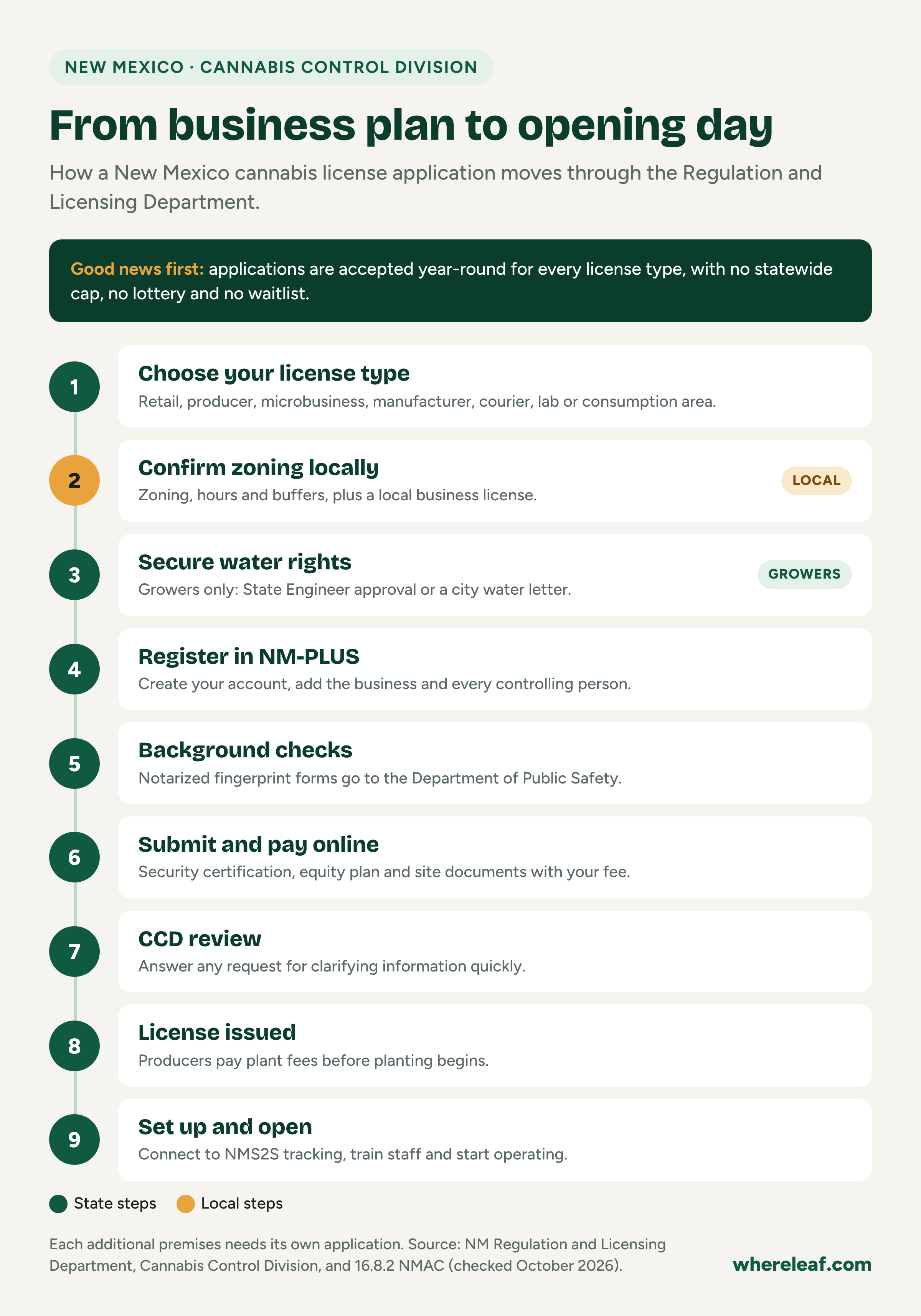
Under 16.8.2 NMAC, the CCD must grant or deny a license within 90 days of accepting a complete application. If the CCD asks for clarifying information, you have 90 days to supply it or the division starts the denial process. Each additional premises needs its own application for that license type.
What requirements do you need to meet?
Ownership and residency
Every applicant, controlling person and employee must be at least 21. A controlling person is anyone with a 10% or larger financial or voting interest, plus officers and board members, and each must be listed in NM-PLUS. The CCD’s rules don’t set a New Mexico residency requirement for owners, though your equity plan must describe the residency of your owners and staff.
Background checks and disqualifying offenses
Each controlling person files notarized fingerprint forms with the Department of Public Safety, not the CCD. Applicants with a criminal record may wait up to 15 days for results. The CCD reviews records case by case. Disqualifying offenses include felony fraud, deceit or embezzlement, and felonies for hiring minors to handle controlled substances. A completed sentence for cannabis possession or distribution can’t be the only reason for a denial.
Capital and water rights
The CCD doesn’t publish a minimum capital or bond amount. Producers must prove a legal right to the water they need before applying. On a non-municipal source, that means approval from the Office of the State Engineer; on city water, a letter from the provider. Domestic wells can’t be used for commercial growing, and hauling water is allowed for only one “bridge” year.
Real estate and buffer zones
You’ll need a local business license, or proof that your jurisdiction doesn’t issue one, and you must follow local zoning. According to the law firm Vicente LLP, the Cannabis Regulation Act doesn’t let towns require more than 300 feet between a cannabis business and a school or daycare center. Confirm the exact local buffer with your planning office.
Security plan and SOPs
Applicants certify that they meet the security rules in 16.8.2 NMAC, which cover alarm systems, video surveillance, limited-access areas, locks and fencing for outdoor and greenhouse grows. Shipments need a manifest and chain-of-custody form, and vehicles must stay locked when unattended. See our dispensary security requirements guide for what to plan.
Insurance
The CCD’s licensing pages don’t set an insurance minimum. Landlords and lenders usually require coverage, so get quotes before you sign a lease.
Staff
All employees must be at least 21. Train them on ID checks, medical sales and purchase limits before opening day; our budtender training requirements guide is a good starting point.
Local approval and zoning in New Mexico
Under the Cannabis Regulation Act, cities and counties can’t ban licensed cannabis operations. They can adopt reasonable time, place and manner rules through zoning, such as limits on density and business hours, and they issue local business licenses.
Consumption areas are the exception: local governments can deny those. Cities such as Albuquerque and Santa Fe have adopted their own cannabis zoning rules, so read your local code before you look at property.
Social equity and priority programs in New Mexico
New Mexico doesn’t run a priority review, lottery or reserved-license program. Instead, the Cannabis Regulation Act builds equity into every application:
- Equity plans: Applicants submit a social and economic equity plan describing how they encourage diversity in employment and whether they serve an underserved rural community. Producers’ plans count when the CCD sets their plant level.
- Microbusinesses: The lowest-cost route, with lower annual fees and no per-plant fees, designed for small operators.
- Past records: A completed sentence for a cannabis offense can’t be the sole reason for a denial.
New Mexico cannabis market at a glance
After you’re licensed: staying compliant
- Renewal: Licenses last 12 months. Renew through NM-PLUS no earlier than 60 days and no later than 30 days before expiration, and pay per-plant fees again if you grow.
- Seed-to-sale tracking: New Mexico switched to a new state system, NMS2S, on September 4, 2026, built by Albuquerque-based Real Time Solutions. Read our seed-to-sale tracking explainer for the basics.
- Inspections and enforcement: The CCD has 20 compliance officers, and the Enforcement Bureau can embargo products and make arrests.
- Changes need approval: Plant count changes, new activities, new controlling persons and a 10% or larger increase in water use all need CCD approval first.
- Packaging and advertising: The CCD is working with industry to remove packaging that appeals to minors. Our packaging and labeling guide and dispensary compliance checklist help you build routines.
Your New Mexico cannabis license checklist
- Choose your license type, and decide whether a microbusiness or integrated microbusiness fits your size.
- Check your city or county zoning, buffer and hours rules, and get a local business license.
- If you’ll grow, secure water rights or a municipal water letter first.
- Form your entity and list every controlling person.
- Send notarized fingerprint forms to the Department of Public Safety for each controlling person.
- Self-register in NM-PLUS and add your business and any agent.
- Write your security plan, SOPs and social and economic equity plan.
- Submit your application and pay the fee online.
- Answer any CCD request for information promptly.
- Set up NMS2S tracking and your point-of-sale system.
- Put renewal dates in your calendar from day one.
For new cannabis businesses: get found on WhereLeaf
Once your license is issued and you’re open, customers still need to find you. Add your business to WhereLeaf so shoppers using our dispensary finder can see your location, hours and menu, and compare our listing packages if you want more visibility. We can’t promise rankings or sales, but an accurate listing helps people choose a licensed business.
Comparing markets? See all our cannabis license guides by state and province.
Frequently asked questions
How much does a cannabis license cost in New Mexico?
The table above lists every CCD fee. For growers, per-plant fees quickly outgrow the base license fee as plant counts rise. Water rights, build-out, security and rent usually cost far more than state fees, and the CCD doesn’t publish a startup cost estimate.
Can I get a cannabis delivery license in New Mexico?
Yes. A courier license lets you deliver to patients, caregivers and adult consumers. As of October 2026, only eight couriers were licensed statewide, so the market is still small. See our guide on how to start a cannabis delivery business.
Do I need to live in New Mexico to get a cannabis license?
The CCD’s rules don’t require owners to be New Mexico residents. Every controlling person must still pass a background check, and you’ll need a local business license where you operate.
How long does it take to get a New Mexico cannabis license?
The clock starts only once the CCD accepts your application as complete, so missing documents are the most common delay. The CCD doesn’t give an overall timeframe because some steps, such as fingerprinting and water rights, depend on other agencies.
Can I open a cannabis consumption lounge in New Mexico?
Yes, with a consumption area license, as long as your local government doesn’t deny it. Alcohol isn’t allowed. As of October 2026, 28 consumption areas were licensed. See our guide to cannabis consumption lounges.
Can I grow cannabis outdoors in New Mexico?
Yes. The CCD’s security rules cover fencing for outdoor and greenhouse grows. Water rights are the main hurdle, because domestic wells can’t be used for commercial growing.
This guide is general information, not legal advice. Rules and fees change, so confirm everything with the New Mexico Cannabis Control Division before you apply.
Sources
- NM Regulation and Licensing Department: Types of Licenses (2025)
- NM Regulation and Licensing Department: CCD Licensing Description and Fees (2025)
- NM Regulation and Licensing Department: Apply for License (2026)
- NM Regulation and Licensing Department: Licensing FAQs
- NM Regulation and Licensing Department: Cannabis Update to the Economic and Rural Development and Policy Committee (2026)
- 16.8.11 NMAC: Cannabis Fees (NM State Records Center and Archives)
- 16.8.2 NMAC: Cannabis Establishment Licenses and Licensing Requirements (NM State Records Center and Archives)
- 16.8.8 NMAC: Plant Count and Production Limits (NM State Records Center and Archives)
- New Mexico Legislature: Senate Bill 152 (2025)
- Vicente LLP (law firm, backup source): How to Navigate New Mexico’s Local Cannabis Zoning Laws (2022)
Last updated: October 2026. Laws and prices change; always check your state or provincial regulator.


