Right now, you can’t apply for a brand-new cannabis license in Nevada. As of October 2026, the Nevada Cannabis Compliance Board (CCB) accepts applications only during application periods it announces in advance, and no period is open or scheduled. The most recent windows were for consumption lounges in 2022 and for one cultivation and one production license in White Pine County in 2024.
That doesn’t mean the door is shut. The CCB is the only state agency that issues cannabis establishment licenses, and it regularly approves sales of existing licenses through a “transfer of interest” process. For most newcomers, buying into or acquiring a licensed business is the realistic way into the Nevada market today, while waiting for the next window.
Below you’ll find every license type and fee, how application periods work, the requirements, local rules and a checklist, all checked against CCB and Nevada law sources in October 2026.
Key takeaways
- Nevada does not take applications on a rolling basis. You can apply only when the CCB announces an application period, and none is open as of October 2026.
- Retail store licenses are capped by county population, so the main route in today is buying an existing license with CCB approval.
- When a window opens, it is short and strict: missing documents or late payment ends your chances for that round, with no grace period.
- Your city or county must allow your business and issue its own business license, and buffer zones apply near schools, community facilities and, in the big counties, casinos.
- Rules differ by state and change often. Always confirm current requirements with the CCB before you invest.
Who regulates cannabis businesses in Nevada?
The Cannabis Compliance Board licenses and regulates both adult-use and medical cannabis businesses. It took over from the Department of Taxation on July 1, 2020. The governing law is Title 56 of the Nevada Revised Statutes, mainly NRS Chapter 678B for licensing, and the CCB’s rules are moving from the old Nevada Cannabis Compliance Regulations (NCCR) into the Nevada Administrative Code (NAC 678A to 678D) during 2026.
Nevada has two tracks:
- Adult-use: retail stores, cultivation, production, distribution, testing and consumption lounges, for customers 21 and older. Voters approved this in 2016, and sales began in 2017.
- Medical: dispensaries, cultivation, production and testing for registered patients. Many businesses hold both a medical and an adult-use license for the same location.
Local governments form the third layer. Cities and counties decide whether cannabis businesses can operate at all, set zoning and hours, and issue the local business license you need before your state license becomes final.
The Board itself is changing too. Governor Joe Lombardo named Michael Miles acting executive director in March 2026, and the Board moved to meeting every other month starting in summer 2026, which affects how quickly transfer and inspection items reach a vote.
What cannabis license types are there in Nevada?
The table lists every Nevada cannabis establishment license, what it allows and the fees in NRS 678B.390. The statute sets these as the maximum the Board may collect, so confirm the exact amount with the CCB when a window opens.
| License type | What it lets you do | Application fee (one-time, nonrefundable) | Initial license fee / annual renewal |
|---|---|---|---|
| Adult-use retail store | Sell cannabis to adults 21+ from a storefront, with delivery allowed under CCB rules | $5,000 | $20,000 / $5,000 |
| Medical dispensary | Sell cannabis to registered medical patients | $5,000 | $30,000 / $5,000 |
| Cultivation facility (adult-use or medical) | Grow cannabis and sell it to other licensees | $5,000 | $3,000 / $1,000 |
| Production facility (adult-use or medical) | Make edibles, concentrates, vapes and other products for other licensees | $5,000 | $3,000 / $1,000 |
| Adult-use distributor | Transport cannabis between licensed establishments | $5,000 | $15,000 / $5,000 |
| Independent testing laboratory (adult-use or medical) | Test cannabis for potency and contaminants | $5,000 | $5,000 / $3,000 |
| Retail cannabis consumption lounge | Run an on-site use lounge attached to or next to your own retail store | $100,000 | $10,000 / $10,000 |
| Independent cannabis consumption lounge | Run a stand-alone lounge that buys products from a licensed retail store | $10,000; $2,500 for social equity applicants | $10,000 / $10,000; the Board may reduce this by regulation |
| Cannabis establishment agent card | Required for every owner, officer, board member and worker | $150 per person | $150 per renewal |
How the fees work: the application fee (the CCB calls it an administrative processing fee) is due by the close of the application period and is nonrefundable, whether or not you win. It must be received by ACH, cashier’s check or money order before 5 p.m. Pacific on the last day; cash, mail and drop boxes are not accepted. You also pay the Board’s actual costs for background investigations, billed at an hourly rate plus travel. License fees, including renewal fees, must be paid in full before a final license is issued.
Nevada has no stand-alone delivery license. Licensed retail stores and dispensaries may deliver under CCB rules, and the CCB’s licensee list shows which ones do. Compare costs in other markets in our guide to dispensary license costs by state.
Are Nevada cannabis licenses open right now?
No. As of October 2026, no application period is open and the CCB has not announced the next one. Check the CCB news page and its email list, because a request for applications is posted online, at the Board office and by email, and the window itself lasts only 10 business days.
Supply is limited by law. NRS 678B.260 caps adult-use retail store licenses by county population:
- 80 in counties of 700,000 or more people (Clark County)
- 20 in counties of 100,000 to 699,999 (Washoe County)
- 4 in counties of 55,000 to 99,999
- 2 in counties under 55,000
Independent consumption lounges are also capped. The Board generally may not issue more than 20, and at least 10 of the first 20 had to go to social equity applicants. In the October 2022 window, the CCB received 100 complete lounge applications and chose independent winners by random drawing.
Can you buy an existing license?
Yes, and it’s the most common way in. A sale of a license, or of an ownership stake, needs CCB approval through a transfer of interest application, and the new owners go through the same suitability investigation as a new applicant. Very small stakes under 5% can qualify for a simplified waiver. Independent lounge licenses can’t be transferred until two years after the lounge starts operating.
How do you apply for a Nevada cannabis license?
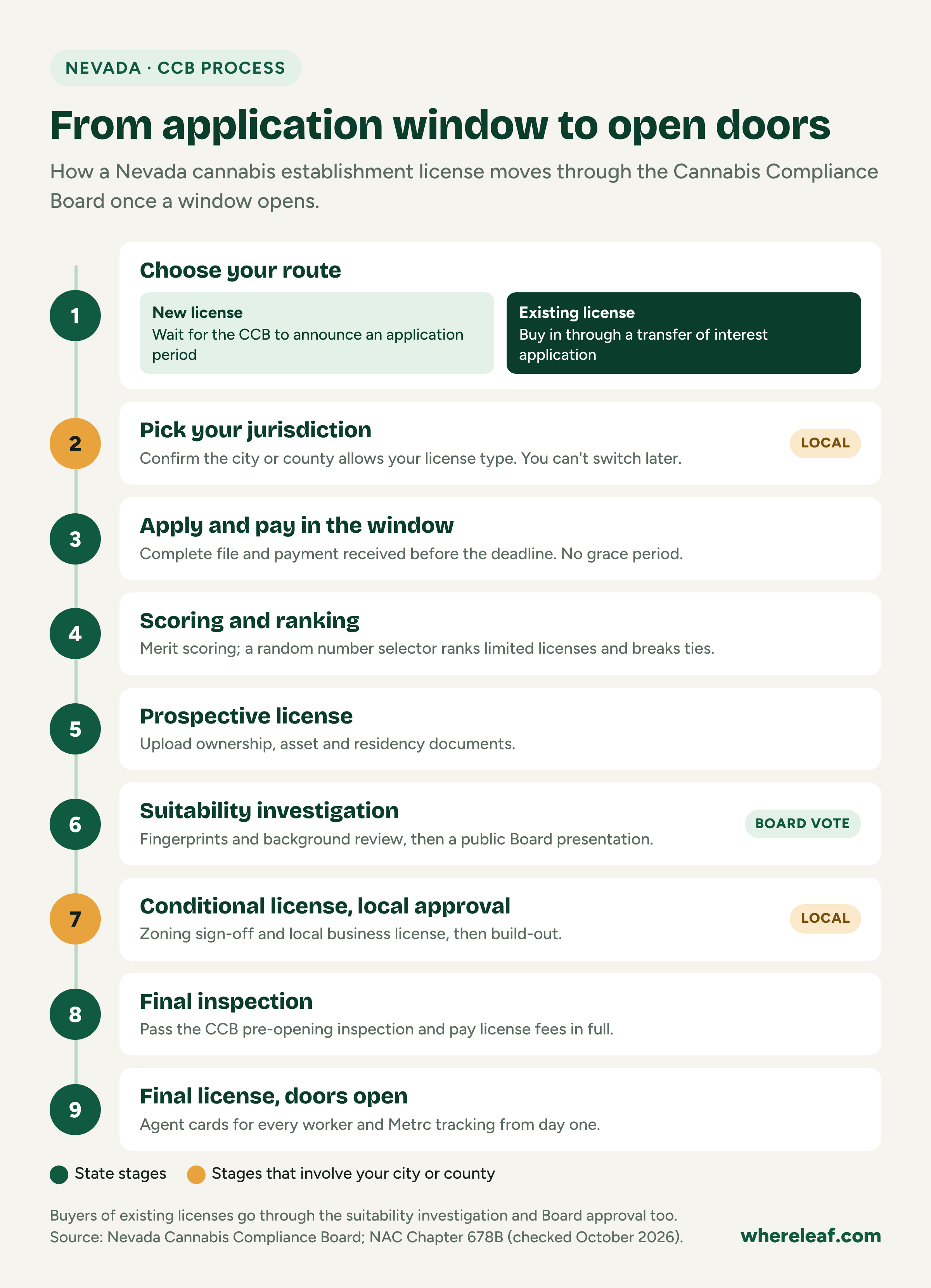
When the CCB opens a window, every applicant follows the same path, from the application period to opening day.
How winners are picked
Applications are scored on criteria of merit, such as your financial resources, experience and plans. Where licenses are limited, the CCB uses a random number selector to rank qualified applicants and to break ties. Winners get a prospective license and 120 days to upload the required documents, then face a suitability investigation and a public presentation to the Board before a conditional license is issued.
A conditional license is not permission to sell. You then have 12 months to secure local approval, finish building and pass a final inspection, or the license must be surrendered. The Board can extend that deadline, and it often does so at its meetings.
What requirements do you need to meet?
Ownership and residency
Owners, officers and board members must be at least 21. Nevada has no state residency rule for standard licenses. You must disclose every owner holding 5% or more, and one person can’t hold both a retail lounge and an independent lounge license.
Background checks and disqualifying offenses
Every owner, officer and board member is fingerprinted and investigated for suitability. Certain felony convictions can disqualify a person, and the CCB also weighs honesty in the application and past regulatory history. Check NRS 678B for the current list before you apply.
Capital
Applicants chosen for a prospective license must prove liquid assets of at least $250,000, or $200,000 for a consumption lounge, from an unencumbered source. Scoring awards extra points for showing two or three times the minimum.
Real estate and buffer zones
Your proposed site must be at least 1,000 feet from a public or private school (preschool through grade 12) and 300 feet from a community facility, such as a park, church or day care center. In counties with 100,000 or more residents, you also need 1,500 feet from a casino with a nonrestricted gaming license. Local rules may add more.
Security plan and SOPs
The CCB requires alarms, video surveillance, controlled access and written procedures for inventory, waste and age checks. Proposed 2026 rules would require a manual ID check at entry and at the sale, with a scanner at one of those points. See our dispensary security requirements guide.
Insurance
The CCB application materials we reviewed don’t set an insurance amount. Your landlord, lender and local jurisdiction will likely require coverage, so ask the CCB and get quotes early.
Staff agent cards and training
Every owner, officer, employee and volunteer needs a CCB agent card before working, and cards must be renewed. Proposed 2026 rules would also require workers to finish training before working on their own. Our budtender training requirements guide covers what to teach new hires.
Local approval and zoning in Nevada
When you apply, you name a local jurisdiction, and you can’t switch to a different one later, though you can move within it. Confirm before you apply that the city or county allows your license type, because a conditional license is worthless where local zoning says no. Clark County, Las Vegas, Henderson, North Las Vegas, Reno and Sparks each run their own business license and zoning processes, and many rural counties limit or ban cannabis businesses.
Don’t start building before you hold a conditional license and local approval. The CCB says any build-out before final licensure is at your own risk. Final licensing requires proof of zoning compliance and a local business license.
Social equity and priority programs
Nevada’s social equity program applies only to consumption lounges. To qualify, an applicant must meet all three tests: at least 51% ownership by qualifying people, at least five years living in a disproportionately impacted area (census tracts with high deprivation and incarceration rates), and a past cannabis offense, theirs or a family member’s, that meets the CCB’s criteria.
Qualifying applicants get a 75% cut in the independent lounge application fee and a reserved share of independent lounge licenses. Conditional independent lounge holders can also ask for reduced initial and renewal fees for hardship. There is no equity track for retail, cultivation or production licenses.
Nevada cannabis market at a glance
After you’re licensed: staying compliant
- Renewal: Renew your license every year and keep agent cards current for every worker.
- Seed-to-sale tracking: Nevada uses Metrc for inventory tracking and launched a Metrc item catalog in 2026. Significant inventory gaps must be reported within 24 hours. Read our seed-to-sale tracking explainer.
- Inspections and discipline: CCB agents inspect licensees and can place a hold on products that fail testing. Since 2025 law changes, disciplinary hearings go before a hearing officer, and unlicensed activity can draw civil penalties up to $50,000.
- Advertising and packaging: Ads and packages must not appeal to people under 21, and warning signs are required at customer entrances. See our packaging and labeling guide and dispensary compliance checklist.
- Changes need approval: Ownership transfers, moves and major changes require CCB approval before you act.
Your Nevada cannabis license checklist
- Sign up for CCB email notices so you hear about the next application period.
- Decide between waiting for a window and buying an existing license.
- If buying, hire a lawyer to review the license history and file a transfer of interest application.
- Check whether you qualify as a social equity lounge applicant and gather proof.
- Form your business entity and list every owner, officer and board member.
- Confirm your city or county allows your license type, and map buffer zones.
- Document your liquid assets and their source.
- Prepare your application, plans and fee payment before the window opens.
- After winning, upload your documents within the deadline and prepare for the suitability investigation.
- Get local approval and a local business license, then build out and pass the final inspection.
- Get agent cards for everyone and set up Metrc before opening day.
For new cannabis businesses: get found on WhereLeaf
Once your doors are open, customers still need to find you. Add your business to WhereLeaf so shoppers using our dispensary finder can see your location, hours and menu, and compare our listing packages if you want more visibility. We can’t promise rankings or sales, but an accurate listing helps people choose a licensed business.
Comparing markets? See all our cannabis license guides by state and province.
Frequently asked questions
How much does a cannabis license cost in Nevada?
The table above lists the state fees, but they are a small part of the total. Buying an existing license in a capped market usually costs far more than the state fees, and you’ll also pay for background investigation hours, rent, build-out and security.
Can I get a delivery license in Nevada?
No separate delivery license exists. Delivery is run by licensed retail stores and dispensaries, and on the CCB’s October 2026 list, 82 of the listed locations offered it. If you want to deliver, you need to own or partner with a licensed store. Our guide on how to start a cannabis delivery business explains the basics.
Do I need to live in Nevada?
No, there is no state residency rule for standard licenses. Social equity lounge applicants are the exception, because they must have lived in a qualifying area for years.
How long does it take to get a Nevada cannabis license?
Expect a long wait before you can even apply. After a window closes, the CCB expected suitability investigations for 2022 lounge winners to take about 120 days, and conditional licensees then have a year to open. Transfers of existing licenses depend on the investigation and the Board’s meeting schedule.
Can I open a cannabis consumption lounge in Nevada?
Only through a lounge license. A retail store owner can add a retail lounge, while independent lounges were awarded by drawing in 2022. Alcohol, tobacco and nicotine aren’t allowed inside. See our guide to cannabis consumption lounges.
What happens if I miss something during the application window?
There is no grace period. An application that is incomplete or whose payment arrives after the deadline is not considered, and you wait for the next window. Prepare documents, ownership details and payment before the period opens.
This guide is general information, not legal advice. Rules and fees change, so confirm everything with the Nevada Cannabis Compliance Board before you apply.
Sources
- Nevada Cannabis Compliance Board: News (2026)
- Nevada Cannabis Compliance Board: List of Licensees (2026)
- Nevada Cannabis Compliance Board: Annual Cannabis Taxable Sales Data, Fiscal 2025 (2026)
- Nevada Cannabis Compliance Board: Consumption Lounge Questions Answered (2022)
- Nevada Cannabis Compliance Board: Final Figures for Consumption Lounge License Applications (2022)
- Nevada Cannabis Compliance Board: CCB to Accept Applications for Cannabis Establishments in White Pine County (2024)
- Nevada Cannabis Compliance Board: Meeting Minutes, June 18, 2026 (2026)
- Nevada Legislature: NRS Chapter 678B, Licensing and Control of Cannabis
- Nevada Legislature: NAC Chapter 678B (2026)
- Nevada Legislature: Proposed Regulation R103-26 of the Cannabis Compliance Board (2026)
Last updated: October 2026. Laws and prices change; always check your state or provincial regulator.


