You can’t apply for most cannabis licenses in Minnesota right now. As of October 2026, the Office of Cannabis Management (OCM) has closed its general cannabis business window and has not set a new one, so microbusiness, retailer, cultivator and most other license types are closed to new applicants. OCM is still taking applications for cannabis testing facilities, cannabis event organizers and lower-potency hemp edible (LPHE) businesses.
OCM is the single state agency that licenses every cannabis and hemp business in Minnesota. Cities and counties don’t issue cannabis licenses, but they register retail locations, certify zoning and can set where businesses go.
Below are every license type and fee, the 2025 lotteries, social equity rules, local approval and a checklist, all checked against OCM pages and Minnesota Statutes in October 2026.
Key takeaways
- Most Minnesota cannabis license types are closed as of October 2026, and OCM hasn’t announced when the next window opens.
- Testing labs, event organizers and lower-potency hemp edible businesses can still apply on a rolling basis.
- Four license types are capped and were awarded by lottery, while the rest have no limit on numbers.
- Cities can’t ban licensed cannabis businesses, but they control zoning, buffers and retail registration.
- Rules differ by state and change often. Always confirm the current requirements with OCM before you apply.
Who regulates cannabis businesses in Minnesota?
The Office of Cannabis Management licenses, inspects and enforces rules for the adult-use market, the medical cannabis program and the hemp-derived edibles market. Its authority comes from Chapter 342 of Minnesota Statutes, created by the 2023 law that legalized adult-use cannabis, and its rules are in Minnesota Rules chapter 9810.
Minnesota now has one regulator for three product groups:
- Adult-use cannabis: Licensed stores began selling to adults 21 and older in September 2025, after OCM issued its first business licenses that June.
- Medical cannabis: Long-standing medical operators hold medical cannabis combination business licenses, which become “macrobusiness” licenses on January 1, 2027.
- Lower-potency hemp edibles: Hemp-derived THC edibles and drinks sold under separate, cheaper LPHE licenses.
Local governments form the second layer. They can’t ban licensed businesses, but they set time, place and manner rules and must register each retail location. Tribal nations regulate cannabis on their own lands, and OCM won’t license a business in Indian country without the Tribal government’s consent.
What cannabis license types are there in Minnesota?
Minnesota uses three fees: an application fee when you apply, an initial license fee when the license is issued, and a renewal fee. The table lists every license type OCM issues, with fees from Minnesota Statutes section 342.11 and OCM’s license pages.
| License type | What it lets you do | Application fee | Annual or renewal fee |
|---|---|---|---|
| Cannabis microbusiness | Small vertical business: grow, make products and run one store | $500 application; $0 initial license | $2,000 |
| Cannabis mezzobusiness (capped) | Mid-size vertical business with a larger grow and up to three stores | $5,000 application; $5,000 initial license | $10,000 |
| Cannabis cultivator (capped) | Grow cannabis and sell it to other cannabis businesses | $10,000 application; $20,000 initial license | $30,000 |
| Cannabis manufacturer (capped) | Make cannabis products and sell them to other cannabis businesses | $10,000 application; $10,000 initial license | $20,000 |
| Cannabis retailer (capped) | Sell cannabis to adults from storefronts | $2,500 application; $2,500 initial license | $5,000 |
| Cannabis wholesaler | Buy and resell cannabis between businesses; can add a hemp product importer endorsement | $5,000 application; $5,000 initial license | $10,000 |
| Cannabis transporter | Move cannabis between licensed businesses | $250 application; $500 initial license | $1,000 |
| Cannabis delivery service | Deliver cannabis and hemp products to customers and patients | Same as transporter | Same as transporter |
| Cannabis testing facility | Test cannabis and hemp products | $5,000 application; $5,000 initial license | $10,000 |
| Cannabis event organizer | Run a licensed cannabis event lasting up to four days in a row | $750 application; $750 initial license | No renewal while licenses are per event; ask OCM about annual licenses |
| Medical cannabis combination business (macrobusiness from January 2027) | Grow, make and sell for medical patients, plus some adult-use activity | $10,000 application; $20,000 initial license | $70,000 |
| Municipal cannabis store | A city- or county-owned cannabis retailer | Not published separately; ask OCM | Not published separately; ask OCM |
| LPHE manufacturer | Make hemp-derived edibles and sell them to other businesses | $250 application; $1,000 initial license | $1,000 |
| LPHE wholesaler | Buy and resell hemp edibles; needs warehouse or office space in Minnesota | $250 application; $10,000 initial license | $10,000 |
| LPHE retailer | Sell hemp edibles to adults 21 and older, with optional delivery and on-site consumption endorsements | $250 per location application; $250 per location initial license | $250 per location |
Two fee rules matter. First, the initial license fee covers the license and its first annual renewal, so the renewal fee is first billed at the second renewal. Second, every fee is nonrefundable, even if OCM denies you. For renewals, OCM sends an invoice after it reviews your application instead of taking payment when you file. Cities can also charge a retail registration fee, capped at whichever is less: $500 or half the state initial license fee at first, then $1,000 or half the state renewal fee. Compare other states in our guide to dispensary license costs by state.
Size limits differ by license. A microbusiness can grow up to 5,000 square feet of indoor canopy or half an acre outdoors and run one store. A mezzobusiness gets 15,000 square feet or one acre and up to three stores. A cultivator gets 30,000 square feet or two acres. A retailer can hold up to five stores, with no more than one per city and three per county. A 2026 law expanded some canopy limits, so check the current numbers with OCM.
Are Minnesota cannabis licenses open right now?
For most types, no. The general cannabis business application window ran from February 18 to March 16, 2025, and OCM’s application page says no new window has been set. Future openings will be announced on OCM’s licensing pages.
What is open as of October 2026:
- Cannabis testing facilities: applications accepted and reviewed on a rolling basis in OCM’s Accela portal.
- Cannabis event organizers: applications for 2026 events close November 16 at 4 p.m. Central. New event organizer applications open in January 2027, when the license becomes an annual, renewable one.
- LPHE manufacturers, wholesalers and retailers: open on a rolling basis.
How the 2025 lotteries worked
Cultivator, manufacturer, mezzobusiness and retailer licenses are capped, so qualified applicants were drawn by lottery. Verified social equity applicants applied first, in a fall 2024 preapproval process, and had their own drawings on June 5, 2025. The general retailer lottery followed on July 22, 2025, with a second chance for social equity applicants who missed out. OCM’s data page lists 150 available retailer licenses, 100 mezzobusiness, 50 cultivator and 24 manufacturer licenses.
Winners still have to pass background checks, sign a labor peace agreement, secure a site and local approval, and submit final plans. According to the accounting firm GreenGrowth CPAs, the four capped types stay at these numbers until at least July 1, 2027, the earliest date OCM can set new caps. Confirm with OCM.
Can you buy an existing license?
Ownership changes go through OCM’s “Making Business Changes” process, and a license can’t simply be sold without approval. GreenGrowth CPAs reports that a social equity license can transfer only to another social equity applicant for its first three years. Local retail registrations can’t be transferred at all.
How do you apply for a Minnesota cannabis license?
All applications go through OCM’s Accela portal, and your business must be physically located in Minnesota. When a window is open, the process follows the stages below.
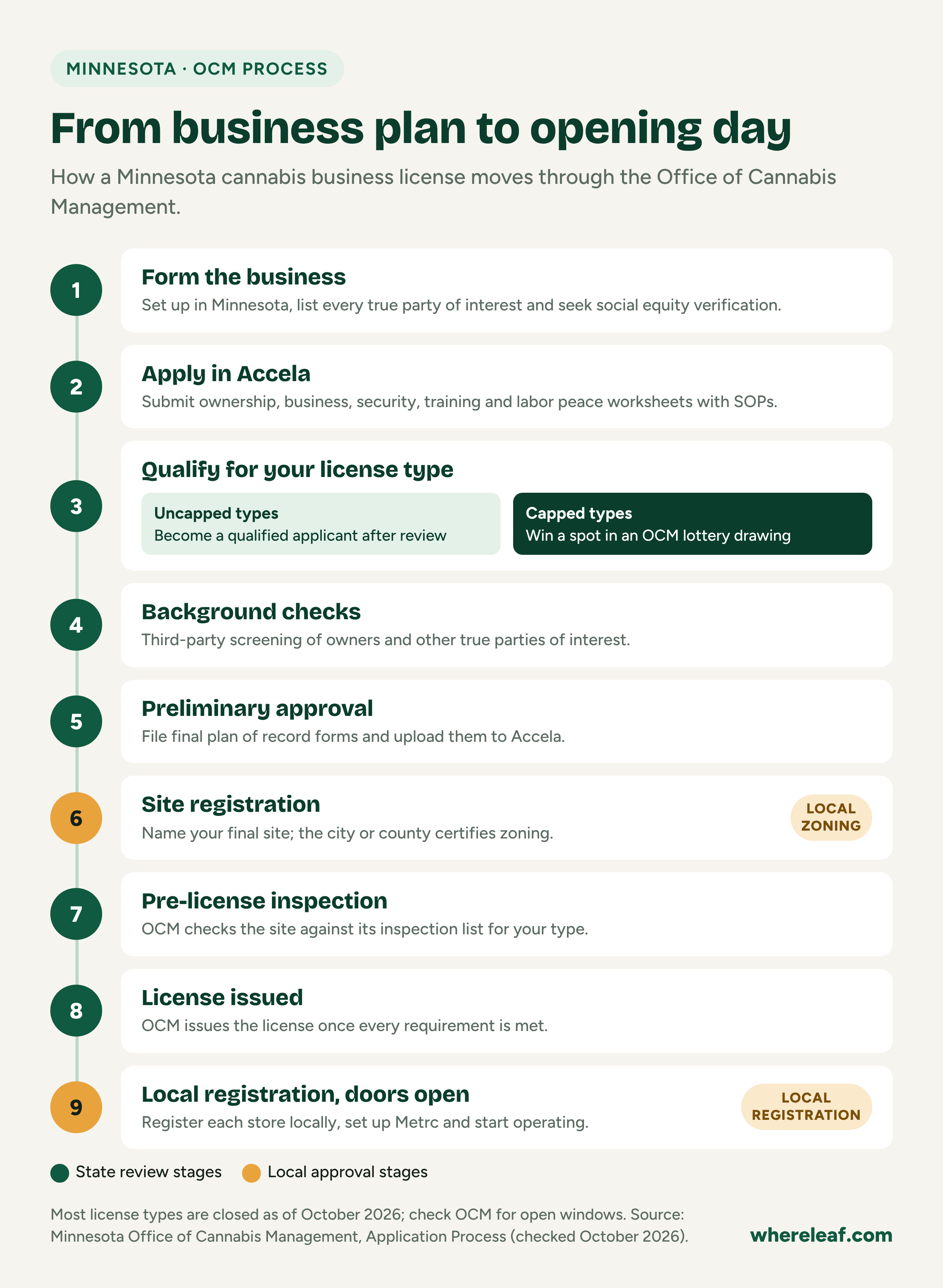
Your first submission includes worksheets for ownership and control, a capitalization table, a business plan, a security plan, a labor peace attestation, a training plan, and SOPs for quality assurance, inventory control and accounting. Testing facilities also file an operations plan.
Once preliminarily approved, you complete online final plan of record forms and upload them to Accela. When you register your final site, OCM has 90 days to review it, and your city or county gets 30 days within that time to certify zoning. OCM says to expect up to 90 days from site registration to licensure.
What requirements do you need to meet?
Ownership and residency
The business must be physically located in Minnesota. OCM doesn’t list a personal residency rule for owners, and it says owners don’t have to live in the same city or county as the business. Every “true party of interest” named on the application must be disclosed and checked. Ownership limits restrict how many licenses one person can hold, and some combinations, such as one retailer license plus one delivery license, are allowed.
Background checks and disqualifying offenses
Each qualified applicant and true party of interest needs a background check from a third-party screening company that meets OCM’s standards, covering the past seven years everywhere you’ve lived or worked. Order it no more than 60 days before you apply. Minnesota Rules 9810.1001 lists disqualifying offenses, including serious drug sale crimes, trafficking, fraud and bribery. Felony disqualifications are permanent unless OCM grants a variance based on rehabilitation, while older cannabis possession convictions can actually qualify you for social equity status.
Capital and financial plan
OCM doesn’t publish a minimum capital or bond amount, but you must submit a capitalization table and business plan showing who funds you.
Real estate
You don’t need a site to apply, but you need one before licensure. Your city or county must certify that the site meets zoning and, where it applies, fire and building codes.
Security plan and SOPs
A security plan and SOPs are part of the first application, and OCM runs a pre-license inspection using checklists for each license type. Our dispensary security requirements guide covers the systems inspectors expect.
Insurance
OCM’s licensing pages don’t set an insurance amount. Your landlord and lender will likely require coverage, so get quotes early.
Labor peace and staff
Applicants must sign a labor peace agreement with a bona fide labor organization, and agreements made on or after August 15, 2025, must address how long the union election period lasts. Cannabis workers also need background checks, and you must submit a training plan. See our budtender training requirements guide.
Local approval and zoning in Minnesota
Under Minnesota Statutes section 342.13, cities and counties can’t prohibit licensed cannabis businesses. They can set reasonable time, place and manner rules, such as hours and zoning districts, as long as the rules don’t amount to a ban. Interim moratoriums were allowed only until January 1, 2025.
Local buffer zones are optional. A city or county may bar cannabis businesses within 1,000 feet of a school, or within 500 feet of a day care, certain licensed residential facilities or a park attraction used by minors, such as a playground. Localities may also cap retail registrations, but at no fewer than one per 12,500 residents, and a city doesn’t have to register more stores if its county already meets that ratio.
Every store needs a local retail registration, which the city or county must issue if you hold a state license, pass a preliminary compliance check and are current on property taxes. Localities run yearly unannounced age-verification checks and can suspend a registration for up to 30 days for local violations.
Social equity programs in Minnesota
A business qualifies as a social equity applicant if people meeting at least one test hold at least 65% of its controlling ownership. The tests, from Minnesota Statutes section 342.17, are:
- a cannabis possession or sale conviction before May 1, 2023, for you, a parent, guardian, child, spouse or dependent, or being the dependent of someone with such a conviction
- being a military veteran, including a service-disabled veteran, or a current or former National Guard member, or having lost honorable status because of a cannabis offense
- living for five years in an area with high cannabis enforcement, a poverty rate of 20% or more, low median income, high SNAP use or high social vulnerability
- being a small farmer who has run and worked a farm for at least three years, with modest gross sales
Verified social equity applicants got an early application period and their own lottery drawings in 2025. According to secondary summaries of the 2026 cannabis law, a qualifying person can now hold up to four social equity licenses, and OCM must say which license types carry social equity priority. Confirm details with OCM’s Social Equity Verification Guide.
Minnesota cannabis market at a glance
After you’re licensed: staying compliant
- Renewal: Licenses renew every year. The renewal opens in Accela 90 days before expiration, and OCM recommends filing at least 30 days ahead. If a renewal isn’t approved by the expiration date, you must stop operating.
- Seed-to-sale tracking: Minnesota licensees track inventory in Metrc. Read our seed-to-sale tracking explainer.
- Inspections and complaints: OCM must respond to local complaints within seven days and inspect within 30 days when needed.
- Business changes: Ownership, location and other changes go through OCM before you make them.
- Advertising and packaging: Follow OCM’s advertising and packaging rules, which are written to keep cannabis away from people under 21. Our packaging and labeling guide and dispensary compliance checklist help.
Your Minnesota cannabis license checklist
- Check OCM’s license types page to see which licenses are open today.
- Decide whether you fit a capped type, an uncapped type or an LPHE license.
- Check whether you qualify for social equity verification and gather proof.
- Form a Minnesota business and list every true party of interest.
- Order background checks from an OCM-attested screening vendor within the timing window.
- Draft your business plan, security plan, training plan and SOPs.
- Sign a labor peace agreement with a bona fide labor organization.
- Ask your city or county about zoning, buffers and retail registration before you sign a lease.
- After preliminary approval, file your final plan of record and register your site.
- Pass the pre-license inspection, set up Metrc and get local retail registration before opening.
For new cannabis businesses: get found on WhereLeaf
Once you’re licensed and open, customers still need to find you. Add your business to WhereLeaf so shoppers using our dispensary finder can see your location, hours and menu, and compare our listing packages if you want more visibility. We can’t promise rankings or sales, but an accurate listing helps people find a licensed business.
Comparing markets? See all our cannabis license guides by state and province.
Frequently asked questions
How much does a cannabis license cost in Minnesota?
The table above lists OCM’s fees for each license. On top of those, you pay your background screening vendor directly, since OCM doesn’t set those prices, and your city or county may charge a retail registration fee. Rent, build-out and security equipment usually cost far more.
When will Minnesota open new cannabis license applications?
OCM hasn’t set a date as of October 2026. Event organizer applications reopen in January 2027, and the new macrobusiness license starts that month, but no general window has been announced. Watch OCM’s licensing page and email updates.
Can I get a delivery license in Minnesota?
Not right now, since delivery service applications are closed. Delivery licenses aren’t capped and weren’t part of the 2025 lotteries. Our guide on how to start a cannabis delivery business explains vehicles, staffing and routing.
Do I need to live in Minnesota?
Your business must be physically located in Minnesota, but OCM doesn’t list a personal residency rule for owners. Social equity status based on where you lived does require time in a qualifying Minnesota area.
How long do I have after preliminary approval?
OCM’s FAQ says preliminarily approved applicants have 18 months to get a license and can ask for a six-month extension. Qualified applicant status awarded before June 1, 2026, expires on January 1, 2027.
Can I open a cannabis consumption lounge in Minnesota?
Not as a standalone cannabis lounge. LPHE retailers can add an on-site consumption endorsement for hemp edibles and drinks, and licensed cannabis events follow OCM’s own event rules. See our guide to cannabis consumption lounges.
This guide is general information, not legal advice. Rules and fees change, so confirm everything with the Minnesota Office of Cannabis Management before you apply.
Sources
- Minnesota Office of Cannabis Management: License Types (2026)
- Minnesota Office of Cannabis Management: Application Process (2026)
- Minnesota Office of Cannabis Management: Cannabis License Renewal (2026)
- Minnesota Office of Cannabis Management: Application and License Holder Data (2026)
- Minnesota Office of Cannabis Management: Lottery Results (2025)
- Minnesota Office of Cannabis Management: Frequently Asked Questions (2026)
- Minnesota Office of Cannabis Management: Background Check Resources for License Applicants
- Minnesota Office of Cannabis Management: Social Equity Verification Guide (2024)
- Minnesota Statutes section 342.11: Fees
- Minnesota Statutes section 342.13: Local Control
- Minnesota Statutes section 342.17: Social Equity Applicants (2025)
- Minnesota Statutes section 342.22: Retail Registration
- Minnesota Rules 9810.1001: Disqualifying Offenses (via Cornell LII)
- GreenGrowth CPAs (accounting firm, backup source): Minnesota Cannabis License Guide 2026 (2026)
- MN Cannabis Hub (news, backup source): Minnesota Cannabis Law Is Now Live: What Changed on August 1, 2026 (2026)
- Cannabis Equipment News (news, backup source): Medical Still Outpacing Recreational Cannabis Sales in Minnesota (2026)
Last updated: October 2026. Laws and prices change; always check your state or provincial regulator.


