

Yes, you can get a cannabis license in Massachusetts right now. As of October 2026, the Massachusetts Cannabis Control Commission (CCC) accepts adult-use marijuana establishment applications on a rolling basis, with no statewide application window or deadline, for retail, cultivation, manufacturing, transport, testing and more.
The CCC is the only state agency that issues these licenses, but your city or town has a real say. Every applicant needs a Host Community Agreement (or a waiver) from the municipality, and some license types are reserved for owners from communities hurt by past drug enforcement. Delivery licenses are one example, and the new social consumption licenses will be another.
Below you’ll find every license type and fee, the 2026 law changes, the application stages and a checklist, checked against CCC sources in October 2026.
Key takeaways
- Massachusetts reviews adult-use applications on a rolling basis, with no statewide cap on the total number of licenses, though one owner can only hold a limited number of each type.
- Delivery licenses are still reserved for equity-qualified owners, so most new entrants will start with retail, cultivation, manufacturing or transport.
- Your town has to sign a Host Community Agreement or waive it, and towns can limit or ban cannabis businesses. Talk to local officials before you sign a lease.
- Social consumption (on-site use) is now legal under state rules, but no licenses are available yet and each town must opt in first.
- Rules differ by state and changed a lot in 2026. Always confirm current requirements with the CCC before you apply.
Who regulates cannabis businesses in Massachusetts?
The Cannabis Control Commission licenses and regulates both the adult-use (recreational) market and the medical marijuana program. Its authority comes from Chapter 94G of the Massachusetts General Laws, created after voters approved legalization in 2016, and Chapter 94I for medical use. The detailed rules are in 935 CMR 500.000 (adult use) and 935 CMR 501.000 (medical).
The law changed again in 2026. Chapter 65 of the Acts of 2026, signed on April 19, 2026, cut the Commission from five members to three, all appointed by the governor. It also doubled the number of retail licenses one owner may hold, removed the rule that medical operators must grow and process everything they sell, and wrote social consumption and research licenses into state law. Emergency rules took effect on June 18, 2026, and permanent rules are still being updated.
There are two tracks:
- Adult-use: Marijuana Establishments (MEs) such as retailers, cultivators and manufacturers. This is where most new businesses apply.
- Medical: The only medical license available today is a fully integrated medical operator (MTC) that grows, processes and sells to registered patients. The CCC is developing new medical license types under Chapter 65.
Cities and towns form the third layer: zoning, Host Community Agreements, a local cannabis sales tax and, in some cases, limits or bans.
What cannabis license types are there in Massachusetts?
The table lists every license type the CCC offers, what it allows and the fees from the CCC’s fee page, last updated October 22, 2026. Cultivator fees depend on your canopy tier and whether you grow indoors or outdoors.
| License type | What it lets you do | Application fee | Initial and annual license fee |
|---|---|---|---|
| Marijuana Retailer | Buy from other licensees and sell to adults 21+ from a storefront | $1,500 | $10,000 |
| Marijuana Cultivator, Tiers 1 to 3 (up to 20,000 sq ft of canopy) | Grow, process and package marijuana and sell it to other licensees, not consumers | Indoor $200 / $400 / $600; outdoor $100 / $200 / $300 | Indoor $1,250 / $2,500 / $5,000; outdoor $625 / $1,250 / $2,500 |
| Marijuana Cultivator, Tier 4 and up (20,001 to 100,000 sq ft) | Same as above, at larger scale | Indoor $2,000; outdoor $1,500 | Indoor rises in steps from $20,000 to $50,000 at the largest tier; outdoor is half the indoor fee |
| Craft Marijuana Cooperative | A resident-run cooperative that grows, makes and sells products to other licensees | Sum of its canopy tier fees, plus $200 indoor / $100 outdoor per location beyond six | Sum of its canopy tier fees, plus $1,250 indoor / $625 outdoor per location beyond six |
| Product Manufacturer | Make and package edibles, vapes, concentrates and other products for other licensees | $1,500 | $10,000 |
| Microbusiness | A small, locally owned Tier 1 cultivator, product manufacturer or both | $0 | 50% of the applicable cultivation and manufacturing fees |
| Delivery endorsement (microbusiness add-on) | Let an equity-owned microbusiness deliver to consumers | $500 | $5,000 |
| Marijuana Delivery Operator | Buy wholesale, store, sell and deliver to consumers’ homes, with no storefront | $1,500 | $10,000 |
| Marijuana Courier | Deliver orders from a retailer or medical operator to consumers for a fee, without selling | $1,500 | $5,000 |
| Third-Party Transporter | Move marijuana between licensees, never to consumers | $1,500 | $5,000 |
| Existing Licensee Transporter | Lets a current licensee transport other licensees’ products | $1,000 | $5,000 |
| Independent Testing Laboratory (and Standards Laboratory) | Test marijuana and products under CCC protocols | $1,500 | $10,000 |
| Social Consumption Establishment (supplemental, hospitality, event organizer) | Allow on-site use; not yet available | $1,500 | $10,000 |
| Research Facility / Research Permit | Grow or buy marijuana for approved research | $300 facility; $1,000 permit | $1,000 |
| Medical operator (MTC) | Grow, process and sell to registered patients | $3,500 | $50,000 |
| Changes after licensing | Approval for a new name, location, structure or owner | $1,000 name or structure change; $5,000 per entity ownership change; $500 per person | Location change: 50% of the license fee (adult use), $10,000 (medical) |
How the fees work: the application fee is nonrefundable and due when you file. The license fee is due within 90 days after the CCC grants a provisional license, or the approval lapses, and the same fee is charged each year at renewal. Background checks, fingerprints, agent registration and monthly Metrc tracking fees come on top.
Some owners pay less. Businesses majority-owned and controlled by Social Equity Program participants or Certified Economic Empowerment Priority Applicants, microbusinesses, and certified minority-, women- or veteran-owned small businesses have application fees waived and license fees halved. Equity-owned couriers and delivery operators pay no license fee the first year. See how this compares with other markets in our guide to dispensary license costs by state.
Are Massachusetts cannabis licenses open right now?
Yes, for most types. As of October 2026, you can submit an adult-use application through the Massachusetts Cannabis Industry Portal (MassCIP) at any time. There is no statewide limit on the number of licenses, but there are limits on owners. Chapter 65 raised the retail cap from three to six licenses per owner, and caps on other types remain in the regulations, such as three cultivator licenses and one cooperative license. Total cultivation canopy for one owner is capped at 100,000 square feet across adult-use and medical licenses.
Three exceptions matter:
- Delivery: Courier, Delivery Operator and delivery endorsement licenses are reserved through April 1, 2029, for businesses majority-owned and controlled by Social Equity Program participants or Certified Economic Empowerment Priority Applicants. The CCC extended this period in March 2026.
- Social consumption: Final rules took effect in January 2026, but the CCC lists these licenses as not yet available, and no application date has been announced. Check with the CCC for timing.
- Medical: New medical license types are still being written. Check with the CCC before planning a medical-only business.
Can you buy an existing license?
Yes, with approval. The CCC must approve a change of ownership or control before closing, and new owners face the same background review and caps. During the exclusivity period, a delivery business must stay majority-owned and controlled by equity-qualified owners, which limits who can buy one.
How do you apply for a Massachusetts cannabis license?
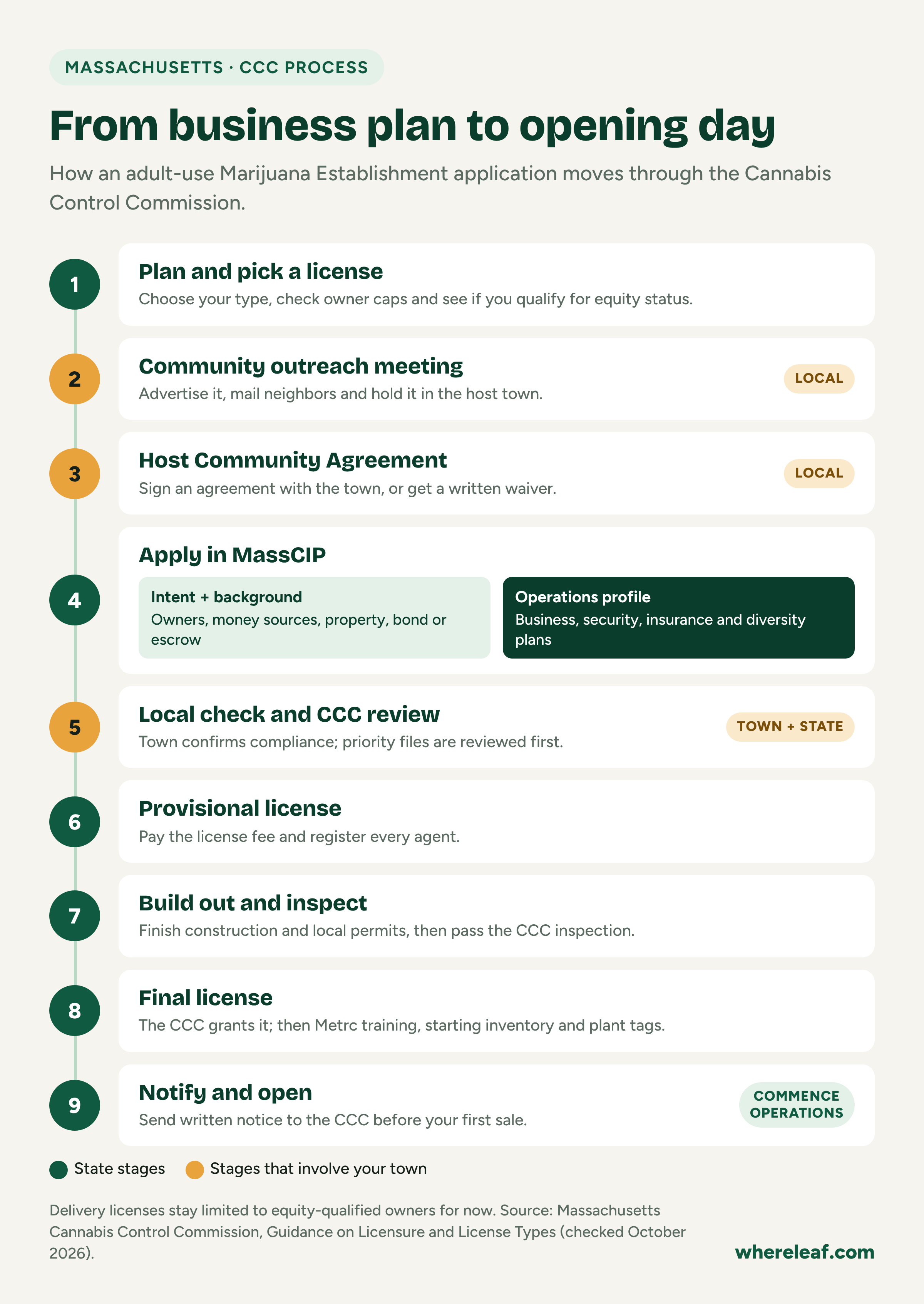
Every adult-use application moves through the same CCC stages, shown below.
What goes in the application
One application covers three parts, filed together with the fee:
- Application of Intent: owners, capital sources, bond or escrow, property interest, Host Community Agreement, outreach proof and a positive impact plan.
- Background Check: every required person and entity, with signed forms and photo ID.
- Management and Operations Profile: formation documents, business, insurance, operating and diversity plans.
Priority applicants are reviewed first, then expedited applicants, then everyone else. Missing items trigger a Request for Information.
What requirements do you need to meet?
Ownership and residency
Owners and agents must be at least 21. Standard licenses have no residency rule. Microbusinesses need a majority of members or executives with 12 consecutive months of Massachusetts residency, and craft cooperative members must be residents, with at least one who filed a farm income form (Schedule F) in the past five years.
Background checks and disqualifying offenses
Owners, executives, managers and controlling funders go through a CCC background check with fingerprints. The CCC weighs criminal history and past regulatory problems. A past marijuana conviction is not automatically a bar, and it can help you qualify for the Social Equity Program.
Capital and bond
Adult-use applicants have no minimum capital requirement, but must show where the money comes from, with a bank record dated within 60 days. You also need a bond or escrow account covering taxes, security, inventory destruction and wind-down costs; an escrow must hold at least $5,000. Medical operators must show $500,000 in capital for a first application.
Real estate and buffer zones
You need a property interest, such as a lease, purchase agreement or option. By default, a marijuana establishment can’t be within 500 feet of an existing public or private K-12 school, though a town can set a shorter distance by bylaw or ordinance.
Security plan and SOPs
You’ll file a security plan, a diversion prevention plan, and storage and transport plans covering alarms, cameras and limited-access areas. See our dispensary security requirements guide.
Insurance
You must plan for general and product liability coverage of at least $1 million per occurrence and $2 million in total each year, with a deductible of no more than $5,000 per occurrence. The policy has to be in place by the time you are licensed.
Staff registration
After provisional licensing, every executive, manager, employee and volunteer must be registered with the CCC as a marijuana establishment agent, and new hires must be registered before they start. Retail staff also need Responsible Vendor Training. See our budtender training requirements guide.
Local approval and zoning in Massachusetts
Local rules depend on how your town voted in 2016. Towns that voted against legalization can ban or limit businesses with a vote of their governing body. Towns that voted for it generally need a local ballot vote to ban a business type or to cap retailers below 20% of the town’s package store liquor licenses. Delivery is different: under Chapter 65, it is allowed everywhere unless a town opts out.
Within six months before applying, hold a community outreach meeting in the host town, advertised in a local paper at least 14 days ahead and mailed to neighbors within 300 feet.
You also need a Host Community Agreement, reviewed and approved by the CCC, or a written waiver from the town. Since March 2024, state rules cap the community impact fee at 3% of gross sales, require it to match documented costs the business actually causes, and end it once a business has held its final license for more than nine years. Towns can’t demand upfront payments or donations.
Social equity and priority programs
Massachusetts has two equity designations:
- Social Equity Program (SEP): a free statewide training and technical help program for people affected by past drug enforcement, such as long-term residents of designated areas of disproportionate impact and people with past drug convictions or a close family member with one. Check the CCC equity page for the full criteria.
- Certified Economic Empowerment Priority Applicants (EEA): businesses certified during a one-time window in April 2018. EEA applicants move to the front of the review line. No new EEA certifications are accepted.
Businesses majority-owned by either group get fee waivers and reductions, waived Metrc monthly fees, and exclusive access to delivery licenses. Each social consumption license type will also be reserved for these owners, plus microbusinesses and craft cooperatives, for 36 months after the first business in that class is told it can open. A state Cannabis Social Equity Trust Fund also offers grants and no-interest or forgivable loans to approved participants.
Massachusetts cannabis market at a glance
After you’re licensed: staying compliant
- Renewal: Renew every year, pay the license fee again and submit your Host Community Agreement for CCC review at each renewal.
- Seed-to-sale tracking: Massachusetts uses Metrc. After your final license, you’ll complete Metrc training, enter starting inventory and tag plants. Read our seed-to-sale tracking explainer.
- Inspections: The CCC inspects before and after final licensing. Deficiencies need a written plan of correction within 10 business days.
- Advertising and packaging: Ads must not appeal to people under 21, and packaging needs CCC-compliant labels. Our packaging and labeling guide and dispensary compliance checklist help you build routines.
- Customer limits: See Massachusetts cannabis purchase limits, which Chapter 65 raised.
Your Massachusetts cannabis license checklist
- Choose your license type and check whether you qualify as a microbusiness, craft cooperative or equity-owned business.
- Form your business entity and list every owner, executive and funder.
- Confirm with the town clerk and planning board that your business type is allowed, and check buffer zones.
- Secure a lease, purchase agreement or option on the property.
- Hold and document your community outreach meeting.
- Negotiate a Host Community Agreement, or get a written waiver.
- Set up the bond or escrow and gather bank records.
- Register in MassCIP and file all three application parts with the fee.
- Pay the license fee within the deadline after provisional approval.
- Register agents, finish build-out and pass the CCC inspection.
- Set up Metrc, then give the CCC written notice before you open.
For new cannabis businesses: get found on WhereLeaf
Once your doors are open, customers still need to find you. Add your business to WhereLeaf so shoppers using our dispensary finder can see your location, hours and menu, and compare our listing packages if you want more visibility. We can’t promise rankings or sales, but an accurate listing helps people choose a licensed business.
Comparing markets? See all our cannabis license guides by state and province.
Frequently asked questions
How much does a cannabis license cost in Massachusetts?
The table above lists every CCC fee, and your total depends on license type, canopy size and whether you qualify for a waiver. State fees are usually a small part of the budget. Rent during approval, build-out, security, legal help and the bond or escrow often cost far more.
Can I get a delivery license in Massachusetts?
Only if your business is majority-owned and controlled by Social Equity Program participants or Certified Economic Empowerment Priority Applicants, until the exclusivity period ends in 2029. Approved delivery businesses may generally deliver between 7 a.m. and 11 p.m., and towns can shorten those hours. Our guide on how to start a cannabis delivery business covers vehicles and staffing.
Do I need to live in Massachusetts?
Not for a standard license such as a retailer or cultivator. Residency rules apply only to microbusinesses and craft marijuana cooperatives, and the community outreach meeting must take place in the host town.
How long does it take to get a Massachusetts cannabis license?
Once your application is complete, the town generally has 60 days to respond on local compliance (30 days for equity applicants), and the CCC then has 90 days to consider it for a provisional license. Finding a site, negotiating the Host Community Agreement and building out usually take longer than the state review.
Can I open a cannabis lounge or café in Massachusetts?
Not yet. The rules allow three formats, but a town must first opt in by ordinance, bylaw or local ballot vote and then sign a separate Host Community Agreement. As of early 2026, no town had finished the opt-in process. Alcohol and tobacco won’t be allowed on licensed premises. See our guide to cannabis consumption lounges.
What changed for applicants in 2026?
The new law gives the Commission a smaller board, raises owner caps and lets medical operators buy products instead of growing everything themselves. It also counts a stake toward the ownership cap only at 20% equity or more, up from 10%.
This guide is general information, not legal advice. Rules and fees change, so confirm everything with the Massachusetts Cannabis Control Commission before you apply.
Sources
- Massachusetts Cannabis Control Commission: License Fees (2026)
- Massachusetts Cannabis Control Commission: License Types (2026)
- Massachusetts Cannabis Control Commission: Guidance on Licensure
- Massachusetts Cannabis Control Commission: Equity Programs
- Massachusetts Cannabis Control Commission: Commission Extends Delivery Exclusivity for Three More Years (2026)
- Massachusetts Cannabis Control Commission: Social Consumption Establishment Regulations Are Now in Effect (2026)
- Massachusetts Cannabis Control Commission: Adult-Use Sales Generated $1.65 Billion in 2025 (2026)
- Massachusetts Cannabis Control Commission: Marijuana Establishments Hit $10 Billion in Gross Sales (2026)
- 935 CMR 500.180: Host Community Agreements (via Cornell LII)
- 935 CMR 500.005: Fees (via Cornell LII)
- Mass.gov: Governor Healey Signs Cannabis Reform Legislation (2026)
- Massachusetts Municipal Association: Governor Signs Cannabis Control Commission Reform Bill into Law (2026)
- Massachusetts Municipal Association: Social Consumption Regulations Webinar (2026)
- Davis, Malm & D’Agostine via Legal 500 (law firm, backup source): Massachusetts and National 2026 Cannabis Wrap Up (2026)
- WWLP-22News: Adult-Use Cannabis Sales in Massachusetts Reach Record $1.65 Billion in 2025 (2026)
Last updated: October 2026. Laws and prices change; always check your state or provincial regulator.


