
Right now, a new business can’t apply for a cannabis license in Kentucky. As of October 2026, Kentucky allows only medical cannabis sales, the Office of Medical Cannabis issues every business license, and its initial application period closed in 2024 with no new window announced.
The Office is part of the Cabinet for Health and Family Services. It sorted thousands of applications in 2024 and awarded the limited licenses by public lottery, so the first businesses were picked at random rather than scored. Adult-use (recreational) cannabis is still illegal in Kentucky.
This guide explains every license type and fee, how the lotteries worked, how existing licenses can be sold, and what to have ready if the Office opens another round. Everything here was checked against Office of Medical Cannabis pages, Kentucky statutes and the 915 KAR Chapter 1 regulations in October 2026.
Key takeaways
- Kentucky is a medical-only market, and the Office of Medical Cannabis is the only state agency that licenses cannabis businesses.
- The first application period is closed and no new one has been announced, so most newcomers will enter by buying an existing license with the Office’s written approval.
- Limited licenses were handed out by random lottery, not by scoring, which is why a strong business plan alone didn’t win a license.
- You can hold only one category of license, so a cultivator can’t also own a dispensary, and testing labs must stay fully independent.
- Rules differ by state and change often. Always confirm current requirements with the Kentucky Office of Medical Cannabis before you invest.
Who regulates cannabis businesses in Kentucky?
The Kentucky Office of Medical Cannabis, inside the Cabinet for Health and Family Services, licenses and inspects cannabis businesses and runs the patient and caregiver program. Its authority comes from Senate Bill 47 of 2023, codified as KRS Chapter 218B, and from House Bill 829 of 2024, which moved the licensing timeline up. The detailed rules sit in Title 915 of the Kentucky Administrative Regulations, Chapter 1.
Here is what is and isn’t in force as of October 2026:
- Medical cannabis: The program took effect on January 1, 2025, and the first dispensary opened in December 2025. Registered patients and caregivers buy from licensed dispensaries, and every business in the supply chain holds an Office license.
- Adult-use cannabis: Not legal. The Marijuana Policy Project reports that none of the 2026 bills to legalize or decriminalize possession got a committee hearing. We found no statewide cannabis question on Kentucky’s November 3, 2026 ballot.
- Hemp-derived products: These are regulated separately and aren’t covered by the licenses in this guide.
Local governments form the second layer. Cities and counties can ban cannabis businesses, set time, place and manner rules, and charge fees to cover their costs. We cover that below.
What cannabis license types are there in Kentucky?
Kentucky has five business license categories, with cultivators split into four tiers by canopy, the area where plants grow. The table shows every type and the fees in 915 KAR 1:010 and 915 KAR 1:020, which match the Office’s license summaries.
| License type | What it lets you do | Application fee | Annual or renewal fee |
|---|---|---|---|
| Tier I cultivator | Grow cannabis in an enclosed, locked facility on up to 2,500 sq. ft. of canopy and sell it to processors, producers and dispensaries | $3,000 nonrefundable application fee, then a $12,000 initial license fee if selected | $12,000 |
| Tier II cultivator | Same activity on up to 10,000 sq. ft. of canopy | $10,000 nonrefundable, then a $25,000 initial license fee | $25,000 |
| Tier III cultivator | Same activity on up to 25,000 sq. ft. of canopy | $20,000 nonrefundable, then a $50,000 initial license fee | $50,000 |
| Tier IV cultivator | Same activity on up to 50,000 sq. ft. of canopy. Not offered in the first licensing round | $30,000 nonrefundable, then a $100,000 initial license fee | $100,000 |
| Processor | Turn raw plant material into cannabis products, including by extraction, and sell them to dispensaries | $5,000 nonrefundable, then a $25,000 initial license fee | $25,000 |
| Producer | Both grow and process. Not offered in the first licensing round | $5,000 plus the matching cultivator tier application fee, then $25,000 plus that tier’s license fee | $25,000 plus the matching cultivator tier renewal fee |
| Dispensary | Sell tested products to registered patients, caregivers and visiting patients from the licensed premises | $5,000 nonrefundable, then a $30,000 initial license fee | $30,000 |
| Safety compliance facility | Test samples from licensed businesses for the Office’s testing rules. Not open to the public | $3,000 nonrefundable, then a $12,000 initial license fee | $12,000 |
| Delivery, transport-only, lounge, microbusiness or adult-use licenses | Not available as separate license types in Kentucky | Not available | Not available |
How the fees work: you pay the application fee by card or ACH when you submit, and it isn’t refunded unless your application arrives after the window closes. If you’re selected, the Office invoices the initial license fee, which is also nonrefundable and due within 15 calendar days. Licenses last one year. The renewal fee is paid with the renewal application and is refunded if the renewal is denied. An earlier draft of the rule listed lower renewal fees for processors, producers and dispensaries, but the version in effect since November 18, 2024 uses the amounts above. Compare other states in our guide to dispensary license costs by state.
Are Kentucky cannabis licenses open right now?
No. As of October 2026, the Office’s business page says the initial application period is closed. That period ran from July 1 to August 31, 2024, and the Office hasn’t published a date for another one. Under 915 KAR 1:020, the cabinet reviews whether more licenses are needed every quarter, so sign up for its updates and check the Businesses page often.
The first round offered a fixed number of licenses in each category, according to law firm Vicente LLP’s summary of the regulations:
- 10 Tier I cultivators, 4 Tier II cultivators and 2 Tier III cultivators.
- 10 processors.
- 48 dispensaries, spread across 11 regions. Each region got at least four, and the Bluegrass and Kentuckiana regions got six each, with two set aside for Fayette County (Lexington) and Jefferson County (Louisville). Other counties may have only one dispensary each.
- No limit on safety compliance facilities, so they weren’t chosen by lottery.
How the lotteries worked
When a category had more eligible applicants than licenses, the Kentucky Lottery Corporation drew winners at random in livestreamed events. Cultivators and processors were drawn on October 28, 2024. Dispensaries followed in two drawings: 36 licenses for nine regions on November 25, 2024, and the final 12 for the Bluegrass and Kentuckiana regions on December 16, 2024. The Office received 4,075 dispensary applications alone.
The process drew criticism. Louisville Public Media found that 33 of the first 36 dispensary winners were formed by people who didn’t live in Kentucky, and that some companies filed hundreds of applications through separate LLCs. State Auditor Allison Ball announced an investigation of the lottery process in April 2025. Check with the Office for any rule changes before a future round.
Can you buy an existing license?
Yes, with the Office’s written approval. Under 915 KAR 1:020, Section 10, the seller emails a request that includes the sale price, the reasons for the sale, the buyer’s eligibility documents, attestations, a transition plan and a notarized affidavit. The buyer can’t already hold a license in a different category, though cultivators may sell to other cultivators in any tier. Provisional licenses can’t be sold. The Office’s licensee list shows many transfers already approved under KRS 218B.080(6). The rule sets no transfer fee, but hire a Kentucky cannabis attorney before you sign.
How do you apply for a Kentucky cannabis license?
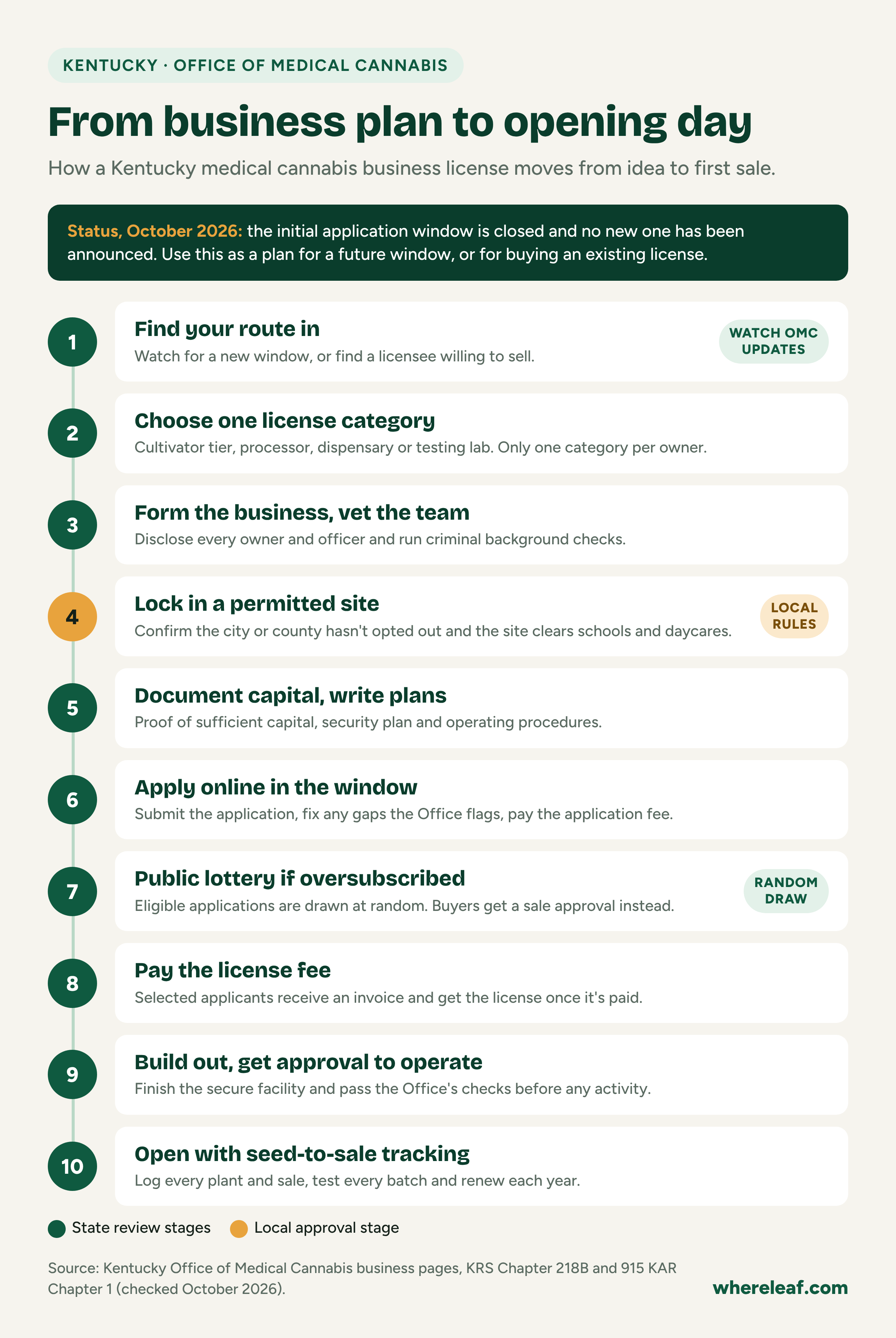
Because no window is open, use this as a preparation plan. The first round showed that winners were chosen at random, but only applications the Office found complete and eligible went into the drawing.
What the application looks for
The Office acknowledges each application, gives you a short window to fix anything missing, and then decides whether you’re eligible. If a lottery winner’s town later bans cannabis businesses, the Office may issue a provisional license that lets the winner find an allowed site. Provisional licenses don’t authorize any cannabis activity and are revoked if the move isn’t requested in time.
What requirements do you need to meet?
Ownership and residency
The statute and regulations we reviewed don’t require owners to live in Kentucky, which is why so many winners were out-of-state groups. You may apply for only one business category at a time, and vertical integration (owning more than one link in the supply chain) wasn’t allowed in the first round. Safety compliance facilities can’t have any management role or financial interest in other licensees, and the reverse is also true. Every ownership change needs the Office’s written approval under Section 8 of 915 KAR 1:020.
Background checks and disqualifying offenses
Every principal officer, board member, agent, volunteer and employee needs a criminal background check before starting work, and all must be at least 21. Under KRS 218B.010, a disqualifying felony offense is a felony that made the person a violent offender, or a felony controlled substance violation. It stops counting once the full sentence, including probation or supervised release, ended five or more years earlier.
Capital
Applicants must document sufficient capital, and licensees must maintain it for the license term. The Office’s summaries list $50,000 for Tier I, $200,000 for Tier II, $500,000 for Tier III and $1,000,000 for Tier IV cultivators, and $150,000 each for processors, dispensaries and testing labs. The Office published separate guidance on what documents prove it. No bond requirement appears in the summaries.
Real estate and buffer distances
Every license type must stay at least 1,000 feet from an existing elementary school, secondary school or daycare center. Cultivation happens only in an enclosed, locked facility, such as a greenhouse or building. Each cultivator application needs its own physical address, and changing location later needs written approval, proof of site control and a site plan.
Security plan and SOPs
Expect alarms, video, access controls and written procedures for inventory, waste, recalls and testing. Cultivators and processors may not use signs that show what happens inside. Our dispensary security requirements guide covers what inspectors usually check.
Insurance
The Office’s license summaries don’t set an insurance amount. Landlords and lenders will still ask for coverage, so get quotes early.
Staff training
Staff must pass background checks, and testing labs need a testing director with an approved chemistry or biology degree. The Office has published worker safety and compliance training guides. See our budtender training requirements guide to plan dispensary training.
Local approval and zoning in Kentucky
Every city and county started out opted in. Under KRS 218B.130, a local government could ban all cannabis businesses by ordinance, or put the question to voters, before January 1, 2025 or before a business tried to locate there. More than 100 cities and counties passed ordinances allowing businesses by November 2024, according to the governor’s office.
Where businesses are allowed, local rules may control time, place and manner but can’t impose an undue burden. Local fees must not exceed the government’s actual added costs. If a county bans cannabis businesses, a city inside it can still allow them by ordinance or a city vote. When a local ordinance bans them, voters can petition with signatures from 10% of registered voters to force a ballot question. Before you sign a lease, check the Office’s opt-out list and get the local rules in writing.
Social equity and small-business programs
Kentucky has no social equity licensing program, reserved licenses or fee discounts in the statute and regulations we reviewed. The Office chose a lottery instead of scoring, and Governor Andy Beshear said a scoring system that favored in-state applicants would likely have been challenged in court.
The closest thing to a small-business route is the tier system. A Tier I cultivator has the lowest fees and capital requirement, so it’s the most realistic entry point if a future round includes more licenses.
Kentucky cannabis market at a glance
After you’re licensed: staying compliant
- Annual renewal: File your renewal at least 60 days before the license expires. The Office sends a notice ahead of time, but don’t rely on it.
- Seed-to-sale tracking: Kentucky contracted with Metrc for its track-and-trace system, according to trade news reports. Every plant, batch and sale must be logged. Read our seed-to-sale tracking explainer.
- Testing: Harvest and production batches must be tested by a licensed safety compliance facility under 915 KAR 1:110 before dispensaries can sell them.
- Inspections and changes: The Office inspects licensees and must approve changes of owner, location or added locations in writing first. Report any local prohibition to the Office within 24 hours.
- Advertising and packaging: Follow the Office’s marketing and labeling rules, and never aim them at minors. Our packaging and labeling guide and dispensary compliance checklist help you build routines.
Your Kentucky cannabis license checklist
- Accept that no application window is open, and decide whether to wait, buy an existing license or work in the industry first.
- Sign up for Office of Medical Cannabis updates so you see any new window or rule change right away.
- Pick one license category and, for cultivation, the tier you can afford.
- Form your entity and list every owner, officer and board member.
- Run background checks early, keeping the disqualifying felony definition in mind.
- Gather proof of capital in the form the Office’s guidance asks for.
- Check the local opt-out list, measure the school and daycare buffer, and secure site control.
- Draft your security plan and SOPs.
- If buying a license, prepare the sale request, transition plan and affidavit with a lawyer.
- Plan for Metrc set-up, testing, staff training and annual renewal.
For new cannabis businesses: get found on WhereLeaf
Once your license is active and your doors are open, patients still have to find you. Add your business to WhereLeaf so people using our dispensary finder can see your location, hours and menu, and compare our listing packages if you want more visibility. We can’t promise rankings or sales, but an accurate listing helps patients reach a licensed business. Cultivators, processors and labs can join our supplier directory.
Comparing markets? See all our cannabis license guides by state and province.
Frequently asked questions
How much does a cannabis license cost in Kentucky?
The table above lists every state fee. The bigger costs are the capital you must document, a compliant building and security, plus legal work. Buying an existing license adds a negotiated price on top, since the sale price must be disclosed to the Office but isn’t capped.
Is recreational weed legal in Kentucky in 2026?
No. Only registered medical patients and caregivers can buy from licensed dispensaries as of October 2026. Possessing cannabis without a card is still a misdemeanor, and lawmakers didn’t advance any legalization bill this year.
Can I get a delivery license in Kentucky?
No separate delivery license exists. Patients buy at a licensed dispensary, and products move between licensees under the Office’s transport and tracking rules. For other markets, see how to start a cannabis delivery business.
Do I need to live in Kentucky to get a cannabis license?
The law and regulations we reviewed don’t require residency. You still have to disclose every owner and backer, pass background checks and follow the one-category rule.
When will Kentucky open new cannabis business licenses?
The Office hasn’t set a date. The regulations let it add licenses after its quarterly reviews, and Tier IV cultivator and producer licenses could be offered in a later round. Until then, buying an approved transfer is the only route.
How long does it take to open after winning a license?
It varies a lot. The first licenses were drawn in late 2024, yet the first dispensary didn’t open until December 2025, and some regions waited until October 2026 for one. Build-out, local rules, supply and Office approval all take time.
This guide is general information, not legal advice. Rules and fees change, so confirm everything with the Kentucky Office of Medical Cannabis before you apply.
Sources
- Kentucky Office of Medical Cannabis: Businesses (2026)
- Kentucky Office of Medical Cannabis: Business Types
- Kentucky Office of Medical Cannabis: Licensees (2026)
- Kentucky Office of Medical Cannabis: Application Analytics (2024)
- Kentucky Office of Medical Cannabis: Cultivator License Summary (2024)
- Kentucky Office of Medical Cannabis: Processor License Summary (2024)
- Kentucky Office of Medical Cannabis: Dispensary License Summary (2024)
- Kentucky Office of Medical Cannabis: Safety Compliance Facility License Summary (2024)
- Kentucky Office of Medical Cannabis: Local Government Rules
- Kentucky Legislature: 915 KAR 1:010, Initial and renewal applications for cannabis business licenses (2024)
- Kentucky Legislature: 915 KAR 1:020, Cannabis business licenses
- Kentucky Legislature: KRS 218B.130, Local government authority (2024)
- KRS 218B.010: Definitions (via Syfert)
- Kentucky Legislature: 2026 Regular Session bills indexed under Cannabis (2026)
- Vicente LLP (law firm, backup source): Kentucky Medical Cannabis Licensing Update: New Bill and Regulations (2024)
- Kentucky Lantern: In final drawing, Kentucky awards more medical marijuana licenses (2024)
- Louisville Public Media: Out-of-state companies score again, land nearly all Kentucky marijuana dispensary licenses (2024)
- Spectrum News 1: Kentucky auditor announces medical cannabis investigation (2025)
- Marijuana Moment: Kentucky now has medical marijuana dispensaries open in every region of the state, governor announces (2026)
- Spectrum News 1: Medical cannabis now available in every Kentucky region (2026)
- Marijuana Policy Project: Kentucky (2026)
- Ganjapreneur (trade news, backup source): Kentucky chooses Metrc for cannabis industry track-and-trace contract (2024)
Last updated: October 2026. Laws and prices change; always check your state or provincial regulator.


