Right now, most new businesses can’t get a cannabis license in Alabama. As of October 2026, the state allows only medical cannabis sales, the Alabama Medical Cannabis Commission (AMCC) issues every business license, and the only category taking new applications is the state testing laboratory license.
Adult-use (recreational) cannabis is illegal in Alabama. The Darren Wesley “Ato” Hall Compassion Act of 2021 created a tightly limited medical program, and after years of scoring disputes and lawsuits, the first dispensary finally opened in June 2026. Alabama has no citizen initiative process, so any move toward adult-use would have to start in the Legislature.
This guide explains every license type and fee, the caps, how the litigation shaped who holds licenses today, and what you’d need to prepare. We checked it against AMCC pages, its fee schedule and its rules in October 2026.
Key takeaways
- Alabama is a medical-only market, and the Alabama Medical Cannabis Commission is the only state agency that licenses cannabis businesses.
- Only the state testing laboratory category is open to new applicants this year. Every other category is capped, and its licenses are awarded or tied up in contested hearings.
- Most owners must have lived in Alabama for a long time, and growers need deep farming experience, so out-of-state investors face real limits.
- Retail sites need a local resolution or ordinance first, so the city or county you pick matters as much as the state license.
- Rules differ by state and change often. Always confirm current requirements with the AMCC before you invest.
Who regulates cannabis businesses in Alabama?
The Alabama Medical Cannabis Commission licenses, inspects and regulates every business that grows, processes, transports, tests or sells medical cannabis. It also runs the patient registry. Its power comes from Chapter 2A of Title 20 of the Code of Alabama, and its detailed rules sit in Chapter 538-X of the Alabama Administrative Code. Chapter 538-X-3 covers applications and licensing.
Here is what is and isn’t legal as of October 2026:
- Medical cannabis: Legal for registered patients and caregivers, who buy from licensed dispensing sites. Patients need a certification from a registered physician and a commission card.
- Product forms: Approved forms include tablets, tinctures, oils, patches and gel cubes. Smokable products and raw plant material are banned, which shapes what a processor can make.
- Adult-use cannabis: Not legal. No bill has passed, and Alabama voters can’t put a statute on the ballot themselves.
Cities and counties form a second layer. Under Ala. Code § 20-2A-51, a dispensing site can only open where the city or county has passed a resolution or ordinance allowing it. The AMCC keeps a list of local governments that have done so.
What cannabis license types are there in Alabama?
Alabama has six license categories. You may apply for only one category at a time, and you can’t hold an economic interest in another licensee or applicant. The table lists each type with the fees from the AMCC Schedule of Fees, Penalties and Fines.
| License type | What it lets you do | Application fee | Annual or renewal fee |
|---|---|---|---|
| Integrated facility | Grow, process, package and dispense from its own dispensing sites, transport between its own facilities and sell to dispensaries | $2,500 application fee | $50,000 license fee each year; $52,500 plus a daily penalty if renewal is late |
| Cultivator | Grow cannabis and sell it to processors, or to dispensaries if it contracts with a processor | $2,500 application fee | $40,000 license fee each year; $42,500 plus a daily penalty if renewal is late |
| Processor | Buy cannabis from cultivators, make and package approved product forms and sell them to dispensaries | $2,500 application fee | $40,000 license fee each year; $42,500 plus a daily penalty if renewal is late |
| Dispensary | Sell medical cannabis to registered patients and caregivers from up to three dispensing sites | $2,500 application fee | $40,000 license fee each year; $42,500 plus a daily penalty if renewal is late |
| Secure transporter | Store and move cannabis between licensees for a fee. It can’t deliver to patients | $2,500 application fee | $30,000 license fee each year; $32,500 plus a daily penalty if renewal is late |
| State testing laboratory | Test cannabis and products from licensed facilities | $2,500 application fee | $30,000 license fee each year; $32,500 plus a daily penalty if renewal is late |
| License transfer | Commission approval to move an existing license to a new holder | $2,500 transfer application fee, plus the license fee for that category | None beyond the category’s annual fee |
| Delivery, lounge, microbusiness or adult-use licenses | Not available in Alabama | Not available | Not available |
A few fee rules matter. The application fee comes with your application, but the much larger license fee is only due within 14 days after the commission awards you a license. If you don’t pay on time, you don’t get the license. The fee schedule also charges for amended applications and for fixing deficiencies, plus a criminal background check fee of $80 per person, and it doesn’t say any fee is refundable. For a wider view, see our guide to dispensary license costs by state.
Are Alabama cannabis licenses open right now?
Only one category is. As of October 2026, the AMCC is taking applications for state testing laboratory licenses. The 2026 offering opened on June 12, 2026, and the window to submit a Request for Application closes on December 31, 2026, though the commission may change that date. Every other category is closed to new applicants.
The law caps most categories:
- Up to 12 cultivator licenses.
- Up to 4 processor licenses.
- Up to 4 dispensary licenses, each with up to three dispensing sites.
- Up to 5 integrated facility licenses, each with up to five dispensing sites.
- No cap on secure transporter or state testing laboratory licenses.
How the litigation played out
The commission first awarded licenses in June 2023, then withdrew them days later after it found math errors in the third-party scoring. It re-awarded licenses in August 2023, and after more challenges, it ran a second do-over in December 2023 under an emergency rule. In April 2025 a Montgomery County circuit judge ruled that emergency rule void, which knocked out the December integrated facility awards.
The Alabama Court of Civil Appeals later held that these fights belong in contested-case hearings under the Alabama Administrative Procedure Act, not in circuit court. That cleared the way for dispensary awards in December 2025. As of late October 2026, three companies hold dispensary licenses and one is still tied up in an appeal before the Court of Civil Appeals.
The integrated facility category is furthest behind. A former Alabama Supreme Court justice, serving as hearing officer, heard testimony from July 27 through August 14, 2026. He’ll recommend the most suitable applicants, the parties can object, and the full commission then votes at a public meeting. No date has been set, and more lawsuits are possible.
Can you buy an existing license?
Licenses can’t be transferred without the commission’s express permission, and a transfer carries its own fee (see the table). The buyer must meet the same residency, background and other eligibility rules as an original applicant. Talk to an Alabama cannabis attorney before you sign anything.
How do you apply for an Alabama cannabis license?
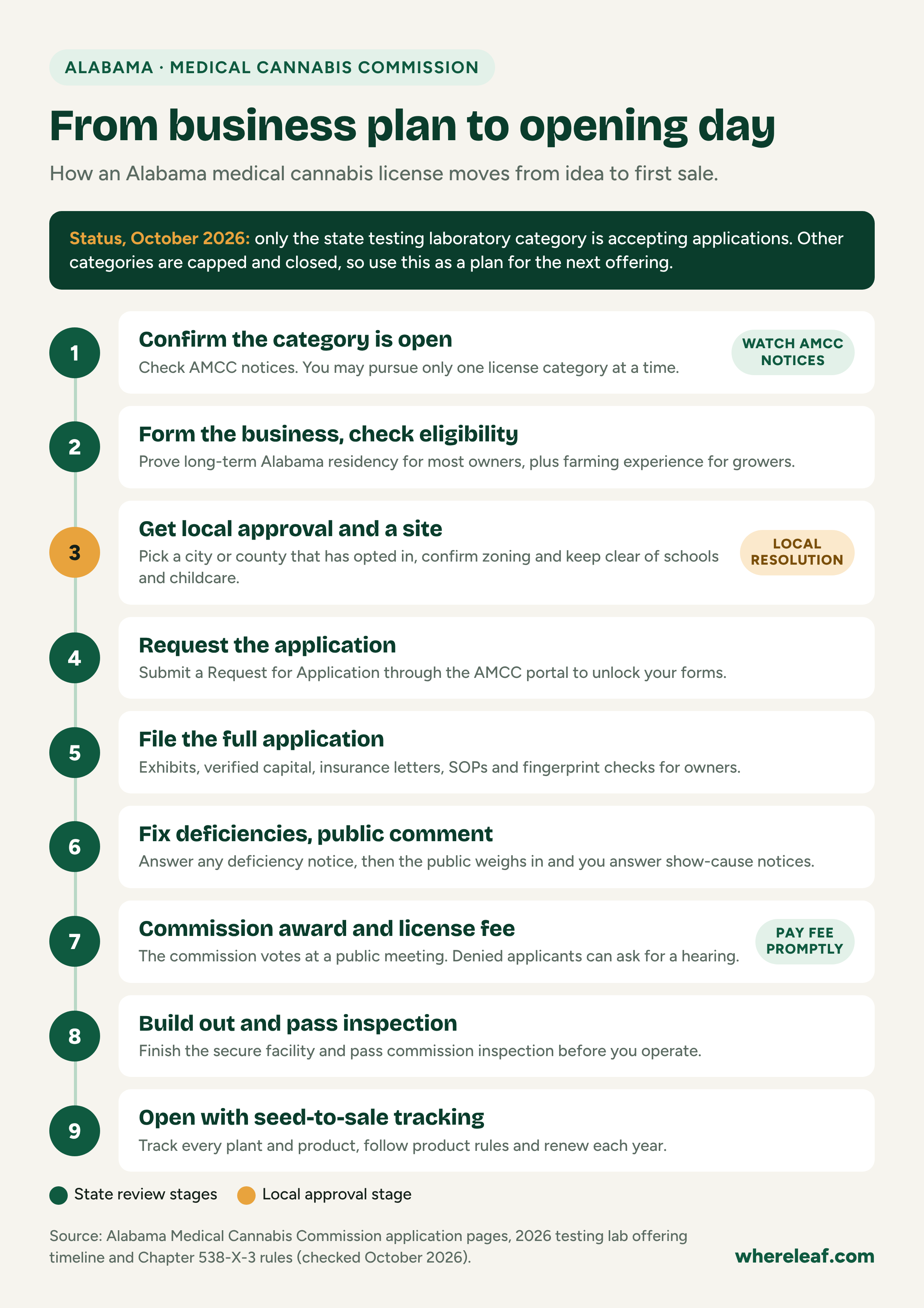
The 2026 testing laboratory offering shows how an AMCC application works. Other categories have followed similar steps in past offerings, so use this as your plan if one reopens.
The testing lab timeline in detail
After you file a Request for Application through the AMCC portal, the commission sends you the application within three days. You then have 30 days to file it with all exhibits. Staff flag any deficiencies, and you get a short window to correct them. Once the commission deems your application submitted, a 30-day public comment period follows. The commission then decides within about 60 days. If you’re denied, you can request an investigative hearing within 14 days.
What requirements do you need to meet?
Ownership and residency
Rule 538-X-3-.14 makes an applicant ineligible unless a majority of its ownership belongs to people who can prove they have lived in Alabama continuously for at least 15 years before applying. The rule doesn’t exempt any category. Integrated facility and cultivator applicants must also show that a majority of ownership has at least 15 years of commercial horticulture or agronomic production experience.
Background checks and disqualifying offenses
Owners, directors, board members and controlling individuals consent to state and FBI fingerprint checks at their own cost. An applicant is ineligible if any of them pleaded guilty to or was convicted of a felony, or a controlled-substance misdemeanor, within the past 10 years, or was released from prison for one in that time. Overturned convictions and expunged charges don’t count. Knowingly filing false information is also disqualifying.
Capital
The rules don’t set a flat dollar minimum. Instead, you must prove “sufficient capital,” meaning enough to cover your budgets for the first three full years after licensure. An independent CPA must verify the source, and you file a three-year financial statement or pro forma.
Real estate and buffer distances
You must show you’re authorized to occupy the property, that it’s in a permissible location and that local zoning approves it. Dispensing sites must sit at least 1,000 feet from schools, day cares and childcare facilities, measured property line to property line. A dispensing site can’t share a building with a certifying physician or another licensee, must offer patient parking and can’t allow on-site use.
Security plan and SOPs
Applications describe each facility, its security and its operating procedures, and you’ll project how many days you’ll need to start operating and reach full capacity. Our dispensary security requirements guide covers the cameras, alarms and access controls inspectors usually check.
Insurance
You must show you can carry adequate liability and casualty insurance, or other financial guarantees, for each facility. The application asks for declarations pages or letters of intent from an A-rated insurer for casualty, workers’ compensation, liability and auto or fleet coverage.
Staff and training
The application includes personnel roster forms, and anyone with a controlling role goes through background checks. Ask the AMCC what registration and checks it requires for staff before you hire. Our budtender training requirements guide helps you build a plan.
Local approval and zoning in Alabama
Alabama uses an opt-in model for retail. A dispensing site can open only in a city, or an unincorporated county area, whose governing body has passed a resolution or ordinance allowing dispensing sites. Birmingham is one city that has passed one, and the AMCC posts the resolutions and ordinances it has received, so check that list first.
Even where a city has opted in, it can limit where dispensaries go through zoning and require a local business license. Birmingham, for example, lists the zoning districts where dispensaries are allowed. Before you sign a lease, get the local resolution, the zoning letter and the business license requirements in writing, because the AMCC application asks for all three.
Social equity and minority-owned set-asides
Alabama doesn’t run a social equity program with fee waivers or loans. It does set aside licenses. Under Rule 538-X-3-.11, at least one-fifth of integrated facility licenses and one-fourth of licenses in every other category must go to businesses that are at least 51% owned, managed and controlled by members of a minority group.
This set-aside was a major issue in the 2026 integrated facility hearing. If you plan to apply as a minority-owned business, document ownership, management and control carefully, because the commission looks past paperwork to who actually runs the company.
Alabama cannabis market at a glance
After you’re licensed: staying compliant
As of late October 2026, the operating industry is small: two dispensary licensees, five cultivators, two processors, two secure transporters and one testing lab. Expect close attention from regulators.
- Annual renewal: Renew on time. Late renewals cost more and add a daily penalty, as the table shows.
- Seed-to-sale tracking: Every plant and product is tracked from seed to sale in the state system. Read our seed-to-sale tracking explainer.
- Inspections and fines: The commission can fine individuals up to $5,000 per violation and licensees up to $25,000 or a day’s gross receipts, whichever is greater.
- Product and label rules: Stick to approved forms and follow labeling and testing rules. Our packaging and labeling guide and dispensary compliance checklist help you build daily routines.
- Advertising: Keep marketing factual and away from anything that appeals to minors.
Your Alabama cannabis license checklist
- Check which AMCC category is open. In 2026, that’s the state testing laboratory license.
- Confirm a majority of your owners meet the Alabama residency rule, and for growing, the horticulture experience rule.
- Run background checks on every owner and controlling person against the 10-year look-back.
- Build a three-year budget and have a CPA verify your capital.
- Pick a city or county that has opted in, then confirm zoning and the school and childcare buffer.
- Get insurance letters of intent and draft your security plan and SOPs.
- File your Request for Application before the deadline, then track every response window.
- Budget for the license fee, due shortly after an award.
- Sign up for AMCC news and meeting notices so you see the next offering on day one.
For new cannabis businesses: get found on WhereLeaf
Once your license is active and your doors are open, patients still have to find you. Add your business to WhereLeaf so people using our dispensary finder can see your location, hours and products, and compare our listing packages if you want more visibility. We can’t promise rankings or sales, but an accurate listing helps people find a licensed business. Labs and transporters can join our supplier directory.
Comparing markets? See all our cannabis license guides by state and province.
Frequently asked questions
How much does a cannabis license cost in Alabama?
The table above lists every state fee. Your real cost is much higher, because the rules require enough capital for three full years of operations before you earn steady revenue. Real estate, security, insurance and legal work for contested hearings can add far more.
Is recreational weed legal in Alabama in 2026?
No. Only registered medical patients and caregivers can buy cannabis, and only from licensed dispensing sites. Possessing cannabis without a commission card is still a crime.
Can I open a dispensary in Alabama?
Not as a new applicant right now. The dispensary and integrated facility licenses are all awarded or tied up in hearings and appeals. Joining or investing in a licensee needs commission approval and must still satisfy the residency rules.
Can I get a delivery license in Alabama?
No. Alabama has no delivery license, and secure transporters can’t deliver to patients. Patients buy in person at a dispensing site. See our delivery business guide for states that allow it.
Do I need to live in Alabama to get a license?
Not every owner does, but most of your ownership must have lived in the state continuously for a long period before you apply. Out-of-state partners can usually hold only a minority stake, and they still go through background checks.
How long does it take to get an Alabama cannabis license?
For a testing lab, the published timeline runs several months from request to license if nothing goes wrong. Growers and retailers have waited years because of litigation, and the first dispensary opened about five years after the law passed.
This guide is general information, not legal advice. Rules and fees change, so confirm everything with the Alabama Medical Cannabis Commission before you apply.
Sources
- Alabama Medical Cannabis Commission: Applicants for Cannabis Business License (2026)
- Alabama Medical Cannabis Commission: Schedule of Fees, Penalties and Fines, rev. December 12, 2024 (2025)
- Alabama Medical Cannabis Commission: 2026 State Testing Laboratory License Offering Timeline (2026)
- Alabama Medical Cannabis Commission: Administrative Code Chapter 538-X-3, Applications and Licensing (2026)
- Alabama Medical Cannabis Commission: Notice of Public Investigative Hearing, Integrated Facility (2026)
- Alabama Medical Cannabis Commission: What is the status of medical cannabis dispensaries in Alabama? (2026)
- Alabama Medical Cannabis Commission: Patients, Caregivers and Physicians (2026)
- City of Birmingham: Information about Medical Cannabis in the City of Birmingham
- Alabama Reflector: Two Alabama cannabis dispensaries expected to open next week (2026)
- WBHM: Alabama commission approves licenses for medical marijuana dispensaries as program eyes 2026 start (2025)
- Cannabis Business Times: Alabama Medical Cannabis Licensing Derailed by Court (2025)
- Bradley Arant Boult Cummings (law firm, backup source): Bama’s Big Stage: Integrated Medical Cannabis Facility Hearings Finally Kick Off in Tuscaloosa (2026)
- Bradley Arant Boult Cummings via National Law Review (law firm, backup source): 14 Applicants, Five Licenses, and One Very Patient Judge (2026)
Last updated: October 2026. Laws and prices change; always check your state or provincial regulator.


