

Yes, you can get a cannabis licence in Yukon. As of October 2026, the territory licenses privately owned cannabis stores, and the Cannabis Licensing Board decides each retail application after the Yukon Liquor Corporation (YLC) reviews it. Applications are accepted at any time, and the law sets no limit on the number of licences.
The territory runs no stores of its own. It handed all retail sales, including online sales and delivery, to private licensees in October 2022, and YLC now acts only as the wholesaler that buys from producers and supplies every store. Growing and processing are separate: those need a federal licence from Health Canada.
This guide covers who regulates what, every licence and fee, whether applications are open, the steps from site search to opening day, and the rules you’ll live with afterwards. We checked it against Yukon government pages, Cannabis Licensing Board decisions, City of Whitehorse rules, Health Canada and the Canada Revenue Agency in October 2026.
Key takeaways
- Yukon licenses private cannabis stores, and applications are taken year-round with no cap on the number of licences.
- Every store buys its products from the Yukon Liquor Corporation, the territory’s only cannabis wholesaler.
- Each application goes through public notice, and an objection triggers a hearing before the Cannabis Licensing Board.
- Licensed stores can also sell online and deliver, under the same social responsibility rules as in-store sales.
- Rules differ by province and territory and change often. Confirm the current requirements with the Yukon Liquor Corporation before you invest.
Who regulates cannabis businesses in Yukon?
The territory: YLC and the Cannabis Licensing Board
Yukon’s Cannabis Control and Regulation Act and its regulations set the rules for retail. YLC handles the front end: it receives applications, checks them, asks for missing information and runs public notice. The Cannabis Licensing Board, an independent board, has sole authority to grant or refuse a retail licence and holds hearings when the public objects.
YLC is also the “distributor corporation.” It sources, warehouses and distributes cannabis to licensed retailers, and retailers help shape which suppliers YLC signs and which products it carries. The minimum age to buy, possess or use cannabis in Yukon is 19.
Health Canada: production and medical sales
The federal Cannabis Act covers cultivation, processing, analytical testing, research and sale for medical purposes. Health Canada issues these licences through its Cannabis Tracking and Licensing System (CTLS). When the territory finished its retail handover, it counted one federally licensed producer in Yukon.
The CRA and municipalities
The Canada Revenue Agency issues the excise licence that cultivators, processors and packagers need, along with excise stamps. Municipalities control zoning, development permits and business licences, and some can override territorial rules on location and hours through their own bylaws.
Cannabis licence types in Yukon
The table covers every territorial and federal licence a Yukon cannabis business might need, plus the business types that don’t exist here. Territorial fees are non-refundable and the same in Whitehorse and the communities. The annual licence fee is pro-rated if your licence isn’t issued on April 1, because every licence term ends on March 31.
| Licence or approval | What it lets you do | Application fee | Annual or renewal fee |
|---|---|---|---|
| Retail licence, sub-class 1: store within a store | Sell cannabis and accessories in a separate area inside another business | $2,050 initial application fee | $2,150 licence fee per 12 months; $1,550 renewal application fee |
| Retail licence, sub-class 2: stand-alone store | Sell cannabis and accessories in a dedicated store | $2,050 initial application fee | $2,150 licence fee per 12 months; $1,550 renewal application fee |
| Online sales and home delivery | Let a licensed retailer take orders online and deliver to adults | No separate fee published; ask YLC | Not published; ask YLC |
| Private wholesale or distribution | Not available; YLC is the only distributor | Not applicable | Not applicable |
| Farm-gate or producer store | No territorial licence class found as of October 2026 | Not applicable | Not applicable |
| Consumption lounge | Not available; use is limited to private residences and adjoining property | Not applicable | Not applicable |
| Micro-cultivation, micro-processing or nursery (Health Canada) | Grow, process or propagate on a small scale | $2,058 screening fee | Higher of $2,500 or 1% of revenue up to $1 million, plus 2.3% above that |
| Standard cultivation or standard processing (Health Canada) | Grow or process at commercial scale and sell to wholesalers such as YLC | $4,109 screening fee | Higher of $23,000 or 2.3% of revenue |
| Sale for medical purposes (Health Canada) | Sell cannabis to registered medical clients | $4,109 (lower micro rate if combined with a micro or nursery licence) | Same as standard, with a possible exemption if all sales are medical |
| Federal security clearance (Health Canada) | Required for each key person on a federal licence | $2,076 per person | Not applicable |
| Analytical testing or research (Health Canada) | Test cannabis for licence holders, or study cannabis | Not published on Health Canada’s fee pages; ask Health Canada | Not published; ask Health Canada |
| CRA cannabis licence (excise) | Cultivate, produce or package cannabis products and buy excise stamps | No application fee; financial security from $5,000 up to $5 million, depending on expected duty | Valid up to five years; renew at least 30 days before expiry |
| YLC supplier listing | Have YLC buy your products and distribute them to Yukon stores | No fee published; ask YLC | No fee published; ask YLC |
| Municipal business licence and development permit | Local approval to occupy and run the store | Varies; ask your municipality | Varies; ask your municipality |
Health Canada’s screening and clearance amounts took effect April 1, 2026. For a wider view, see our comparison of dispensary licence costs.
Are cannabis licences open in Yukon right now?
Yes. As of October 2026, YLC accepts retail applications on a rolling basis. There’s no window, lottery or cap, although the board does weigh how many licences already exist in an area.
- Processing time: YLC says a decision typically takes 8 to 12 weeks, and longer if the file is incomplete or draws objections.
- Recent activity: YLC’s public register, last updated April 29, 2026, shows licences granted or approved in Whitehorse, Dawson City, Watson Lake and Carmacks. Applications on public notice included a Fire and Flower store in Whitehorse and Mountain High Cannabis in Haines Junction.
- Federal licences: Health Canada takes cultivation and processing applications at any time through CTLS.
- Buying a store: We found no published rule on transferring a Yukon retail licence. If you plan to buy an existing store, ask YLC whether you need a new application before you sign.
The territory’s spring 2026 briefing notes say YLC is also exploring a new distribution model to support the legal industry, with no timeline given. Retailers asked for the option to buy directly from producers during the five-year review, so watch for changes there.
How to get a cannabis retail licence in Yukon, step by step
The graphic shows the usual order for a new store. YLC recommends talking to its licensing staff before you file, which can save weeks of back-and-forth later.
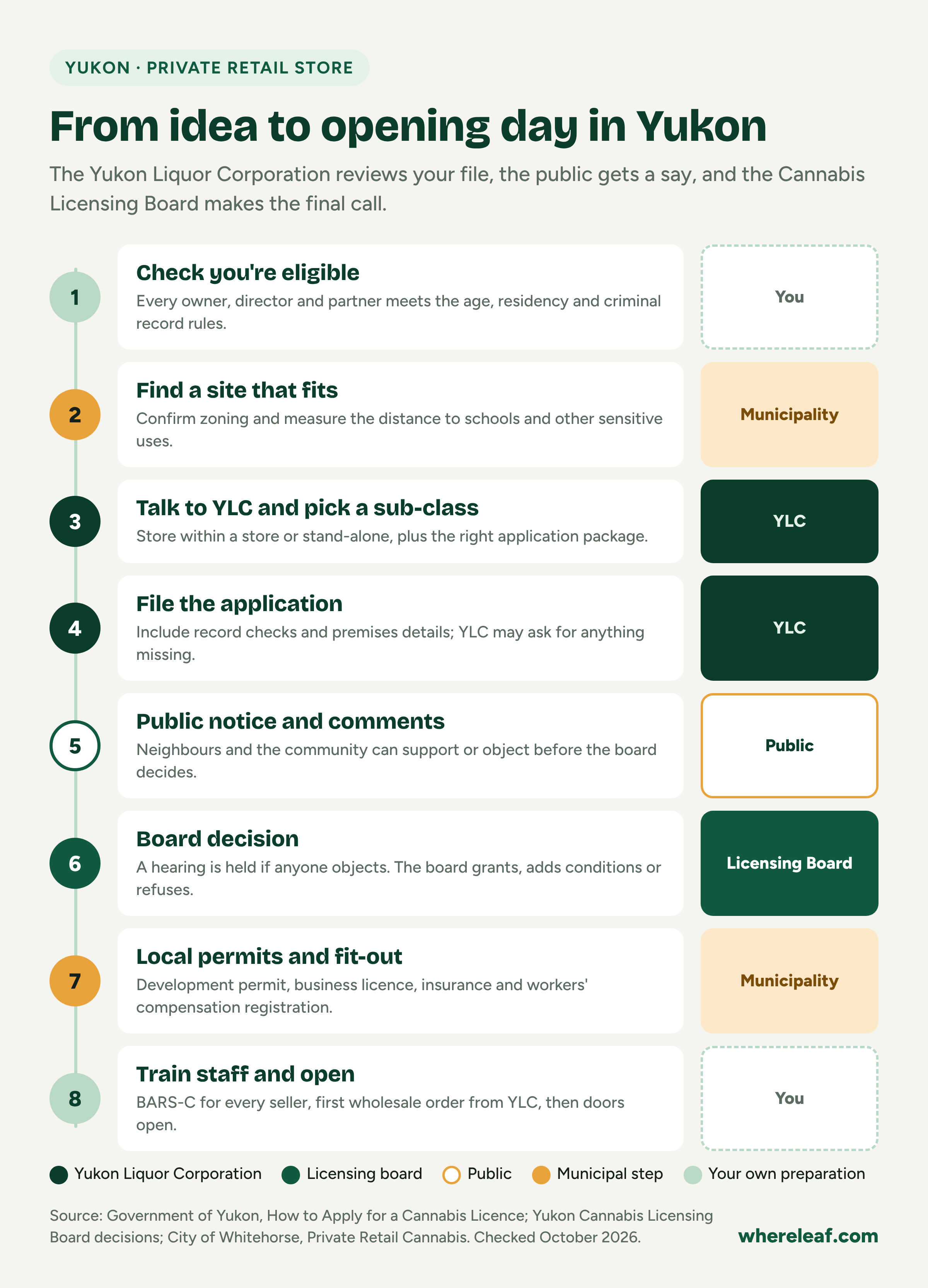
A grower or processor follows the federal path instead: notify local police, fire and government, get security clearances, file in CTLS and submit a site evidence package with floor plans and a video tour. Once licensed, you can ask YLC to list your products.
Requirements you’ll need to meet
Ownership and residency
Applicants must be at least 19 and ordinarily resident in Canada; you don’t have to live in Yukon. Employees of the distributor corporation can’t hold a licence. A licensee can be a person, a corporation or a partnership.
Background checks and disqualifying offences
Licensees, managers, directors and employees provide criminal record checks with the application. You must show that no applicant, director, partner or person in charge of the premises has a conviction for a prescribed offence punishable by imprisonment, as set out in section 26(3) of the Act and the retail policies.
Capital and character
Yukon sets no minimum capital or bond for a store. The board can still consider your planned capital spending, your character and compliance history, and whether you own or lease the premises when it weighs the public interest.
Real estate and buffer distances
Under section 7 of the retail regulation, every point on the store’s lot lines must be more than 150 metres from an elementary or secondary school building, unless a valid municipal bylaw sets a different rule. In a 2023 decision, the board counted a private school as a school when it refused a Whitehorse store, so measure carefully and check every nearby school.
Security, SOPs and insurance
YLC’s retail cannabis policies set the operating standards for stores, so ask YLC for the current version before you design your floor plan, security set-up and procedures. The City of Whitehorse asks for proof of general liability insurance before it issues a business licence. Our security requirements guide covers common set-ups.
Staff training
Anyone selling cannabis must complete Be A Responsible Server – Cannabis (BARS-C), a free course required by YLC. Delivery staff must check that the customer is of legal age and not intoxicated. See our budtender training guide.
Local approval and zoning
Municipalities shape where stores go. In Whitehorse, cannabis shops fall under the “retail services, restricted” use in the zoning bylaw and are allowed only in Marwell and specific downtown zones. The city adds a 100-metre buffer from parks with play structures, temporary shelters, services for at-risk youth or people who use substances, and other restricted retail. You’ll also need a city development permit and business licence.
The regulation lets stores open from 9 a.m. to 2 a.m. at most, and a municipal bylaw or the board can set shorter hours. Licensed premises can’t sell alcohol or tobacco unless a municipal bylaw, or a ministerial order in an unincorporated community, allows it. Public comments matter too: in its 2023 refusal, the board gave weight to community views and to the number of school-aged children near the site.
Social equity and small-business programs
As of October 2026, Yukon has no cannabis social equity or priority licensing program. The flat territorial fees are the same everywhere, which helps small operators in rural communities. YLC also cut its wholesale markup from 22% to 20% in December 2021 and moved to a per-unit service charge, which lowered costs for retailers.
Federally, micro-class producers pay lower Health Canada fees. The five-year review, released in October 2024, led the government to say it would explore regulatory amendments. Recommendations included researching direct sales from producers to retailers, allowing branded merchandise in stores and revisiting the frosted-window rule.
Yukon cannabis market at a glance
The legal market is strong for a small population, and tourism likely plays a part. The flip side is that a handful of stores already serve the main communities, so location matters.
After you’re licensed: staying compliant
- Renewals: Licences last up to three years and end on March 31, so mark the renewal date on your calendar and pay the licence fee each year.
- Purchasing: Buy only from YLC. Its special-order program can bring in products that aren’t on the regular list.
- Reporting and records: The regulation requires regular reporting to YLC. Our seed-to-sale tracking guide explains the federal side for producers.
- Online and delivery sales: Apply the same age and intoxication checks you use in store.
- Customer information: Licensees agreed to display a safe-storage card, developed with Health Canada, from January 2026.
- Advertising: Federal promotion rules apply, including the ban on promotion that appeals to young people.
Our dispensary compliance checklist turns these into daily and monthly tasks.
Your Yukon cannabis licence checklist
- Confirm every owner, director and partner meets the eligibility rules.
- Call YLC’s licensing office to talk through your plan and pick the right application package.
- Choose sub-class 1 or 2 based on your space.
- Check zoning and measure distances to schools and other sensitive uses.
- Secure the premises with a lease or purchase that allows cannabis retail.
- Gather criminal record checks for everyone required.
- File your application and prepare for public notice and any hearing.
- Apply for your municipal development permit and business licence.
- Register with Yukon Workers’ Safety and Compensation Board if you’ll have employees.
- Get every seller through BARS-C training before opening day.
- Set up your YLC wholesale account and first order.
For new cannabis businesses: get found on WhereLeaf
Once your Yukon store is licensed, add it to WhereLeaf so local shoppers and visitors using our dispensary finder can see your hours, location and delivery area. Our listing packages add photos and a fuller profile. WhereLeaf is a directory of licensed businesses, and we don’t promise rankings or traffic.
Comparing markets? See all our cannabis license guides by state and province.
Frequently asked questions
How much does a cannabis licence cost in Yukon?
The territorial fees are in the table above. Budget well beyond them for rent, fit-out, security equipment, insurance, opening inventory bought from YLC and staff wages, since we found no official estimate of total start-up costs.
Can I open a cannabis store outside Whitehorse?
Yes. Licensed stores operate in several communities, and the fees are the same everywhere. Smaller municipalities and unincorporated areas have their own zoning and permit rules, so check with the local government or the territory before you commit.
Can I run a delivery-only cannabis business in Yukon?
Online sales and delivery are offered by licensed retailers, so you need a retail licence first. Ask YLC whether a delivery-focused model fits a sub-class before you plan around it.
What happens if someone objects to my application?
The board must hold a hearing, where you and objectors can speak. It can then grant the licence, grant it with conditions or refuse it if it isn’t satisfied the law is met or that a licence is in the public interest.
Can a Yukon grower sell straight to stores?
Not today. A federally licensed producer sells to YLC, which distributes to retailers, so get your products listed with YLC first.
Can I open a cannabis lounge in Yukon?
No. Consumption is allowed only in private homes and adjoining property, and there’s no licence for consumption spaces, though municipalities raised tourist demand for them during the five-year review.
This guide is general information, not legal advice. Rules and fees change, so confirm everything with the Yukon Liquor Corporation before you apply.
Sources
- Government of Yukon: How to Apply for a Cannabis Licence
- Government of Yukon: Find Cannabis Licence Applications and Licence Holders (2026)
- Government of Yukon: Regulation for Private Cannabis Retail Licensing Announced (2019)
- Yukon Cannabis Licensing Board: Decision, Community Cannabis Inc., Item 22-01 (2023)
- Government of Yukon: Cannabis Retailers Can Now Offer Online Sales and Home Delivery (2022)
- Government of Yukon: Government of Yukon Completes Handover of Cannabis Retail Sales to Private Sector (2022)
- Government of Yukon: List Your Cannabis Product with the Yukon Liquor Corporation
- Government of Yukon: Five-Year Review of the Cannabis Control and Regulation Act Completed (2024)
- Government of Yukon: Yukon Liquor Corporation Briefing Notes, Spring 2026 (2026)
- Government of Yukon: Yukon Liquor Corporation Briefing Notes, Fall 2024 (2024)
- City of Whitehorse: Private Retail Cannabis
- Health Canada: Cannabis Transactional Fees for Licence Holders (2026)
- Health Canada: Cannabis Annual Regulatory Fee and Exemption (2026)
- Health Canada: Licence Application Summary for Cultivation, Processing and Sale for Medical Purposes (2026)
- Canada Revenue Agency: EDM6-2 Obtaining and Renewing a Cannabis Licence
- StratCann (news backup): Yukon Cannabis Sales Reach $10.4 Million in 2024-25 with Net Income Up 51% (2025)
- StratCann (news backup): Yukon Cannabis Report Highlights Need for Cannabis Consumption Spaces for Tourists (2024)
Last updated: October 2026. Laws and prices change; always check your state or provincial regulator.


