
Nova Scotia doesn’t issue cannabis licences for private stores. As of October 2026, the Nova Scotia Liquor Corporation (NSLC) is the province’s only authorized cannabis retailer for the general public, selling through its own stores and website. The one exception is narrow: a Mi’kmaw band or band-owned corporation can sign an agreement with the NSLC to run a legal store on reserve.
If you want a cannabis business in Nova Scotia, the main route is federal. Health Canada licenses growing, processing and medical sales, and a licensed producer can sell to the NSLC, to other licence holders or to medical clients. Farm-gate sales, where a grower sells straight to shoppers at the farm, aren’t allowed under provincial law.
This guide covers who licenses what, every licence and fee, what private businesses can and can’t do, and the steps from an empty site to an NSLC listing. It was checked against Nova Scotia legislation, provincial news releases, Health Canada and the Canada Revenue Agency in October 2026.
Key takeaways
- You can’t open a private cannabis store or delivery service in Nova Scotia; the NSLC holds the retail market.
- Growers and processors need a Health Canada licence first, and then sell mainly to the NSLC or other licence holders.
- Only Mi’kmaw bands and band-owned corporations can become authorized sellers, and only through an agreement with the NSLC.
- The province strengthened penalties for illegal stores and the landlords who rent to them in 2026, so a grey-market storefront is a serious legal risk.
- Rules differ by province and change often. Confirm the current requirements with the NSLC and Health Canada before you invest.
Who regulates cannabis businesses in Nova Scotia?
The province and the NSLC
Nova Scotia’s Cannabis Control Act and its regulations set the provincial rules, and Attorney General Scott Armstrong introduced the 2026 amendments. Under section 9, the NSLC may buy, store, distribute and sell cannabis from federally authorized producers, plus cannabis accessories, and it decides which products and prices it carries. Section 20 bars anyone other than an authorized seller from selling cannabis or running a cannabis store, and section 12 says any other authorized seller must buy only from the NSLC.
The minimum age is 19 to buy, possess or use cannabis. Sellers must check government photo ID for anyone who looks under 25.
Health Canada: production and medical sales
The federal Cannabis Act covers cultivation, processing, analytical testing, research and sale for medical purposes, all licensed by Health Canada through its Cannabis Tracking and Licensing System (CTLS). The provincial Act doesn’t apply to activities carried out under these federal licences. Medical cannabis is sold by federally licensed sellers to registered clients, outside the NSLC system.
The CRA and your municipality
The Canada Revenue Agency issues the excise licence every cultivator, processor or packager needs, along with excise stamps. Municipalities handle land use and building permits for production sites, and can restrict home growing further than the province does.
Cannabis licence types in Nova Scotia
The table covers every licence, agreement or approval that applies in Nova Scotia, including the business types that don’t exist here. Health Canada’s screening fees are per application and non-refundable, and its annual fee is the higher of a set minimum or a percentage of the previous year’s cannabis revenue.
| Licence or approval | What it lets you do | Application fee | Annual or renewal fee |
|---|---|---|---|
| Private retail store | Not available; only the NSLC may sell to the general public | Not applicable | Not applicable |
| Authorized cannabis seller agreement (Mi’kmaw communities) | Lets a band or band-owned corporation run one store on reserve, stocked only by the NSLC | None set in the regulations; terms are negotiated with the NSLC | None set in the regulations; ask the NSLC |
| Farm-gate or producer store | Not available under provincial law | Not applicable | Not applicable |
| Private delivery, wholesale or distribution | Not available; the NSLC or people it authorizes handle storage, transport and delivery | Not applicable | Not applicable |
| Consumption lounge | Not available; the Act makes no provision for lounges | Not applicable | Not applicable |
| Micro-cultivation, micro-processing or nursery (Health Canada) | Grow, process or propagate on a small scale | $2,058 screening fee | Higher of $2,500 or 1% of revenue up to $1 million, plus 2.3% above that |
| Standard cultivation or standard processing (Health Canada) | Grow or process at commercial scale and sell to provincial buyers such as the NSLC | $4,109 screening fee | Higher of $23,000 or 2.3% of revenue |
| Sale for medical purposes (Health Canada) | Sell cannabis to registered medical clients | $4,109 (lower micro rate if combined with a micro or nursery licence) | Same as standard, with a possible exemption if all sales are medical |
| Federal security clearance (Health Canada) | Required for each key person on a federal licence | $2,076 per person | Not applicable |
| Import or export permit (Health Canada) | Move cannabis across the border for permitted purposes | $767 per permit request | Not applicable |
| Analytical testing or research (Health Canada) | Test cannabis for licence holders, or study cannabis | Not published on Health Canada’s fee pages; ask Health Canada | Not published; ask Health Canada |
| CRA cannabis licence (excise) | Cultivate, produce or package cannabis products and buy excise stamps | No application fee; financial security from $5,000 up to $5 million, depending on expected duty | Valid up to five years; renew at least 30 days before expiry |
| NSLC product listing | Have the NSLC buy and sell your products in Nova Scotia | Not published; ask the NSLC | Not published; ask the NSLC |
| Accessory shop | Sell pipes, papers and similar accessories to adults | No provincial cannabis licence; ask your municipality about business permits | Varies; ask your municipality |
Health Canada’s screening and clearance amounts took effect April 1, 2026, and are adjusted each year for inflation. For comparison with other markets, see our guide to dispensary licence costs.
Are cannabis licences open in Nova Scotia right now?
For most private businesses, the answer is no. Here’s the status as of October 2026.
- Private retail: Closed. When it created the Mi’kmaw seller option in April 2025, the province said it had no plans to authorize other third-party cannabis sellers.
- Mi’kmaw authorized sellers: Open to bands and band-owned corporations under the Cannabis Retail Regulations, in force since April 3, 2025. Each store needs a negotiated agreement with the NSLC.
- Farm-gate sales: Not permitted. We found no provincial framework for them as of October 2026; when CBC asked in 2021, the province said only that it would keep monitoring consumer demand.
- Federal production licences: Open. Health Canada accepts applications at any time through CTLS.
- Supplying the NSLC: The NSLC buys from federally licensed producers, but we couldn’t find a public schedule of product calls. Contact the NSLC directly about listing.
Federal licences belong to a company, so buying an existing Nova Scotia producer is possible. Any new key people will need Health Canada security clearance, and the CRA licence must stay valid through the change.
How to start a licensed cannabis business in Nova Scotia, step by step
The graphic shows the usual order for a new grower or processor aiming to sell to the NSLC. You can’t start any cannabis activity until Health Canada issues your licence.
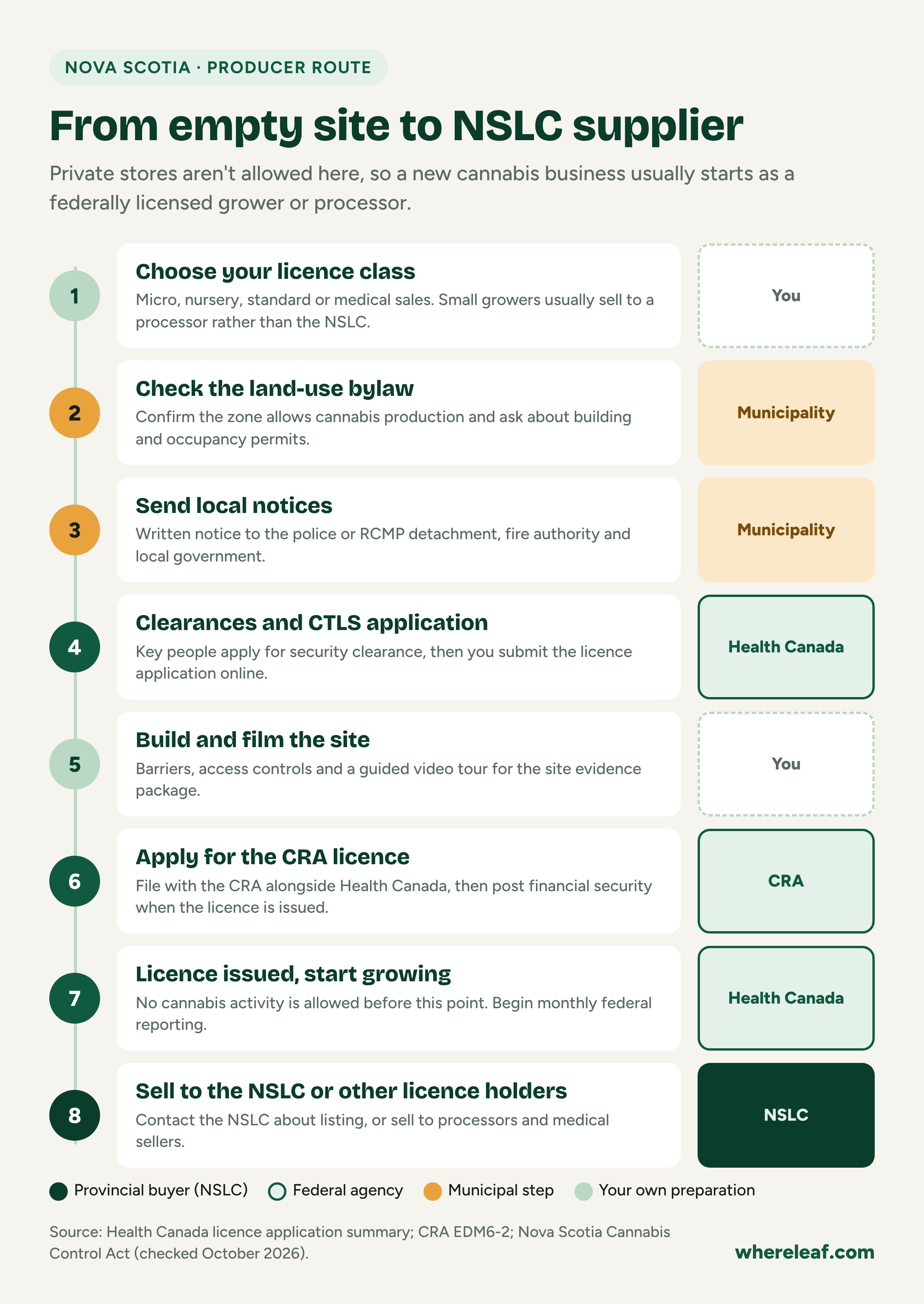
If you plan a micro-cultivation licence, remember that small growers usually sell their harvest to a processor or another licence holder, who handles packaging and the sale to the NSLC.
Requirements you’ll need to meet
Ownership and residency
Health Canada and the CRA don’t require owners to live in Nova Scotia, but every key person must pass a federal security clearance. For the on-reserve retail option, the seller must be a band or a corporation whose shares are all owned by a band.
Background checks and disqualifying offences
Health Canada screens key site personnel, people with direct control and associated individuals. Each person applies through their own CTLS account no more than one month before you submit the licence application.
Capital and financial security
There’s no provincial capital requirement for producers. The CRA asks for financial security based on the excise duty you expect to owe, posted once Health Canada issues your licence.
Real estate and site control
Before you apply, send written notice to your local police or RCMP detachment, fire authority and local government. Your site evidence package must include a site plan, floor plans, a description of physical barriers and restricted access, and a guided video tour. For an on-reserve store, the premises must be a permanent, non-movable retail building on reserve.
Security plan
Micro and nursery sites need a physical security attestation. Standard sites also need details of camera monitoring and intrusion detection systems. Our security requirements guide explains how these systems are usually planned.
SOPs and insurance
Processors need a Quality Assurance Person and a good production practices attestation, and every licence needs a record-keeping attestation. Neither the province nor Health Canada sets an insurance amount, though your landlord and lender likely will.
Staff rules
Nova Scotia has no provincial staff permit for producers. In an authorized on-reserve store, anyone who handles or sells cannabis must be 19 or older, and the store must follow NSLC responsible retail training. Our budtender training guide covers the basics.
Local approval and zoning
Because there are no private stores, local approval in Nova Scotia is mostly about production sites. Check your municipality’s land-use bylaw before you buy or lease, since zoning for cannabis cultivation and processing varies from place to place. You’ll also need building and occupancy permits for any construction.
Talk to the municipal planner early about odour, lighting, setbacks and fencing, and get answers in writing. Health Canada asks you to notify the local government, but that notice is not the same as local approval.
Social equity and small-business programs
As of October 2026, Nova Scotia has no cannabis social equity or priority licensing program. Its main targeted measure is the Mi’kmaw authorized seller option, which keeps store profits within the community. The province has said it wants more legal cannabis sales in First Nations communities, although some Mi’kmaw leaders reject provincial regulation and are developing their own laws.
Local producers do get visibility. In March 2026, the NSLC held a pop-up at its Clyde Street store in Halifax featuring Nova Scotian licensed producers. Federally, micro-class licences carry lower Health Canada fees.
Nova Scotia cannabis market at a glance
A local brand already has a real share of NSLC shelves, which shows the corporation does list Nova Scotia producers.
After you’re licensed: staying compliant
- Federal reporting: Licence holders report inventory and sales monthly to the federal tracking system. Our seed-to-sale tracking guide explains how it works.
- Annual fees and renewals: Pay Health Canada’s annual regulatory fee, renew your CRA licence before it expires and keep security clearances current.
- On-reserve stores: Sell only in original packaging, cap each sale at 30 grams of dried cannabis or the equivalent, allow no sampling, keep records for at least seven years and report monthly. The NSLC can inspect at any time.
- Advertising: Federal promotion rules apply to producers, and the provincial Act now sets fines of $10,000 to $25,000 for unauthorized advertising.
- Illegal sales: Since the 2026 amendments took effect in late June, running an unauthorized cannabis store carries a fine of $15,000 to $50,000, and landlords who allow one can be fined too.
Use our compliance checklist and packaging and labelling guide to build daily routines.
Your Nova Scotia cannabis licence checklist
- Confirm your idea is legal here: production, medical sales, an on-reserve store or accessories, not a private dispensary.
- Pick your Health Canada licence class and incorporate your company.
- Check the municipal land-use bylaw before you buy or lease a site.
- Send written notices to police, fire and local government.
- Have key people apply for security clearance through CTLS.
- Submit your Health Canada application and site evidence package.
- Apply for the CRA cannabis licence at the same time.
- Hire a Quality Assurance Person if you’ll process cannabis.
- Contact the NSLC about its listing process before your first harvest.
- Set up monthly federal reporting and record keeping.
For new cannabis businesses: get found on WhereLeaf
Licensed Nova Scotia producers, processors, accessory retailers and service providers can add a listing to WhereLeaf and appear in our supplier directory, where buyers and partners across Canada look for vendors. Our listing packages add a fuller profile. WhereLeaf is a directory of licensed businesses, so an unauthorized storefront doesn’t belong on it.
Comparing markets? See all our cannabis license guides by state and province.
Frequently asked questions
Can I open a dispensary in Nova Scotia?
No, unless your business is a Mi’kmaw band or band-owned corporation with an NSLC agreement. Shoppers can learn to spot illegal sellers with our guide on how to tell if a dispensary is licensed; in Nova Scotia, legal cannabis comes only from the NSLC or an NSLC-authorized seller.
How much does it cost to start a cannabis business in Nova Scotia?
Government fees are in the table above. They’re small next to the cost of a secure building, equipment, staff, testing and months of operating before your first sale, and we found no official estimate of total start-up costs.
Can a Nova Scotia grower sell directly to customers?
Not to recreational shoppers. A grower with a federal licence for sale for medical purposes can sell to registered medical clients, usually online and by mail, but recreational sales must go through the NSLC.
Do I need to live in Nova Scotia?
No. Federal licences don’t carry a provincial residency rule, but your site must be in the province, and you’ll deal with Nova Scotia municipal rules and the NSLC as your main buyer.
Can I sell cannabis accessories in Nova Scotia?
Yes. Accessories such as pipes and papers don’t need a provincial cannabis licence, but the Act bans selling them to anyone under 19, and you can’t sell cannabis itself alongside them.
Can I grow cannabis at home in Nova Scotia?
Adults can grow up to four plants per household for personal use, and municipalities may add limits. Homegrown cannabis can’t be sold, so a business needs a Health Canada licence.
This guide is general information, not legal advice. Rules and fees change, so confirm everything with the Nova Scotia Liquor Corporation (NSLC) and Health Canada before you apply.
Sources
- Nova Scotia Legislature: Cannabis Control Act, as amended (2026)
- Government of Nova Scotia: Cannabis Retail Regulations, N.S. Reg. 72/2025 (2025)
- Government of Nova Scotia: Nova Scotia Cannabis Laws
- Government of Nova Scotia: New Cannabis Regulations Support Legal Sales in Mi’kmaw Communities (2025)
- Nova Scotia Legislature: Bill 200, Cannabis Control Act amendments, third reading (2026)
- Health Canada: Cannabis Transactional Fees for Licence Holders (2026)
- Health Canada: Cannabis Annual Regulatory Fee and Exemption (2026)
- Health Canada: Licence Application Summary for Cultivation, Processing and Sale for Medical Purposes (2026)
- Canada Revenue Agency: EDM6-2 Obtaining and Renewing a Cannabis Licence
- Global News (news backup): Nova Scotia Rolls Out New Cannabis Rules (2026)
- StratCann (news backup): Nova Scotia Passes Bill to Increase Enforcement Against Unlicensed Cannabis Stores and Landlords (2026)
- StratCann (news backup): Nova Scotia Reports $138.8 Million in Cannabis Sales for Fiscal 2025/26 (2026)
- CBC News (news backup): Annapolis Valley Farmer Seeks Cannabis Farm-Gate Sales (2021)
Last updated: October 2026. Laws and prices change; always check your state or provincial regulator.


