
As of October 2026, you can’t apply for a new cannabis license in Florida. The state is medical-only, the only business license is the vertically integrated MMTC license issued by the Florida Department of Health’s Office of Medical Marijuana Use (OMMU), and no application window is open.
An MMTC (Medical Marijuana Treatment Center) license covers the whole chain: one company grows, processes, transports and sells its own products to registered patients. There are no separate licenses for stand-alone dispensaries, growers or delivery services, and recreational sales remain illegal after a 2026 ballot drive failed to qualify.
The last licensing round only finished in September 2026, and the law ties future licenses to patient numbers. This guide covers how that works, what an MMTC license costs, the Black farmer license, buying an existing MMTC and what to prepare, all checked against OMMU pages and Florida law in October 2026.
Key takeaways
- Florida licenses only vertically integrated MMTCs. You can’t get a license just to run a dispensary, grow, process or deliver.
- No application window is open, and OMMU hasn’t announced the next batching cycle. Buying an existing MMTC with OMMU approval is the main way in right now.
- New licenses are tied by law to growth in the patient registry, so future rounds are likely but their timing isn’t set.
- Recreational cannabis isn’t on the November 2026 ballot, so the market stays medical-only for now.
- Rules differ by state and change often. Always confirm current requirements with OMMU before you invest.
Who regulates cannabis businesses in Florida?
The Office of Medical Marijuana Use, part of the Florida Department of Health, licenses MMTCs, approves each stage of their operations, certifies testing labs and runs the patient registry. Voters added medical cannabis to the state constitution in 2016 (Article X, Section 29), and the details are in section 381.986 of the Florida Statutes and OMMU’s rules in Chapter 64 of the Florida Administrative Code.
Here is what is in force as of October 2026:
- Medical cannabis: Legal for registered patients with a physician certification, sold only by MMTCs.
- Adult-use cannabis: Not legal. A 2024 amendment won a majority but fell short of the supermajority Florida requires. In February 2026 the state said a new amendment lacked enough valid signatures, and the Florida Supreme Court dismissed the case, so it won’t appear on the November 3, 2026 ballot.
Counties and cities form the local layer. They can’t license cannabis businesses, but they can ban MMTC dispensing facilities inside their borders, as explained below. Hemp products are regulated separately by the Department of Agriculture and Consumer Services.
What cannabis license types are there in Florida?
Florida’s system is simple on paper: one business license plus lab certification. The table shows each type and the fees OMMU publishes or that are set by rule.
| License type | What it lets you do | Application fee | Annual or renewal fee |
|---|---|---|---|
| MMTC license (general) | Grow, process, transport and dispense medical marijuana and low-THC cannabis, including delivery to patients | $146,000 per application, nonrefundable (Rule 64ER22-9, used in the last batching cycle) | Renewed every two years. The fee comes from an OMMU formula and was reported at about $1.3 million per renewal (news backup); ask OMMU for the current schedule |
| Pigford/Black farmer MMTC license | Same as a general MMTC license, set aside for recognized Pigford v. Glickman class members | No window open; ask OMMU for any future fee | Same two-year renewal as other MMTCs |
| Cultivation, processing and dispensing authorizations | The three stage approvals every new MMTC needs before selling | No separate fee published; part of the MMTC license | None published |
| Additional dispensing location | Open a new storefront under an existing MMTC license | Not published; ask OMMU | None published |
| Certified marijuana testing laboratory | Test MMTC products for potency and contaminants; can’t be owned by an MMTC | Set by Department rule; not published on the pages we checked, so ask OMMU | Renewed every two years; fee set by rule, so ask OMMU |
| Change of ownership | OMMU approval to transfer an MMTC to a qualified new owner | Not published; ask OMMU | None |
| Stand-alone dispensary, grower, processor, delivery, distributor, microbusiness, lounge or adult-use licenses | Not available in Florida | Not available | Not available |
The renewal fee isn’t a fixed number in the statute. Under the renewal rule, OMMU sets it for two calendar years at a time from the program’s costs, minus initial application fees collected in that period, which is why it has changed between cycles. Compare other states in our guide to dispensary license costs by state.
Are Florida cannabis licenses open right now?
No. As of October 2026, OMMU isn’t accepting MMTC applications, and it hasn’t published dates for another batching cycle.
The most recent cycle shows how slowly rounds move. Applications were filed from April 24 to April 28, 2023. OMMU sent decision letters on November 26, 2024, with 22 applicants receiving a notice of intent to approve, and it issued final approval letters to those 22 on September 11, 2026.
How the license count grows
Florida doesn’t cap licenses at a fixed number. Section 381.986(8)(a) says that within six months after the registry reaches 100,000 active qualified patients, OMMU must license four more MMTCs, and four more for each further 100,000 patients. OMMU decides how and when to run the batching cycle, so watch its notices page rather than counting patients yourself.
Can you buy an existing MMTC?
Yes, with approval. The statute lets an MMTC transfer ownership to someone who meets all licensing requirements. The MMTC must notify OMMU at least 60 days before the change, and OMMU must approve or deny a complete application within 30 days. An individual or entity can hold only one MMTC license, and an MMTC or anyone owning 5% or more of one can’t acquire another MMTC. Sale prices aren’t published by OMMU, so get a lawyer and a valuation before negotiating.
How do you apply for a Florida MMTC license?
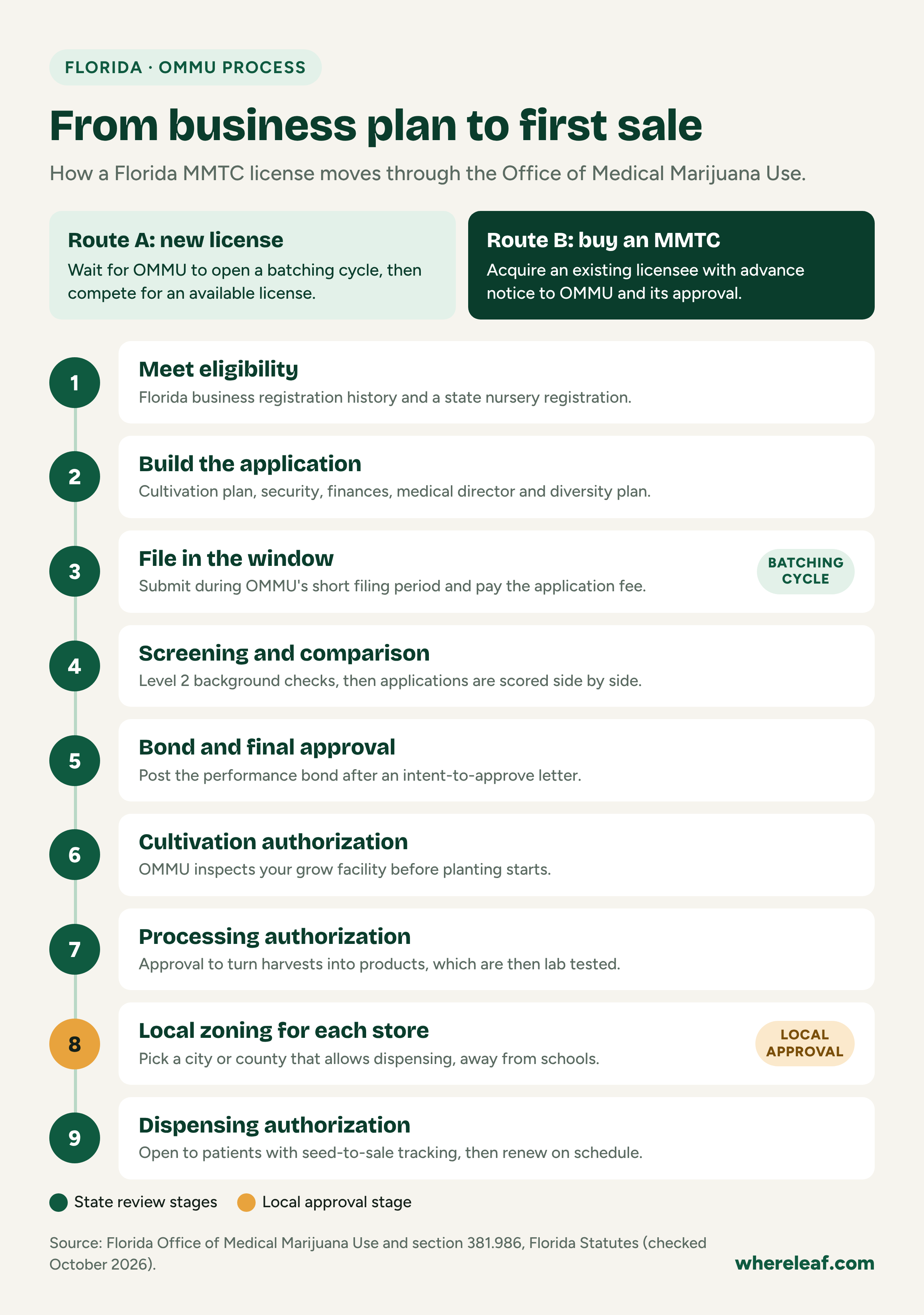
When a cycle opens, OMMU publishes the forms and a short filing window, then compares applications in one batch. After approval, a new MMTC still has to earn three separate authorizations before its first sale.
Why approval isn’t the finish line
A license approval letter lets you start building, not selling. OMMU authorizes cultivation only after it inspects the grow facility, then authorizes processing once you can make products, and finally authorizes dispensing at each store. Every product batch must pass testing at a certified lab before it reaches a shelf. Because each step depends on the one before it, a new MMTC often spends a long stretch paying rent, staff and bond costs before its first sale, so build that runway into your financial plan.
What requirements do you need to meet?
Ownership and business history
Under section 381.986(8)(b), an applicant must have been registered to do business in Florida for the previous five consecutive years and hold a valid nursery certificate of registration from the Department of Agriculture and Consumer Services. There’s no personal residency rule for owners in the statute, but every owner with 5% or more and every manager is screened. Pigford class members applying for the reserved license are exempt from some of the standard requirements.
Background checks and disqualifying offenses
Owners, managers and employees must pass a level 2 background screening under chapter 435. Convictions under chapters 837 (perjury and false statements), 895 (racketeering) and 896 (money laundering) are disqualifying, along with other offenses listed in the law.
Capital and bond
You must show you can run the business for the two-year approval cycle, backed by certified financial statements. After approval, you post a $5 million performance bond, which drops to $2 million once you serve at least 1,000 qualified patients. A letter of credit or cash deposit can replace the bond.
Real estate and buffer distances
Dispensing facilities may not be within 500 feet of a public or private elementary, middle or secondary school unless the local government approves the site after a public hearing. Cultivation and processing facilities need secure, enclosed sites that pass OMMU inspection.
Security plan and SOPs
The application must show cultivation and processing ability, security and inventory controls. MMTCs can’t dispense between 9 p.m. and 7 a.m., and transport vehicles must carry a manifest, keep products locked in a separate compartment and have two staff on board. Our dispensary security requirements guide covers the basics.
Medical director, diversity plan and insurance
Each MMTC needs a physician medical director and must file a diversity plan. OMMU doesn’t publish a set insurance amount, so ask your surety and insurer early.
Staff training
Employees must pass screening and complete training required by OMMU rules. See our budtender training requirements guide for building a program.
Local approval and zoning in Florida
A county or city may ban MMTC dispensing facilities by ordinance. If it doesn’t ban them, it can’t cap how many open, and its rules on location can’t be stricter than those for pharmacies. Local governments can also approve a dispensing site inside the school buffer after a public hearing.
Local rules vary widely across Florida, so check the current ordinance and talk to the local planning office before you sign a lease. Ask whether your site needs a zoning letter, business tax receipt or site plan review.
Social equity and priority programs
Florida has no general social equity program with reserved licenses or fee cuts. Its one targeted measure is the Pigford/Black farmer license, set aside in the 2017 law for a Black farmer who is a recognized class member in the Pigford lawsuits over discriminatory federal farm lending.
OMMU began taking those applications in March 2022. After legal challenges, HB 387 of 2023 required licenses for qualifying applicants, and the Department issued two Pigford licenses on July 11, 2023, to farmers from Suwannee County and Bascom. Every MMTC applicant must also file a diversity plan.
Florida cannabis market at a glance
After you’re licensed: staying compliant
- Two-year renewal: File your renewal application in the window before your license period ends, and budget for the renewal fee.
- Seed-to-sale tracking: The law requires a Department-approved system that traces products from seed to sale. Read our seed-to-sale tracking explainer.
- Testing: Products must be tested by a certified marijuana testing laboratory before sale. See how to read cannabis lab results.
- Inspections and new locations: OMMU inspects facilities and approves each new dispensing location before it opens.
- Advertising and packaging: Follow the statute’s limits on advertising and its packaging rules, and never market to minors. Our packaging and labeling guide and dispensary compliance checklist help you set routines.
Your Florida MMTC license checklist
- Accept that no window is open, and decide between waiting for a cycle and buying an existing MMTC.
- Subscribe to OMMU notices so you see the next batching cycle announcement.
- Confirm your entity’s Florida business registration history and nursery registration.
- Identify every owner and manager, and run level 2 screening early.
- Build audited financials showing you can operate for the full approval cycle.
- Line up a surety for the performance bond.
- Recruit a physician medical director and write your diversity plan.
- Map cities and counties that allow dispensing facilities, and check school buffers.
- Draft security, transport, inventory and recall SOPs.
- Plan your cultivation build-out so you’re ready for each stage inspection.
For new cannabis businesses: get found on WhereLeaf
Once your MMTC has dispensing authorization and your stores are open, patients still need to find them. Add your locations to WhereLeaf so people using our dispensary finder can see addresses, hours and menus, and compare our listing packages if you want more visibility. We can’t promise rankings or sales, but accurate listings help people find a licensed business.
Comparing markets? See all our cannabis license guides by state and province.
Frequently asked questions
How much does a cannabis license cost in Florida?
The table above shows the state fees. The real barrier is capital: you need certified financial statements proving you can fund a full grow, processing and retail operation for two years, plus a large bond, before your first sale.
Can I open just a dispensary in Florida?
No. Only MMTCs may sell, and each must grow and process what it sells. The statute bars MMTCs from contracting out cultivation, processing or dispensing, with a narrow exception for some of the earliest license holders.
Can I get a delivery license in Florida?
There’s no separate delivery license. MMTCs themselves may deliver to qualified patients, and the statute lets them deliver around the clock even though storefront sales stop overnight. For delivery rules in other states, see how to start a cannabis delivery business.
Is recreational marijuana on the 2026 Florida ballot?
No. The state determined the amendment fell short of the valid signatures it needed by the February 1 deadline, and the Florida Supreme Court dismissed the related case on February 4, 2026. The campaign disputed the count, but there is no cannabis question on this year’s ballot.
How long does it take to get an MMTC license?
Plan for years. In the last cycle, about 19 months passed between filing and intent-to-approve letters, according to ACS Laboratory, and final approvals came almost two years after that. Each authorization stage adds more time.
Do I need to live in Florida?
The statute doesn’t require owners to be residents, but the applying business must have a long Florida registration history and a state nursery registration. All owners and managers still need level 2 screening.
This guide is general information, not legal advice. Rules and fees change, so confirm everything with the Florida Office of Medical Marijuana Use before you apply.
Sources
- Florida OMMU: Medical Marijuana Treatment Centers (2026)
- Florida OMMU: April 2023 MMTC Batching Cycle (2026)
- Florida OMMU: Weekly Update, August 28, 2026 (2026)
- Florida Statutes: Section 381.986, Medical Use of Marijuana (2025)
- Florida Statutes: Section 381.988, Medical Marijuana Testing Laboratories (2025)
- Florida Administrative Code: Rule 64ER22-9, MMTC License Application Requirements (2022)
- Florida Administrative Code: Rule 64ER22-10, Renewal Application Requirements for MMTCs (via Cornell LII)
- WUSF (news, backup source): Judge backs increased pot license fee in Florida (2023)
- Green Market Report (news, backup source): Florida court maintains $1.3M medical marijuana license renewal fees (2025)
- GrayRobinson (law firm, backup source): Florida MMTC Licenses (2023)
- WUSF (news, backup source): Two Black farmers get marijuana licenses (2023)
- CBS12 (news, backup source): Florida Supreme Court dismisses recreational marijuana case (2026)
- ACS Laboratory (industry, backup source): Applying for a Florida MMTC License in 2026 (2026)
Last updated: October 2026. Laws and prices change; always check your state or provincial regulator.


