A dispensary compliance checklist breaks your legal duties into daily, weekly, monthly and annual tasks so nothing slips between inspections. The core items are the same in most legal markets: check every ID, keep inventory matched to the state tracking system, keep cameras and alarms working, train staff on time, file tax and sales reports, and renew licenses before they expire.
Regulators don’t expect perfection, but they do expect a system. When an inspector finds a problem, a store that can show written procedures, logs and training records is in a far better position than one that can’t.
This guide gives you a ready-to-use compliance calendar, the violations regulators cite most often, how fines are set, and a printable checklist. It draws on real enforcement data and rules from several states, checked in October 2026.
Key takeaways
- Most violations fall into a few groups: sales to minors, inventory tracking errors, security lapses, record-keeping gaps and advertising or packaging problems.
- Penalties are usually tiered, so a missing sign earns a warning while selling outside the tracking system can threaten your license.
- A written compliance calendar, with a named owner for each task, prevents most problems.
- Inspectors look for proof. If it isn’t logged, signed or saved, assume it didn’t happen.
- Rules differ by state and province. Always check your regulator’s current rules and bulletins.
What does dispensary compliance cover?
Dispensary compliance means following every rule attached to your license, from how you check IDs at the door to how you destroy expired product. Nevada’s Cannabis Compliance Board gives a useful map of what auditors review at a sales facility:
- Licensing, fees and taxes
- Personnel and training records
- Security systems and procedures
- Standard operating procedures (SOPs)
- Inventory control and the state tracking system
- Sales transactions
- Deliveries and transportation
- Advertising, required signs and accessibility
Most states inspect the same areas, even if they name them differently. Field inspectors check the store itself, while desk audits review your documents. Build your checklist so it covers both.
Your daily, weekly, monthly and annual compliance calendar
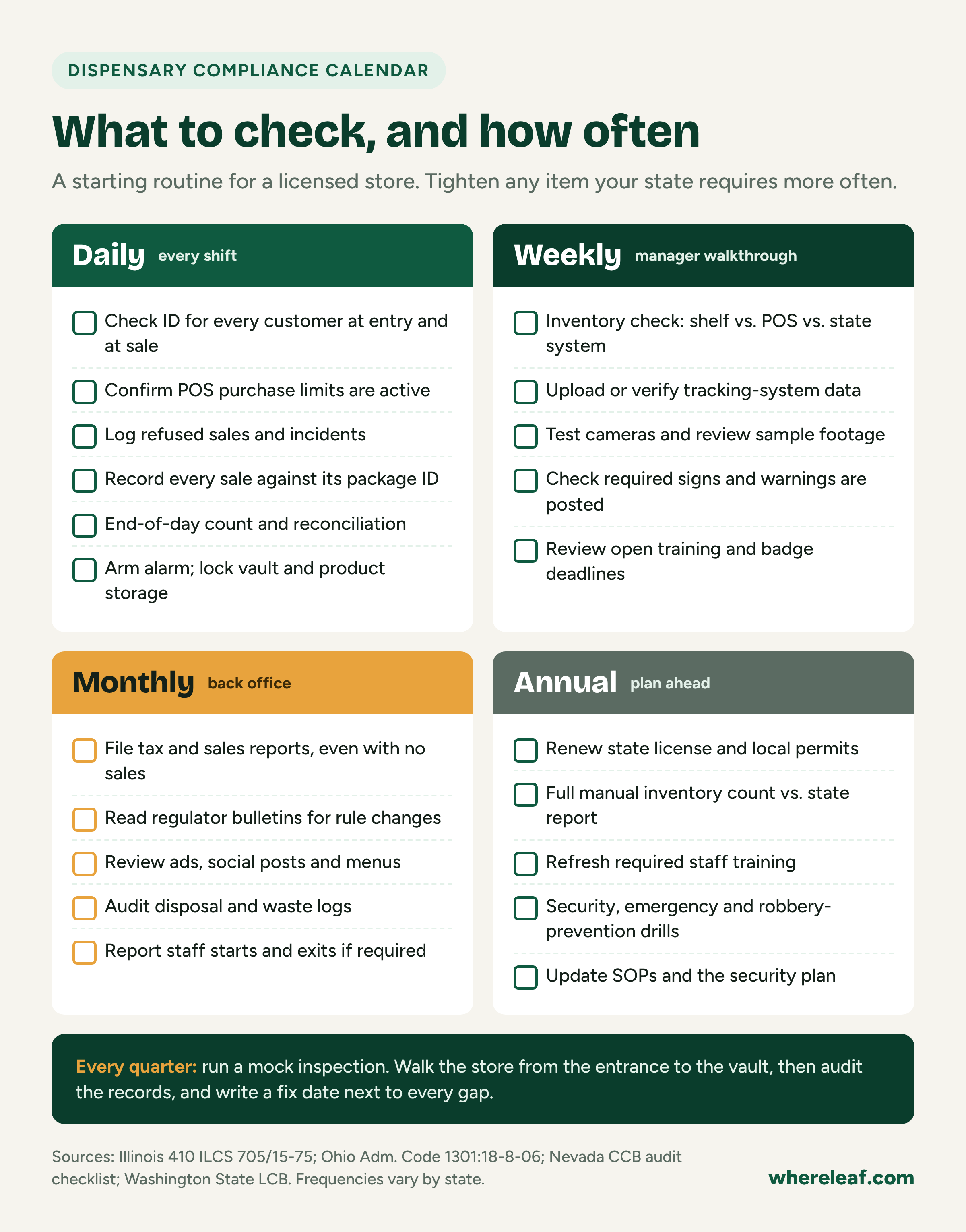
The graphic below sorts common compliance tasks by how often they come up. Adjust it to your state’s rules, then assign each task to a specific person.
Daily tasks
Daily work centers on the sales floor and the inventory system. Illinois, for example, requires the agent-in-charge to reconcile the state tracking system, the POS and the physical stock every day. Even where daily reconciliation isn’t required, a quick end-of-day count of high-value items catches errors while they’re still easy to trace. See our guide on seed-to-sale tracking for how the tracking side works.
Weekly tasks
Ohio requires a weekly inventory check comparing physical stock with internal and state records. Washington State requires weekly data uploads to its CCRS reporting system. A weekly manager walkthrough is also the right time to test cameras, check that signs are posted and review any refused sales.
Monthly tasks
Monthly work is mostly paperwork: tax and sales reports, reviewing employee badges and training deadlines, and checking the regulator’s bulletins for rule changes. Nevada classes a missed monthly tax or sales report as its lowest category of violation, but repeated misses add up.
Annual tasks
Once a year, renew licenses and local permits, refresh required training and run a full audit. Ohio requires a full manual inventory count compared against a report from the state system each year. Nevada requires annual training on security, emergency response and robbery prevention.
What are the most common dispensary violations?
Michigan’s Cannabis Regulatory Agency publishes a monthly disciplinary action report. In its September 2025 report, 12 actions involved METRC (tracking system) non-compliance and 12 involved non-compliant sales, with some actions covering both. Surveillance and security problems appeared in 3. Other actions involved failing to report ownership or location changes, packaging and advertising, and waste disposal.
Across states, the same problems come up again and again:
- Sales to minors or without proper ID checks. Some regulators test stores with underage decoys. See our guide on how dispensaries scan IDs.
- Selling over the purchase limit. Usually a POS setting or a staff override problem.
- Inventory tracking errors. Unrecorded sales, undocumented adjustments or product that can’t be traced to a package ID.
- Security lapses. Dead cameras, missing footage or an alarm that wasn’t armed. Our dispensary security requirements guide covers the details.
- Training and badge gaps. Staff working without a current agent card or required course. See our budtender training requirements guide.
- Packaging, labeling and advertising. Non-compliant labels, health claims or ads that could appeal to minors. Our packaging and labeling guide explains the rules.
- Failing to report changes. New owners, managers or a change in operations that the regulator wasn’t told about.
How much are dispensary fines?
Most states use a tiered system: the more serious the violation, the higher the penalty and the more likely a suspension. Nevada’s regulations show how this works. The table lists its five categories, with examples and the presumed penalty for a first violation in the published regulation.
| Nevada category | Example violations | Presumed first-violation penalty |
|---|---|---|
| Category I (most serious) | Operating without a required license; selling cannabis that isn’t in the seed-to-sale system; false statements to the Board | Civil penalty up to $90,000, plus suspension up to 30 days or revocation |
| Category II | Selling to someone under 21 without checking age; letting minors enter; not keeping alarm and surveillance systems | Up to $25,000, plus suspension up to 20 days |
| Category III | Missing records, including tracking records; untagged plants; not following the security plan; on-site consumption | Up to $10,000 |
| Category IV | Staff not carrying agent cards; advertising violations; improper storage | Up to $5,000 |
| Category V (least serious) | Missing a monthly tax or sales report; required signs not posted; not reporting a name change | Warning |
The Board can raise or lower these amounts based on factors such as how serious the violation was, any financial gain and the licensee’s compliance history. Nevada has proposed rule changes since this version was published, so check the current regulation.
How other states set penalties
Oregon calculates civil penalties from days of suspension. Under its rules, a licensee can pay $165 per day of suspension for a sale to a minor, or $250 per day for most other violations. Aggravating factors can raise a penalty, capped at $10,000 per violation, and the OLCC may offer a standard 30% reduction in a settlement. Colorado lets stores that hold its Responsible Vendor designation cite it as a mitigating factor.
Massachusetts shows how much enforcement happens without formal penalties. Most problems there end in a notice of deficiency, a written list of issues the store must fix, rather than a fine.
How do you prepare for a dispensary inspection?
Many inspections are unannounced, so the best preparation is a store that’s always ready. When an inspector arrives:
- Have a point person. Name a manager on every shift who greets inspectors, escorts them and pulls documents.
- Keep a compliance binder or shared folder. Licenses, SOPs, security plan, training records, staff badges and recent reconciliation reports in one place.
- Know where footage is. Staff on duty should be able to pull camera footage quickly.
- Don’t guess. If you don’t know an answer, say you’ll find out, then follow up in writing.
- Fix and document. If you get a notice of deficiency, write a corrective action plan, fix the issue and keep proof.
Self-audits
Run your own mock inspection every quarter. Use your state’s audit checklist if it publishes one; Nevada does. Walk the store as an inspector would, starting outside with the entrance and signage, then the sales floor, vault, back office and records. Write down every gap and assign a fix date.
What records should a dispensary keep?
Record-keeping rules vary, but Illinois is a good model: most required documents must be kept in a secure, locked location for 5 years, while inventory adjustment records must stay at the dispensary for 2 years. Common records to keep include:
- Licenses, permits and renewal confirmations
- Employee files with background checks, agent cards and training certificates
- Inventory reconciliations, adjustments and disposal logs
- Transfer manifests and receiving records
- Sales records and tax filings
- Security system maintenance logs and incident reports
- Visitor logs for restricted areas
- Copies of advertising and menus
In Canada, provinces set record rules. Ontario stores, for example, follow the AGCO’s Registrar’s Standards and report sales through the Ontario Cannabis Store‘s data platform.
Who should own each compliance task?
A checklist only works when every line has a name next to it. In a small store, one manager may own most of it. In a larger operation, split the work so no one person becomes a single point of failure. Here is a common way to divide it:
- Shift lead: opening and closing checks, ID-check spot reviews, refused-sale log, end-of-day counts and cash drop.
- Inventory manager: receiving transfers, adjustments, disposals, reconciliations and the state tracking system.
- General manager: staffing, training deadlines, badge renewals, regulator notifications and inspection visits.
- Security lead or vendor: camera and alarm testing, footage storage, access control and incident reports.
- Owner or compliance lead: license renewals, tax filings, rule-change monitoring, marketing review and quarterly self-audits.
A worked example: one week at a single-location store
On Monday, the general manager reads the regulator’s newest bulletin and flags a labeling change for the inventory manager. Each day, the shift lead closes out the POS and the inventory manager reconciles any differences before the next morning. On Wednesday, the security lead tests every camera, notes one with a blurry view and books a repair. On Friday, the general manager checks that a new hire’s training deadline is on the calendar and that two badges due for renewal have been submitted. On Saturday, the owner reviews the week’s social posts for banned claims before they go live.
None of these tasks takes long on its own. The value comes from doing them on schedule and writing them down, so that when an inspector asks, the store can show a full record instead of a promise.
If you add a second location, copy the same structure rather than stretching one manager across both. Consistent procedures across stores also make it easier to train staff who move between them.
Your dispensary compliance checklist
Screenshot or print this and post it in the back office.
- Check ID for every customer, every time, and log refused sales.
- Confirm the POS enforces purchase limits and can’t be overridden casually.
- Reconcile the state tracking system, POS and shelf on your state’s schedule.
- Accept transfers only after counting against the manifest.
- Test cameras and alarms and log the results.
- Keep every employee’s badge, background check and training current.
- Notify the regulator of staff, ownership or operational changes on time.
- File tax and sales reports on time, even in a month with no sales.
- Review ads, social posts and menus for banned claims and youth appeal.
- Dispose of waste using your state’s approved method and log it.
- Renew licenses and local permits well before they expire.
- Run a quarterly self-audit and keep a written corrective action plan.
For dispensary owners
A compliant store is a trustworthy store, and shoppers notice. Make it easy for them to confirm you’re licensed: list your dispensary on WhereLeaf with your license details, and compare our listing packages to highlight your hours and menu. Compliance software, security and POS vendors can reach owners through our supplier directory. Shoppers can check what to look for in our guide on how to tell if a dispensary is licensed.
Frequently asked questions
How often do regulators inspect dispensaries?
It varies by state and by your history. Many regulators do routine inspections plus unannounced visits and complaint-driven checks. Stores with past violations can expect more frequent visits.
What is the most common reason dispensaries get fined?
Inventory tracking errors and non-compliant sales, such as missed ID checks or sales over the limit, are among the most frequently cited problems. Security lapses and failing to report business changes are also common.
Can a dispensary lose its license for one violation?
It can for the most serious violations, such as selling product outside the legal tracking system or lying to regulators. Most first violations lead to a warning, a fine or a short suspension instead.
Do I need a compliance manager?
Most states don’t require that exact title, but someone must own compliance. Many stores assign it to a general manager or hire a dedicated compliance lead once they have multiple locations.
What is a notice of deficiency?
It’s a written notice listing problems an inspector found. You usually must submit a plan to fix them by a deadline. Handling it promptly often keeps a minor issue from turning into a fine.
Does compliance software replace a checklist?
No. Software can automate reporting and reminders, but someone still has to count product, check IDs and review records. Use software to support your checklist, not replace it.
Sources
- Nevada Cannabis Compliance Board: Combined Dispensary Audit Checklist (2023)
- Nevada Cannabis Compliance Board: Regulation 4, Disciplinary Proceedings (2021)
- Michigan Cannabis Regulatory Agency: Disciplinary Action Report, September 2025
- Michigan LARA: Cannabis Regulatory Agency Takes Disciplinary Action Against Licensees (2025)
- Massachusetts Cannabis Control Commission: Eighth Annual Activities Report (2025)
- Cornell LII: Or. Admin. Code 845-025-8590, Sanction Schedule
- Colorado Marijuana Enforcement Division: Responsible Vendor Training Program
- Illinois General Assembly: 410 ILCS 705/15-75, Inventory Control System
- Ohio Administrative Code: Rule 1301:18-8-06 (2025)
- Washington State Liquor and Cannabis Board: CCRS Frequently Asked Questions
- AGCO: Steps to Become a Cannabis Retailer
Last updated: October 2026. Laws and prices change; always check your state or provincial regulator.