Right now, a new business can’t apply for a grower, processor or dispensary permit in West Virginia. As of October 2026, the state allows only medical cannabis sales, the Office of Medical Cannabis (OMC) at the West Virginia Department of Health issues every permit, and the only application still open is for testing laboratories.
Adult-use (recreational) cannabis is still illegal. Lawmakers file legalization and decriminalization bills most sessions, but none has passed. West Virginia doesn’t let citizens put laws on the ballot, so any change has to come from the Legislature.
That doesn’t mean there’s nothing to plan. This guide explains every permit type and fee, how the one big application round worked, how existing permit holders change hands, and what to prepare if the state ever reopens. We checked everything against OMC pages, the West Virginia Medical Cannabis Act and its rules in October 2026.
Key takeaways
- West Virginia is a medical-only market, and the Office of Medical Cannabis is the only state agency that issues cannabis business permits.
- Grower, processor and dispensary applications have been closed since the state’s first round, and no new window has been announced. Lab applications are the exception.
- Permits can’t be transferred, so most newcomers enter by working for, investing in or buying into an existing permit holder, with any change in control reported to the state.
- Counties have real power: a dispensary needs a sign-off from the county board of health, and voters can ban cannabis businesses in their county.
- Rules differ by state and change often. Always confirm current requirements with the Office of Medical Cannabis before you invest.
Who regulates cannabis businesses in West Virginia?
The Office of Medical Cannabis, part of the Bureau for Public Health within the West Virginia Department of Health, issues permits, approves products, inspects facilities and registers patients and physicians. The state Code calls it “the bureau.” Its authority comes from the Medical Cannabis Act, Chapter 16A of the West Virginia Code, passed in 2017 as Senate Bill 386. The detailed rules are in Title 64 of the Code of State Rules, including series 64-109 (general provisions) and 64-111 (laboratories).
Here is what is and isn’t in force as of October 2026:
- Medical cannabis: Legal. Registered patients buy from permitted dispensaries. Forms such as dry leaf for vaporizing, oils, tinctures and pills are allowed, but smoking and edibles are not.
- Vertical integration: Allowed since SB 1037 in 2019, so one company can grow, process and sell.
- Edibles bill: HB 5260 would add edibles to the medical program. It passed the House in March 2026, but we found no record that it became law, so check with OMC.
- Adult-use cannabis: Not legal, and no adult-use bill has passed either chamber.
Local governments form a second layer. Counties don’t issue cannabis permits, but they can block them, as the section on local approval explains.
What cannabis license types are there in West Virginia?
West Virginia calls its licenses “permits,” and a permit holder is a medical cannabis organization. The table lists every type and the fees set in W. Va. Code §16A-6-6.
| License type | What it lets you do | Application fee | Annual or renewal fee |
|---|---|---|---|
| Grower permit | Grow cannabis in an indoor, enclosed, secure facility in West Virginia, at up to two locations | $5,000 nonrefundable application fee, plus a $50,000 permit fee that is returned if the permit isn’t granted | $5,000 renewal fee covering all locations, returned if the renewal isn’t granted |
| Processor permit | Turn cannabis into allowed forms such as oils, tinctures, pills and vape products, and sell to dispensaries | $5,000 nonrefundable application fee, plus a $50,000 permit fee that is returned if the permit isn’t granted | $5,000 renewal fee covering all locations, returned if the renewal isn’t granted |
| Dispensary permit | Sell medical cannabis and related devices to registered patients and caregivers | $2,500 nonrefundable application fee, plus a $10,000 permit fee for each location, returned if not granted | $2,500 renewal fee covering all locations, returned if the renewal isn’t granted |
| Laboratory approval | Test cannabis for growers and processors as an independent, accredited lab | Not published; ask the Office of Medical Cannabis | Not published; ask the Office of Medical Cannabis |
| Permit amendment | Approval to relocate or to change the activities on an existing permit | $250 per amendment | None |
| Delivery, transport, lounge, microbusiness or adult-use licenses | Not available. Permit holders move products under OMC transport security rules | Not available | Not available |
A few fee rules matter. The application fee is nonrefundable, while the much larger permit fee comes back if you aren’t chosen. All fees are paid by certified check or money order. Permits last one year, and you must file the renewal no more than six months and no less than four months before your permit expires. Compare other states in our guide to dispensary license costs by state.
Are West Virginia cannabis licenses open right now?
No, except for labs. OMC stopped taking grower, processor and dispensary applications at 3:00 p.m. on February 18, 2020, and says it isn’t accepting more “at this time.” It hasn’t announced a future round. Lab applications reopened in June 2020 on an ongoing basis with no limit on the number of labs.
The Act caps how many permits can exist:
- No more than 10 grower permits and 10 processor permits.
- No more than 100 dispensary permits statewide.
- One person may hold only one grower permit, one processor permit and up to 10 dispensary permits.
Every opening was filled in 2020. Since then, some permits have lapsed or been consolidated: in September 2025, Mountain State Spotlight reported that OMC listed only nine grower, nine processor and 74 dispensary permits as active. Unused cap room doesn’t mean a window is open, because OMC decides when to take applications.
Can you buy an existing permit?
Not directly. Section 16A-6-3 says permits are nontransferable. What can change is who owns the company that holds one. Permit holders must report changes in control, including ownership changes, to OMC, and every new principal or financial backer faces the same background checks. Hire a West Virginia cannabis attorney before you sign a deal.
How do you apply for a West Virginia cannabis permit?
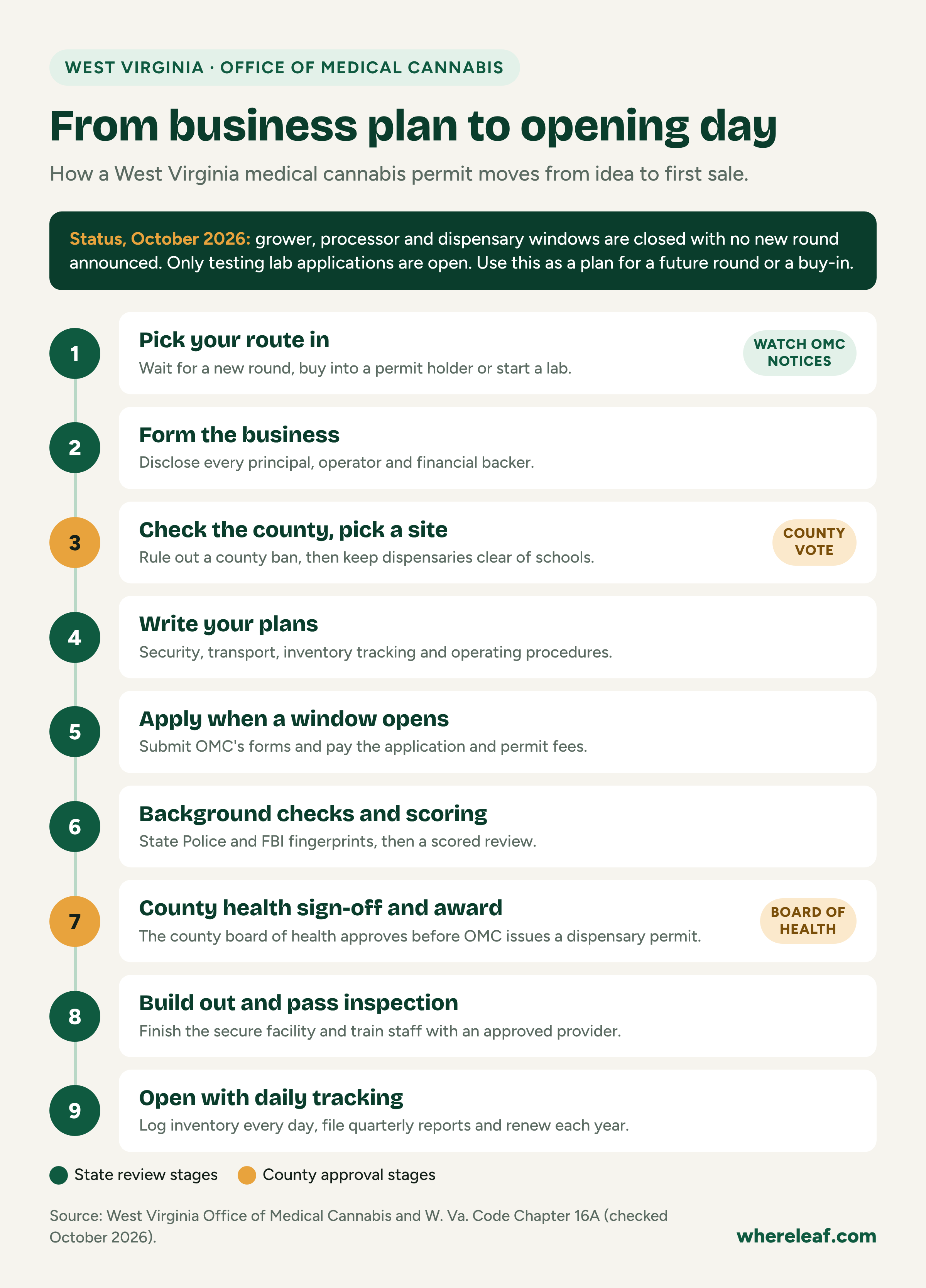
Because no grower, processor or dispensary window is open, use this as a preparation plan. The 2019-2020 round was a scored competition, and the strongest applicants had their team, county sign-offs and plans ready on day one.
What lab applicants submit
Under rule 64-111-4, a lab applies on OMC’s form with the fee and sends a certificate of accreditation from an ILAC MRA-recognized body, its accredited procedures, an equipment list, a quality assurance program, chain-of-custody steps and staff competency checks. OMC also checks that the lab is financially and professionally suitable.
What requirements do you need to meet?
Ownership and residency
The Act once had a residency requirement, but OMC says it doesn’t apply it after the U.S. Supreme Court’s 2019 Tennessee Wine and Spirits ruling. Applicants must list every principal and financial backer and disclose any controlling interest in drug manufacturing or distribution businesses in the past 10 years.
Background checks and disqualifying offenses
Principals, financial backers, operators and employees go through fingerprint checks with the State Police and the FBI. Under Section 16A-6-12, anyone with a felony conviction tied to illegal drugs or controlled substances can’t work for, own or back a permit holder. Dispensaries alone may ask OMC for a waiver.
Capital
Applicants must show financial fitness and the ability to secure land, buildings and equipment. We didn’t find a fixed dollar minimum in the Act, so ask OMC what proof it expects.
Real estate and buffer distances
A dispensary may not be within 1,000 feet of the property line of a public, private or parochial school or a day-care center, though OMC can change that limit if patient access requires it. A dispensary can’t share a site with a grow or processing facility, and growers and processors must work indoors in West Virginia.
Security plan and SOPs
Grow and processing sites need electronic locks and surveillance, and transport must follow OMC rules on sealed containers, vehicle security, GPS and delivery records. Our dispensary security requirements guide covers what inspectors look for.
Insurance
The OMC pages we checked don’t set an insurance amount. Landlords and lenders will expect coverage, so price it early.
Staff permits and training
Staff go through OMC’s employee background check process and complete required training from an approved provider, such as SeedTalent, Green CulturED or Green Flower. See our budtender training requirements guide for building a training plan.
Local approval and zoning in West Virginia
Counties have more say here than in many states. Before OMC issues a dispensary permit, it needs written approval from the county board of health and a statement that the county commission hasn’t voted to disapprove. Under Section 16A-7-6, a county can also ban medical cannabis organizations by an ordinance approved by a vote of its residents, and the ban stays until a later vote changes it.
The health board review is not a rubber stamp. In October 2020, Monongalia County’s board approved 20 of 21 dispensary proposals and rejected the one sited within the day-care buffer. Before you sign a lease, check your county’s status, local zoning and the school and day-care distances.
Social equity and small-business programs
West Virginia doesn’t run a social equity licensing program. There are no reserved permits, fee waivers or priority scoring for local or minority-owned businesses in the sources we checked.
The realistic paths for a small business are ancillary work, such as security, construction, compliance consulting and packaging, or a minority stake in an existing permit holder. A testing lab is the only permit type you can still apply for, though it needs accreditation and expertise.
West Virginia cannabis market at a glance
After you’re licensed: staying compliant
- Annual renewal: File in the four-to-six-month window before your permit expires. OMC must renew unless it finds you unlikely to prevent diversion or follow state law.
- Seed-to-sale tracking: The Act requires an electronic inventory system that tracks cannabis daily, which OMC can access directly. Read our seed-to-sale tracking explainer.
- Testing and products: Growers and processors contract with an approved independent lab, and new products and devices need OMC approval through its submission forms.
- Inspections and reports: Expect announced and unannounced inspections, and file OMC’s quarterly industry report. The state can also impose temporary price caps if prices become excessive.
- Advertising and packaging: Follow OMC rules for marketing and labels, and never aim them at minors. Our packaging and labeling guide and dispensary compliance checklist help you build routines.
Your West Virginia cannabis license checklist
- Accept that no grower, processor or dispensary round is open, and decide whether to wait, invest in an existing permit holder or start a lab.
- Watch OMC and Department of Health news for any new application window.
- Form your business entity and list every principal, operator and financial backer.
- Run background checks on your team early, keeping the drug-felony bar in mind.
- Check whether your county has voted to ban cannabis businesses, and talk to the county board of health.
- Shortlist sites and measure the school and day-care buffer.
- Document your financing and draft your security plan and SOPs.
- If buying in, plan for reporting the change in control and legal review.
- Plan for inventory tracking, staff training, quarterly reports and annual renewal.
For new cannabis businesses: get found on WhereLeaf
Once you hold a permit and open your doors, patients still need to find you. Add your business to WhereLeaf so people using our dispensary finder can see your location, hours and menu, and compare our listing packages if you want more visibility. We can’t promise rankings or sales, but an accurate listing helps people find a licensed business. Labs and ancillary companies can join our supplier directory.
Comparing markets? See all our cannabis license guides by state and province.
Frequently asked questions
How much does a cannabis license cost in West Virginia?
The table above lists every state fee. The bigger costs are a secure indoor facility, security systems, staff, legal work and months of running costs before your first sale, and none of these have a published state estimate.
Is recreational weed legal in West Virginia in 2026?
No. Adult-use cannabis isn’t legal as of October 2026, and only registered patients can buy from dispensaries. Because there’s no citizen ballot initiative, legalization would need a bill passed by both chambers and signed by the governor.
Can I get a delivery license in West Virginia?
No. West Virginia has no delivery license, and patients buy in person at dispensaries. If you’re interested in delivery in other states, see our guide on how to start a cannabis delivery business.
When will West Virginia issue new dispensary permits?
OMC hasn’t announced a date, and it hasn’t said whether lapsed permits will be offered again. Until it does, the only way into the dispensary business is through a company that already holds a permit, with the change in control reported to OMC.
Do I need to live in West Virginia to get a permit?
No. OMC says it doesn’t enforce the residency rule in the Act, and many of the 2020 grower winners were out-of-state companies. You still need to disclose every owner and pass background checks.
How long does it take to open after a permit is awarded?
OMC doesn’t publish a standard timeline. In the 2020 round, the state estimated up to six months just to start approving permits after the window closed, and patient sales didn’t begin until late 2021.
This guide is general information, not legal advice. Rules and fees change, so confirm everything with the West Virginia Office of Medical Cannabis before you apply.
Sources
- West Virginia Office of Medical Cannabis: Industry (2026)
- West Virginia Office of Medical Cannabis: OMC Stat Sheet (2026)
- West Virginia Legislature: W. Va. Code Chapter 16A, Article 6, Medical Cannabis Organizations
- West Virginia Legislature: W. Va. Code Chapter 16A, Article 7, Medical Cannabis Controls
- West Virginia Legislature: W. Va. Code §16A-8-2, Dispensary Facility Requirements
- W. Va. Code R. §64-111-4: Approval of Laboratories (via Cornell LII)
- West Virginia Legislature: HB 5260, Relating Generally to Medical Cannabis (2026)
- West Virginia Public Broadcasting: W.Va. to accept medical marijuana lab permits indefinitely (2020)
- Mountain State Spotlight: Medical cannabis in West Virginia, explained (2025)
- Parkersburg News and Sentinel: Applications for medical marijuana operations open in West Virginia (2019)
- WOAY: Last West Virginia county approves cannabis dispensaries (2020)
- Cannabiz Media: West Virginia receives 285 applications for 120 potential licenses (2020)
- Ganjapreneur: West Virginia licenses mainly out-of-state firms for medical cannabis cultivation (2020)
- Marijuana Policy Project: West Virginia (2026)
- NORML: Medical cannabis sales finally set to begin in West Virginia (2021)
Last updated: October 2026. Laws and prices change; always check your state or provincial regulator.


