Yes, a new business can still get a cannabis license in South Dakota, but only for the medical market. As of October 2026, the South Dakota Department of Health (DOH) accepts applications for medical cannabis establishment registration certificates, and there’s no statewide cap on how many it can issue. The real gatekeepers are cities and counties, many of which cap the number of businesses or have already filled their slots.
Adult-use (recreational) cannabis is still illegal. Voters approved medical cannabis with Initiated Measure 26 in November 2020, but adult-use measures failed or were struck down in 2020, 2022 and 2024, and none is on the November 3, 2026 ballot. In February 2026, a Senate committee also rejected a bill that would have shut the medical program down.
This guide explains each establishment type and fee, how local approval works, who qualifies, and the steps from planning to opening day. Everything here was checked against DOH pages, South Dakota Codified Law and the Administrative Rules in October 2026.
Key takeaways
- South Dakota is a medical-only market, and the Department of Health is the state agency that registers every cannabis business.
- There’s no statewide limit on licenses, so the state accepts applications year-round, but your city or county may cap numbers, run its own lottery or already be full.
- Local approval comes first. The state won’t consider your application complete without proof that your site meets local zoning and ordinance rules.
- The four business types are cultivation, product manufacturing, dispensary and testing. There are no delivery-only, lounge or microbusiness licenses.
- Rules differ by state and change often. Always confirm current requirements with the South Dakota Department of Health before you invest.
Who regulates cannabis businesses in South Dakota?
The South Dakota Department of Health, through its Office of Medical Cannabis, registers establishments, inspects them, runs the patient registry and handles complaints. Its authority comes from Chapter 34-20G of South Dakota Codified Law, which started as Initiated Measure 26 and took effect July 1, 2021. The detailed rules are in Article 44:90 of the Administrative Rules of South Dakota.
Here’s what’s in force as of October 2026:
- Medical cannabis: Legal since July 2021. The first dispensary certificates were issued in January 2022. Registered cardholders buy from certified dispensaries.
- Adult-use cannabis: Not legal. The 2020 constitutional amendment was struck down in court, and voters rejected Initiated Measure 27 in 2022 and Initiated Measure 29 in 2024.
- 2026 session: Lawmakers rejected SB 181, which would have ended the medical program, and SB 194, which would have limited product types. The program continues as it was.
Cities and counties form a strong second layer. They can license establishments locally, cap their numbers and set where they may operate. Tribal nations run their own programs on tribal land, which this guide doesn’t cover.
What cannabis license types are there in South Dakota?
South Dakota calls its licenses registration certificates, and each business is a medical cannabis establishment. You need a separate certificate for each activity, even at one site. The fee comes from rule 44:90:03:17, effective September 9, 2024.
| License type | What it lets you do | Application fee | Annual or renewal fee |
|---|---|---|---|
| Cultivation facility | Grow cannabis and supply it to other medical cannabis establishments | $9,000 nonrefundable, per certificate | $9,000 nonrefundable renewal every 12 months |
| Cannabis product manufacturing facility | Make cannabis products such as concentrates and edibles and supply them to dispensaries | $9,000 nonrefundable, per certificate | $9,000 nonrefundable renewal every 12 months |
| Dispensary | Sell cannabis, cannabis products and supplies to registered cardholders | $9,000 nonrefundable, per certificate | $9,000 nonrefundable renewal every 12 months |
| Cannabis testing facility | Independently test cannabis for safety and potency for other establishments | $9,000 nonrefundable, per certificate | $9,000 nonrefundable renewal every 12 months |
| Location transfer | DOH approval to move an existing certificate to a new address | Not published; ask the Department of Health | None |
| Local license or permit | City or county permission to operate, where the local government requires one | Set by each city or county; ask your local government | Set by each city or county |
| Delivery-only, lounge, microbusiness or adult-use licenses | Not available under state law or DOH rules | Not available | Not available |
One fee rule is worth knowing. A 2024 law (SB 43) lets the Department set the certificate fee up to a ceiling of $20,000, adjusted each year for inflation, so the fee can rise again through rulemaking. Manufacturers that make edibles also need a separate food service license. Compare other markets in our guide to dispensary license costs by state.
Are South Dakota cannabis licenses open right now?
At the state level, yes. As of October 2026, the Department takes applications through its online licensing portal, and the law sets no statewide cap. Section 34-20G-55 says the Department must register an applicant that meets the requirements no later than 90 days after receiving the application.
Locally, it depends where you are:
- Capped cities: Sioux Falls allows no more than five dispensaries at a time, and its city page says no dispensary licenses are available, while it does take testing facility applications.
- Local lotteries: When more people apply than a city allows, some cities draw lots. DOH has posted lottery results for Yankton, Rapid City and North Sioux City.
- State tie-breaker: Under section 34-20G-56, if applicants outnumber a local cap, the Department asks the city or county for its preference and considers it.
The market has also shrunk. The Mitchell Republic counted 142 registered establishments in mid-2024, before the fee rose, and DOH reports that new applicants are replacing businesses that closed or never opened. The current DOH list is shorter; see the stat row below. If your preferred city is full, compare nearby towns and counties, because local caps vary a lot and a short drive can change your odds.
Can you buy an existing establishment?
Yes, with limits. Under rule 44:90:03:04, a transfer of 50 percent or more of the ownership counts as a brand-new application. Smaller stakes can change hands if the business is in substantial compliance, DOH gets written notice in advance, the new owners qualify and any local license is reissued. Cities don’t have to approve a transfer, so check local rules first.
How do you apply for a South Dakota cannabis license?
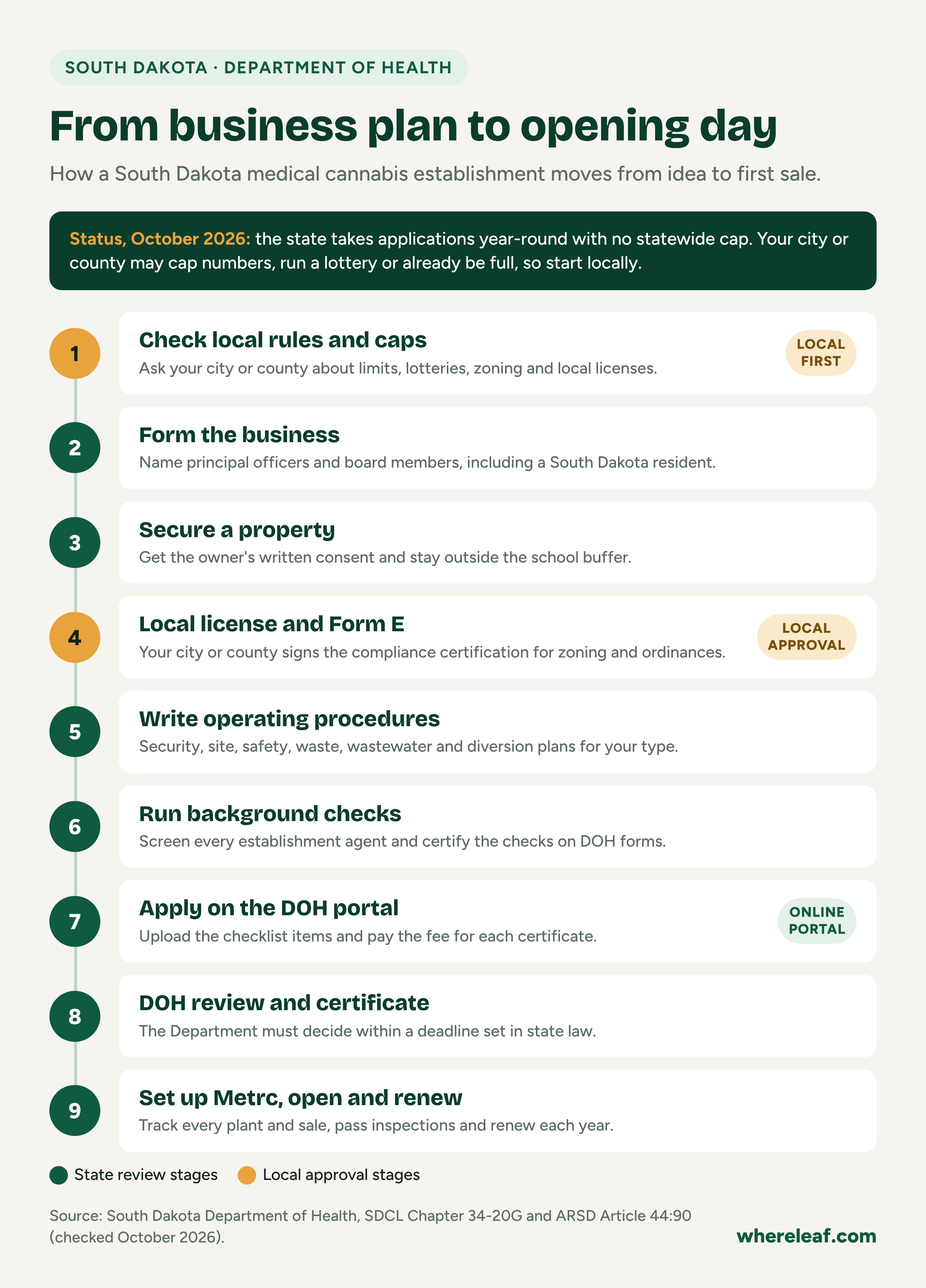
The order matters: local approval comes before the state application is complete, so start with your city or county. DOH publishes 2025 checklists and video walkthroughs for each establishment type.
What the application asks for
Rule 44:90:03:01 lists the contents: the application form, operating procedures, proof that the property owner consents, the local compliance certification (Form E), copies of local licenses, ID for principal officers and board members, organizing documents, certification of background checks and the fee. Changes to anything you submit must be reported within 10 days.
What requirements do you need to meet?
Ownership and residency
At least one principal officer must be a South Dakota resident. No principal officer or board member can be under 21, and none can have served with an establishment whose certificate was revoked.
Background checks and disqualifying offenses
You must certify that criminal background checks were done for all establishment agents, using DOH forms. An establishment may not employ anyone under 21 or anyone convicted of a disqualifying felony offense, which the law defines as a violent crime classified as a felony where the person was convicted.
Capital and bond
Chapter 34-20G and the DOH checklists don’t set a minimum capital amount or a bond. Budget for the build-out, the yearly certificate fee and several months of operating costs before revenue.
Real estate and buffer distances
The site can’t be within 1,000 feet of a public or private school that existed before your application. You need the property owner’s written consent, and many cities add their own setbacks and zoning districts.
Security plan and SOPs
Rule 44:90:03:05 requires written operating procedures covering a management plan, site plan, hours, workplace safety, a security plan that maps every door, window, light, alarm sensor and camera, diversion prevention, waste disposal and visitor controls. Our dispensary security requirements guide explains what inspectors usually check.
Insurance
The state rules we reviewed don’t set an insurance amount. Landlords and lenders usually require coverage, so get quotes early.
Staff training
The DOH application asks you to certify background checks for every establishment agent, and everyone must meet the age rule. A rules package DOH presented to lawmakers in August 2026 adds training on the inventory tracking system. Our budtender training requirements guide helps you plan onboarding.
Local approval and zoning in South Dakota
Section 34-20G-58 lets cities and counties pass ordinances on the time, place and manner of operation, limits on the number of establishments, setbacks, local licensing and reasonable fees. A county ordinance covers the whole county except cities that have their own.
There’s one big limit on local power. Section 34-20G-59 says no city or county may prohibit a dispensary, either directly or with rules that make operating one impracticable. In practice, that means caps and strict zoning rather than outright bans, so ask your planning office for the current cap, any waiting list and whether a conditional use permit is needed.
Sioux Falls shows how the layers stack up. A business there needs a city license, the state registration certificate and a city certificate of occupancy, and zoning approval runs through a conditional use permit from the Planning Commission. Expect a similar mix in other larger cities, and get every local approval in writing before you file with the state.
Social equity and small-business programs
South Dakota doesn’t have a social equity licensing program, reserved licenses or fee discounts for small or minority-owned businesses. Every applicant pays the same state fee. Because there’s no statewide cap, though, a small operator in a town without a local limit can enter the market without competing in a scored round.
South Dakota cannabis market at a glance
After you’re licensed: staying compliant
- Renewal: File every 12 months with all parts of an initial application, though you can certify that operating procedures haven’t changed. DOH must issue the renewal within 45 days of a complete filing.
- Seed-to-sale tracking: South Dakota uses Metrc, which went live in August 2022. Read our seed-to-sale tracking explainer.
- Inspections and fines: DOH and Department of Public Safety inspectors visit during business hours. SB 43 allows fines of up to $10,000 per inspection for serious or repeated violations, plus probation or suspension.
- Testing and recalls: Testing facilities sample and test products under DOH rules, and DOH posts recalls by tag number. The state doesn’t refund dispensaries for recalled products.
- Labels and advertising: SB 43 also tightened labeling, including onset time, allergens and a standard symbol on edibles. Our packaging and labeling guide and dispensary compliance checklist help you build routines.
Your South Dakota cannabis license checklist
- Call your city or county to learn its cap, lottery rules, local license and zoning.
- Pick your establishment type, and plan a separate certificate for each activity.
- Form your business with at least one South Dakota resident as a principal officer.
- Screen principals and staff for the age rule and violent felony convictions.
- Find a site outside the school buffer and get the owner’s written consent.
- Get your local license and the signed Form E.
- Write operating procedures, including security, waste and diversion plans.
- Create an account on the DOH licensing portal and use the current checklist.
- Set up Metrc and staff training before opening.
- Calendar the yearly renewal, and add a food service license if you’ll make edibles.
For new cannabis businesses: get found on WhereLeaf
Once you hold a certificate and open your doors, cardholders still need to find you. Add your business to WhereLeaf so people using our dispensary finder can see your location, hours and menu, and compare our listing packages if you want more visibility. We can’t promise rankings or sales, but an accurate listing helps people find a licensed business. Cultivators, manufacturers and labs can join our supplier directory.
Comparing markets? See all our cannabis license guides by state and province.
Frequently asked questions
How much does a cannabis license cost in South Dakota?
The table above lists the state fee. Local license fees, rent, build-out, security systems and legal help usually cost far more, and they vary widely by city. Neither DOH nor the Legislature publishes typical startup totals, so get local quotes before you commit.
Is recreational weed legal in South Dakota in 2026?
No. Adult-use cannabis isn’t legal as of October 2026, and no legalization measure is on the November 3, 2026 ballot. Only registered cardholders can buy from dispensaries.
Can I get a delivery license in South Dakota?
No. The state doesn’t offer a delivery license, so ask DOH before planning any delivery service from a dispensary. For how delivery works elsewhere, see our guide on how to start a cannabis delivery business.
Do I need to live in South Dakota to own a cannabis business?
Not every owner does, but at least one principal officer must be a state resident. Out-of-state investors often partner with a local officer, and every principal must still pass the background and age rules.
How long does it take to get licensed?
The state clock is the shorter part, because DOH has a legal deadline to decide once your file is complete. The local stage can take longer if your city needs a hearing, a conditional use permit or a lottery, so start there first.
Is there a limit on how many dispensaries South Dakota allows?
Not at the state level. Limits come from cities and counties, and the larger cities tend to have the tightest caps, so smaller towns without a local limit can be easier to enter.
This guide is general information, not legal advice. Rules and fees change, so confirm everything with the South Dakota Department of Health before you apply.
Sources
- South Dakota Department of Health: Medical Cannabis Establishments (2026)
- South Dakota Department of Health: Establishments List (2026)
- South Dakota Department of Health: South Dakota Medical Cannabis Program (2026)
- South Dakota Department of Health: Medical Cannabis Establishment Application Checklist (2021)
- South Dakota Department of Health: Medical Cannabis Annual Legislative Report, SFY2024 (2024)
- South Dakota Department of Health: Presentation to the Medical Cannabis Oversight Committee (2026)
- South Dakota Legislature: SDCL 34-20G-55, Application for medical cannabis establishment
- South Dakota Legislature: SDCL 34-20G-56, County and municipality limitation on number of establishments
- South Dakota Legislature: SDCL 34-20G-57, Establishment registration renewal
- South Dakota Legislature: SDCL 34-20G-58, Local ordinances on medical cannabis establishments
- South Dakota Legislature: SDCL 34-20G-59, Local government prohibition of dispensaries not permitted
- South Dakota Legislature: SDCL 34-20G-62, Employment restrictions
- South Dakota Legislature: SDCL 34-20G-1, Definitions
- South Dakota Legislature: ARSD 44:90:03:17, Fees for registration certificates
- South Dakota Legislature: ARSD 44:90:03:02, Certificate renewal
- South Dakota Legislature: ARSD 44:90:03:04, Transfer of ownership
- South Dakota Legislature: ARSD 44:90:03:05, Operating procedures
- ARSD 44:90:03:01: Initial application for registration certificate (via Justia, 2025)
- South Dakota Legislature: Senate Bill 43, enrolled (2024)
- South Dakota Rules: Department of Health medical cannabis fee rule (2024)
- City of Sioux Falls: Cannabis licensing (2026)
- Mitchell Republic: South Dakota medical marijuana businesses facing a fee increase (2024)
- KOTA: Medical marijuana home cultivation licenses surge in South Dakota (2026)
- NORML: South Dakota lawmakers reject bills that sought to dismantle the medical cannabis program (2026)
- South Dakota Searchlight: Marijuana legalization fails in unofficial South Dakota results (2024)
- SDPB: State issues first medical marijuana dispensary licenses (2022)
- Ballotpedia: Marijuana laws on the ballot (2026)
Last updated: October 2026. Laws and prices change; always check your state or provincial regulator.


