

Can you get a cannabis license in Virginia right now? Not yet: as of October 2026, the Virginia Cannabis Control Authority (CCA) is still writing the rules for the adult-use market and is not taking business applications. Under the 2026 state budget, applications open by February 1, 2027, the first licenses can be issued from May 1, 2027, and retail sales start on July 1, 2027.
The CCA is the only state agency that issues cannabis business licenses in Virginia. Today it oversees a small medical program run by a handful of pharmaceutical processors, and it is building the licensing system for growers, processors, stores, delivery services, labs and microbusinesses.
This guide explains each planned license type and the proposed fees, the timeline, the lottery, ownership and location rules, the impact licensee program and what to do now. Everything was checked against CCA pages, the Code of Virginia and legislative staff summaries in October 2026. Because the regulations are still in draft, some details will change.
Key takeaways
- Virginia isn’t accepting adult-use license applications yet, but the budget law sets firm dates for the first window and the first sales.
- Fees and many operating rules are still in draft and could change before the CCA finalizes them.
- If more qualified people apply than there are licenses, the CCA will hold a lottery, with a separate draw for impact applicants.
- Cities and counties can’t ban cannabis stores, but they control zoning, business licenses and hours.
- Rules differ by state and are still moving here. Always check with the Virginia Cannabis Control Authority before you spend money.
Who regulates cannabis businesses in Virginia?
The Virginia Cannabis Control Authority licenses and regulates cannabis businesses. A governor-appointed Board of Directors approves its regulations, and a Cannabis Public Health Advisory Council reviews draft rules before they are final. From 2026, the CCA also oversees regulated hemp products.
The laws that apply
- The Cannabis Control Act (Title 4.1, Subtitle II of the Code of Virginia) sets the license types, refusal grounds, local powers and taxes.
- The 2026 budget (House Bill 30, enacted as 2026 Special Session I, Chapter 1 and signed on June 29, 2026) added the retail market, the timeline, the impact licensee program and dual-use privileges for medical operators.
- CCA regulations, released in draft in September 2026, will fill in fees, security and operating rules.
Adult-use vs. medical
Adults 21 and older have been allowed to possess and grow small amounts since 2021, but there has been no legal store. The only legal sales today happen through the medical program, where pharmaceutical processors grow, process and sell to people with a practitioner’s certification. Each processor serves one of Virginia’s five health service areas. For consumer rules, see our guide to Virginia cannabis laws.
A joint legislative commission also oversees the move to a retail market, and lawmakers can still change details in the 2027 session.
Cannabis license types in Virginia
The Code says the CCA Board sets license fees at a level that covers its regulatory costs. The fees below come from the CCA’s initial draft regulations of September 2026, as summarized by law firm Foley Hoag, and are proposed, not final. In the draft, applicants pay a non-refundable application fee, an initial license fee when approved and an annual renewal fee after that. The one-time conversion fees are set in the budget law itself.
| License type | What it lets you do | Application fee | Annual or renewal fee |
|---|---|---|---|
| Retail marijuana store | Sell cannabis to adults 21+ from a storefront | $4,000, plus $20,000 initial license (proposed) | $15,000 (proposed) |
| Cultivation, Tier I | Grow up to 5,000 sq ft of canopy, indoors or outdoors | $3,000, plus $20,000 initial license (proposed) | $15,000 (proposed) |
| Cultivation, Tier II | Grow up to 10,000 sq ft, indoors or outdoors | $3,000, plus $25,000 initial license (proposed) | $20,000 (proposed) |
| Cultivation, Tier III | Grow up to 15,000 sq ft, indoors only | $5,500, plus $30,000 initial license (proposed) | $25,000 (proposed) |
| Cultivation, Tier IV | Grow up to 25,000 sq ft, indoors only | $7,500, plus $35,000 initial license (proposed) | $30,000 (proposed) |
| Cultivation, Tier V | Grow up to 30,000 sq ft, indoors only; capped statewide | $7,500, plus $50,000 initial license (proposed) | $45,000 (proposed) |
| Processing facility | Turn cannabis into edibles, vapes, concentrates and other products | $5,000, plus $30,000 initial license (proposed) | $25,000 (proposed) |
| Microbusiness | Grow, process and sell from one premises, generally up to 5,000 sq ft indoors or 10,000 sq ft outdoors | $1,000, plus $2,500 initial license (proposed) | $6,000 (proposed) |
| Transporter | Move cannabis between licensed businesses | $500, plus $2,500 initial license (proposed) | $5,000 (proposed) |
| Delivery operator | Deliver retail orders to adults’ homes | $500, plus $2,500 initial license (proposed) | $5,000 (proposed) |
| Testing facility | Test cannabis for potency and contaminants; can’t hold other license types | $1,000, plus $2,000 initial license (proposed) | $2,000 (proposed) |
| Hemp business cultivation or processing license | A path for long-standing hemp growers and processors into the cannabis market | One-time $500,000 license fee, payable over up to three years | Not published; ask the CCA |
| Dual-use privileges (existing pharmaceutical processors only) | Let a medical operator also grow, process and sell for adult use | One-time $10 million conversion fee, payable over up to three years | Not published; ask the CCA |
| Pharmaceutical processor (medical) | Grow, process and dispense for certified patients in one health service area | $10,000, plus $120,000 initial permit (proposed) | $100,000 (proposed) |
| Cannabis dispensing facility (medical) | A processor’s additional medical dispensary | $4,000, plus $40,000 initial permit (proposed) | $30,000 (proposed) |
| Consumption lounge | No such license in Virginia law | Not applicable | Not applicable |
Impact licensees are not a separate license type. They apply for the same licenses above and can get partial fee waivers, explained in the social equity section.
Are Virginia cannabis licenses open right now?
No. As of October 2026, the CCA is not accepting adult-use license applications. The draft rules came out in September 2026. The CCA’s posted schedule has the advisory council finishing its review in December 2026 and the regulations taking effect in January 2027.
The 2027 licensing schedule
- By February 1, 2027: applications open for medical processors seeking dual-use privileges, qualifying hemp businesses and microbusinesses. Legislative staff say the CCA may begin accepting other license applications from the same date.
- By May 1, 2027: the CCA can award up to 100 microbusiness licenses and up to 20 cultivation and processing licenses for hemp businesses. Dual-use fees, or an approved payment plan, are due.
- By July 1, 2027: at least 55 more licenses must be issued, and retail sales begin.
Retail stores face a statewide cap, shown in the stat row below, and Tier V cultivation is limited to five licenses until January 1, 2028. For other types, the Board sets the numbers, and impact applicants must have at least as many licenses available as everyone else. A CCA report on license and canopy limits is due to lawmakers on November 1, 2026.
What about medical permits?
Virginia has five pharmaceutical processors, one per health service area. The CCA takes new processor applications only during a posted notice of open application, and none is open. Each processor may run a limited number of dispensing facilities, so outsiders can’t apply for a medical dispensary on their own.
Can you buy or transfer a license?
Not freely. Any change of ownership, sale or transfer needs the Board’s prior written approval. Impact licenses carry a five-year holding period, with limited estate-planning exceptions. Unselected lottery applications may be kept for up to a year for later rounds.
How to apply for a Virginia cannabis license, step by step
The graphic shows how the process will work once the CCA opens a licensing period, based on the budget law and legislative staff summaries. The draft regulations may add detail.
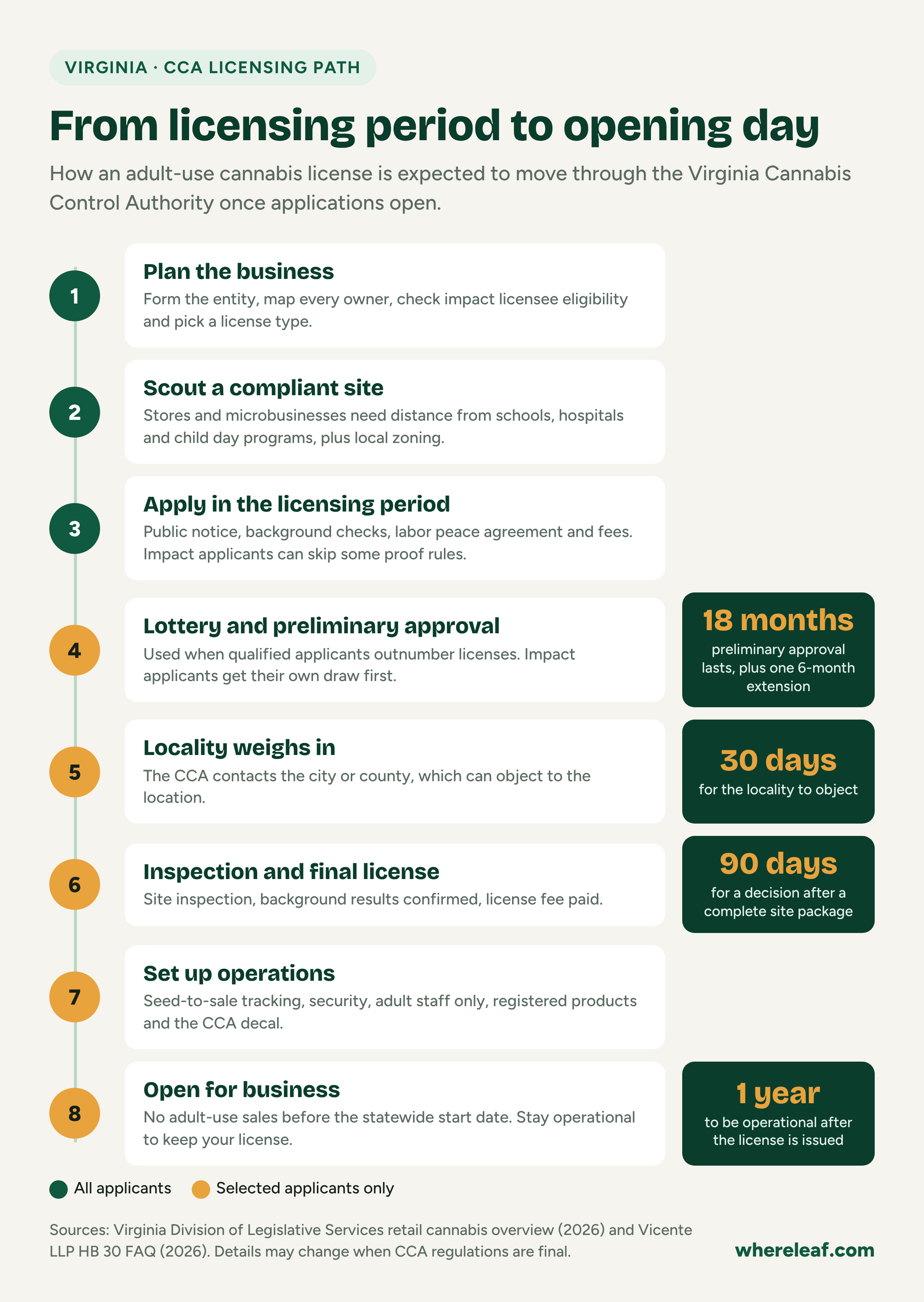
Winning the lottery gives you preliminary approval, not the right to open. You still have to secure a site, meet zoning, pass inspection and pay the license fee.
Requirements you’ll need to meet
Ownership and residency
Owners, officers and directors must be at least 21. One person may hold an interest of 10% or more in no more than five licenses, not counting transporter licenses, and only one Tier V cultivation license. Microbusiness and pharmaceutical processor owners can’t hold other license types, and testing labs must be independent. The summaries we reviewed set no general state residency rule for owners; impact status, however, depends on where you’ve lived.
Background checks and disqualifying offenses
Every applicant goes through a background check. The Board must refuse a license if an owner has a felony conviction or a crime of moral turpitude within the past seven years, or hasn’t finished a sentence or probation. Felony marijuana distribution under Virginia Code 18.2-248.1 is excluded from that rule. Lying on the application, hiding an owner and being 90 or more days behind on local taxes are also grounds for refusal.
Capital and finances
You must show financial responsibility sufficient for the business you propose. The final rules will define proof of funds. Impact applicants are excused from proof-of-funds requirements at the application stage.
Real estate
A retail store or microbusiness can’t be within 1,000 feet of a hospital, school, college or child day program, and localities can only shrink that buffer, not expand it. Store sales floors are capped at 2,500 square feet. Premises can’t be places that sell alcohol or tobacco, and must allow law enforcement to observe sales areas.
Security plan
The draft regulations require compliance with security and location rules before a license is issued. Specific camera, alarm and storage standards will be in the final rules. Our dispensary security requirements guide shows what other states require.
SOPs
Expect to write standard operating procedures for inventory, testing, packaging, ID checks and recalls. Virginia’s product rules already require mandatory testing, registered products and strict labeling, so build your SOPs around them.
Insurance
The sources we reviewed don’t set an insurance minimum. Ask the CCA, your landlord and your lender what they will require.
Staff and labor peace
Licensees may not employ anyone under 21, even as a volunteer. Every applicant, renewal applicant and licensee must also keep a labor peace agreement with a recognized union, in which the union agrees not to strike and you agree not to block organizing. See our budtender training requirements guide for staff training.
Local approval and zoning in Virginia
Unlike many states, Virginia does not let cities or counties opt out of the retail market. Localities can:
- apply normal zoning, land use and business license rules;
- set hours of sale by ordinance;
- reduce, but not increase, the state buffer distances; and
- penalize public consumption in parks, playgrounds, streets and sidewalks.
Every locality must also levy a local cannabis tax of between 1% and 3.5%. When you apply, the CCA notifies the locality, which can object, and the Board weighs local objections when deciding whether a location has too many licenses already. Talk to the planning office early about where a cannabis business fits.
Impact licensee program and other equity measures
Virginia’s version of social equity is the impact licensee. To qualify, a business must be at least 51% owned and controlled by people who either lived in a jurisdiction disproportionately policed for marijuana between 1999 and 2025, or lived three of the past five years in a historically economically disadvantaged community. They must also meet at least one more test, such as:
- a past marijuana misdemeanor conviction, or a parent, child, sibling or spouse with one;
- attending a public school in a disadvantaged community;
- receiving a Pell Grant, or attending a college where many students were Pell-eligible;
- being a U.S. military veteran; or
- qualifying for USDA distressed farmer assistance.
Benefits include a separate lottery, partial fee waivers, eligibility for grants and low-interest loans, exemption from proof-of-funds and premises-control rules at the start, and the right to form cooperative agreements. The Cannabis Equity Business Loan Fund will receive 75% of license fees collected in the first year of licensing. Medical operators that convert must also join a three-year impact licensee accelerator. Census tract changes on July 1, 2026, removed the disadvantaged-community label from some areas, according to Outlaw Report, so check your area’s current status.
Virginia cannabis market at a glance
The excise tax rises to 8% on July 1, 2029. Medical sales, hemp products and sales between licensed businesses are not subject to it.
After you’re licensed: staying compliant
- Open on time. The Board must suspend or revoke a license that isn’t operational on schedule.
- Track every plant and sale. The CCA must have a seed-to-sale tracking system ready by February 1, 2027. Read our seed-to-sale tracking explainer.
- Display the CCA decal. Licensed retailers must post the official decal, and selling without one brings civil penalties.
- Test, register and label products under the Code’s testing and packaging rules. See our packaging and labeling guide.
- Follow delivery limits. No deliveries to military bases, schools, child day centers, hospitals, prisons, the State Capitol or public gatherings.
- Keep records open to inspection and renew each year. Our dispensary compliance checklist helps.
Your Virginia cannabis license checklist
- Read the CCA’s draft regulations and follow the advisory council’s review.
- Choose a license type and check whether you qualify as an impact licensee.
- Form your entity and map every owner with a 10% or larger interest.
- Pull background records for owners and fix any tax delinquencies.
- Shortlist sites that meet the state buffer and local zoning.
- Start talks with a union about a labor peace agreement.
- Line up capital, banking and insurance quotes.
- Draft security plans and SOPs so you can move fast after selection.
- Watch the CCA retail market page for the licensing period announcement.
For new cannabis businesses: get found on WhereLeaf
Once your Virginia business is licensed and open, list it on WhereLeaf so adults using our dispensary finder can see your location, hours and menu. Compare our listing packages for more visibility. Growers, processors and service providers can join our supplier directory.
Comparing markets? See all our cannabis license guides by state and province.
Frequently asked questions
How much does a cannabis license cost in Virginia?
The table shows the proposed state fees, which may change when the rules are final. Also budget for background checks, legal help, the local business license, rent and build-out. We found no reliable published estimate of total startup costs for Virginia yet.
Can I get a cannabis delivery license in Virginia?
Yes, once licensing opens. Delivery operator is one of the planned license types, and delivery operators can’t hold an interest in a testing lab.
Do I need to live in Virginia?
We found no general residency requirement in the law summaries, but impact licensee status depends on living in qualifying Virginia areas. Confirm with the CCA, since the final rules may add details.
Can my hemp business get a cannabis license?
Possibly. Hemp growers or processors registered with the state agriculture department before January 1, 2021, and in good standing as of September 1, 2026, can apply for a limited number of set-aside cultivation and processing licenses, and for microbusiness licenses. Check the CCA’s hemp information page for eligibility.
Can I start selling before July 1, 2027?
No. Licensees may prepare their operations before that date, but no adult-use retail sale is legal until it arrives.
Will Virginia allow consumption lounges?
Not under current law. There is no lounge license, and using cannabis in public is illegal. See how consumption lounges work in other states.
This guide is general information, not legal advice. Rules and fees change, so confirm everything with the Virginia Cannabis Control Authority before you apply.
Sources
- Virginia Cannabis Control Authority: Retail Marijuana Market (2026)
- Virginia Cannabis Control Authority: Virginia’s New Marijuana and Hemp Laws, What You Need to Know (2026)
- Virginia Cannabis Control Authority: Pharmaceutical Processors (2026)
- Virginia Cannabis Control Authority: Dispensary Locations (2026)
- Code of Virginia: Section 4.1-810, Conditions Under Which the Board Shall or May Refuse to Grant Licenses (2026)
- Code of Virginia: Section 4.1-1002, Fees for State Licenses (2026)
- Code of Virginia: Section 4.1-1602.1, Dual-Use Privileges (2026)
- Virginia Division of Legislative Services: Retail Cannabis Overview for the Joint Commission (2026)
- Foley Hoag (law firm, backup source): Virginia’s Initial Draft of Adult-Use Marijuana Regulations (2026)
- Vicente LLP (law firm, backup source): Virginia Retail Cannabis Law (HB 30) FAQs (2026)
- Virginia Business: State Authority Releases Draft Retail Marijuana Regulations (2026)
- Associated Press via WECT: Virginia to Allow Recreational Marijuana to Be Sold in Retail Stores Beginning 2027 (2026)
- Outlaw Report: Virginia CCA July 2026 Board Meeting (2026)
Last updated: October 2026. Laws and prices change; always check your state or provincial regulator.


