
Can you get a cannabis license in Maryland right now? Not yet for most new applicants: as of October 2026, the Maryland Cannabis Administration (MCA) has no application round open, and it has not set a date for its second round. The MCA is the state agency that issues every cannabis business license in Maryland, for both adult-use and medical sales.
The first round, held in 2023 and 2024, was open only to social equity applicants and awarded licenses by lottery. Those winners are still turning conditional licenses into working businesses, and the MCA gave them more time in 2026. A second round is allowed by law, but it depends on how the state responds to a disparity study published in late 2025.
This guide covers every Maryland license type and fee, what the next round is expected to look like, the requirements and local rules, social equity eligibility and the steps from application to opening day. Everything was checked against the MCA, state law, Maryland regulations and legislative analysts in October 2026.
Key takeaways
- Maryland licenses are awarded in rounds, by lottery, and no round is open for new applicants right now.
- The first round was limited to social equity applicants, and micro licenses are expected to stay that way.
- You don’t need a property to apply. Winners get a conditional license and time to find a site, raise money and pass inspections.
- Counties and cities can set reasonable zoning but can’t ban cannabis businesses outright through rules that unduly burden them.
- Rules differ by state and change often. Always confirm with the MCA before you spend money on a site or an application.
Who regulates cannabis businesses in Maryland?
The MCA took over from the old medical cannabis commission when adult-use sales began on July 1, 2023. It licenses growers, processors, dispensaries and other businesses, registers labs and staff, inspects facilities and enforces the rules. A separate Office of Social Equity verifies social equity status and runs support programs.
The laws that apply
- The Cannabis Reform Act of 2023, which created the adult-use market and the licensing rounds.
- Title 36 of the Alcoholic Beverages and Cannabis Article of the Maryland Code, which sets license caps, application fees and limits on local governments.
- COMAR Title 14, Subtitle 17, the MCA’s regulations, including the fee schedule.
- Later amendments, such as Senate Bill 215 of 2025 (Chapter 120), which changed on-site consumption rules and second-round authority.
Adult-use and medical together
Maryland doesn’t split licenses into adult-use and medical. A licensed dispensary serves both adults 21 and older and registered patients, and it must make accommodations for patients, such as patient-only hours or dedicated lines. Existing medical businesses converted to the new licenses when adult-use sales began, so there are no medical-only business licenses left. For shopper rules, see our Maryland cannabis purchase limits guide.
The local layer
Counties and municipalities control zoning, and some set their own distance rules for dispensaries. They can’t charge cannabis taxes or demand payments from licensees. The section on local approval below explains the limits.
Cannabis license types in Maryland
Every new license comes in a standard or micro version, plus two special types. The application fee is non-refundable and paid when you apply. The licensing fee is paid when you’re licensed and again at each renewal, and covers a five-year term. Social equity licensees pay half the licensing fee. The MCA may waive or reduce any fee.
| License type | What it lets you do | Application fee | Licensing or renewal fee (per five-year term) |
|---|---|---|---|
| Standard dispensary | Run a storefront selling to adults and patients; delivery, drive-thru and curbside allowed under MCA conditions | $5,000 | $25,000; social equity $12,500 |
| Micro dispensary | Retail without a storefront, such as delivery, with fewer than 10 employees | $1,000 | $10,000; social equity $5,000 |
| Standard grower | Grow indoors, outdoors or both, within the MCA’s canopy limit, and sell to processors and dispensaries | $5,000 | $50,000; social equity $25,000 |
| Micro grower | Grow on less than 10,000 sq ft of indoor canopy, or the equivalent | $1,000 | $10,000; social equity $5,000 |
| Standard processor | Make and package products such as vapes, concentrates and edibles | $5,000 | $25,000; social equity $12,500 |
| Micro processor | Process a limited volume of cannabis | $1,000 | $10,000; social equity $5,000 |
| Incubator space | Provide shared space, such as a commercial kitchen, for micro licensees; no growing or processing by the license holder | $5,000 | $10,000; social equity $5,000 |
| On-site consumption | Let adults use cannabis on site and sell single-serving products; not currently offered | $5,000 | $10,000; social equity $5,000 |
| Micro-to-standard conversion | Upgrade a micro license to a standard one | Not applicable | Grower $50,000; processor or dispensary $25,000 for a full term, or pro-rated by month |
| Edible cannabis product permit | Lets a processor make edibles | $1,000 | Not published; ask the MCA |
| Independent testing laboratory | Test cannabis for licensees (a registration, not a lottery license) | $500 registration | $500 every two years |
| Academic research institution / research and development entity | Research with cannabis (registrations) | $500 / $1,000 | $100 / $500 per new or modified project |
| Cannabis agent (staff) registration | Work for a licensee | $25 | $25 every two years |
| Ownership transfer (5% or more) | Approval for new owners | $1,000 per entity; $500 per individual | Not applicable |
| Change of location | Move a grower, processor or dispensary | $500 | Not applicable |
The fee schedule sits in COMAR 14.17.21.02, and the statute caps a standard licensing fee and lets renewal fees be based on revenue, so check the current regulation before you budget. Our guide to dispensary license costs by state compares Maryland with other markets.
Are cannabis licenses open in Maryland right now?
No. As of October 2026, the MCA has not announced a request for applications for the second round, and we found no MCA notice setting a date. Check the MCA’s website and sign up for its updates before planning around any timeline.
What happened in the first round
The first round was limited to verified social equity applicants. The MCA held lottery drawings on March 14 and June 28, 2024. Some winners withdrew or were denied, leaving 192 to move forward to conditional licenses, according to the MCA’s 2026 budget testimony. By then, only 13 had reached full licensure. Separately, the existing medical businesses converted: 18 growers, 23 processors and 96 dispensaries, according to the Department of Legislative Services.
What the second round could look like
State law allows a second round on or after May 1, 2024, with up to 25 standard grower, 25 standard processor and 120 standard dispensary licenses, 70 micro grower and 70 micro processor licenses, and 10 incubator space licenses. Final numbers can change based on regional demand. The 2025 law removed the MCA’s express authority to issue on-site consumption licenses in that round.
The holdup is the disparity study. If it shows strong evidence of discrimination, the law points to remedial measures, which could mean another round limited to social equity applicants. If not, the round would be open to all qualified applicants, with micro licenses still reserved for social equity applicants. The state’s study, published October 1, 2025, found evidence of discrimination across Maryland industries, and the MCA told lawmakers it was reviewing what that means with its lawyers. After the second round, more licenses depend on a market demand study.
Can you buy an existing license?
Not easily. Maryland generally bars transferring ownership or control of a license for five years after licensure, with exceptions such as a sale to employees through an employee stock ownership plan. A 2026 bill proposed shortening that period; confirm with the MCA whether it passed before you negotiate a deal. Any transfer of 5% or more needs MCA approval.
How to apply for a cannabis license in Maryland, step by step
When a round opens, the process follows the path below. The application itself is scored pass/fail, and the lottery, not a points ranking, decides who wins.
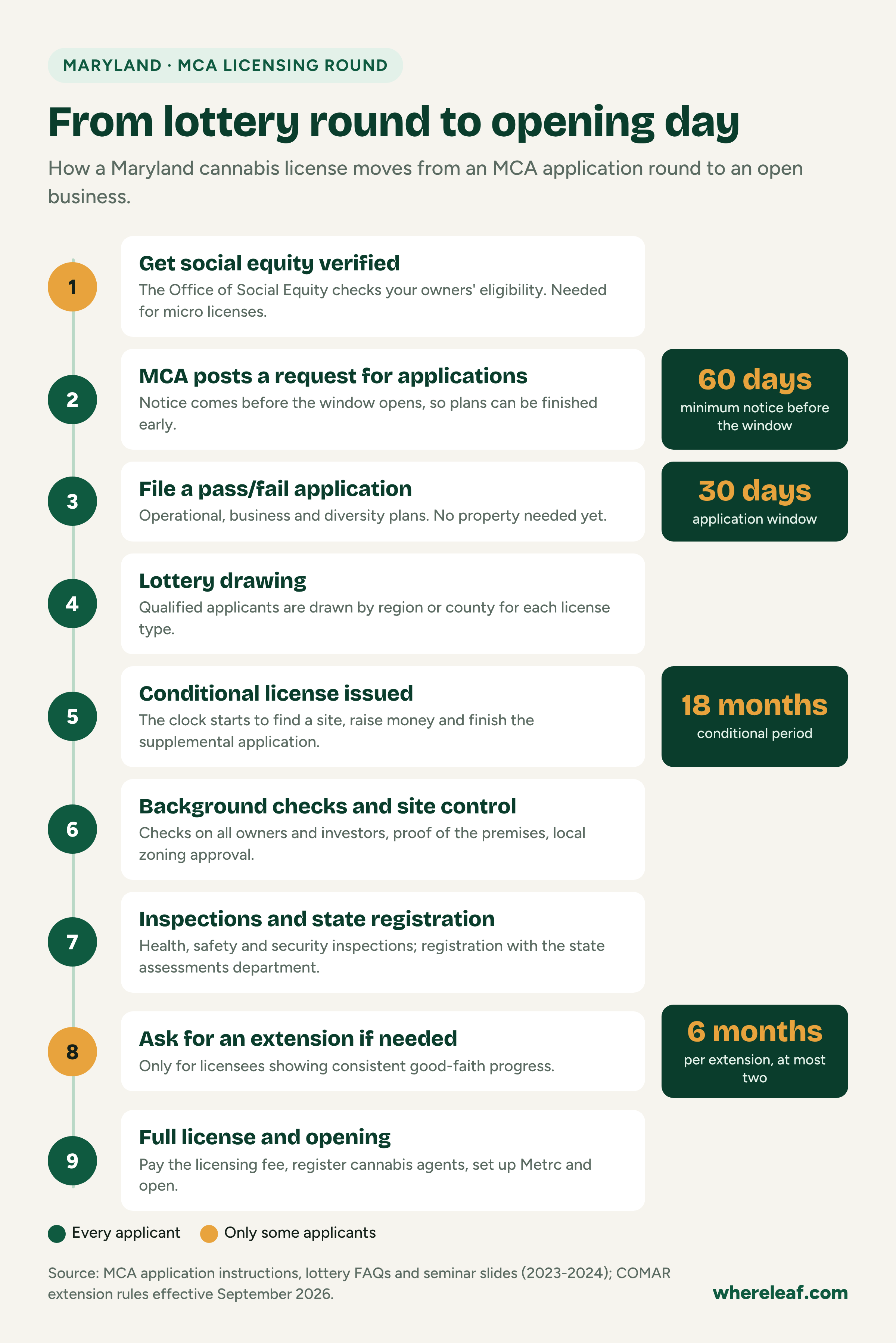
Your application must include an operational plan, a business plan showing a likelihood of success and a diversity plan. A person can appear on only one application per license type in a round, and on no more than two applications in total per round. Growers and processors are drawn by region and dispensaries by county, so pick your target area carefully.
Requirements you’ll need to meet
Ownership and residency
There is no Maryland residency rule for owners. Social equity status, though, requires at least 65% of the business to be owned and controlled by qualifying people, and out-of-state applicants must document that they meet the criteria. Your capitalization table must account for all equity, and the MCA limits how many businesses one person can have an interest in.
Background checks and disqualifying offenses
During the conditional period, the MCA runs criminal history and financial background checks on all owners and investors and verifies who controls the company. Ask the MCA for the current list of disqualifying offenses before you bring on partners, because one problem investor can hold up the whole license.
Capital and bonds
The MCA doesn’t set a minimum capital or bond amount, but your business plan must show you can succeed. Many winners raise money during the conditional period through investors, loans or state programs. Budget for rent, build-out and payroll well before you make your first sale.
Real estate and buffer zones
You don’t need property to apply. During the conditional period you must show legal control of a site that meets zoning. Dispensaries must generally be at least 500 feet from schools, child care centers and similar sites, and 1,000 feet from another dispensary.
Security plan and SOPs
Your premises must pass the MCA’s security inspection before you open, and your SOPs should cover inventory, ID checks, waste, recalls and patient accommodations. See our dispensary security requirements guide for what inspectors usually look for.
Insurance
The MCA doesn’t publish an insurance minimum. Landlords and lenders usually require general liability and property coverage, so get quotes early.
Staff registration
Everyone who works for a licensee must register with the MCA as a cannabis agent before starting work. Our budtender training requirements guide covers training for retail staff.
Local approval and zoning in Maryland
Local governments in Maryland have less power over cannabis than in many states. Under state law they can:
- Set reasonable zoning rules for cannabis businesses.
- Raise the minimum distance between dispensaries, up to one-half mile, by local ordinance.
- Ban on-site consumption establishments or set their hours.
They can’t:
- Pass zoning or other rules that unduly burden a licensee.
- Charge cannabis businesses fees heavier than those on similar businesses.
- Stop cannabis deliveries or transport passing through.
- Require money, donations or services from an applicant.
- Add a local cannabis tax.
Call the county or city planning office before you sign a lease, and ask which zones allow your license type and whether a special exception hearing is needed.
Social equity programs in Maryland
A social equity applicant must be majority owned by people who meet one of these tests, verified by the Office of Social Equity:
- Lived in a disproportionately impacted area for at least five of the ten years before applying. These are areas where cannabis possession charges ran well above the state average.
- Attended a public school in such an area for at least five years.
- Attended a Maryland four-year college for at least two years where at least 40% of students are Pell Grant eligible.
Benefits include a lower licensing fee, access to micro licenses, and support through the Cannabis Business Assistance Fund and a capital access program for loans and grants. First-round applicants who passed minimum qualifications but weren’t drawn could have their application fee waived when applying for the same license class in a later round.
Maryland cannabis market at a glance
Demand is well established, but the existing conversion licensees have years of head start. A new business needs a clear plan for how it will win customers from them.
After you’re licensed: staying compliant
- Renewals: licenses run for five years, and you pay the licensing fee again at renewal.
- Conditional deadlines: under rules effective September 14, 2026, the MCA can approve up to two extensions for conditional licensees making good-faith efforts. Don’t count on more.
- Inspections: expect routine MCA inspections. Our dispensary compliance checklist helps you prepare.
- Tracking: record every plant, package and sale in Maryland’s Metrc seed-to-sale system. See seed-to-sale tracking explained.
- Taxes: collect the state’s cannabis sales and use tax, which rose to 12% in July 2025. See our cannabis tax rates by state guide.
- Advertising and packaging: follow MCA rules on marketing and labels, and keep anything that could appeal to minors off your packaging. See our packaging and labeling guide.
- Changes: new owners, management agreements and site moves need MCA approval first.
Your Maryland license checklist
- Sign up for MCA updates so you see the second-round notice the day it’s posted.
- Check whether your owners qualify for social equity status and gather proof covering the years you’ll need.
- Choose a license type and a region or county, keeping to the per-round application limits.
- Form your business entity and build a capitalization table that adds up to all of the equity.
- Draft your operational, business and diversity plans now, so you’re ready when the window opens.
- Line up investors and lenders who will pass background checks.
- Research county zoning and dispensary distance rules in your target area.
- If you win, secure a site, pass background checks and inspections within your conditional period.
- Register every employee as a cannabis agent and set up Metrc before opening.
- Calendar your conditional deadline, renewal date and tax filing dates.
For new cannabis businesses: get found on WhereLeaf
Once you’re licensed and open, customers need to find you. Add your business to WhereLeaf so shoppers using our dispensary finder can see your location, hours and menu, and compare our listing packages if you want extra features. Growers, processors and service providers can join our supplier directory. We don’t promise rankings or traffic, but an accurate listing makes you easier to find.
This guide is general information, not legal advice. Rules and fees change, so confirm everything with the Maryland Cannabis Administration before you apply.
Comparing markets? See all our cannabis license guides by state and province.
Frequently asked questions
How much does a cannabis license cost in Maryland?
The table above lists the MCA’s application, licensing and registration fees. Those are the smallest part of the bill: rent during the conditional period, build-out, security, inventory and payroll come first, and they vary widely by county. Social equity winners can apply to state support programs to help cover them.
When is Maryland’s next cannabis license round?
There’s no date yet. The MCA must post notice well before the application window opens, so you’ll get some warning. Watch the MCA’s licensing page and be ready to file quickly.
Can I get a delivery license in Maryland?
There’s no separate delivery license. Standard dispensaries can deliver under MCA conditions, and a micro dispensary can operate without a storefront, which suits a delivery model. Our cannabis delivery business guide covers the practical side.
Do I need to live in Maryland to get a license?
No. Maryland has no owner residency rule, and out-of-state applicants can qualify for social equity status if they meet the criteria, for example by having attended school in a disproportionately impacted area.
Can I open a consumption lounge in Maryland?
Not yet. On-site consumption licenses are written into the law but aren’t part of the next round as currently planned, and counties can ban them.
How long does it take to open after winning the lottery?
Longer than most winners expect. Only a small share of first-round winners had opened by early 2026, mainly because finding zoned property and money took time. Plan your finances for a long conditional period.
Sources
- Maryland Division of State Documents: COMAR 14.17.21.02, Cannabis Fees
- Maryland General Assembly: Alcoholic Beverages and Cannabis § 36-403, Fees
- Maryland General Assembly: Alcoholic Beverages and Cannabis § 36-404, Licensing Rounds
- Maryland General Assembly: Alcoholic Beverages and Cannabis § 36-405, Local Governments
- Maryland Cannabis Administration: Fiscal Year 2027 Budget Testimony (2026)
- Maryland Cannabis Administration: Lottery Process and Licensing Rounds FAQs (2024)
- Maryland Cannabis Administration: Application General Instructions (2023)
- Maryland Cannabis Administration: Technical Assistance Seminar Slides (2023)
- Maryland Department of Legislative Services: Fiscal and Policy Note, SB 215 (2025)
- Maryland Department of Legislative Services: Fiscal and Policy Note, HB 1519 (2026)
- Office of Governor Wes Moore: More Than $1.1 Billion in Total Sales During First Year of Cannabis Legalization (2024)
- The Marijuana Herald (news backup source): Maryland Adopts New Marijuana Rules Allowing Licensing Extensions (2026)
Last updated: October 2026. Laws and prices change; always check your state or provincial regulator.


